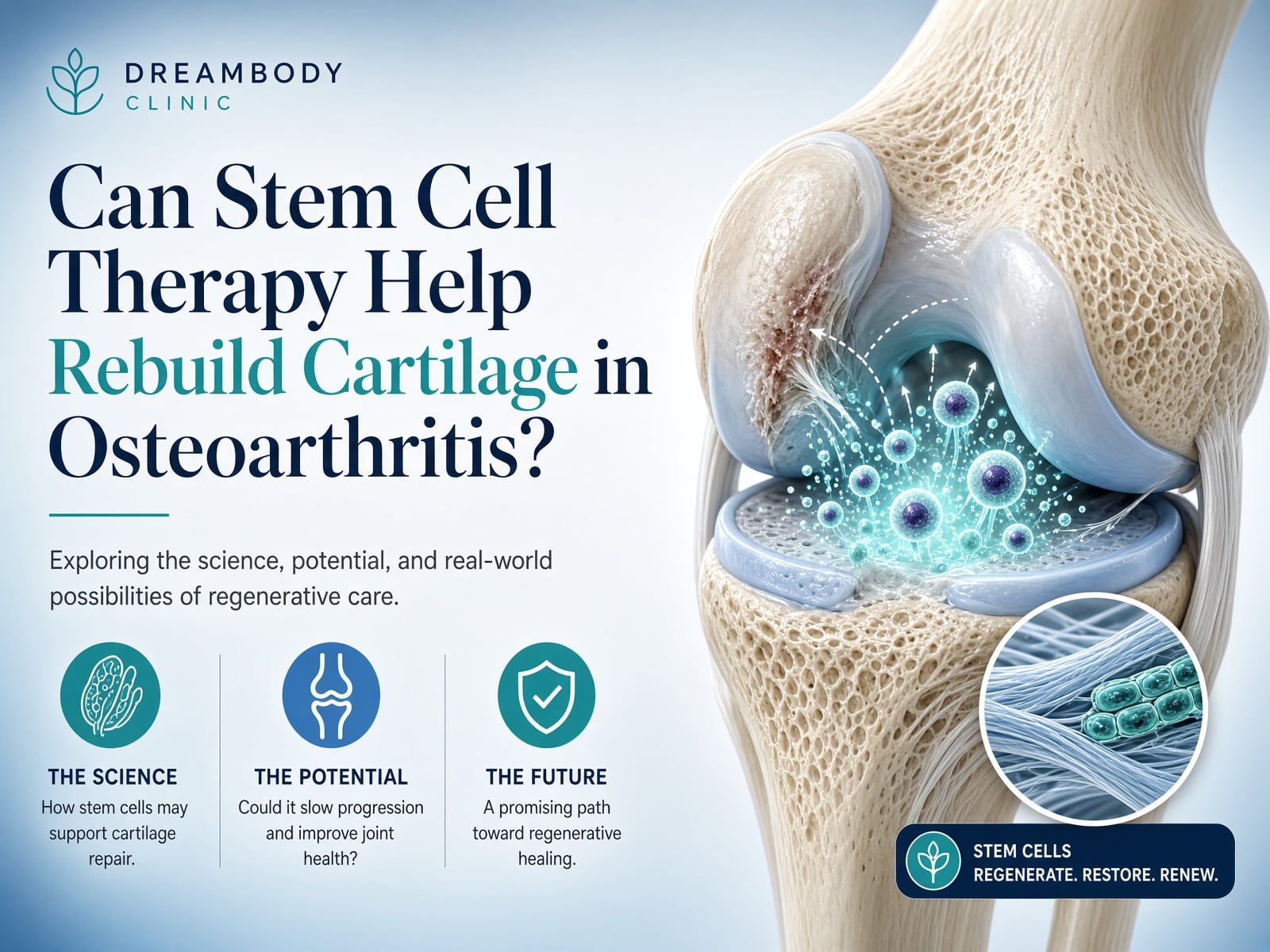
Can Stem Cell Therapy Help Rebuild Cartilage in Osteoarthritis?
If you have osteoarthritis, you have probably been told that cartilage loss is permanent. For a long time, that was largely true. Conventional treatments focused on slowing the damage or managing pain, but nothing could actually rebuild what had worn away. Stem cell therapy for osteoarthritis is changing that thinking. At Dream Body Clinic in Puerto Vallarta, patients are exploring regenerative options that go beyond pain relief and target the root of the problem: cartilage damage itself.
What Happens to Cartilage When You Have Osteoarthritis?
Cartilage is the smooth, rubbery tissue that lines the ends of your bones inside a joint. Its job is to absorb shock and allow bones to glide against each other without friction. In osteoarthritis, this tissue gradually wears down. As it thins and cracks, bones begin to rub together, causing pain, swelling, stiffness, and a loss of movement that gets worse over time.
The joints most commonly affected include the knees, hips, and shoulders, though osteoarthritis can develop in virtually any joint in the body. According to the CDC, over 32.5 million adults in the United States live with osteoarthritis, making it one of the most widespread joint conditions globally. That number reflects just how serious and how common this condition truly is.
What makes osteoarthritis particularly difficult to treat is the nature of cartilage itself. Unlike bone or muscle, cartilage has almost no blood supply. It relies on the slow movement of joint fluid to receive nutrients, which means it has very limited ability to repair itself once damaged. The cells responsible for maintaining cartilage, called chondrocytes, are sparse and slow to replicate. Once cartilage loss reaches a certain point, the body simply cannot keep up with the damage on its own.
This biological limitation is exactly why researchers and clinicians have been looking at regenerative approaches. The question is no longer just how to manage osteoarthritis but whether the tissue itself can be restored.
How Does Stem Cell Therapy Target Cartilage Damage?
Stem cell therapy for osteoarthritis works by introducing mesenchymal stem cells, commonly called MSCs, directly into the damaged joint. These are adult stem cells with a remarkable ability to sense their environment and respond to it. When injected into a joint affected by osteoarthritis, MSCs get to work through several biological pathways at the same time.
The first mechanism is differentiation. MSCs have the ability to develop into chondrocytes, which are the specialized cells that build and maintain cartilage, but when administered into people the MSCs don’t differentiate. Instead they contributing to new cartilage tissue formation by guiding the process of chondrocyte formation and the healing process. This is what gives stem cell cartilage repair its regenerative potential, something no painkiller or cortisone shot can offer.
The second mechanism involves paracrine signaling. MSCs release a range of proteins and growth factors that communicate with surrounding cells. These signals can wake up dormant local cells, reduce inflammation, and create a more favorable environment for tissue repair. Think of it as the MSCs acting as a biological coordinator rather than doing all the work alone.
The third mechanism is immunomodulation. Osteoarthritis has an inflammatory component, and MSCs are well known for their ability to calm overactive immune responses in the joint. By reducing chronic inflammation, they help protect the remaining cartilage and create conditions where repair becomes possible. To understand more about how stem cells support joint recovery and regeneration, you can explore the full breakdown of these mechanisms.
What Types of Stem Cells Are Used for Cartilage Repair?
Not all stem cells are the same, and the source matters when it comes to treating cartilage damage. At Dream Body Clinic, the primary focus is on mesenchymal stem cells sourced from human umbilical cord tissue, specifically from a region called Wharton’s Jelly, as well as adipose-derived MSCs obtained from fat tissue.
Wharton’s Jelly-derived MSCs are allogeneic, meaning they come from a donor rather than the patient. These cells are younger, more potent, and tend to have stronger regenerative activity compared to cells harvested from older patients. They also do not require an additional procedure on the patient to collect them, which simplifies the treatment process considerably. Because they are immunologically naive, the risk of rejection is low, making them a practical and effective option for joint repair protocols.
Adipose-derived MSCs, on the other hand, are autologous, coming from the patient’s own fat tissue. These cells are also capable of differentiating into cartilage-producing cells and have a strong safety profile. The choice between these cell types depends on the patient’s age, health history, and the extent of cartilage loss. You can review more about the certified stem cells used at Dream Body Clinic to understand what quality standards and sourcing protocols are in place.
Is Stem Cell Therapy for Osteoarthritis Backed by Research?
The short answer is yes, and the body of evidence is growing. Multiple peer-reviewed studies have examined the use of MSCs in cartilage repair, with results that are encouraging on both safety and efficacy. Researchers have consistently found that MSC-based treatments are well tolerated, with low rates of adverse effects compared to surgical alternatives.
Studies published in clinical orthopedic and regenerative medicine journals have reported meaningful reductions in pain scores among patients receiving intra-articular MSC injections. Beyond symptom relief, some trials have documented structural changes, including improved cartilage thickness visible on MRI scans. This kind of measurable, structural improvement is what separates regenerative therapy from conventional treatments that only address symptoms.
One area of active interest is the use of allogeneic MSCs from umbilical cord tissue and placenta, which have shown consistent anti-inflammatory effects alongside chondrogenic potential. The mesenchymal stem cell research in cartilage repair compiled by Dream Body Clinic offers a detailed look at the clinical literature informing their treatment protocols. While stem cell therapy for osteoarthritis is not yet classified as standard of care in many countries, the research direction is clearly pointing toward its legitimacy as a regenerative option.
What Do Clinical Studies Say About MSCs and Cartilage Regeneration?
Several clinical trials have specifically examined how MSCs perform when applied to damaged cartilage in osteoarthritic joints. A study published in the journal Stem Cell Research & Therapy followed patients with knee osteoarthritis who received intra-articular MSC injections and found statistically significant improvements in pain, function, and quality of life at the 12-month mark. MRI assessments in a subset of participants showed increased cartilage volume in the treated joint.
Engineered and umbilical cord MSC protocols have also shown early promise for patients with moderate-to-severe cartilage damage. Studies in this area report that these cells can survive and integrate within the joint environment long enough to produce meaningful regenerative effects. For a detailed look at what the clinical evidence shows, mesenchymal stem cells for cartilage repair resource provides an evidence-based overview of this emerging area.
What Is the Treatment Process at Dream Body Clinic for Osteoarthritis?
The patient journey at Dream Body Clinic is structured to make the process straightforward, even for international visitors traveling from the US, Canada, or Europe. It begins with a consultation before you even arrive in Puerto Vallarta. During this stage, the clinical team reviews your medical history, imaging results, and current condition to determine whether you are a good candidate for MSC therapy and which protocol suits your situation best.
Once you arrive at the clinic, the process is very simple: Day 1 – arrive and rest, Day 2 – blood work and MRI, Day 3 – Review in Consultation with Doctor then payment, Day 4 – Treatment, and Day 5 – Fly home. The treatment itself is delivered through an intra-articular injection, meaning the stem cells are placed directly into the affected joint using imaging guidance to ensure precise placement. The procedure is performed in office and does not require general sedation or a hospital stay. Patients are up and moving the same day, though rest and limited activity are recommended for the first 24 to 48 hours.
Post-treatment follow-up is built into the Dream Body Clinic model. The team provides guidance on activity, nutrition, and any supplementary support to optimize recovery. Regular check-ins after you return home allow the clinical team to monitor your progress and address any questions as they arise. If you are ready to take the next step, you can learn more about how to book orthopedic stem cell treatment and what the scheduling process looks like.
How Long Does It Take to See Results After Stem Cell Therapy for Cartilage?
Results from stem cell therapy for osteoarthritis do not happen overnight, and it is important to set realistic expectations. Most patients begin to notice early changes within the first two to four weeks following treatment. These initial effects are usually related to reduced inflammation in the joint, which can translate into less pain and better range of motion relatively quickly.
The more significant structural changes, where new cartilage tissue is forming or the joint environment is meaningfully improving, typically develop over a period of three to six months. This is consistent with the biological timeline for chondrocyte differentiation and tissue remodeling. Some patients continue to see gradual improvements for up to a year after their treatment.
Individual results do vary. Factors that influence outcomes include the patient’s age, how advanced the cartilage loss is, the overall health of the joint, and lifestyle factors such as body weight and activity level. Patients in earlier stages of osteoarthritis generally see faster and more complete responses, while those with significant damage may experience meaningful relief and slowed progression rather than full restoration. Honest conversations about expectations are a core part of the intake process at Dream Body Clinic.
How Does Dream Body Clinic Compare to Conventional Osteoarthritis Treatments?
Most people with osteoarthritis go through a predictable treatment ladder. It typically starts with physical therapy and anti-inflammatories, moves to corticosteroid injections, and eventually leads to joint replacement surgery for severe cases. Each of these options has a role, but none of them actually rebuild cartilage.
| Treatment | Regenerative Potential | Invasiveness | Recovery Time | Duration of Effect |
|---|---|---|---|---|
| Corticosteroid Injections | None | Minimally invasive | Minimal | Weeks to months |
| Hyaluronic Acid Therapy | None | Minimally invasive | Minimal | Months |
| Total Joint Replacement | None (replaces joint) | Major surgery | 3 to 6 months | Long-term, but permanent |
| Stem Cell Therapy (MSCs) | Yes (cartilage regeneration) | Minimally invasive | 24 to 48 hours | Ongoing improvement over 8 to 12 months |
Corticosteroid injections work by suppressing inflammation, and they can provide short-term relief. The problem is that repeated injections may actually accelerate cartilage loss over time, making them a short-term solution with long-term trade-offs. Hyaluronic acid injections add lubrication to the joint but do not address the underlying tissue damage.
Joint replacement surgery is effective for end-stage osteoarthritis, but it is a major procedure with significant recovery requirements. It also comes with risks inherent to any major surgery, and the artificial joint has a functional lifespan that may require revision surgery years down the line. Stem cell therapy offers something none of these treatments can: the potential to repair and regenerate the tissue itself, not just manage the symptoms around it. For a full comparison of approaches and pricing, the orthopedic stem cell treatment prices and information page at Dream Body Clinic provides a transparent breakdown.
Why Do International Patients Choose Puerto Vallarta for Osteoarthritis Treatment?
Puerto Vallarta has become a recognized destination for regenerative medicine, and Dream Body Clinic is a significant part of why that reputation has grown. Patients from the United States, Canada, and across Europe travel here specifically for access to stem cell protocols that are either unavailable or significantly more expensive in their home countries.
Cost is one factor. Stem cell therapy for osteoarthritis in the US can run into the tens of thousands of dollars when available at all, and insurance typically does not cover it. In Puerto Vallarta, patients can access the same quality of care at a fraction of the price without compromising on safety or clinical standards. Dream Body Clinic follows rigorous safety protocols and uses certified, lab-tested stem cells that meet international quality benchmarks.
Beyond the clinical aspects, Puerto Vallarta itself makes recovery genuinely comfortable. The city is walkable, warm, and easy to navigate. It has excellent international flight connections, a strong hospitality infrastructure, and a relaxed environment that supports rest and recovery. The clinic’s support team coordinates logistics for international patients, including recommendations for local accommodations and activities to keep the experience positive from arrival to departure. The accommodations, activities, and travel tips for Dream Body Clinic patients resource is a helpful starting point for planning your visit.
What Should You Bring and Prepare Before Traveling for Stem Cell Treatment?
Preparation before traveling for stem cell therapy is straightforward, and the Dream Body Clinic team provides clear guidance every step of the way. Having the right documents and information ready before you arrive makes the clinical intake process smoother and ensures your treatment plan can be finalized quickly.
Here is what patients are typically asked to bring or prepare in advance:
- Recent imaging of the affected joint, including X-rays and MRI scans if available
- A complete list of current medications and supplements, including dosages
- Any relevant medical records, such as previous orthopedic evaluations or lab results
- A list of known allergies, particularly to medications or biologics
- Travel documents, including passport and travel insurance information
- Comfortable clothing and footwear suitable for limited activity after injection
The clinic’s coordination team is available before your trip to answer questions, review your submitted records, and prepare your treatment protocol in advance. This means that when you arrive, the clinical team already knows your case and is ready to proceed efficiently. Post-treatment, the team remains accessible for follow-up consultations, whether by phone, video call, or email, so you are never without support once you return home.
What Are Real Patients Saying About Stem Cell Therapy for Joint Pain?
Patient experience is one of the most honest indicators of how a treatment actually performs in real life. Clinical data tells you what happened in a controlled study; patient stories tell you what it felt like to live through the process and what changed afterward. At Dream Body Clinic, patients from a range of backgrounds and with varying degrees of osteoarthritis have shared their experiences with MSC therapy for joint pain.
Common themes in patient accounts include meaningful reductions in daily pain, improved ability to walk or exercise, and a return to activities that had become difficult or impossible before treatment. Many patients also comment on the quality of care they received throughout their stay in Puerto Vallarta, noting that the clinical team was thorough, communicative, and attentive to individual concerns.
When evaluating any medical treatment, firsthand accounts from real patients carry significant weight. They provide context that statistics alone cannot. You can see countless patient testimonial videos on the Dream Body Clinic Youtube Channel to hear directly from people who have been through the process and see how their outcomes compare to your own situation.
Frequently Asked Questions
Can stem cell therapy actually regrow cartilage in an osteoarthritis patient?
Yes, stem cell therapy has shown the ability to contribute to cartilage regeneration in osteoarthritis patients. Mesenchymal stem cells can guide the differentiation of chondrocytes, the cells that produce cartilage, and they release signals that support tissue repair. Clinical studies have documented MRI-confirmed increases in cartilage volume in treated joints. Results depend on the extent of damage and the patient’s overall health, but regenerative potential is a real and documented aspect of MSC therapy. We typically see stage 1 and stage 2 osteoarthritis patients see a full recovery while stage 3 and stage 4 osteoarthritis patients typically improve 1 to 2 stages which is a big deal when it comes to inflammation reduction and pain. The best part is that those patients that don’t get to 100% with one treatment can always come back a year later to improve on any progress made.
How many stem cell sessions are typically needed to treat osteoarthritis?
Most patients at Dream Body Clinic receive a single treatment session for osteoarthritis, which involves a targeted intra-articular injection into the affected joint. Some patients with multiple affected joints or more advanced damage may benefit from additional sessions. The clinical team assesses each case individually and recommends a protocol based on the extent of cartilage loss and the patient’s response over time. About 80% of patients with stage 1 or stage 2 osteoarthritis get full regeneration with 1 treatment. While about 15% get major improvement, but not full regeneration. About 5% of patients are non-responders. For stage 3 and stage 4 osteoarthritis patients the majority see noticeable improvement, but will need a follow up treatment a year later to get close to full regeneration. We always hope our treatments will be one and done, but we have to give realistic expectations.
Is stem cell therapy for osteoarthritis painful or invasive?
The procedure is minimally invasive. It involves a precisely guided injection into the joint in office. Most patients describe the experience as similar to a standard joint injection, with mild discomfort at the injection site that resolves quickly. There is no need for general anesthesia, no surgical incisions, and no hospital admission. Recovery is typically measured in days rather than weeks or months.
How does stem cell treatment for osteoarthritis compare to knee replacement surgery?
Stem cell therapy is far less invasive and carries significantly lower procedural risk than total knee replacement. It preserves the natural joint rather than replacing it, and recovery is measured in days rather than months. The key difference is that stem cell therapy works best when meaningful cartilage tissue remains, while knee replacement is typically reserved for end-stage cases. For patients who are not yet at the surgical threshold, MSC therapy can be an effective way to delay or potentially avoid surgery altogether.
What stages of osteoarthritis respond best to stem cell therapy?
Patients with mild to moderate osteoarthritis, typically classified as Grade 1 to Grade 3 on the Kellgren-Lawrence scale, tend to see the strongest responses to stem cell therapy. At these stages, enough cartilage tissue remains for MSCs to build upon and protect. Patients with Grade 4 osteoarthritis, where cartilage is nearly or completely absent, may still benefit from reduced inflammation and pain but are less likely to see full structural regeneration.
Are there any risks or side effects associated with stem cell injections for cartilage repair?
Stem cell therapy using MSCs has a well-established safety profile across clinical literature. The most commonly reported side effects are mild and temporary, including soreness or swelling at the injection site in the days following treatment. Serious adverse events are rare. At Dream Body Clinic, all stem cells used are rigorously screened and certified, which further reduces the risk of contamination or rejection. Patients with specific health conditions are evaluated carefully before treatment to confirm they are suitable candidates.
How much does stem cell therapy for osteoarthritis cost at Dream Body Clinic?
The cost of stem cell therapy for osteoarthritis at Dream Body Clinic is substantially lower than equivalent treatments in the United States or Canada, which is one of the primary reasons international patients seek care in Puerto Vallarta. Pricing varies based on the number of joints being treated, the type and volume of stem cells used, and the specific protocol recommended. For current pricing details and what is included in the treatment package, the orthopedic stem cell treatment prices and information page provides a transparent and up-to-date breakdown.
Stem cell therapy for osteoarthritis represents a genuine shift in how joint damage can be approached. Rather than managing symptoms indefinitely, MSC therapy offers a path toward actual tissue repair, reduced inflammation, and a better quality of life. Dream Body Clinic in Puerto Vallarta brings together certified stem cells, experienced clinical staff, and a patient-first approach that has made it a trusted destination for non-surgical cartilage regeneration. If you are living with osteoarthritis and looking for something more than another round of injections or the prospect of surgery, regenerative therapy may be worth a serious look.
Call us at (888) 704-3977 for a Free Consultation