Fix Your Torn Rotator Cuff, Labrum, or Shoulder Arthritis Without Surgery
Learn how stem cell therapy at Dream Body Clinic can help repair rotator cuff tears, labrum damage, arthritis, and tendinitis without surgery. Discover a regenerative approach in Puerto Vallarta, Mexico.
A torn rotator cuff, damaged labrum, or worn shoulder cartilage is one of the most common reasons people are told they need surgery. For years, the default path has been cortisone shots first and an operation later. Many patients are now asking a different question: is it possible to repair the shoulder without going under the knife?
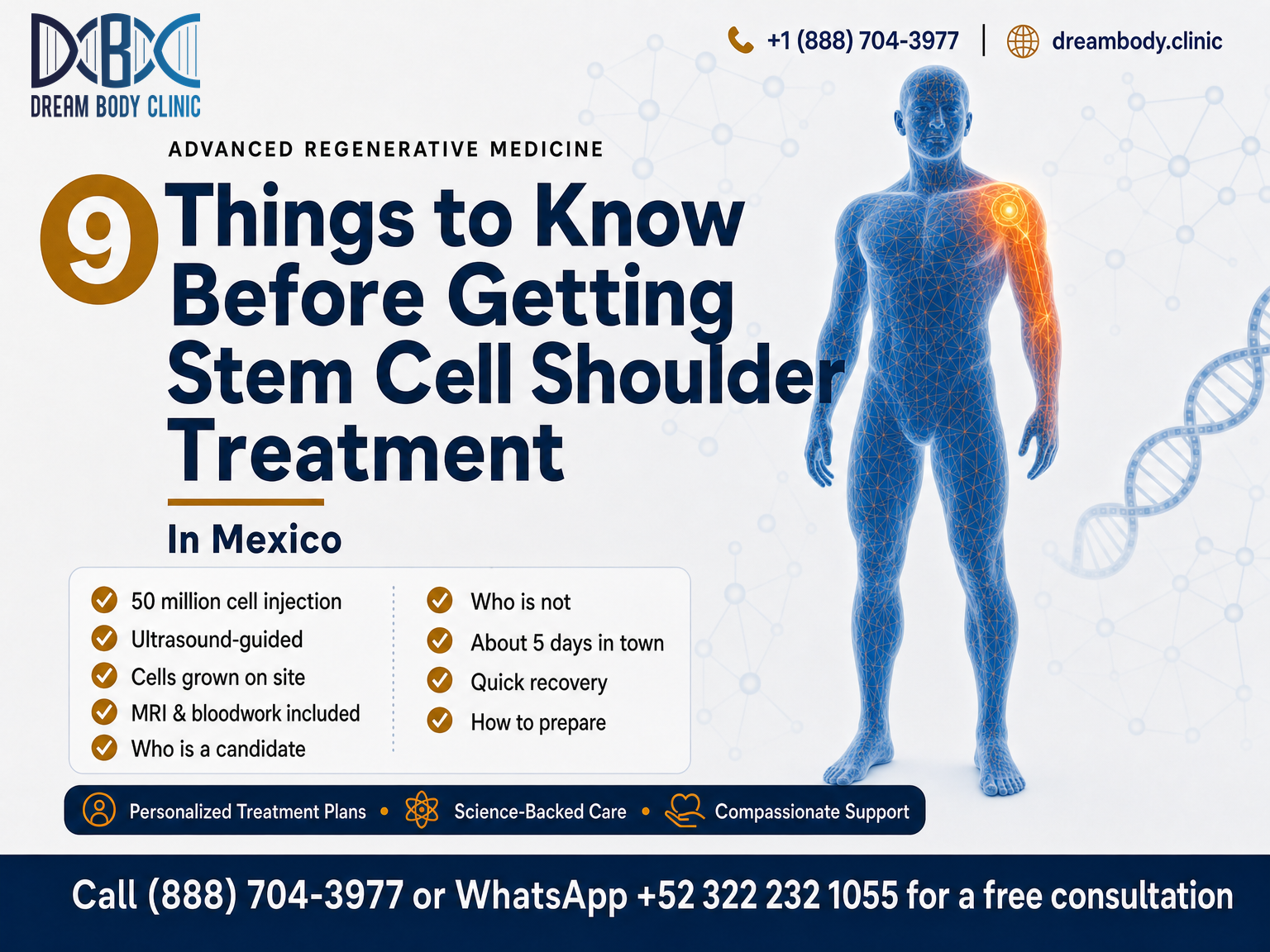
In many cases, yes. With the right regenerative approach, mesenchymal stem cells can help the body repair damaged cartilage, labrum, tendon, and ligament instead of cutting tissue out. At Dream Body Clinic in Puerto Vallarta, Mexico, the stem cell shoulder treatment is built around 50 million mesenchymal stem cells, an on-site MRI, and a short five-day stay so patients can pursue real tissue repair without a surgical recovery.
This guide walks you through how the shoulder gets injured, why surgery is not always the best first move, how stem cells work on labrum tears, supraspinatus and other rotator cuff tears, arthritis, and tendinitis, and what treatment actually looks like at the clinic.
What Makes the Shoulder Break Down
The shoulder is the most mobile joint in the body. That mobility comes at a cost: stability depends on a ring of cartilage (the labrum), four rotator cuff tendons (supraspinatus, infraspinatus, teres minor, and subscapularis), ligaments, the joint capsule, and the cartilage that lines the ball and socket.
When any of those structures fail, pain, weakness, night pain, and loss of overhead motion follow.
Common problems this treatment is designed to address:
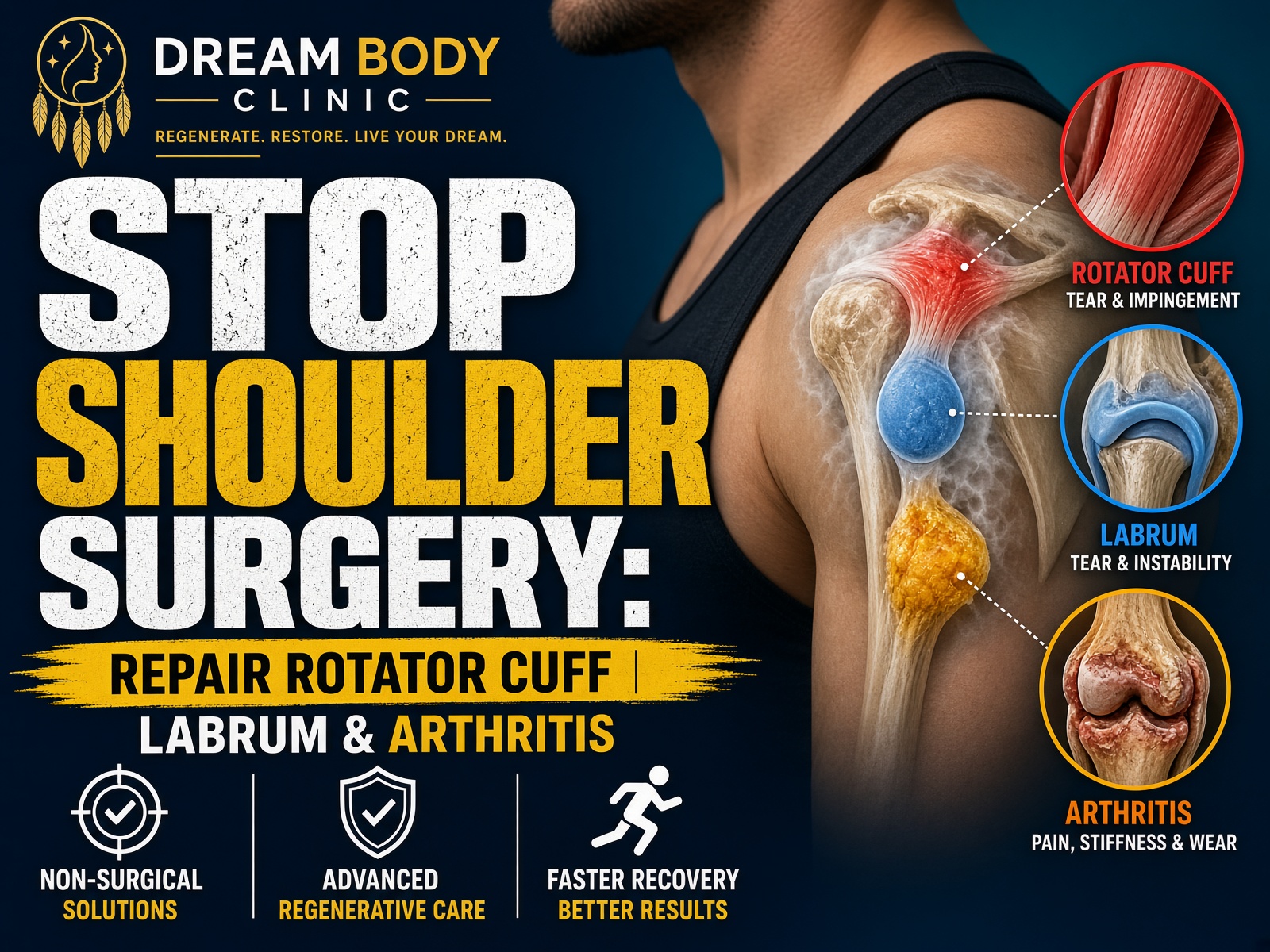
- Rotator cuff and supraspinatus tears. The supraspinatus is the tendon most often torn. Partial tears, degenerative tearing, and some full-thickness tears that are not massive retracted injuries can be candidates for regenerative treatment.
- Labrum tears. The labrum cushions and stabilizes the socket. Tears cause clicking, catching, instability, and pain with reaching or throwing.
- Arthritis and cartilage damage. Worn cartilage leads to grinding, stiffness, and constant ache. Mesenchymal stem cells are used to support cartilage repair rather than jump straight to joint replacement.
- Tendinitis and tendon damage. Overuse and age-related breakdown of rotator cuff tendons and the biceps tendon cause swelling, weakness, and pain that does not resolve with rest alone.
- Ligament and muscle injury. Ligaments stabilize the joint. Muscle and supporting tissue around the shoulder can also be inflamed or scarred after years of compensation.
Symptoms that usually bring people in include pain at night, inability to sleep on that side, weakness lifting the arm, reduced range of motion, and pain that returns every time a cortisone shot wears off.
Why Surgery and Steroid Shots Are Not Always the Answer
When a shoulder MRI shows a rotator cuff tear, labrum tear, or arthritis, two options get offered most often: another steroid injection or surgery.
Steroid shots can quiet inflammation for weeks or months. They do not rebuild tendon, labrum, or cartilage. Repeated steroids can also weaken tissue over time.
Surgery—rotator cuff repair, labral repair, or later joint replacement—can be the right choice for some complete tears and mechanical problems. It also means anesthesia, restricted motion for weeks, months of physical therapy, and no guarantee the repaired tissue will stay strong. Removing or cutting tissue changes the joint. In arthritis, replacing the joint is a last-resort step many people want to delay.
Regenerative treatment sits in the middle: a minimally invasive injection that aims to improve the health of the existing tissue instead of cutting it or masking the pain.
How Mesenchymal Stem Cells Help the Shoulder Heal
At Dream Body Clinic the protocol uses 50 million mesenchymal stem cells (MSCs) delivered by intra-articular injection. MSCs do not work like a glue that instantly patches a tear. They act as signaling cells. They reduce inflammation, guide the cells that rebuild cartilage, tendon, labrum, ligament, and muscle, and help the body break down excess scar tissue.
Labrum tears
The labrum is a ring of cartilage around the socket. When it is torn, the shoulder can feel unstable and painful. MSCs can promote growth of new, healthy tissue and the extracellular matrix components the labrum needs, including collagen and elastin. They also secrete growth factors that support repair and can reduce pain and instability when tissue is still present to work with.
Rotator cuff and supraspinatus tears
Tendons connect muscle to bone. The supraspinatus is the most commonly injured rotator cuff tendon. MSCs can guide tenocytes (the cells that make tendon), support collagen production, and reduce inflammation in the damaged tendon. That is why this approach is used for tendon damage and chronic tendinitis, not only “bone-on-bone” arthritis.
Arthritis and cartilage damage
Cartilage cushions the joint. In osteoarthritis it wears down. MSCs can support cartilage repair by guiding chondrocytes, helping produce collagen and proteoglycans, lowering inflammation that drives further breakdown, and sending paracrine signals that encourage nearby cells to repair tissue.
Tendinitis
Chronic tendinitis is inflamed, degenerated tendon—not just a simple strain. Reducing inflammation and supporting new collagen is the goal, rather than another anti-inflammatory shot that fades.
Ligament and muscle damage
Ligaments stabilize the joint. MSCs can guide fibroblasts and collagen production. In muscle, they can support myoblasts and the proteins involved in contraction while lowering inflammation.
Scar tissue
Injured shoulders often fill in with scar instead of organized tissue. MSCs can help break down scar by producing enzymes such as matrix metalloproteinases, guiding healthier cell types into the area, modulating the immune response so inflammation does not stay stuck “on,” and promoting new blood supply so tissue can actually remodel.
This is not a band-aid. After injection the shoulder goes through a healing response. Pain and function typically improve gradually over weeks to months as tissue health improves.
What the Treatment Process Looks Like at Dream Body Clinic
The published package for one shoulder is $3,500 USD and is described as all-inclusive for the protocol administered in the clinic’s certified facility.
What’s included
- 50 million mesenchymal stem cells via intra-articular injection
- On-site shoulder MRI
- Full blood panel
Patients need to be in town at least five days. A typical schedule:
- Day 1: Arrive and rest
- Day 2: MRI and bloodwork
- Day 3: Review the MRI, confirm candidacy, then payment
- Day 4: Treatment
- Day 5: Fly home
If you stay longer than five days, days do not have to be consecutive.
The clinic uses an Esaote S-Scan open MRI so the team can see bone and soft tissue—cartilage, labrum, tendons, and ligaments—before treating. They do not guess. The open design is less claustrophobic than a closed tunnel, but patients still need to fit the shoulder coil; height, weight, and waist size matter.
If you already have an MRI from the past year, you can email the written radiology report (not the images) to info@dreambodyclinic.net for a preliminary look. A new MRI is still part of the treatment protocol. The most common reasons someone is not a candidate are large osteophytes or a complete tear that the doctors judge will not respond.
If the MRI shows you are not a candidate, you pay only for the MRI ($500 USD) and blood panel ($300 USD), not the full treatment.
The injection itself is minimally invasive. There is no surgical incision and no general anesthesia for the procedure as described on the treatment page. Most people return to normal activity over a period of weeks, with benefits continuing to build over the following months.
Both shoulders (or additional joints) can be treated on the same trip if appropriate.
Stem Cell Therapy vs. Surgery: A Direct Comparison
| Factor | Stem Cell Shoulder Treatment | Typical Shoulder Surgery |
|---|---|---|
| Approach | 50 million MSCs injected into the joint | Repair, debridement, or replacement under anesthesia |
| Imaging | On-site MRI included before treatment | Pre-op MRI, then operating room |
| Downtime | Days in town; gradual return over weeks | Weeks of restricted motion, months of therapy |
| Tissue | Aims to support repair of existing cartilage, labrum, tendon | Cuts, stitches, or removes tissue; replacement removes the joint surface |
| Infection / surgical risk | Low-risk injection alternative as described by the clinic | Standard surgical risks |
| Best fit | Partial tears, labrum damage, arthritis, tendinitis, many chronic injuries | Massive retracted tears, locking mechanical problems, failed conservative care |
Results vary. This is not a guaranteed substitute for every surgical case. That is why MRI screening comes first.
Who Is a Good Candidate?
You may be a strong candidate if you have:
- A partial rotator cuff or supraspinatus tear
- Labrum damage without a problem that must be fixed mechanically first
- Shoulder arthritis or cartilage wear
- Chronic tendinitis that keeps returning after rest and injections
- Ligament or supporting-tissue injury
- Pain and loss of function that have not been solved by physical therapy and steroid shots
You may not be a candidate if the MRI shows a complete tear the doctors consider beyond this protocol, or significant osteophytes that change the joint too much. The clinic’s stated goal is an honest read of the images before anyone pays for cells.
Frequently Asked Questions
Can a rotator cuff or labrum tear heal without surgery?
Many partial tears, degenerative rotator cuff injuries, labrum injuries, and arthritic shoulders are treated with regenerative injections rather than an operation. Massive complete tears and some mechanical problems may still need surgery first. MRI review is how that decision is made.
How do stem cells help a supraspinatus tear?
The supraspinatus is a rotator cuff tendon. MSCs can reduce inflammation, guide tendon cells, and support collagen—the material that gives tendon its strength—rather than only numbing the area.
How is this different from PRP or a patient’s own bone-marrow cells?
Many regenerative clinics use concentrated platelets and/or a patient’s own stem cells from bone marrow or fat. Dream Body Clinic’s published shoulder protocol is a defined 50-million mesenchymal stem cell intra-articular injection plus MRI and labs in one package.
How long until I feel better?
This is not instant. The shoulder goes through a healing response. People often notice change over weeks, with more improvement over a few months as tissue quality improves.
Is the MRI included?
Yes. One shoulder MRI is included in the $3,500 package. A new MRI is required with treatment even if you send an older report for screening.
How long do I need to stay in Puerto Vallarta?
At least five days. Day 2 imaging, Day 3 review and payment, Day 4 treatment is the typical flow.
What if I am not a candidate after the MRI?
You pay for the MRI and blood panel only.
How much does it cost?
The published stem cell shoulder treatment package is $3,500 USD for one shoulder, including 50 million MSCs, MRI, and full blood panel.
Taking the Next Step Toward Shoulder Recovery
A torn rotator cuff, damaged labrum, or arthritic shoulder does not automatically mean surgery. For many patients, a high-dose mesenchymal stem cell injection—paired with an MRI so the team knows exactly what they are treating—is a way to pursue tissue repair with a short stay and no surgical incision.
If you want to know whether you are a candidate, start with a free consultation. If you already have a recent MRI, send the written radiology report.
Call for a free consultation: (888) 704-3977
WhatsApp: +52 322 232 1055
Email your MRI report: info@dreambodyclinic.net
Stem Cell Shoulder Treatment: https://dreambody.clinic/stem-cell-shoulder-treatment/