Multiple Sclerosis Stem Cell Treatment in Mexico | 300M IV + 50M Intrathecal MSC Protocol
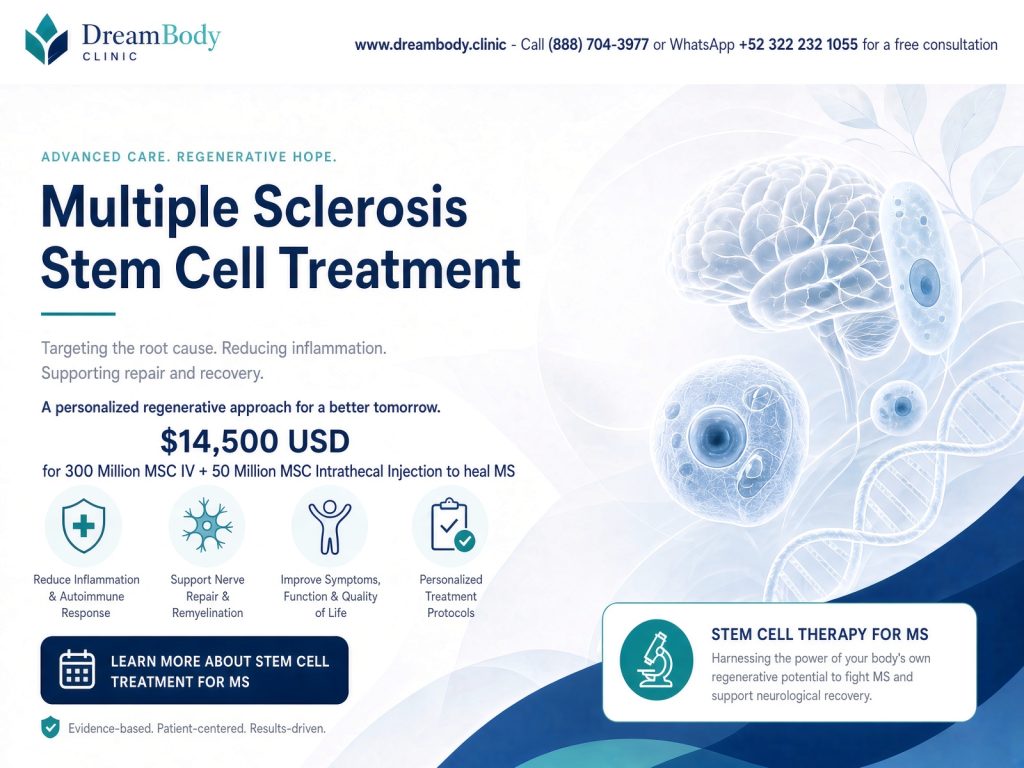
Short answer: The Multiple Sclerosis Stem Cell Treatment at Dream Body Clinic is a protocol of a 300 million MSC IV infusion plus 50 million MSCs by intrathecal injection, offered in Bucerias, Nayarit (Puerto Vallarta area) for $14,500 USD. Results are modest and vary from person to person, and a physician reviews your history before treatment.
- Price: $14,500 USD; flights and hotels are not included
- Protocol: A 300 million MSC IV infusion plus 50 million MSCs by intrathecal injection
- Stay: plan on about 5 days in Bucerias, Nayarit (Puerto Vallarta area)
- Cells: donor mesenchymal stem cells (MSCs) from Wharton’s jelly (umbilical cord tissue) and placenta, grown in our own ISO 7 cleanroom lab (tested to ISO 14644-1) on site and never frozen
- Licensing: COFEPRIS licence 23-TR-18-020-0001 (Regenerative Medicine); clinic open since 2012
- Hours: Monday to Friday 8 AM to 4 PM, Saturday 8 AM to 2 PM
- Reviews: rated 4.9 from 766 Google reviews (see our Google Maps listing)
Dream Body Clinic’s Multiple Sclerosis stem cell treatment is a protocol using mesenchymal stem cells (MSCs).
The protocol combines a 300 million MSC intravenous (IV) infusion with a 50 million MSC intrathecal injection that delivers cells directly into the cerebrospinal fluid. This dual approach aims to modulate the immune response, support remyelination, and promote a more favorable environment for neural tissue in the spinal cord and brain.
Our MSCs are derived from Wharton Jelly & placenta from live, healthy births in our COFEPRIS certified and ISO rated lab on site.
Patients travel to our facility in Bucerias, Nayarit (Puerto Vallarta area), Mexico for a typical five-day stay. The all-inclusive treatment package is $14,500 USD and includes the stem cell infusions, a post-treatment NAD+ and high-dose Vitamin C IV, and care by our medical team in a certified facility.
Many patients with MS seek this approach when conventional disease-modifying therapies have not sufficiently slowed progression or improved quality of life. Results vary by individual factors such as disease duration and the extent of existing neurological damage; earlier intervention is generally associated with better potential outcomes.
Call (888) 704-3977 or email info@dreambodyclinic.net for a free consultation to discuss whether this protocol may be appropriate for your situation.
Please note: Results in studies have been modest and variable. Many patients report changes over 3 to 6 months, but results vary and some see little or no benefit. A physician decides whether you may be a candidate after reviewing your records. Read the research: Stem Cell Therapy for Multiple Sclerosis
Multiple Sclerosis Stem Cell Treatment
We require patients to be in town for at least 5 days. Below is what a typical schedule looks like, but exact details are subject to change depending on availability and schedule:

What’s included in your protocol
Typical Treatment Schedule
Watch & Learn
Kevin’s daughter’s patient story (multiple sclerosis)
Sugar Crush author Dr. Jacoby discusses mesenchymal stem cells
Multiple Sclerosis Stem Cell Treatment at Dream Body Clinic
Improved symptoms, including reduced inflammation, decreased fatigue, and increased mobility and balance
Remyelination is being studied in the laboratory; it has not been shown in people
Possible neuroprotective signaling (still under study)
Personalized treatment plans tailored to each patient's unique needs and medical history
Administration of MSCs by experienced professionals
What Does the Research Say About Myelin in Multiple Sclerosis?
How to Mesenchymal Stem Cells work for Multiple Sclerosis Treatment?
How do Mesenchymal Stem Cells Protect the Nervous System?
What Does the Research Say About MSCs and Neural Tissue?
How does the Interleukin 10 Released by MSCs Help Multiple Sclerosis Symptoms?
Reduction of inflammation: IL-10 can suppress the activity of pro-inflammatory immune cells, such as T-cells and macrophages, which attack the nervous system in MS. By inhibiting the production of these inflammatory mediators, IL-10 can help to reduce inflammation in the nervous system and prevent damage to the myelin sheath.
Modulation of T-cell activity: IL-10 can alter the activity of T-cells in MS patients by inducing regulatory T cells (Tregs). Tregs play a critical role in maintaining immune tolerance by inhibiting the activation of dendritic cells and other immune cells. This modulation can prevent the immune system from attacking the nervous system and causing damage to the myelin sheath.
Promoting neuroprotection: IL-10 can stimulate the production of neuroprotective factors, such as nerve growth factor (NGF) and brain-derived neurotrophic factor (BDNF), which are being studied for protecting cells of the central nervous system.
Induction of anti-inflammatory cytokine production: IL-10 can promote the production of other anti-inflammatory cytokines, such as IL-4 and IL-13, which can provide additional immunoregulatory benefits.
How do the Mesenchymal Stem Cells Help Immunomodulation in Multiple Sclerosis?
Suppression of pro-inflammatory proteins: In MS, the immune system recognizes specific proteins in the nervous system as foreign and attacks them. MSCs can suppress the production of specific pro-inflammatory proteins by the immune system, such as tumor necrosis factor-alpha (TNF-α), interferon-gamma (IFN-γ), and interleukin-1 beta (IL-1β), which can cause tissue damage in MS.
Induction of immunosuppressive molecules: MSCs can release molecules such as interleukin 10 (IL-10), transforming growth factor-beta (TGF-β), and prostaglandin E2 (PGE2), which have immunosuppressive properties. IL-10 can suppress the activation and proliferation of immune cells, TGF-β regulates the immune response and may support self-tolerance, and PGE2 can reduce inflammation.
Modifying the activity of regulatory T cells: MSCs can induce the activity of a type of immune cell called regulatory T cells (Tregs). Tregs play a crucial role in protecting against autoimmunity by suppressing the activation and proliferation of immune cells that recognize normal tissues as foreign.
Promoting the release of anti-inflammatory factors: In response to inflammation, MSCs can produce and release various anti-inflammatory factors, cytokines, and growth factors. These factors can reduce inflammation, stimulate neuroprotective processes, and support the survival of nervous system cells.
MS Stem Cell Therapy Patient Case Study
Note: This is one patient’s experience in 2019 with an earlier protocol that differs from our current one. It is not a typical or guaranteed result, and individual results vary. The first patient to do our original MS Stem Cell Treatment protocl with the 300 Million Stem Cell IV plus 5 sessions of Nebulized Stem cells delivered via nebulization was performed in May of 2019. This patient came to us with brain fog so severe that he couldn’t even go fishing without issue. We updated to adding the nebulized stem cells to get as many stem cells directly to the brain as possible in the least invasive way.
This patient was 30 years old at the time of his diagnosis. You will see below the MRI of his brain that confirmed this diagnosis. Below that is his newest brain MRI which was done December 31st of 2019 which was 7 months after his MS Stem Cell Treatment at Dream Body Clinic. He also had MRI’s done on this Thoracic and Cervical Spine to look for lesions or signs of MS. Both of these MRI’s showed no signs of lesions or signs of MS. The patient is doing amazing now and has decided to come back this May for a 100 Million IV not to treat anything, but because he does not want to see his multiple sclerosis symptoms return.
How do the induced Tregs from Mesenchymal Stem Cells help Multiple Sclerosis Symptoms?
How to get the Multiple Sclerosis Stem Cell Treatment
In conclusion, the multiple sclerosis stem cell treatment could be a promising solution for individuals who are facing this condition. The Dream Body Clinic will review your records, and a physician decides whether you may be a candidate. While this treatment is not yet widely available, ongoing research suggests that it is a viable alternative to traditional multiple sclerosis management methods. If you are interested in learning more about this treatment, we recommend calling us for a free consultation at (888) 704-3977. If you are ready to get the MS Stem Cell Treatment then click the image below for details on how to book.
How long do the Multiple Sclerosis Stem Cell Treatment Results Last?
How long any benefit lasts is not known. Many patients report changes over 3 to 6 months, but results vary and some see little or no benefit.
The mesenchymal stem cells that are administered via IV will stay in the system for 8 months to a year. During that time they are thought to interact with immune cells, mainly by releasing signals that may calm inflammation. After 8 to 12 months any MSCs that are free bound in your system will differentiate into an osteoblast (bone cell), adipocyte (fat cell) or chondrocyte (cartilage cell). They will then contain the donors HLA markers and your immune system will destroy and remove them. This is an easy process for your immune system and there is no negative reaction in your body from it. Some of the MSCs that were free bound from the IV will find capillaries to call home. They will attach and be considered a pericyte.
There are a lot of other benefits outside of just fixing your brain lesions or spinal cord lesions such as anti-aging. An in-depth look at how the stem cell IV works for anti-aging
Mesenchymal Stem Cells for Multiple Sclerosis Studies
Selected peer-reviewed publications supporting this treatment.
What Does the Research Say About Multiple Sclerosis Stem Cell Treatment?
The biggest controlled trial of MSCs in MS (MESEMS, 2021, 144 people) found IV bone marrow MSCs safe and well tolerated, but they did not reduce new inflammatory MRI lesions compared with placebo. A smaller trial (2020, 48 people with progressive MS) found less disability worsening at six months with intrathecal or IV MSCs than with a sham procedure; the researchers called the benefits short-term and said a larger trial is needed. Most of these trials used patients’ own cells, not donor Wharton’s jelly and placenta cells like ours.
What this means for you: results in studies were modest and varied, most studies were small, and no study has tested our exact protocol. Read the full summary with citations: Stem Cell Therapy for Multiple Sclerosis: What the Research Shows.
Is Multiple Sclerosis Stem Cell Treatment in Mexico Safe?
Any injection or infusion carries risk, and the quality of the clinic and its lab matters most. In May 2024 the CDC reported three U.S. patients who developed Mycobacterium abscessus infections in 2022 after donor embryonic stem cell injections at clinics in Baja California and Guadalajara. Investigators suspected a common contaminated product. Dream Body Clinic is in Bucerias, Nayarit, and was not one of those clinics. Source: CDC Morbidity and Mortality Weekly Report, May 2024.
Here is how we reduce those risks, so you can check them yourself:
- COFEPRIS licences: the clinic operates under COFEPRIS licence 23-TR-18-020-0001 (Regenerative Medicine), with 23-TR-18-020-0002 (Stem Cell Bank) and 23-TR-18-020-0003 (Stem Cell Collection Center). Ask to see them during your consultation.
- Batch testing before release: each lot is tested by third-party, COFEPRIS-authorized laboratories for cell identity, sterility, mycoplasma, endotoxin and viability, and you receive a copy of the analysis for your lot.
- Donor screening: donors are screened for HIV, hepatitis B and C, syphilis and Chagas disease.
- Lab and handling: cells are grown in our own ISO 7 cleanroom lab (tested to ISO 14644-1) on the clinic property, never frozen, and given within 24 hours. See our lab licences and testing details.
A physician reviews your history and test results first and will tell you if you are not a good candidate. For the side effects reported after MSC treatment and what to watch for, read Stem Cell Therapy: Safety, Side Effects and Results.
Frequently Asked Questions About Multiple Sclerosis Stem Cell Treatment
How much does multiple sclerosis stem cell treatment cost?
$14,500 USD for a 300 million MSC IV infusion plus 50 million MSCs by intrathecal injection. Flights and hotels are not included.
Is this treatment FDA-approved?
No. These treatments have not been approved by the U.S. Food and Drug Administration (FDA). Dream Body Clinic’s regenerative medicine treatments are provided under COFEPRIS licensing (license 23-TR-18-020-0001). COFEPRIS is Mexico’s equivalent of the FDA, and Mexico is where we operate.
Is it safe to get stem cell treatment in Mexico?
Any injection or infusion carries risk. A 2024 CDC report linked serious infections to donor stem cell injections at other clinics in Baja California and Guadalajara; Dream Body Clinic, in Bucerias, Nayarit, was not one of them. The clinic operates under COFEPRIS licence 23-TR-18-020-0001, grows cells in its own ISO 7 cleanroom lab (tested to ISO 14644-1), and releases each lot only after third-party testing.
How long do I need to stay?
Plan on about 5 days in Bucerias, Nayarit (Puerto Vallarta area).
What does the research show?
Mixed. The largest controlled trial found IV MSCs safe but no better than placebo on new MRI lesions; a smaller trial reported short-term benefits with intrathecal and IV MSCs that still need a larger trial to confirm. Read the full summary: Stem Cell Therapy for Multiple Sclerosis: What the Research Shows.
Related treatments: hereditary spastic paraplegia stem cell treatment, trigeminal neuralgia stem cell treatment and peripheral neuropathy stem cell treatment.
Side Effects or Risks
- 1 in 100 people will experience a slight fever and/or headache for a few hours after treatment or the next day.
- Any treatment involving an injection such as an IV runs a risk of infection.
- 1 in about 30 patients will experience some lower back pain near the intrathecal injection site. It typically lasts a few hours to a few days before fully dissipating. We provide tramacet to all patients as a way to deal with this if it occurs.
- 1 in about 30 patients will experience a migraine like headache and sometimes nausea with it from the intrathecal treatment. In most cases taking 1 tramacet will relieve these side effects. In some cases the headache can last a few hours to a few days. We provide tramacet to all patients just in case to deal with this.
- A very small percentage of patients for this treatment will be non-responders. As with any medication or treatment there is always a chance of no change. Tylenol does not always fix a headache as an example.
- We do not treat patients that have had cancer within the past 5 years. There is still no conclusive evidence linking stem cells to make cancer worse, but we prefer to stay on the side of safety until more information is available.
- As with any medical treatment there is no guarantee of results. Results vary, and some patients see little or no benefit.
- In all patients who receive an intravenous treatment of any sort, there is a risk of releasing a thrombus or plaque from the veins, even more so if the patient has mainly high cholesterol levels. If a thrombosis or phlebitis were to occur, it would occur immediately. This has not been an issue with our patients, but any sort of IV has this risk. This is why we do bloodwork for all patients to make sure that treatment is as safe as possible for them.
The only side effects that have been documented are the following:
Our lab has over 9 years of experience cultivating mesenchymal stem cells. See our stem cell certifications
Or email us at info@dreambodyclinic.net