Rheumatoid Arthritis Stem Cell Treatment: Mesenchymal Stem Cell (MSC) Therapy for Immune Regulation and Joint Repair
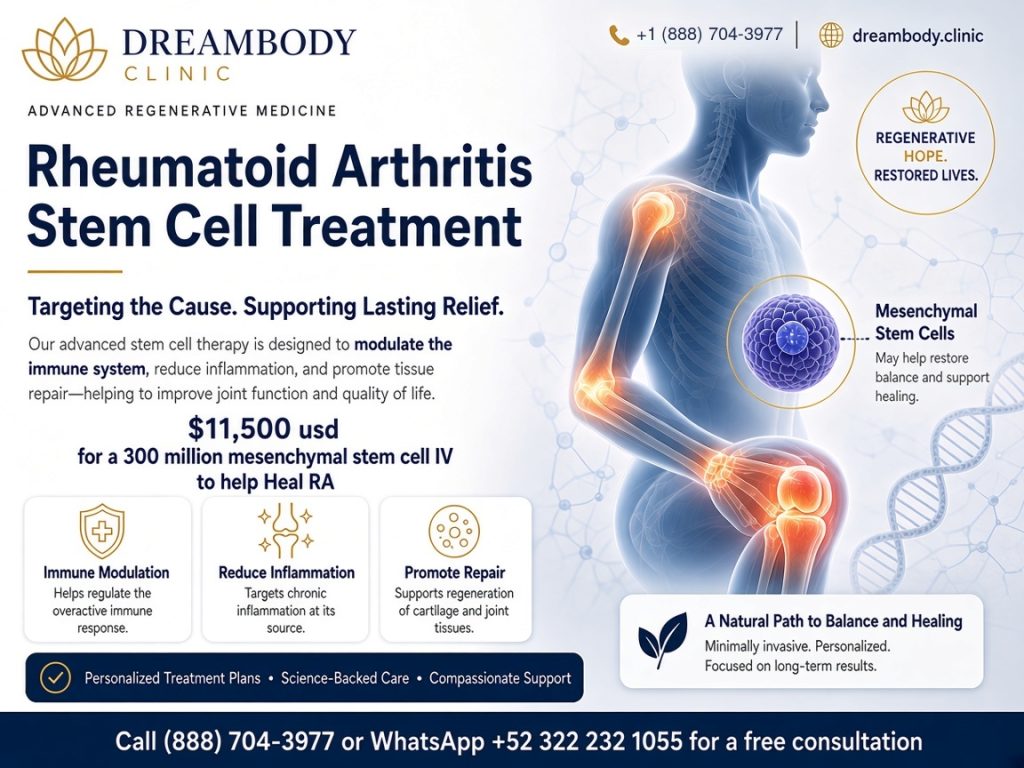
Rheumatoid arthritis stem cell treatment uses Allogeneic mesenchymal stem cells (MSCs) derived from Wharton Jelly (umbilical cord tissue) & Placenta from live, healthy births which are isolated and cultivated in our ISO & COFEPRIS certified lab on site. This is to help calm the overactive immune response that causes chronic joint inflammation, pain, and tissue damage. These cells work through immunomodulation—releasing anti-inflammatory factors, regulating T cells, B cells, dendritic cells, and NK cells, and supporting the body’s ability to repair damaged cartilage and soft tissue.
At Dream Body Clinic, the protocol features a high-dose intravenous infusion of 300 million umbilical cord-derived (Wharton’s jelly) MSCs, followed by NAD+ and high-dose vitamin C support. This short, structured treatment aims to reduce joint swelling and stiffness, improve mobility, and support longer-term immune balance, with many patients noticing progressive benefits over the following 3 to 6 months.
Rheumatoid Arthritis Stem Cell Treatment
We require patients to be in town for at least 4 days. Below is what a typical schedule looks like, but exact details are subject to change depending on availability and schedule
What’s included in your protocol
Typical Treatment Schedule
Watch & Learn
The Rheumatoid Arthritis Stem Cell Treatment at Dream Body Clinic
How do Mesenchymal Stem Cell Work for Rheumatoid Arthritis?
what Immune Cells do the MSCs Affect in Rheumatoid Arthritis?
T cells: MSCs can modulate the activity of T cells by suppressing their activation and proliferation, inducing the differentiation of regulatory T cells, and inducing a state of anergy in T cells. This can help to reduce inflammation and prevent autoimmunity.
B cells: MSCs can inhibit the proliferation and differentiation of B cells, which are immune cells that produce antibodies. This can help to reduce the production of autoantibodies and slow the progression of joint damage.
Dendritic cells: MSCs can inhibit the maturation and activation of dendritic cells, which are immune cells that initiate and regulate T cell responses. This can help to reduce the activation of pathogenic T cells in rheumatoid arthritis.
NK cells: MSCs can suppress the activity of natural killer (NK) cells, which are immune cells that play a role in killing infected or cancerous cells. This can help to reduce inflammation and limit tissue damage.
How do Mesenchymal Stem Cells Affect T Cells for rheumatoid arthritis?
How do Mesenchymal Stem Cells Affect B Cells for rheumatoid arthritis?
Inhibition of B cell proliferation: MSCs can suppress B cell proliferation, reducing the number of B cells that are able to produce harmful antibodies in rheumatoid arthritis.
Inhibition of immunoglobulin production: MSCs can also suppress the production of immunoglobulins (also known as antibodies) by B cells, further reducing the production of harmful self-reactive antibodies in rheumatoid arthritis.
Induction of B cell apoptosis: MSCs can induce apoptosis, or cell death, of B cells, further reducing the number of harmful B cells in rheumatoid arthritis.
Promotion of regulatory B cells: MSCs can induce the differentiation of regulatory B cells, which play a role in immune regulation and suppression of inflammation.
How do Mesenchymal Stem Cells Affect Dendritic Cells for Rheumatoid Arthritis?
Inhibition of dendritic cell maturation and activation: MSCs can inhibit the maturation and activation of dendritic cells, which reduces their ability to activate T cells and generate an inflammatory response.
Promotion of tolerogenic dendritic cells: MSCs can induce the differentiation of tolerogenic dendritic cells, which are immune cells that promote immune tolerance and prevent autoimmunity.
Suppression of dendritic cell-mediated T cell proliferation: MSCs can suppress the ability of dendritic cells to stimulate T cell proliferation, reducing the activation of pathogenic T cells, and the subsequent production of pro-inflammatory cytokines.
How do Mesenchymal Stem Cells Affect NK Cells for Rheumatoid Arthritis?
What Receptors do MSCs Interact with in Immune Cells for Rheumatoid Arthrits?
Toll-like receptors (TLRs): TLRs are a family of receptors expressed on immune cells, including dendritic cells and macrophages. MSCs can interact with TLRs and inhibit the production of pro-inflammatory cytokines in the immune cells.
Chemokine receptors: Chemokine receptors, such as CXCR4 and CCR7, are expressed on various immune cells, including T cells and dendritic cells. MSCs can interact with these receptors and inhibit the migration of pro-inflammatory immune cells, reducing inflammation.
Adhesion molecules: Adhesion molecules, such as intercellular adhesion molecule 1 (ICAM-1) and vascular cell adhesion molecule 1 (VCAM-1), are expressed on endothelial cells and immune cells, such as T cells and monocytes. MSCs can interact with these molecules and inhibit the adhesion of immune cells to the endothelium, reducing inflammation.
CD40 and CD86: CD40 and CD86 are co-stimulatory molecules expressed on the surface of dendritic cells. MSCs can interact with these molecules and inhibit the activation of dendritic cells, reducing the production of pro-inflammatory cytokines.
Steve's Amazing Recovery from Rheumatoid Arthritis from Our Stem Cell Treatment
December 17 at 11:02 AM ·
Steve’s story..
As I’m doing dishes at home, I realized that it was just about a year ago that we were trying to decide between fusing Steve’s left leg or amputation. Every ortho doc/specialist that saw Steve said it was the worst knee they had ever seen. A replacement was not even an option. Not even a hinged replacement, as his leg bones were deteriorating as well. At this time, it had been almost 8 months since he could no longer stand at work, We were starting to lose hope that he would ever return. The last few specialists we saw said Steve would never walk again without one of these surgeries.
I didn’t know it at the time but Steve knew his right leg was following right behind the left. He was afraid to tell as I was looking for a glimmer of hope. We then decided to schedule his leg fusion surgery. The surgery was set for January 2.
We kept the surgery date until the weekend before. If for some reason the fuse didn’t take, he would now need a full leg amputation as he would have metal fused in his whole leg bone. There were truly no good options, but we cancelled the Fuse surgery and we asked for the surgeon to call us to begin the process for amputation above the knee.
At this point, Steve’s knee was so painful that he would scream in pain, if it was touched.
For a couple weeks, no call. We took it as a sign. Steve also expressed to me his fear that his “good leg” would end up in the same as the other. At that point I spent endless hours online researching anything that would give us any other options.
Stem cells kept coming up in the search results. I disregarded them for a long time, as we had heard from multiple docs that they would not help him as there was no cartilage left in his knee.
Well, my curiosity got the best of me so I clicked on stem cell therapy. It couldn’t hurt at this point. We also knew nothing about stem cells, so everything we read was eye opening. There was a clinic in Lake Oswego that had a free seminar on a Friday for a couple hours, for people that were looking for more info. I got Mychal to cover me at WOM and I was able to take him to this seminar.
At this point, Steve could not even get into my jeep without me helping him in and out. He had been completely wheelchair bound for months now.
His main issues were
#1 nerve pain. shooting pain in his legs/shoulders and wrists. He compared it to being stabbed with a red hot knife. His knees were also very painful.
#2 Having zero mobility. His left knee had no bone structure or cartilage left. The x-rays looked nothing like a knee. His right knee was close behind, it was a grade 4, bone on bone. Steve could not go anywhere on his own at this point.
#3 He had multiple detached biceps, both rotator cuffs torn, and his right wrist was still healing from an infection he had 8 mo. earlier, which ended up eating up his wrist bones.
#4 No doctor or specialist could pin-point what the heck happened to Steve,
He was finally diagnosed with severe destructive arthritis. Doctors were truly stumped before they made this diagnosis They did agree that Steve had a bunch of connective tissue problems. Doctors had ran close to 100 different blood panels, MRI’s, bone scans, xrays, biopsies.
Steve’s bones and joints were dissolving and nobody knew why. Steve went from walking and working to wheelchair bound in less than a year.
So we signed up to have a consult the following Monday. We still knew nothing more than what we had heard at the seminar. The doc did mention that Mexico was like the wild wild west of stem cells. We thought nothing of it at the time.
We ended up getting 16,000 stem cells in Lake Oswego.
The first thing that happened, even within the first week, is Steve had no nerve pain. He no longer needed Oxycontin and Weed gummies just to get a few hours of sleep. A few weeks later A dog could sit on his knee, and he no longer had the intense pain there. He continued to slowly improve over the next few weeks. Since he had no cartilage in his knee, we did not expect his knee to rebuild itself, but the intense pain had subsided. This felt like a miracle.
We also stopped eating gluten as of January as it causes inflammation.
After all this, I joined Stem Cell groups on FB for more info. I became obsessed and enthralled with Stem Cells and results. We quickly found out that it is illegal to administer live umbilical stem cells in the us. The cells in the US were frozen, then thawed and administered. The cells were then hoped to replicate over time. Acupuncture is recommended weekly.
Once we found out the live stem cell possibilities outside the US, I got Steve an expedited passport and booked a trip to Dream Body Clinic in Puerto Vallarta..
Steve immediately felt comfortable, when he talked to Josh on the phone. (Josh moved to PV from Seattle 10 years ago, after seeing what Stem Cells were capable of, and taking in to account the FDA’s restrictions of live stem cells.)
At this point it had been almost 3 months since stem cell treatment in Lake Oswego. The main improvements were the nerve pain, and that Steve’s biceps were now attached and his rotator cuffs had less pain.
Steve had just under a billion stem cells administered on April 23, 2018. He had 300 million intravenously, and many different injections into multiple joints. including knees, wrists, shoulders.
“That amount is hard to fathom after we paid almost 20K for 16,000 in Oregon.
For the Billion live cells (not frozen) it was a few thousand cheaper even including the flight/hotel. Steve was in Puerto Vallarta for almost 4 days. In this time he had multiple MRI’s, complete blood panels and consults with the Doctor at Dreambody Clinic. Steve recieved 62,000 times the amount of live stem cells from DreamBody Clinic.
Stem cells are supposed to multiply over time and start healing. When Steve arrived home- (He went by himself, but had assistance with an attendant and wheelchair for the trip) He already was feeling results. Before Mexico, he could not get out of a sitting position easily. He showed me how easy it was to pull himself up.
Over the next few weeks, his energy level increased drastically. I would find him in the basement or the top floor of our house cleaning when I would come home from work. It was truly amazing. Something was going on inside his knees as going up or down the stairs was not an option, even with crutches.
Later in the summer, Steve became able to hang from his ankles freely from the inversion table. I was amazed.
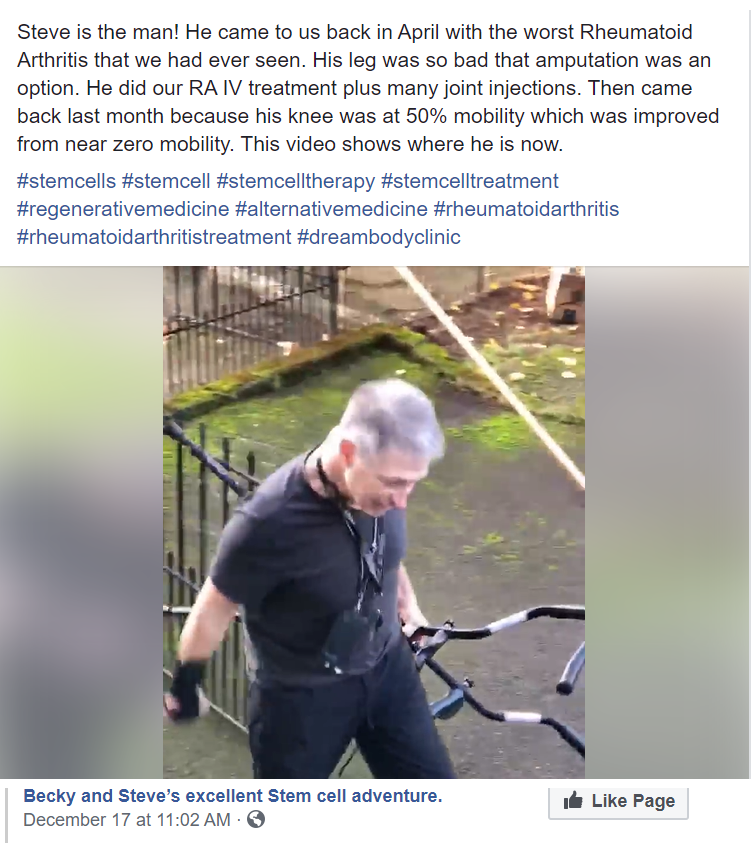
He was gaining muscle again, and was beginning to look like himself. His energy kept improving. He can now walk short distances without an aid. (see video)
Steve was diagnosed with Left Ventricle Heart Failure in 2017, he has been on so many different heart medications for this, and required to daily report his weight and blood pressure in an online journal. A few months ago, he was taken off the heart failure program after an echo showed much improved function.
There are so many exciting things I have noticed over the year, sometimes I forget how awful last year was. He is still far from normal, but I appreciate this past year over 2018 so much.
Many of you know this story, but it just struck me how much a year can change things. Praying that 2020 brings even more healing and hope. Very thankful for credit cards as well.
How do Mesenchymal Stem Cells Guide the Removal of Scar Tissue in an Injured Joint?
Production of enzymes and cytokines: MSCs produce enzymes and cytokines that can help to break down scar tissue and promote its removal. Matrix metalloproteinases (MMPs) are a family of enzymes that can degrade extracellular matrix, the substance that makes up scar tissue. MSCs can produce MMPs, which can break down scar tissue and promote the growth of new tissue.
Guiding specific cell types: MSCs can guide many different cell types, depending on the microenvironment in which they are located. In the case of joint injuries, MSCs can guide fibroblasts and chondrocytes, which are the cells that make up ligament and cartilage tissue, respectively. When MSCs guide these cells, they can help to replace scar tissue with new, healthy tissue.
Modulation of the immune system: MSCs can modulate the immune system, which plays a key role in inflammation and tissue repair. When tissue is injured, the immune system responds by triggering an inflammatory response. However, if the inflammatory response is too severe or prolonged, it can lead to the formation of scar tissue. MSCs can help to modulate the immune response by reducing inflammation and promoting the growth of new tissue.
Promotion of angiogenesis: Angiogenesis is the process by which new blood vessels are formed. Injured tissue requires a robust blood supply to promote healing and removal of scar tissue. MSCs can promote angiogenesis by secreting growth factors that stimulate the growth of new blood vessels. By promoting angiogenesis, MSCs can help to promote the removal of scar tissue by providing the injured tissue with the oxygen and nutrients it needs to repair itself.
How do Mesenchymal Stem Cells Regenerate Cartilage for Rheumatoid Arthritis Patients?
How long do the Rheumatoid Arthritis Stem Cell Treatment Results Last?
How to get the Rheumatoid Arthritis Stem Cell Treatment
Call (888) 704-3977 For a Free Consultation
Side Effects or Risks
- 1 in 100 people will experience a slight fever and/or headache for a few hours after treatment or the next day. We have found that 500mg of Tylenol easily resolves this issue.
- Any treatment involving an injection such as an IV runs a risk of infection. We have never had a patient experience an infection due to our sterility protocols,.
- 1 in about 30 patients will experience some stiffness and minor swelling at the site of the intra-articular injection. This typically only lasts a few hours, but can last up to 2 days. We provide tramacet to all patients as a way to deal with this if it occurs.
- A very small percentage of patients for this treatment will be non-responders. As with any medication or treatment there is always a chance of no change. Tylenol does not always fix a headache as an example.
- We do not treat patients that have had cancer within the past 5 years. There is still no conclusive evidence linking stem cells to make cancer worse, but we prefer to stay on the side of safety until more information is available.
- As with any medical treatment there is no guarantee of results, but our outcomes have been great for the vast majority of patients.
- In all patients who receive an intravenous treatment of any sort, there is a risk of releasing a thrombus or plaque from the veins, even more so if the patient has mainly high cholesterol levels. If a thrombosis or phlebitis were to occur, it would occur immediately. This has not been an issue with our patients, but any sort of IV has this risk. This is why we do bloodwork for all patients to make sure that treatment is as safe as possible for them.
The only side effects that have been documented are the following:
Our lab has over 8 years of experience cultivating mesenchymal stem cells with perfect safety and efficacy. See Stem Cell Certification by Clicking Here
Mesenchymal Stem Cells for Rheumatoid Arthritis Studies
Selected peer-reviewed publications supporting this treatment.
Call (888) 704-3977
For a Free Consultation
Or email us at info@dreambodyclinic.net