Dream Body Clinic · Autoimmune Therapy

Fibromyalgia
Stem Cell
Treatment

Modulate the immune system. Reverse inflammation. Regenerate tissue.

Are you or a loved one suffering from Fibromyalgia, an autoimmune disease that causes inflammation and tissue damage throughout the body? Then it’s time to consider stem cell therapy as an effective treatment option.

All-Inclusive Package
$11,500 USD
300M Stem Cell IV + NAD+ & Vit C
Complete Treatment Package
$11,500
USD
All-inclusive Fibromyalgia Stem Cell Treatment — cutting-edge regenerative therapy administered by highly skilled medical professionals.
The Treatment Consists Of

What’s included in your protocol

300 Million Stem Cell IV

Cutting-edge mesenchymal stem cell infusion administered intravenously by our highly skilled medical team in a sterile, state-of-the-art facility.

NAD+ & High Dose Vitamin C IV

NAD+ and High Dose Vitamin C IV drip administered immediately after the stem cells to maximise cellular repair and immune support.

Patient Itinerary

We require patients to be in town for at least 4 days

Below is what a typical schedule looks like, but exact details are subject to change depending on availability and schedule. If you are in town for more than 4 days then the itinerary may not be all consecutive days.

Itinerary
Arrive & Rest
Settle in, recover from travel, and prepare for your treatment week.
Itinerary
Bloodwork & Payment
Comprehensive bloodwork to confirm treatment safety, followed by payment processing.
Itinerary
Treatment Day
Receive your 300 Million Stem Cell IV followed by NAD+ and High Dose Vitamin C IV.
Itinerary
Fly Home
Cleared for travel. We continue to support your recovery remotely.
Advanced Regenerative Medicine

The Fibromyalgia Stem Cell Treatment at Dream Body Clinic

Don’t let Fibromyalgia hold you back from living your best life. Our goal is to help you accomplish all of your health and wellness goals and get back to doing what you love.

Dream Body Clinic Care Team

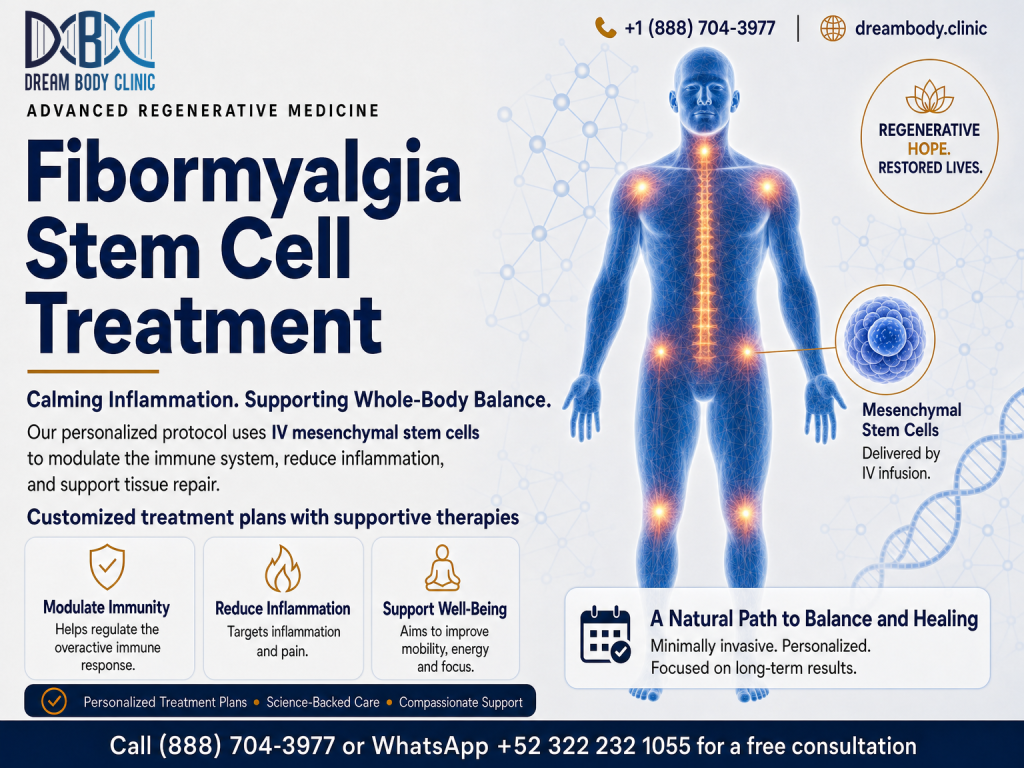
At Dream Body Clinic, we offer cutting-edge Fibromyalgia Stem Cell Treatment that uses Mesenchymal Stem Cells (MSCs) to modulate the immune system and promote tissue regeneration. MSCs have been shown to have a beneficial effect on the immune system, reducing inflammation and autoimmune reactions, and promoting the growth and differentiation of tissue-specific cells.

Our stem cell therapy is administered by highly skilled medical professionals in a sterile, state-of-the-art facility, using minimally invasive techniques that prioritize your safety and comfort.

Our Fibromyalgia Stem Cell Treatment includes stem cell infusions and other supportive therapies designed to optimize outcomes. Our team of experienced professionals will customize your treatment plan according to your unique case and medical history.

Our Fibromyalgia Stem Cell Treatment has been shown to reduce symptoms, improve quality of life, and enhance overall health and well-being in Fibromyalgia patients. Many of our patients have reported significant improvements in symptoms, including reduced inflammation and pain, improved mobility and flexibility, decreased fatigue, and enhanced cognitive function.

Contact us today to learn more about our Fibromyalgia Stem Cell Treatment and how it can help you regain your health and vitality.

Free Consultation
You can also email us at info@dreambodyclinic.net
Patient Education

Hear it from our Medical Team

Two short videos covering how Fibromyalgia Stem Cell Treatment works and what to expect.

Rumble
BitChute
The Science

How does the Fibromyalgia Stem Cell Treatment Work?

Mesenchymal stem cells (MSCs) are an effective treatment for Fibromyalgia due to their immune modulatory effects. The immune system of Fibromyalgia patients is overactive, which leads to inflammation and autoimmune attacks on healthy tissue. MSCs are able to down-regulate inflammation and diminish autoimmune responses by interacting with immune cells, including T cells, B cells, and dendritic cells.

Research has shown that MSCs have the ability to inhibit the proliferation of T cells and promote regulatory T cells, which play a critical role in limiting autoimmunity. MSCs have also been shown to decrease the production of autoantibodies, which are antibodies that attack healthy tissues in Fibromyalgia patients.

In addition, MSCs have been shown to promote tissue repair and regeneration, which is important in Fibromyalgia patients who may experience damage to various organs and tissues. MSCs work for Fibromyalgia by enhancing immune regulation, suppressing inflammation, reducing autoantibody production, and promoting tissue repair. MSCs are believed to exert their beneficial effects on the immune system in several ways, including:

Mechanism

Immunomodulation

MSCs modulate the immune system by blocking the production of inflammatory cytokines — small proteins secreted by immune cells that contribute to inflammation — and they also increase the production of anti-inflammatory cytokines.

Mechanism

Regulation of T Cell Function

T cells play an important role in the pathogenesis of Fibromyalgia. MSCs can alter T cell activity by reducing the proliferation of T cells and promoting the generation of regulatory T cells (Tregs). Tregs help to suppress the immune response and prevent autoimmune reactions.

Mechanism

Regulation of B Cell Function

In Fibromyalgia, B cells produce autoantibodies that attack healthy tissue, and this process leads to tissue damage. MSCs can suppress B cell proliferation and the production of autoantibodies.

Mechanism

Promotion of Tissue Repair

In Fibromyalgia, tissues and organs may be damaged due to inflammation and autoimmune reactions. MSCs can assist in tissue repair and regeneration by promoting the activation and differentiation of tissue-specific cells.

Overall, the beneficial effects of MSCs on the immune system appear to be multiple and varied and may contribute to their potential use as a therapy for Fibromyalgia.

MSCs & The Immune System

How Mesenchymal Stem Cells Benefit T Cells

Mesenchymal stem cells (MSCs) have the ability to benefit T cells in the treatment of Fibromyalgia, an autoimmune disease characterized by an overactive immune system. Here are some of the ways that MSCs may benefit T cells in Fibromyalgia treatment:

Inhibition of T Cell Proliferation

MSCs can inhibit the proliferation of T cells, which play a crucial role in the development and progression of Fibromyalgia. T cell proliferation can lead to the production of autoantibodies, which attack healthy tissue and contribute to the pathology of Fibromyalgia.

Promotion of Tregs

Regulatory T cells (Tregs) play a critical role in immune regulation and in preventing autoimmune reactions. MSCs can promote the generation and activation of Tregs, which can help to suppress the immune response and prevent autoimmune reactions in Fibromyalgia patients.

Decreased Inflammatory Cytokines

Inflammatory cytokines are small proteins secreted by immune cells that contribute to inflammation and tissue damage in Fibromyalgia. MSCs can reduce the production of inflammatory cytokines, such as interleukin-17 (IL-17), which are produced by T cells, and this helps to reduce inflammation and protect healthy tissue.

Induction of T Cell Apoptosis

In Fibromyalgia, T cells may accumulate in tissues and organs and contribute to the development of lupus nephritis, a condition in which the kidneys are damaged due to inflammation and immune reactions. MSCs can induce the apoptotic death of T cells, which can help to reduce the accumulation of T cells in tissues and prevent tissue damage.

Overall, the ability of MSCs to modulate T cell activity and promote immune regulation makes them an effective therapy for Fibromyalgia.

MSCs & Autoantibodies

How Mesenchymal Stem Cells Benefit B Cells

Mesenchymal stem cells (MSCs) have the ability to benefit B cells in the treatment of Fibromyalgia, an autoimmune disease characterized by an overactive immune system. Here are some of the ways MSCs may benefit B cells:

Inhibition of B Cell Proliferation

MSCs can inhibit the proliferation of B cells, which are responsible for producing autoantibodies that attack healthy tissue in Fibromyalgia patients. By reducing the proliferation of B cells, MSCs can help to reduce autoimmune reactions and protect healthy tissue.

Suppression of Antibody Production

In addition to inhibiting B cell proliferation, MSCs can also suppress the production of autoantibodies that contribute to tissue damage in Fibromyalgia. This may be due to the ability of MSCs to reduce the activation of B cells and their differentiation into plasma cells.

Induction of B Cell Apoptosis

MSCs can induce the apoptotic death of B cells, which can help to reduce the production of autoantibodies and prevent tissue damage in Fibromyalgia patients.

Modulation of Cytokine Production

In Fibromyalgia, B cells can produce cytokines that contribute to tissue damage and inflammation. MSCs can modulate cytokine production by B cells, reducing the production of inflammatory cytokines such as interleukin-6 (IL-6).

Overall, the ability of MSCs to modulate B cell activity and reduce autoimmune reactions makes them a great therapy for Fibromyalgia.

Regeneration & Repair

How MSCs Benefit Tissue Regeneration

Mesenchymal stem cells (MSCs) have been shown to benefit tissue regeneration in the treatment of Fibromyalgia, an autoimmune disease characterized by an overactive immune system that can lead to inflammation and tissue damage. Here are some of the ways that MSCs may benefit tissue regeneration in Fibromyalgia treatment:

Promotion of Tissue Repair

MSCs can promote tissue repair by secreting growth factors and cytokines that stimulate the growth and differentiation of tissue-specific cells. This can be particularly important in the case of Fibromyalgia, where damage to various organs and tissues can occur.

Modulation of the Immune System

MSCs can modulate the immune system by suppressing inflammation and reducing autoimmune reactions. This can help to reduce tissue damage and create a more favorable environment for tissue regeneration.

Promotion of Angiogenesis

Angiogenesis refers to the process of new blood vessel formation, which is critical for tissue regeneration. MSCs can promote angiogenesis by secreting factors that stimulate the growth of blood vessels and improve blood flow to damaged tissues.

Guidance of Tissue-Specific Cells

MSCs have the ability to guide tissue-specific cells, such as chondrocytes, osteocytes, and adipocytes. This can be particularly useful in cases where tissue damage or loss has occurred.

Overall, the ability of MSCs to promote tissue repair and regeneration, as well as modulate the immune system, makes them a wonderful therapy for Fibromyalgia.

Cellular Migration Science

Fibromyalgia Stem Cell Treatment and Chemotaxis

Chemotaxis is the process by which cells are attracted or repelled by specific chemicals in their surrounding environment. The chemicals that act as the attractants or repellents are called chemotactic agents, or chemotaxins. Chemotaxis is an essential process for many biological functions, such as immune responses, wound healing, embryonic development, and bacterial movement.

In the context of regenerative medicine, MSCs are often used to repair or replace damaged tissues. Chemotaxis plays an essential role in the migration of MSCs to the site of tissue damage. When an injury occurs, cells in the damaged tissue release chemotactic agents that attract MSCs to the site of the injury. Once MSCs reach the damaged tissue, they can guide differentiation and regeneration of various cell types to help repair the damaged tissue.

Chemotaxis is regulated by several signaling pathways, including the phosphoinositide 3-kinase (PI3K)/Akt and mitogen-activated protein kinase (MAPK) pathways. These pathways help to regulate the migration and differentiation of MSCs by controlling the expression of various genes and proteins.

Chemotaxis is also an important process in immune responses, as immune cells must be able to migrate to sites of infection or injury to fight off pathogens and repair damaged tissues. In this context, chemotaxis is regulated by various cytokines and chemokines that are produced by the tissue.

Thus, chemotaxis is a fundamental biological process that plays a crucial role in tissue repair, immune responses, and many other physiological processes. This process is crucial for reversing Fibromyalgia Symptoms.

Safety & Transparency

Side Effects or Risks

The only side effects that have been documented are the following:

  • 1 in 100 people will experience a slight fever and/or headache for a few hours after treatment or the next day. We have found that 500mg of Tylenol easily resolves this issue.
  • Any treatment involving an injection such as an IV runs a risk of infection. We have never had a patient experience an infection due to our sterility protocols.
  • A very small percentage of patients for this treatment will be non-responders. As with any medication or treatment there is always a chance of no change. Tylenol does not always fix a headache as an example.
  • We do not treat patients that have had cancer within the past 5 years. There is still no conclusive evidence linking stem cells to make cancer worse, but we prefer to stay on the side of safety until more information is available.
  • As with any medical treatment there is no guarantee of results, but our outcomes have been great for the vast majority of patients.
  • In all patients who receive an intravenous treatment of any sort, there is a risk of releasing a thrombus or plaque from the veins, even more so if the patient has mainly high cholesterol levels. If a thrombosis or phlebitis were to occur, it would occur immediately. This has not been an issue with our patients, but any sort of IV has this risk. This is why we do bloodwork for all patients to make sure that treatment is as safe as possible for them.
Our lab has over 8 years of experience cultivating mesenchymal stem cells with perfect safety and efficacy. See Stem Cell Certification by Clicking Here
Long-Term Outcomes

How long do the Fibromyalgia Stem Cell Treatment results last?

The results from the fibromyalgia stem cell treatment can last for years or even indefinitely. This is because the stem cells are reprogramming your immune system to work the way it was designed to work. Once the immune cells are reprogrammed and any damage is repaired throughout the body then things will work the way they should. This will last because it is real regeneration and not just a pill to cover up symptoms.

The mesenchymal stem cells that are administered via IV will stay in the system for 8 months to a year. During that time they will interact with immune cells and seek out inflammation where they will guide cellular regeneration. After 8 to 12 months any MSCs that are free bound in your system will differentiate into an osteoblast (bone cell), adipocyte (fat cell) or chondrocyte (cartilage cell). They will then contain the donors HLA markers and your immune system will destroy and remove them. This is an easy process for your immune system and there is no negative reaction in your body from it. Some of the MSCs that were free bound from the IV will find capillaries to call home. They will attach and be considered a pericyte. When they do this they can live in your system indefinitely in a beneficial way to your system.

The Fibromyalgia Stem Cell Treatment is allowing your body to heal like it did when you were a little kid. There are a lot of other benefits outside of just fixing your Fibromyalgia symptoms such as anti-aging. Click Here for An in depth look at how the stem cell IV works for Anti-Aging

MSCs Stay Active
8–12 mo
Mesenchymal stem cells administered via IV remain active and engaged with your immune system.
Real Regeneration
Years
Results can last years or even indefinitely — this is real regeneration, not a pill to cover symptoms.
Take The Next Step

How to get the Fibromyalgia Stem Cell Treatment
In conclusion, the Fibromyalgia stem cell treatment could be a promising solution for individuals who are facing this condition. The Dream Body Clinic provides personalized treatment plans using stem cells to repair and regenerate damage to the whole body which may lead to improved mobility and relief of symptoms. While this treatment is not yet widely available, ongoing research suggests that it is a viable alternative to traditional Fibromyalgia management methods. If you are interested in learning more about this treatment, we recommend calling us for a free consultation at (888) 704-3977. If you are ready to get the Fibromyalgia Cell Treatment then click the image to the right for details on how to book.

Ready to Reclaim Your Health?

Call (888) 704-3977

For a Free Consultation

Or email us anytime at info@dreambodyclinic.net