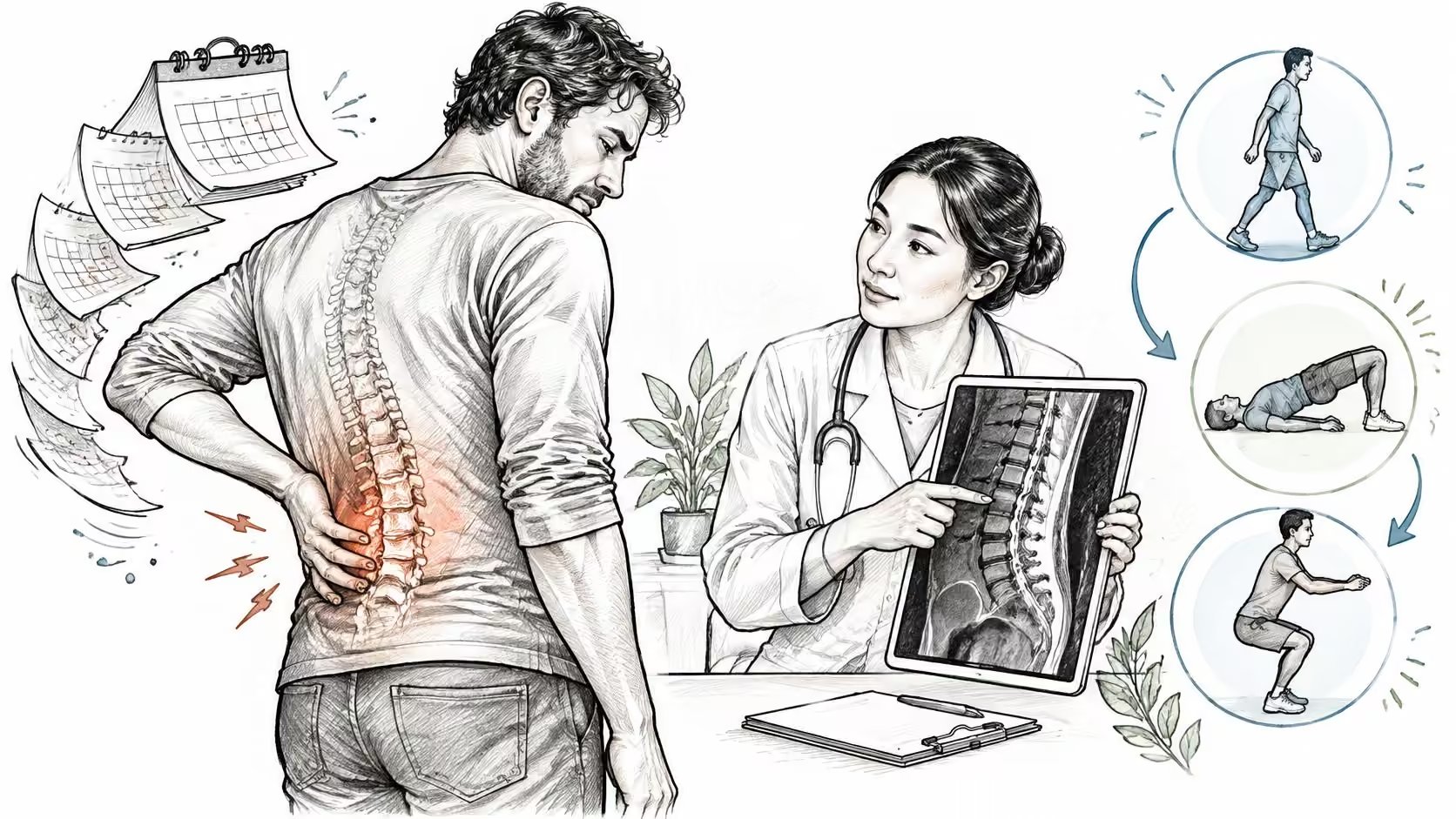
Your lower back has been sore since sometime in early spring. Not the kind of pain that drops you to the floor, just a dull, stubborn ache that builds through a long meeting, eases when you walk to the car, then comes back at 3am when you roll over. You've stopped mentioning it because it isn't new anymore.
Months of pain changes the questions you ask. It stops being about what you did on one bad Saturday and becomes about whether something is structurally wrong, whether it will ever settle, and whether the stretching and the new pillow are doing anything. Sorting that out starts with one distinction: mechanical pain, nerve-related pain, or a presentation that needs urgent review.
The guidance below is what a clinician would walk you through in a consultation. What the timeline means, which symptoms can't wait, what imaging can and can't settle, and how to judge whether anything you try is working.
Table of Contents
- What Months of Lower Back Pain Mean
- Red Flags and When to Book a Specialist
- Causes Behind Pain That Lasts for Months
- What an MRI Can and Cannot Tell You
- Conservative Care That Works and How Long It Takes
- How MSC Therapy Works in the Lower Back
- Realistic Recovery Timelines for Each Treatment Path
What Months of Lower Back Pain Mean
Three months or more is the line that separates an episode from a long-term condition, and crossing it is not a reassuring milestone. Up to one-third of people who seek care for an acute episode still report pain of at least moderate intensity a year later, according to the NICE guideline on low back pain and sciatica. Pain intensity rises and falls across that stretch without the label changing.
Clinicians divide the timeline into bands rather than treating the pain as one block. Anything under six weeks counts as acute. Six weeks to three months is subacute, the zone where the trend matters more than the symptom itself. From three months on, the label is chronic, and the focus of assessment shifts away from the pain score toward what the pain is doing to your life: function, work limitations, sleep, mood and possible nerve involvement.
Persistent symptoms do not automatically mean dangerous structural disease. Most low back pain is non-specific, meaning no single serious underlying cause is identified. The World Health Organization puts the number of people living with low back pain in the hundreds of millions, expects that figure to keep climbing toward mid-century as populations grow and age, and ranks it as the leading cause of disability worldwide. Months of pain are a common human problem, which is exactly why they deserve a structured answer rather than another wait-and-see month.
Check where your own timeline sits:
| Duration | Classification | What it usually means | Next step |
|---|---|---|---|
| Under 6 weeks | Acute | Most episodes improve within weeks | Stay active and use self-care; watch for red flags |
| 6 weeks to 3 months | Subacute | Pain is persisting and the trend matters | Track function weekly; see a clinician if not improving |
| 3 to 12 months | Chronic | Persistent pain needing broader assessment of function, sleep, work and nerve involvement | Structured evaluation and a rehabilitation plan |
| 12 months or more | Long-standing chronic | Pain is entrenched and often affects work and mood | Specialist review and a multidisciplinary plan |
If stiffness is worst in the first hour after waking, the Virginia Beach guide to pain-free mornings from Willis Furniture & Mattress explains why the mattress and pillow setup shapes how that first hour goes.
The band tells you how urgently to act. Your function tells you what the pain is costing. Track that second measure weekly with concrete markers: how far you walk before pain stops you, whether you can sit through a full workday, how many times pain wakes you at night. Those markers improve or worsen well before the pain score itself does, which makes them the better early signal of whether your current approach is working.
Red Flags and When to Book a Specialist
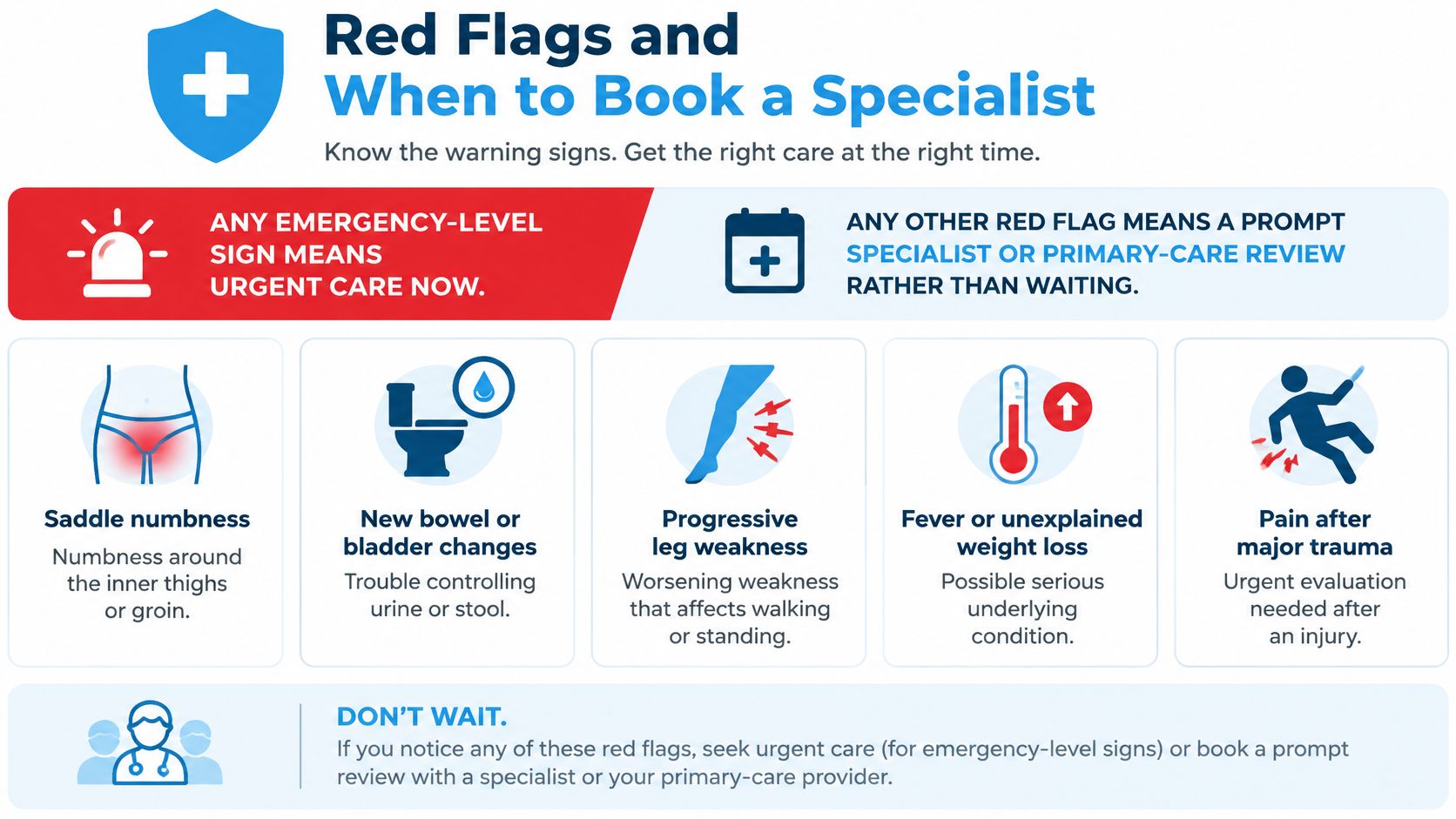
One rule sorts everything else. Any emergency-level sign means urgent care today, and any other red flag means a prompt appointment with a clinician rather than another month of waiting to see.
Signs that can't wait for a routine appointment
- Saddle numbness with bladder or bowel change: numbness around the inner thighs or groin, combined with trouble controlling urine or stool, can indicate cauda equina syndrome. That combination needs same-day assessment in an emergency department, not a next-week booking.
- Progressive leg weakness: strength that drops over days rather than weeks, or a foot that drags when you walk, points to a nerve root under real pressure.
- New bladder or bowel changes: incontinence, or being unable to pass urine at all, moves this out of the musculoskeletal category.
The rule to remember: groin numbness plus any change in bladder or bowel control is a same-day emergency.
The other red flags belong in the urgent-review group. Fever alongside back pain raises the question of infection. Unexplained weight loss, a history of cancer, or major trauma such as a fall from height all change the assessment. So does osteoporosis with sudden severe pain, which raises fracture risk, and pain that wakes you repeatedly at night and doesn't ease with rest. Severe leg pain with a neurological deficit, or any picture that suggests systemic illness, also warrants prompt review rather than routine chronic-pain management.
Stable pain with none of those features can usually be managed with a structured plan. The trigger for a specialist review is different: pain that has lasted three months or more with limited function despite structured conservative care, or nerve symptoms that persist beyond several weeks of treatment. If pain runs down the leg rather than staying in the back, the signs of sciatic nerve pain walkthrough helps separate genuine nerve pain from muscular referral patterns.
What a specialist review actually involves
Expect a neurological examination, a functional assessment, a review of any imaging, and a plan that compares rehabilitation with interventional and regenerative options. Bring four things: a pain diary, a list of treatments already tried with dates, your imaging reports, and a current medication list.
Ask any clinic the same five questions. Which indication is being treated, what cell dose and delivery route are used, which outcomes are tracked and how, what the follow-up schedule looks like, and how its authorization can be verified independently.
Dream Body Clinic has spent nine years helping people get out of lower back pain, and one pattern holds across that time: the cases that go best are the ones sorted early into mechanical, nerve-related or urgent categories. Write down which red-flag items apply to you today, then request a lower back assessment with your reports in hand.
Causes Behind Pain That Lasts for Months
An ache that builds across a warehouse shift behaves differently from a disc pressing on a nerve root, and the difference decides the treatment. Most long-lasting lower back pain falls into four groups: mechanical, nerve-related, joint-related and psychosocial. Getting the group right matters more than getting a precise label, because the group decides whether imaging helps, whether nerve tissue is involved, and whether rehabilitation alone is likely to work.
The largest group is non-specific mechanical pain, where the ache follows loading patterns: worse after a long sit or repeated bending, easier after twenty minutes of movement. Physical work stacks the odds. In a 2025 study of 480 women working as geriatric nursing assistants in Spain, 44.2% reported persistent low back pain. That figure reflects cumulative load outrunning recovery, not a fragile spine.
| Likely cause | Typical pattern | Key clue | How it is confirmed |
|---|---|---|---|
| Non-specific mechanical pain | Ache worse with sitting or bending, eases with movement | No nerve signs and no serious cause found | Clinical examination; imaging not routinely needed |
| Disc degeneration or herniation | Back pain with possible leg pain if a nerve root is involved | Radiating leg pain, numbness or reflex change | Neurological examination and MRI when nerve involvement is suspected |
| Facet joint arthritis | Pain on extension or twisting, stiffness after rest | Localised back pain that worsens with standing backward bends | Clinical examination; specialist assessment and targeted imaging |
| Spinal stenosis | Leg heaviness or pain on walking, eased by sitting | Walking tolerance clearly reduced | MRI or CT correlated with clinical findings |
| Sacroiliac joint dysfunction | One-sided pain low in the back or buttock | Pain reproduced by provocation tests over the joint | Clinical tests and specialist assessment |
| Psychosocial and sleep factors | Pain out of proportion to findings, fear of movement, poor sleep | Pain persists despite normal scans | Screening for mood, sleep, work stress and activity avoidance |
When several causes reinforce each other
Months of pain usually has more than one driver. A stiff facet joint makes you move less, weakened supporting muscles tire sooner, broken sleep lowers your tolerance, and fear of bending keeps the whole loop running. Treat one element and the others often loosen with it.
Sleep deserves specific attention because it is the lever people skip. A sagging or unsupportive sleep surface can keep the morning stiffness cycle going, and the back pain advice from Woodstock Mattress walks through how to spot that pattern.
Disc findings need context too. A scan abnormality counts as a cause only when it matches your examination and your symptom pattern, which is why the degenerative disc disease and spondylosis overview treats imaging as one input rather than a verdict.
Match your own pattern to one or two rows above before you read anything else. Notice whether leg symptoms, walking tolerance or sleep are part of the picture, because those three details steer the next decision more than pain severity does. Track function rather than the ache alone: how far you can walk before symptoms appear, or how long you can sit, tells you more about which group you belong to than a daily pain rating does.
What an MRI Can and Cannot Tell You
A report that says disc degeneration or a bulging disc doesn't prove the disc is causing your pain. Degenerative findings are common and may not explain symptoms, which is why the WHO guidance on low back pain recommends a thorough clinical assessment, and why major guideline summaries advise against routine imaging when there are no neurological deficits and no signs of serious disease. Chronic primary low back pain, the kind that outlasts the acute window, is defined as pain that can't reliably be attributed to a specific disease or structural lesion.
The MRI is a map of the terrain. Your neurological examination and symptom history are the compass that shows which route the pain is actually taking.
Scans can become a problem rather than a solution. Incidental findings can trigger procedures you didn't need, weeks of anxiety, and real expense, all without changing your pain. Duration alone is not a reason to order an MRI or to move straight to an invasive treatment.
Imaging becomes relevant in specific situations:
- Progressive weakness or numbness, where a nerve root may be under increasing pressure.
- Bowel or bladder dysfunction, which needs urgent assessment regardless of what a scan shows.
- Suspected cancer or infection, particularly with fever, weight loss or a cancer history.
- Fracture risk, such as osteoporosis with sudden severe pain after minor trauma.
- Systemic illness, where back pain is one feature among several.
- Severe persistent nerve pain, where the level and cause of compression guide the plan.
What MRI establishes well is anatomy: nerve compression, the pattern of a disc herniation, stenosis, and the condition of the facet joints. What it can't establish on its own is the source of your pain, because the same image can belong to someone with no symptoms at all.
Our lower back process starts with an MRI, and for nerve pain symptoms in the back or neck we recommend starting with an MRI. When neuropathy comes from herniated discs, we address the disc problem first with a separate protocol. Bring three things to any clinician: the imaging report itself rather than a summary, a clear history of which leg symptoms appeared when, and a two-week symptom log. Then ask the one question that decides everything: how will this scan change the plan? Ask whether the MRI step is required for your case, because a clinician can also judge the need for imaging from your examination and history.
Conservative Care That Works and How Long It Takes
For chronic pain without nerve-root involvement, non-drug care comes first. The American College of Physicians guideline recommends structured exercise, motor-control training, multidisciplinary rehabilitation, cognitive behavioral therapy, yoga, tai chi, mindfulness-based stress reduction, spinal manipulation or acupuncture before escalating to invasive treatment.
The evidence behind those options is real but modest. A 2025 Cochrane review of chronic low back pain treatments found that exercise, acupuncture and psychological therapies probably reduce pain and improve function over three to twelve months, and that multidisciplinary programmes probably improve both outcomes. Traction probably does not reduce short-term pain.
Measure what you want back. A pain score tells you how today felt. Walking distance tells you whether the treatment is working.
| Option | Evidence summary | Time window | Role in the plan |
|---|---|---|---|
| Structured exercise | Probably reduces pain and improves function | 3 to 12 months | Foundation of most plans |
| Cognitive behavioral therapy | Probably reduces pain and improves function | 3 to 12 months | Best where fear of movement dominates |
| Multidisciplinary rehabilitation | Probably improves pain and function together | Improvement accumulates across the programme | For pain that has affected work and mood |
| Acupuncture | Probably reduces pain and improves function | 3 to 12 months | Reasonable adjunct alongside exercise |
| Spinal manipulation | Recommended as a non-drug option before invasive care | Trial for several weeks, then reassess | Short-term relief paired with active work |
| Traction | Probably does not reduce short-term pain | Not a primary choice | Low priority |
Because average effects are modest, progress has to be measured in function: walking tolerance, sitting time, sleep quality, medication use, work capacity and a validated disability score. Two people can report the same pain number while one is back to full shifts and the other can't sit through dinner.
Where medication fits
Medication is a secondary decision, not a first move. NSAIDs may be considered when non-drug care hasn't been enough. Duloxetine or tramadol are later-line options. Opioids require exceptional justification, because expected benefits are limited while the risks include dependence, overdose and persistent functional impairment.
Run a fair trial of any programme. Commit to a structured plan for several weeks, record your measures at baseline, and reassess at six to twelve weeks. If sleep is one of your main limits, choosing a mattress for back pain is a cheaper intervention to test than most treatments, and it affects every night rather than two sessions a week. No functional change at twelve weeks is information, not failure. It means the plan needs a different ingredient, not more of the same.
How MSC Therapy Works in the Lower Back
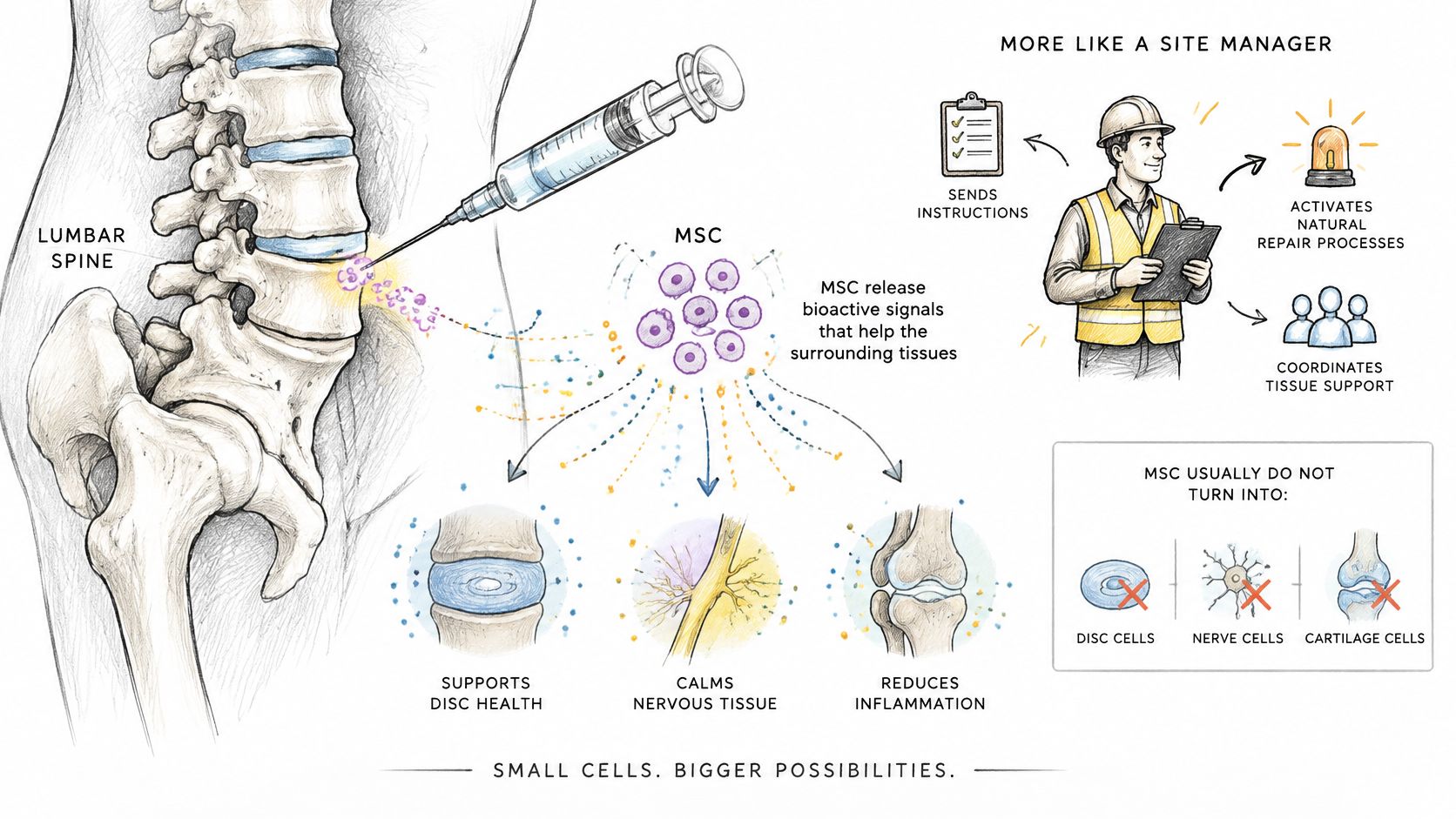
The core idea: mesenchymal stem cells don't mainly turn into disc, nerve or cartilage cells. They work by sending out specialized signals that guide your own healing process.
A construction site where the crew is still capable but the foreman hasn't shown up is the closest everyday analogy. Injected cells work like that foreman. They coordinate the existing crew by sending signals, while your own cells do the rebuilding. That distinction explains why the effect builds over months and why it depends on what tissue you still have.
What the cells actually do
The mechanism is called the paracrine effect. Transplanted cells release anti-inflammatory cytokines such as interleukin-10 and transforming growth factor-beta, plus trophic factors such as IGF-1 and GDF-5, as described in research on MSC therapy for degenerative disc disease. Those signals reduce inflammatory activity, inhibit the enzymes that break down the disc's extracellular matrix, limit cell death, and stimulate your remaining disc cells to produce matrix.
Many transplanted cells survive only briefly at the injection site. That's precisely why the signalling matters more than persistence. The cells don't need to take up residence to change the environment around a degenerative disc or an irritated nerve root.
This mechanism is what makes the therapy relevant to degenerative disc disease and discogenic pain, where the problem is a disc losing water content and structural integrity. It remains a proposed mechanism, and the evidence stops short of guaranteed tissue regeneration. Anyone promising a rebuilt disc on a fixed schedule is describing something the biology doesn't support.
The regulatory picture in Mexico
MSC therapy is not FDA-approved for back pain in the United States. At Dream Body Clinic, treatments are delivered under COFEPRIS oversight in Mexico. COFEPRIS is Mexico's federal regulator for health products and clinical research, responsible for approving and monitoring human clinical studies, and it plays a role often compared to the FDA or the European EMA, as outlined in the ISCT update on MSC regulation. That falls short of FDA approval, so ask any clinic for its specific authorization, establishment permits and protocol documentation, and confirm them with the regulator directly.
Dream Body Clinic's lower back treatment uses mesenchymal stem cell injections combined with an intravenous infusion, and its lower back process starts with an MRI to identify the source of the problem. In the protocol the clinic describes, that meant four injections of 25 million cells into the lower back plus a 100 million cell IV. Sciatica from a herniated disc is among the cases it has treated, and the stem cell injections for lower back pain page sets out what the treatment involves.

Expect change to build gradually, with the signals doing their work over months. The evidence base for MSC therapy in lower back pain is still limited, and results vary across studies. The sensible response is to judge the treatment on tracked function instead of on a promise.
Realistic Recovery Timelines for Each Treatment Path
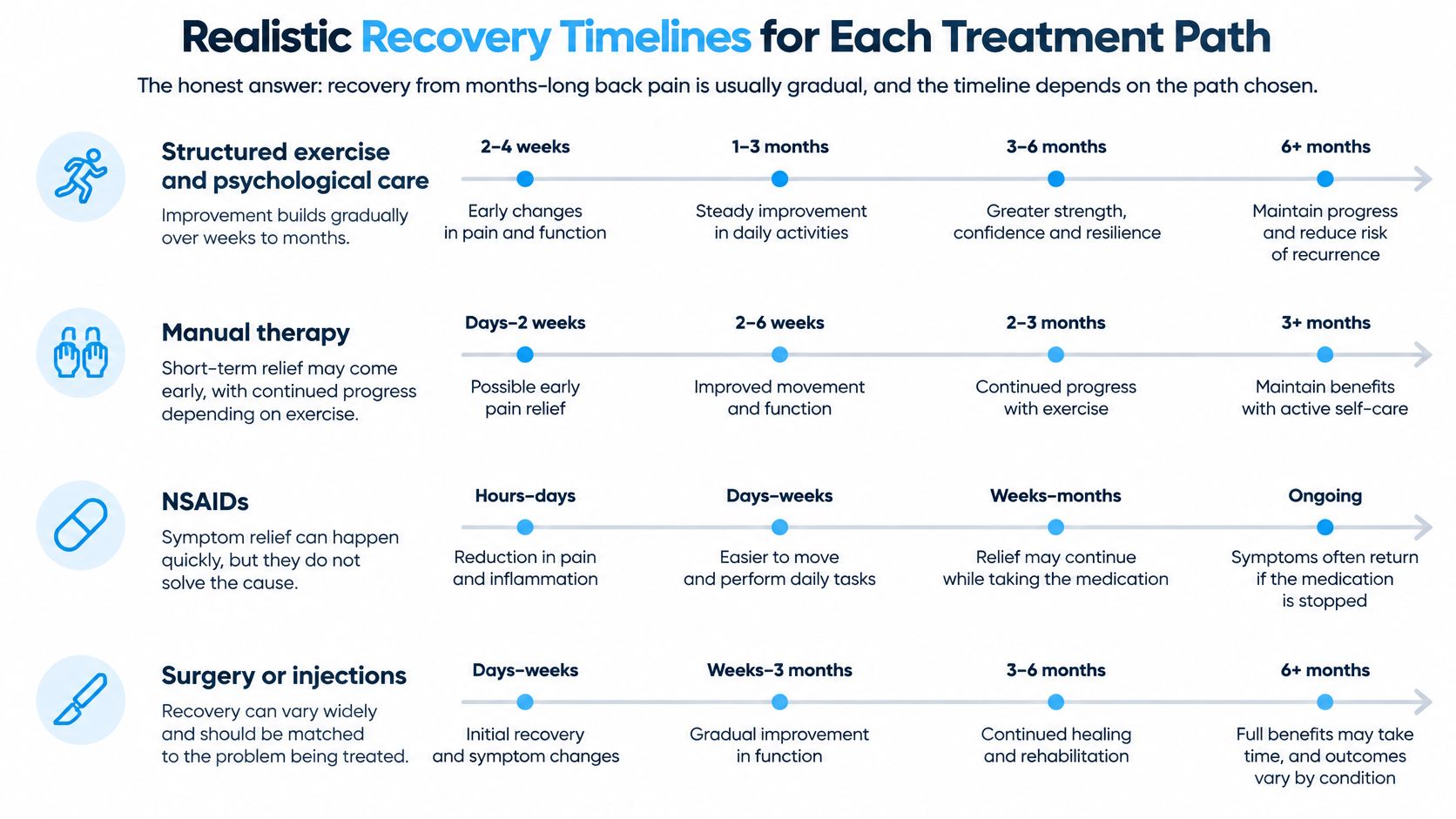
Recovery from months-long back pain is usually gradual, and the timeline depends on which path you take. Anyone offering a fixed date for full resolution is guessing. What you can do is match your expectations to the path, then check your own function against a documented schedule instead of against how you feel on a given morning.
Two things often change first: walking tolerance and sleep. Pain scores tend to lag behind both, which is why a week that feels no better can still be a week of progress.
One limit sits above every timeline in this section. If symptoms worsen at any point, or new nerve or saddle symptoms appear, that calls for urgent review as described in the red-flags section, whatever stage of recovery you are in.
| Treatment path | Early signal | Typical improvement window | Caveat |
|---|---|---|---|
| Structured exercise and psychological therapy | Better walking tolerance and sleep first | 3 to 12 months | Average effects are modest |
| Multidisciplinary rehabilitation | Function and pain improve together | Measured across the review's 3 to 12 month window | Needs consistent attendance and home practice |
| MSC therapy for disc-related lower back pain (Dream Body Clinic protocol) | Nerve relief in days to weeks for many patients | Further gains over 2 to 3 months; full resolution often 3 to 6 months | Results vary and are not guaranteed; worsening or new nerve or saddle symptoms need urgent review |
| Research reference: intradiscal MSC injection (25 million cells per disc, sham-controlled) | Sustained pain and disability reduction at long-term follow-up | Reported at long-term follow-up | Only 24 patients; not generalizable |
| Meta-analysis of MSC therapy for lumbar discogenic pain | Significant pain and Oswestry Disability Index improvement | Assessed after treatment; follow-up varied across included studies | Very high heterogeneity (I-squared 98 percent) |
What the published studies actually show
A 2023 meta-analysis of mesenchymal-cell therapy for lumbar discogenic pain reported a statistically significant pain reduction after treatment, with a mean Visual Analogue Scale difference of 41.62 points and a 95% confidence interval of 24.32 to 58.93. The same analysis found significant improvement in Oswestry Disability Index scores, the standard measure of back-related functional limitation. The caveat is real: heterogeneity was very high, with I-squared at 98%, meaning outcomes varied substantially across studies depending on cell source, dose, injection technique, patient selection, disc severity and follow-up length.
A long-term randomized study of intradiscal MSC injection enrolled 24 patients with symptomatic chronic lumbar degenerative disc disease that had not responded to conservative management. Participants received a single intradiscal injection of 25 million allogeneic bone marrow-derived MSCs per affected disc, or a sham procedure, and the treated group showed sustained reductions in pain and disability. Twenty-four patients is an early signal. It cannot be generalized to everyone with months of back pain, and larger trials are needed to pin down the best dose and which disc patterns respond.
Those we treat typically see meaningful change within three to six months, though some report relief within days or weeks. Track pain, walking distance, sleep and medication use at baseline, six weeks, three months and six months. If nothing functional has changed at three months, that is the trigger for re-evaluation. If symptoms worsen before then, or new nerve or saddle symptoms appear, skip the schedule entirely and get the urgent review described in the red-flags section.
If months of lower back pain have left you weighing options that do not include more waiting, Dream Body Clinic treats herniated discs, degenerative disc disease, facet joint arthritis and sciatica with image-guided mesenchymal stem cell protocols under COFEPRIS oversight in Mexico. Patients from more than 40 countries travel to our Bucerias clinic after conservative care has plateaued, and many report nerve relief within days to weeks before function improves further over two to three months. Visit Dream Body Clinic to send your MRI report and symptom history for a complimentary case review.