
You’ve just received another lab report, and the number that matters most, your eGFR, is moving in the wrong direction. Your nephrologist is discussing medications, blood pressure, diet, dialysis planning, or transplant evaluation, while online searches keep presenting stem cell therapy for kidney failure as a possible regenerative answer. It’s understandable to look for something that might protect the kidney before options become more limited.
The difficult part is separating a biologically plausible treatment from a clinically proven one. Mesenchymal stem cells, often called MSCs, are being studied as a supportive therapy for kidney disease, but they don’t replace a kidney, and they don’t turn into new filtering units. Their proposed role is closer to a repair crew that sends instructions to the tissue already present.
This guide explains that idea in plain language, then examines what human trials have shown, which patients have been studied, and how MSC protocols may fit alongside nephrology care. It also provides a practical framework for discussing candidacy and risk with a qualified medical team, including an individualized review at a clinic such as Dream Body Clinic Kidney Disease Stem Cell Treatment
Table of Contents
- Introduction to Stem Cell Therapy for Kidney Failure
- How MSCs Support Kidneys Through Paracrine Signaling
- What Current Evidence Shows and What It Does Not
- How MSC Protocols Complement Standard Nephrology Care
- Who Is Being Studied and How Candidacy Is Assessed
- Risks Safety Signals and What to Expect From Treatment
- Key Takeaways and Next Steps for Informed Decisions
Introduction to Stem Cell Therapy for Kidney Failure
Consider a patient with chronic kidney disease caused by diabetes. The person may still be working, caring for family, and feeling mostly well, yet repeated laboratory tests show declining kidney function and increasing concern about protein in the urine. Dialysis may not be needed today, but the possibility has become part of every medical conversation.
That situation creates two questions. First, can anything slow or support the remaining kidney function? Second, could a regenerative treatment delay dialysis or make future treatment easier? Those questions are reasonable, but they need careful answers because kidney disease varies by cause, stage, inflammation, scarring, cardiovascular health, and dialysis status.
Standard nephrology care remains the foundation. Blood pressure and diabetes management, kidney-protective medicines, treatment of complications, laboratory monitoring, and preparation for dialysis or transplantation cannot be replaced by an infusion. An MSC protocol may be the way out of eventual dialysis.
The phrase “stem cell therapy kidney failure” can also create confusion because it groups together very different approaches. Research includes MSCs, extracellular vesicles and kidney organoids, with differences in cell source, delivery route, disease cause, and severity. Results from moderate CKD or diabetic kidney disease shouldn’t be presented as though they automatically apply to every person with end-stage renal disease.
The most useful way to think about MSC therapy is as supportive signaling. The cells may release biological messages that influence inflammation, blood-vessel health, oxidative stress, and local repair activity. The MSCs are amazing at guiding the regeneration process.
How MSCs Support Kidneys Through Paracrine Signaling
The central misconception is simple to correct: MSCs don’t differentiate into replacement kidney cells in the way many patients imagine. They aren’t injected into a damaged kidney and expected to become a complete set of new glomeruli, tubules, or blood vessels. Reviews describe MSCs as barely detectable in recovering tissue, and experimental work indicates that direct transformation into injured renal cells isn’t the main explanation for recovery review of MSC mechanisms.
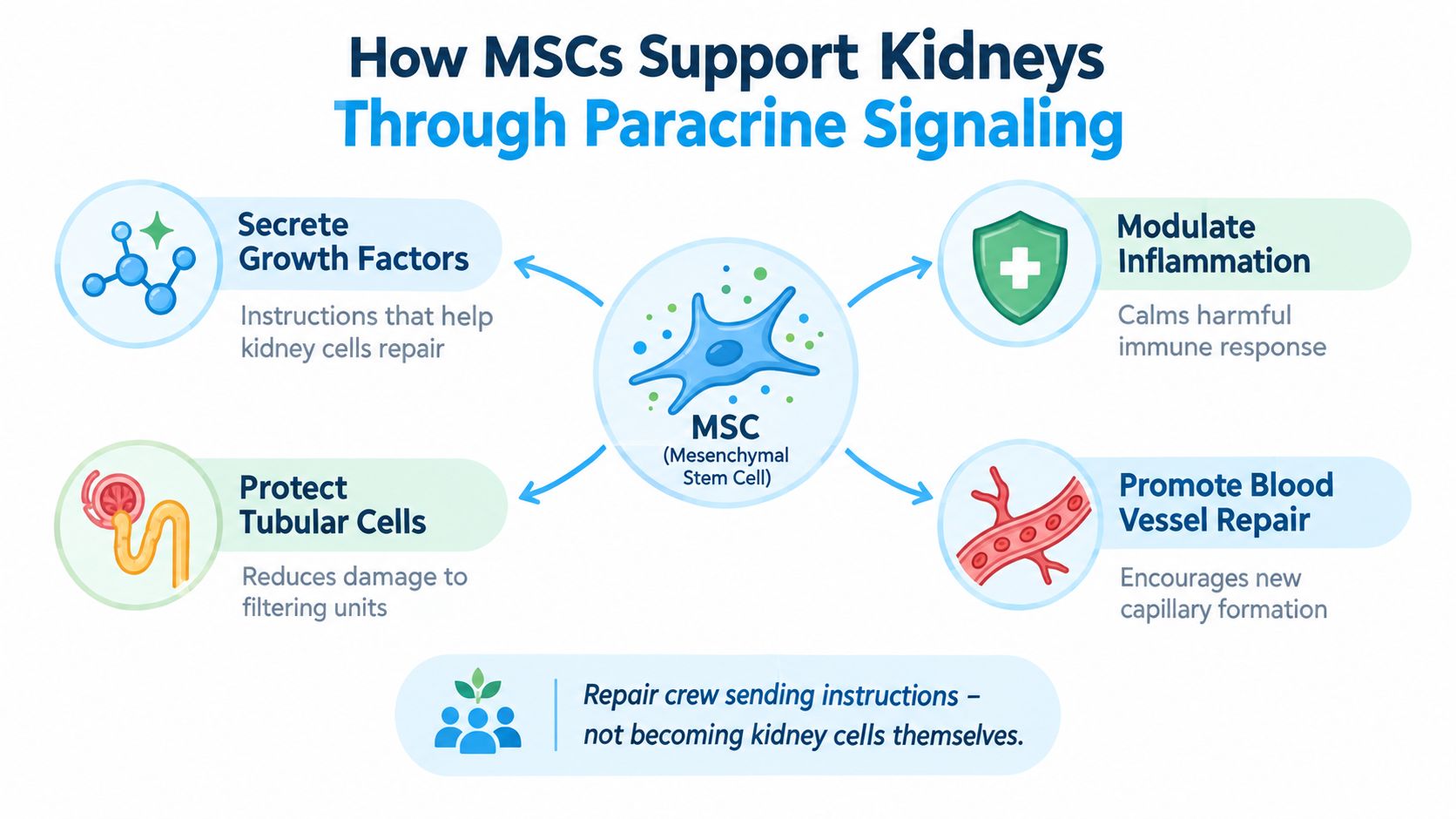
A more accurate analogy is a repair crew arriving at a damaged building. The crew may not become bricks, pipes, or electrical wires. Instead, it assesses the damage, sends instructions, calms dangerous activity, and coordinates the workers already inside the building. In kidney disease, paracrine signaling means that MSCs release specialized signals that influence nearby cells and the surrounding tissue environment.
The signaling process in plain language
The process can be understood in steps:
- MSCs encounter a stressed tissue environment. Kidney injury may involve inflammation, oxidative stress, poor microcirculation, and cell damage.
- They release biological messages. These include growth factors, cytokines, chemokines, and extracellular vesicles or exosomes.
- Those messages influence local behavior. They may activate endogenous repair, moderate excessive immune activity, support blood-vessel health, and limit apoptosis.
- The kidney’s own cells respond. The intended effect is not cell replacement by the MSCs. It is a change in the conditions surrounding the kidney’s remaining viable cells.
A kidney-focused review describes these secreted factors as signals that can activate repair, reduce inflammation and oxidative stress, promote angiogenesis, and limit apoptosis kidney disease review of paracrine mechanisms. Another mechanistic review identifies signaling molecules such as IGF-1, VEGF, hepatocyte growth factor, soluble factors, growth factors, and chemokines as part of the proposed response review of MSC effects in renal pathology.
Why direct engraftment isn’t the main story
If MSCs were acting mainly by becoming kidney cells, researchers would expect substantial, durable incorporation into injured renal structures. Instead, experimental research has associated renoprotection with complex paracrine actions that protect and regenerate damaged vasculature, rather than direct engraftment experimental study of MSC paracrine renoprotection.
That distinction matters for expectations. A signaling-based treatment may support the kidney’s repair environment without rebuilding tissue that has already been permanently replaced by scar. It also means that the effect can depend heavily on disease stage, the cause of injury, the condition of the remaining tissue, and the quality of the cell product and protocol. For readers exploring related mechanisms, this overview of hepatocyte growth factor and MSC support in renal failure provides additional context.
What Current Evidence Shows and What It Does Not
A person with advanced kidney disease may hear that stem cells can help the kidneys repair themselves. The human research is more limited and more specific. A 2026 review found that clinical trials involving MSC therapy increased over the preceding decade, especially in chronic kidney disease and diabetic nephropathy. It also concluded that direct evidence of benefit in end-stage renal disease remains limited, with no clinical trial specifically targeting patients with ESRD receiving long-term dialysis 2026 review of stem cell and bioengineering approaches for ESRD.
Researchers are studying safety, feasibility, dosing, and biological signals in people. These studies have not established that MSC therapy reverses advanced kidney failure or reliably keeps patients off dialysis.
Where the research falls short, Dream Body Clinic picks up the slack. With over 9 years of real world application of MSCs for renal failure we have found that stage 1 and stage 2 renal failure responds incredibly well to our 300 million MSCs IV protocol. About 80% of these patients go into full remission and their kidneys go back to normal function. About 15% see improvement, but probably need another round of treatment 6 months after or later to get back to full function and about 5% are non-responders. At stage 3 renal failure those numbers invert with only about 15% of those patients seeing full renal function restored. At stage 4 we have never seen a patient get back to full renal function with 1 treatment, but we have seen them improve to stage 3. They can then come back again anytime after 6 months for another round and continue improvement. Once a person is on dialysis stem cell therapy won’t help.
What the early clinical signal looked like
A 2022 phase I study enrolled 12 patients with moderate-to-severe CKD and used allogeneic adipose tissue-derived stem cells. It reported no fatal adverse events. An eGFR increase was observed in 7 of 12 subjects, or 58%, at week 24, and in 6 of 12 subjects, or 50%, by week 48 Mayo Clinic report on the phase I CKD study.
Those results provide an early clinical signal, not confirmation of a durable treatment effect. A small phase I study can show that a protocol was tolerated and that kidney measurements changed. It cannot determine how much of that change came from treatment, how long it will persist, whether the result applies to other causes of CKD, or whether patients avoid dialysis or live longer.
The Mayo Clinic trial description shows the same limited purpose. The study assessed safety, tolerability, dosing, and kidney-repair biomarkers for allogeneic adipose-derived MSCs. It was not designed to prove routine reversal of kidney disease Mayo Clinic trial description.
Biomarkers aren’t the same as hard outcomes
eGFR and proteinuria help clinicians track filtration and kidney-barrier injury. Patients also need answers about daily life and long-term treatment:
- Dialysis avoidance: Can treatment delay or prevent kidney replacement therapy?
- Transplant timing: Can it postpone transplantation without unacceptable risk?
- Hospitalization: Can it reduce complications that disrupt daily life?
- Survival and function: Can it improve long-term health and independence?
Recent reviews describe small sample sizes, short follow-up, and uncertainty about lasting effects as important limitations. The current trial situation also includes early-phase and ongoing randomized studies, with some protocols using eGFR change as the primary endpoint instead of dialysis-free survival review of the clinical trial landscape.
The evidence supports careful investigation, not a promise of renal recovery. Disease cause also affects how well findings may apply. A review of MSC research in lupus nephritis illustrates why results from one kidney condition cannot automatically be extended to another.
How MSC Protocols Complement Standard Nephrology Care
Standard nephrology care and MSC supportive protocols address different parts of the problem. Nephrology focuses on controlling the drivers and consequences of kidney disease. MSC research focuses on whether cellular signaling can improve the tissue environment around remaining kidney structures.
A nephrologist may manage blood pressure, diabetes, proteinuria, anemia, fluid balance, mineral disturbances, medication safety, and planning for dialysis or transplantation. Those responsibilities remain central before, during, and after any regenerative consultation.
| Care Aspect | Standard Nephrology Care | MSC Supportive Protocol |
|---|---|---|
| Primary role | Protect remaining function and manage complications | Explore biological support through paracrine signaling |
| Main tools | Medication, laboratory monitoring, nutrition guidance, dialysis or transplant planning | Cell-based infusion or another protocol selected after medical review |
| Treatment target | Blood pressure, glucose, proteinuria, anemia, fluid and electrolyte balance | Inflammation, immune signaling, oxidative stress, vascular support, and repair pathways |
| Monitoring | eGFR, creatinine, urine protein, symptoms, blood pressure, and treatment response | The same kidney monitoring, plus protocol-specific safety and follow-up review |
| Limitation | Cannot always stop progressive structural damage | Doesn’t replace dialysis, transplantation, or disease-specific nephrology treatment in severe cases. |
The approaches work in parallel, not as competing philosophies. For example, a patient may need medication adjustment for blood pressure and diabetes while a clinical team evaluates whether an MSC protocol is medically reasonable. Stopping proven care to pursue an unvalidated intervention could remove the very support that protects kidney function. At Dream Body Clinic we have patients maintain their advised medications and have them slowly come off of medications post treatment as renal function improves.
MSCs are also studied for immune-modulating effects, but “immunomodulatory” shouldn’t be confused with universal suppression of the immune system or guaranteed control of kidney inflammation. The biology depends on the disease context and the signals present in the tissue. This discussion of the immunosuppressive potential of MSCs offers a focused explanation of that distinction.
A practical care plan should define where a patient is at versus where they are going. With the Stem Cell Kidney Disease Treatment we do our best to give realistic expectations based on each patients case. Then we help them monitor their progress after treatment.
Who Is Being Studied and How Candidacy Is Assessed
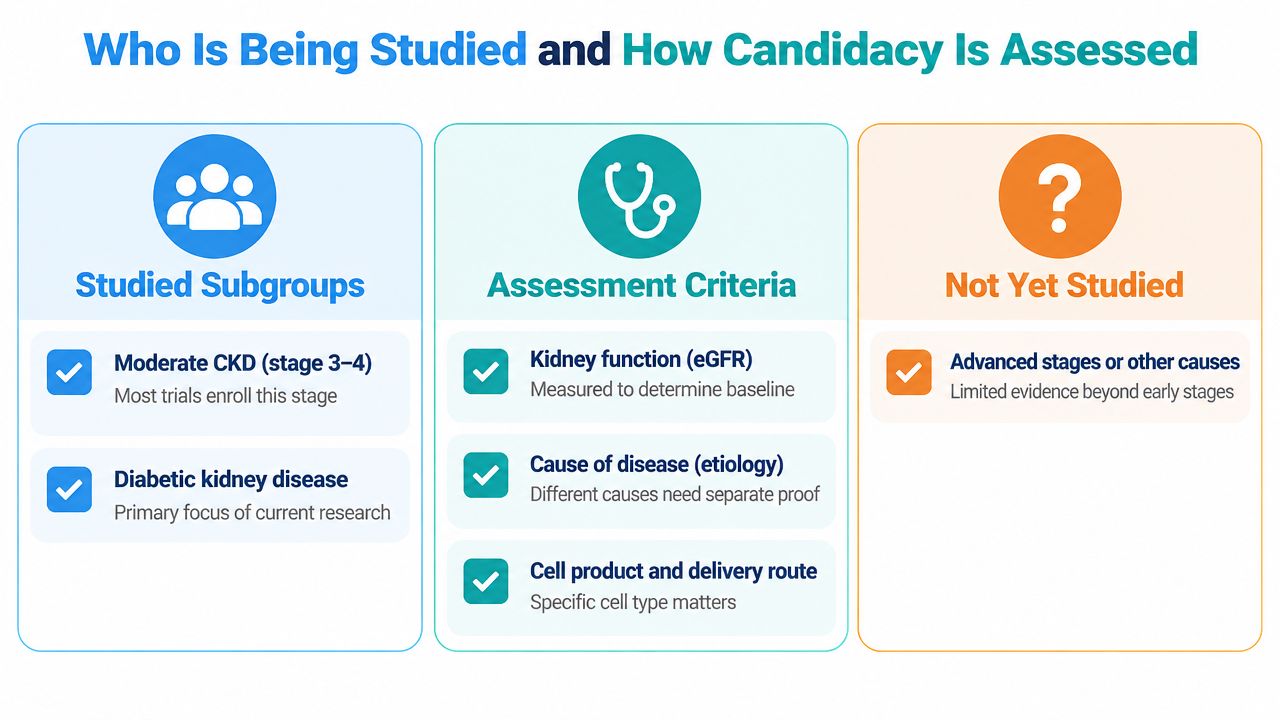
The phrase “kidney failure” covers patients with very different clinical situations. A person with moderate CKD, someone with diabetic kidney disease, and a patient receiving long-term dialysis don’t represent interchangeable study populations. The available evidence is concentrated mainly in moderate CKD and diabetic kidney disease, while applicability to advanced ESRD remains uncertain recent clinical trial listing and kidney disease research context.
We have seen the best results treating stage 1 and 2 renal failure. Stage 3 and 4 renal failure are more difficult, but often worth treating. Once a patient is on dialysis it is too late and MSCs won’t help.
Start with the disease stage
The first question is not “Which stem cell product should I choose?” It’s “What is happening to my kidneys now?” A case review should examine current eGFR, the direction of change over time, creatinine, urine protein or albumin, blood pressure, diabetes control, and complications such as anemia or fluid imbalance.
A single result rarely explains the whole situation. Trends help clinicians distinguish stable disease from active decline, while proteinuria may provide additional information about damage to the kidney’s filtering barrier.
Identify the cause
Etiology matters because diabetic kidney disease, autoimmune disease, vascular injury, inherited conditions, and other causes may involve different biological processes. A promising result in one subgroup shouldn’t be generalized to another without direct evidence.
The treatment details matter too. Like using a high dose IV of MSCs. We have found that doing at least 1.4 million MSCs per pound of body weight in an IV is the ideal dose. This is the point of peak result before diminishing returns. For patients over 150 lbs it is usually a 300 million MSC IV. Doing double the dose doesn’t produce double the results after this point.
Use a candidacy checklist
Bring these questions to a nephrologist and any regenerative medicine team:
- What is my current kidney stage? Ask for the latest eGFR and the trend across previous tests.
- What caused the damage? Clarify whether diabetes, hypertension, autoimmune disease, medication exposure, or another condition is most likely.
- How much protein is in my urine? Proteinuria can help describe ongoing kidney-barrier injury.
- Am I receiving dialysis? If receiving dialysis then stem cell therapy is not advised.
- What is the cell product? Ask about the source, preparation, dose, route, and quality controls. At dream body clinic we lay it all out here – Our Lab
- What happens if the disease progresses? Dialysis and transplant planning should continue when medically indicated.
A responsible review may conclude that treatment isn’t appropriate. That isn’t a failure of the consultation. It means the team has weighed disease stage, comorbidities, infection risk, cancer history, medications, and expectations instead of assuming that one protocol fits every patient. At Dream Body Clinic we always let people know if they are a good candidate or not. We want to treat people that we know we can help.
Risks Safety Signals and What to Expect From Treatment
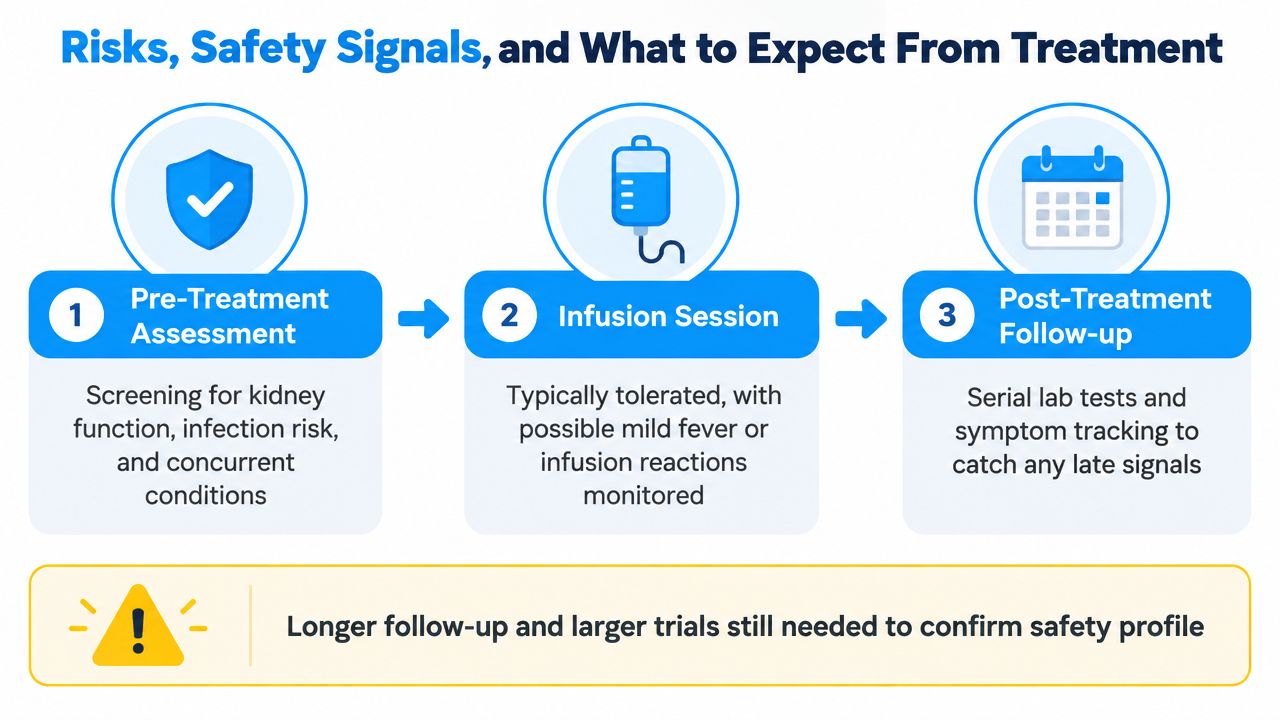
Early MSC studies have generally found acceptable short-term safety and tolerability. We have found that the risks are minimal if proper assessment is done ahead of time. There is a point where kidney health is too deteriorated or other factors deem a patient not a good candidate and we have no problem telling people if they are not a good candidate. For the stem cell IV there is always a risk of infection. We have never had an infection, but any IV treatment carries that risk. We take every precaution to prevent that from happening. A small percentage of IV patients will develop a mild fever the night of treatment. It is rare, but does happen. It is because the immune system detects a large number of something new arriving so it flares up and creating a fever is a great way to stop intruders. The immune system quickly realizes that the MSCs are not an enemy and backs down. A Tylenol can speed this process up and there is no long term risk or danger from it.
Before an infusion
A careful process begins with medical records rather than a sales promise. The clinical team should review kidney function, recent laboratory trends, urine findings, infections, other conditions, medications, dialysis status, and the reason treatment is being considered. These details help determine whether an infusion is reasonable and which risks need attention.
The proposed therapy should also be understood as support through biological signaling, not as a replacement kidney. MSCs are not expected to rebuild a failing organ, and a treatment that appears well tolerated does not necessarily prevent dialysis or produce durable improvement.
Ask who remains responsible for nephrology follow-up. Confirm which laboratory tests will be repeated, how abnormal results will be handled, and whether the protocol includes clear instructions for urgent symptoms.
Follow-up creates the safety picture
Follow-up should track symptoms and laboratory trends instead of relying on how someone feels on a single day. Dream Body Clinic’s stated model includes scheduled remote check-ins at approximately 3, 6, and 12 months, although each patient should confirm the exact monitoring plan during medical review.
A useful follow-up conversation asks:
- Which results matter? Define eGFR, creatinine, proteinuria, blood pressure, and other relevant tests before treatment.
- What counts as benefit? Separate a temporary biomarker change from durable clinical improvement.
- What counts as harm? Establish symptoms and laboratory changes that require immediate contact.
- What remains unchanged? Continue nephrology appointments, medication management, dialysis decisions, and transplant evaluation as needed.
Safety signal: Early tolerability is encouraging, but it does not establish a complete long-term safety profile.
Key Takeaways and Next Steps for Informed Decisions
The most important correction is conceptual. MSCs don’t become new kidney cells and rebuild a failing organ. Their proposed role is paracrine support, meaning they release specialized signals that may influence inflammation, oxidative stress, blood-vessel health, cell survival, and the kidney’s own repair environment.
The next point is practical. Kidney patients need outcomes that matter in daily life and long-term planning, not just a favorable laboratory movement. A serious consultation should discuss whether the intended outcome is stabilization, a change in eGFR, reduced proteinuria, delayed dialysis, transplant timing, fewer hospitalizations, or another clearly defined goal. I
A sensible decision path
- Gather current records. Include nephrology notes, eGFR and creatinine trends, urine protein results, medication lists, imaging, biopsy information if available, and dialysis history.
- Discuss the idea with your nephrologist. Ask whether your disease cause and stage resemble the populations studied.
- Request a transparent case review. Ask about cell source, preparation, route, dose, contraindications, monitoring, costs, and follow-up.
- Protect standard care. Don’t stop prescribed treatment or delay dialysis, transplant evaluation, or urgent medical care because of a regenerative protocol.
- Define success before treatment. Agree on which kidney and quality-of-life measures will be followed, and what will happen if they don’t improve.
Learn all about the Stem Cell Kidney Disease Treatment at Dream Body Clinic Here – Kidney Disease Stem Cell Treatment
Dream Body Clinic provides individualized case reviews for international patients considering MSC-based support for kidney disease within its Mexico-based, COFEPRIS-regulated clinical setting. Visit Dream Body Clinic to review the kidney protocol information, prepare your medical records, and begin a direct conversation about whether an assessment is appropriate alongside ongoing nephrology care.
Call us at (888) 704-3977 or on WhatsApp at +523222321055 for a free consultation