You’re sitting at your desk, or lying in bed, when one arm suddenly seems to beat with its own rhythm. It may feel like a deep throb, a heartbeat under the skin, or a pulse that becomes painful when you focus on it. The first question is usually, “Is this my circulation, my heart, a nerve, or just a muscle?”
Pulsating arm pain is a symptom description, not a diagnosis. It can arise from musculoskeletal tissue, irritated nerves, blood vessels, the heart, or increased awareness of a normal arterial pulse. The safest way to think about it isn’t to search through a long list of causes. Use a decision path: check for emergency signs first, then examine vascular clues, nerve patterns, movement-related features, and the symptom’s persistence.
Table of Contents
- Why Your Arm Feels Like It Is Pulsing
- Checking for Vascular Causes First
- When Arm Pain Signals a Heart Attack or Stroke
- Nerve-Related Causes and Cervical Radiculopathy
- Musculoskeletal Causes and Safe Self-Care
- Regenerative Options for Persistent Arm Pain
- Your Action Plan for Pulsating Arm Pain
Why Your Arm Feels Like It Is Pulsing

A pulse-like sensation can come from different “instruments” producing a similar rhythm. An artery is one instrument, expanding with each heartbeat. A nerve is another, sending irregular electrical messages that the brain may interpret as throbbing, burning, or an electric sensation. A muscle can twitch or tighten repeatedly, creating movement that feels rhythmic even though blood flow is normal.
That distinction matters because the same word, pulsating, can describe both harmless pulse awareness and a problem requiring immediate care. You may notice the radial artery at the wrist more clearly after exercise, caffeine, stress, or lying still. You may also be feeling referred pain from the neck, shoulder, or chest rather than a disorder in the arm itself.
Start with the pattern, not the label
Ask yourself four questions:
- When did it begin? A sudden, severe onset deserves more caution than a mild ache that followed repetitive work.
- What brings it on? Pain during exertion, pain that improves with rest, or pain that appears with breathlessness changes the urgency.
- What else is happening? Numbness, weakness, color change, swelling, sweating, nausea, or lightheadedness can be more informative than the pulsing quality.
- Can the arm function normally? Difficulty gripping, lifting, dressing, or using the hand suggests that the symptom is more than simple awareness of an artery.
Upper-extremity symptoms occur frequently and often fluctuate. In a three-year prospective study of newly hired workers, 72% reported upper-extremity symptoms at least once, while 12% reported persistent symptoms and 27% reported fluctuating symptoms (prospective research on upper-extremity symptoms). That finding doesn’t identify the cause of your pain, but it does explain why symptoms may appear, fade, and return.
The first task isn’t to name the condition. It’s to decide whether the arm is threatened, the heart or brain may be involved, or the symptom can be assessed routinely.
Checking for Vascular Causes First
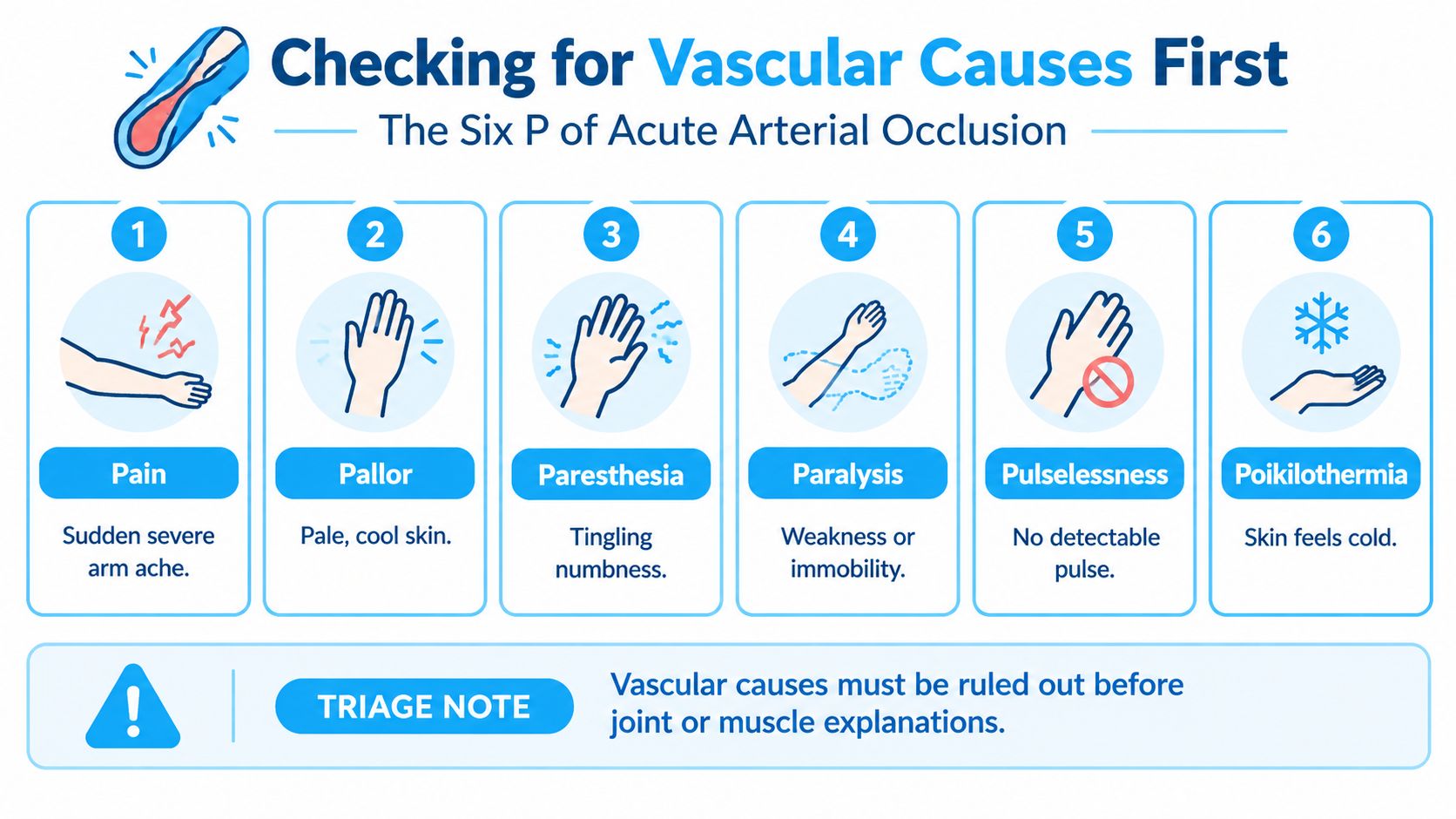
A circulation problem can become dangerous before a muscle or joint problem does, so assess blood flow before assuming that the pain is mechanical. Acute arterial occlusion means that arterial inflow is abruptly reduced or blocked. Without enough oxygenated blood, the tissues, nerves, and muscles below the blockage begin to malfunction.
Clinicians often remember the warning pattern as the six Ps:
- Pain, particularly sudden and severe pain that seems disproportionate to movement.
- Pallor, meaning an arm or hand looks unusually pale compared with the other side.
- Paresthesia, such as tingling, pins and needles, or numbness.
- Paralysis, meaning weakness, loss of coordination, or inability to move normally.
- Pulselessness, when a pulse that is normally detectable becomes weak or absent.
- Poikilothermia, a technical term for an unusually cold limb.
The combination is more concerning than a rhythmic sensation by itself. A cold, pale, numb hand may indicate that arterial blood is no longer reaching the tissues effectively. A new pulse deficit or rapidly developing weakness can signal that nerves and muscles are losing oxygen.
Compare both arms carefully
Place both arms side by side in similar positions. Look at skin color, feel the temperature with the backs of your fingers, and compare any swelling or visible color difference. Press a fingernail or fingertip briefly to observe capillary refill, then compare how quickly color returns on each side. This home check can’t confirm or exclude a vascular disorder, but a clear asymmetry increases the need for urgent assessment.
If you know how to locate a radial pulse at the wrist, compare both sides gently. Don’t keep pressing repeatedly if the pulse is difficult to find, and don’t assume a normal wrist pulse rules out every vascular problem. Medical evaluation may include bilateral blood-pressure measurements, examination of the axillary, brachial, radial, and ulnar pulses, and Doppler assessment when a pulse is diminished (clinical guidance on acute arterial occlusion).
If the arm is suddenly painful, cold, pale, numb, weak, or pulseless, don’t massage it, apply heat, or exercise it. Call emergency services and keep the limb at rest while you wait.
Massage and strenuous movement may seem logical for a tight muscle, but they’re inappropriate when blood flow is compromised. Don’t delay care while trying to stretch, “work out” a cramp, or wait for the color to return. For readers who want to understand how clinicians investigate circulation and cardiac structure, this overview of advanced heart imaging explained provides useful background, but it isn’t a substitute for emergency evaluation of an acutely threatened arm.
Here’s a short educational video that illustrates why vascular symptoms require prompt attention:

When Arm Pain Signals a Heart Attack or Stroke
No chest pain doesn’t automatically make arm pain safe. The American Heart Association recognizes discomfort in one or both arms as a heart-attack symptom, especially when it occurs with chest discomfort, shortness of breath, nausea, sweating, or lightheadedness (American Heart Association emergency guidance).
Think of the cardiac screen as a cluster of symptoms rather than a single sensation. Arm discomfort that begins during exertion, appears with breathlessness, or comes with a cold sweat or faint feeling should not be explained away as a pulled muscle. It may also occur without obvious chest pressure, so the absence of classic chest pain isn’t a reliable safety test.
Use a separate screen for stroke
Stroke symptoms usually announce a sudden loss of neurological function. Check whether one side of the face droops, whether one arm becomes weak or numb, whether speech becomes difficult or confused, or whether there are sudden vision, balance, or coordination changes. A one-sided arm symptom is especially concerning when it appears abruptly.
The two screens answer different questions:
- Heart attack screen: Is there arm discomfort with chest symptoms, breathlessness, nausea, sweating, lightheadedness, or an exertional pattern?
- Stroke screen: Is there sudden one-sided weakness or numbness, facial drooping, speech difficulty, confusion, vision trouble, dizziness, or loss of balance?
If either screen is positive, call emergency services rather than driving yourself or arranging a routine orthopedic visit. Emergency responders can begin assessment while you’re being transported. A practical review of arm pain in cardiac emergencies is available through this resource on ACLS certification with ProMed Certifications, while information about how to heal heart disease or heart damage should be considered educational and not a reason to postpone urgent care.
Sudden symptoms, symptoms during exertion, or symptoms that don’t resolve deserve action, not observation.
A state health fact sheet illustrates why broad recognition isn’t enough. In a survey of adult Tennesseans conducted in 2005, 86.6% identified arm or shoulder pain as a heart-attack symptom, but only 21.5% identified all ten heart-attack and stroke warning signs and recognized calling 911 as the appropriate first response (Tennessee heart-attack and stroke symptom fact sheet). The lesson is practical: knowing that arm pain can matter is different from recognizing the full emergency pattern and acting quickly.
Nerve-Related Causes and Cervical Radiculopathy
Once circulation and emergency cardiac or neurological patterns have been considered, shift your attention from plumbing to wiring. An irritated nerve behaves somewhat like a frayed electrical cable. The cable may carry distorted signals, and the brain may experience those signals as burning, electric, aching, or pulsatile pain even when arterial flow is normal.
Cervical radiculopathy occurs when a nerve root leaving the neck becomes compressed or irritated. A herniated disc or narrowed opening, called a foramen, can affect the root before it travels into the shoulder and arm. The pain may begin near the neck or shoulder blade and follow a particular pathway down the arm, often with tingling, numbness, focal weakness, or altered reflexes.
Match the symptoms to the nerve
A focused examination doesn’t start with an MRI alone. A clinician maps sensation across the arm, tests specific muscle groups, and compares reflexes. The biceps, brachioradialis, and triceps reflexes can provide clues about which nerve-root level may be involved. Strength testing looks for a pattern rather than just asking whether the arm feels sore.
The word dermatomal describes a skin region supplied mainly by a particular nerve root. If pain, altered sensation, weakness, and reflex changes line up along that region, cervical radiculopathy becomes more plausible. If they don’t align, the clinician may consider a peripheral nerve problem, shoulder disorder, or another source.
When imaging helps
MRI is most useful when symptoms continue beyond approximately four to six weeks, when objective neurological deficits progress, or when red flags raise concern for myelopathy, abscess, malignancy, or another serious condition (clinical review of cervical radiculopathy). Electromyography and nerve-conduction studies can help when peripheral neuropathy is an alternative or when examination and MRI findings don’t match.
An image can show disc degeneration in someone who has no pain. That’s why treatment decisions should follow the clinical pattern, not the scan in isolation. . For related neck structures, information on the cervical facet joint may provide additional context, but it shouldn’t be used to self-diagnose.
Musculoskeletal Causes and Safe Self-Care
Muscles, tendons, and joints can create a deep ache that seems to pulse, particularly after repetitive lifting, prolonged computer use, unfamiliar exercise, or sleeping in an awkward position. A tendon may hurt when it is loaded. A tired muscle may twitch. A normal artery may become more noticeable after exertion or caffeine.
The useful comparison is behavioral, not just descriptive:
| Possible pattern | What you may notice |
|---|---|
| Muscle overuse | A sore, localized ache linked to lifting, gripping, or repeated activity. |
| Tendon irritation | Pain with a particular movement or resisted effort, often near the shoulder, elbow, or wrist. |
| Muscle twitching | Brief visible or felt contractions that may come and go while the surrounding tissue remains functional. |
| Pulse awareness | A rhythmic sensation without progressive weakness, color change, or loss of temperature symmetry. |
These patterns can overlap. A rotator cuff problem, for example, may cause upper-arm pain that becomes more noticeable when lying on the affected side. Nerve irritation can also make an ordinary muscle ache feel unusually electric or rhythmic. The pattern over time is more useful than the label you assign during a single episode.
A conservative first response
If emergency signs are absent and the pain clearly follows activity, try relative rest rather than complete immobilization. Reduce the provoking task, use gentle range-of-motion exercises that don’t increase pain, and return to activity gradually. Keep a short log noting the onset, movement triggers, exertion, sleep position, numbness, weakness, swelling, and whether the sensation is changing.
Don’t use home care as an excuse to ignore a worsening pattern. Arrange clinical assessment if the pain lasts beyond a few weeks, becomes more intense, repeatedly wakes you, or interferes with sleeping, dressing, household tasks, work, or normal movement. A resource on rotator cuff popping may help explain one mechanical shoulder pattern, but persistent or function-limiting symptoms still need an examination.
Safe to monitor means mild, improving, activity-linked symptoms with normal color, warmth, strength, and function. It doesn’t mean ignoring symptoms indefinitely.
Regenerative Options for Persistent Arm Pain
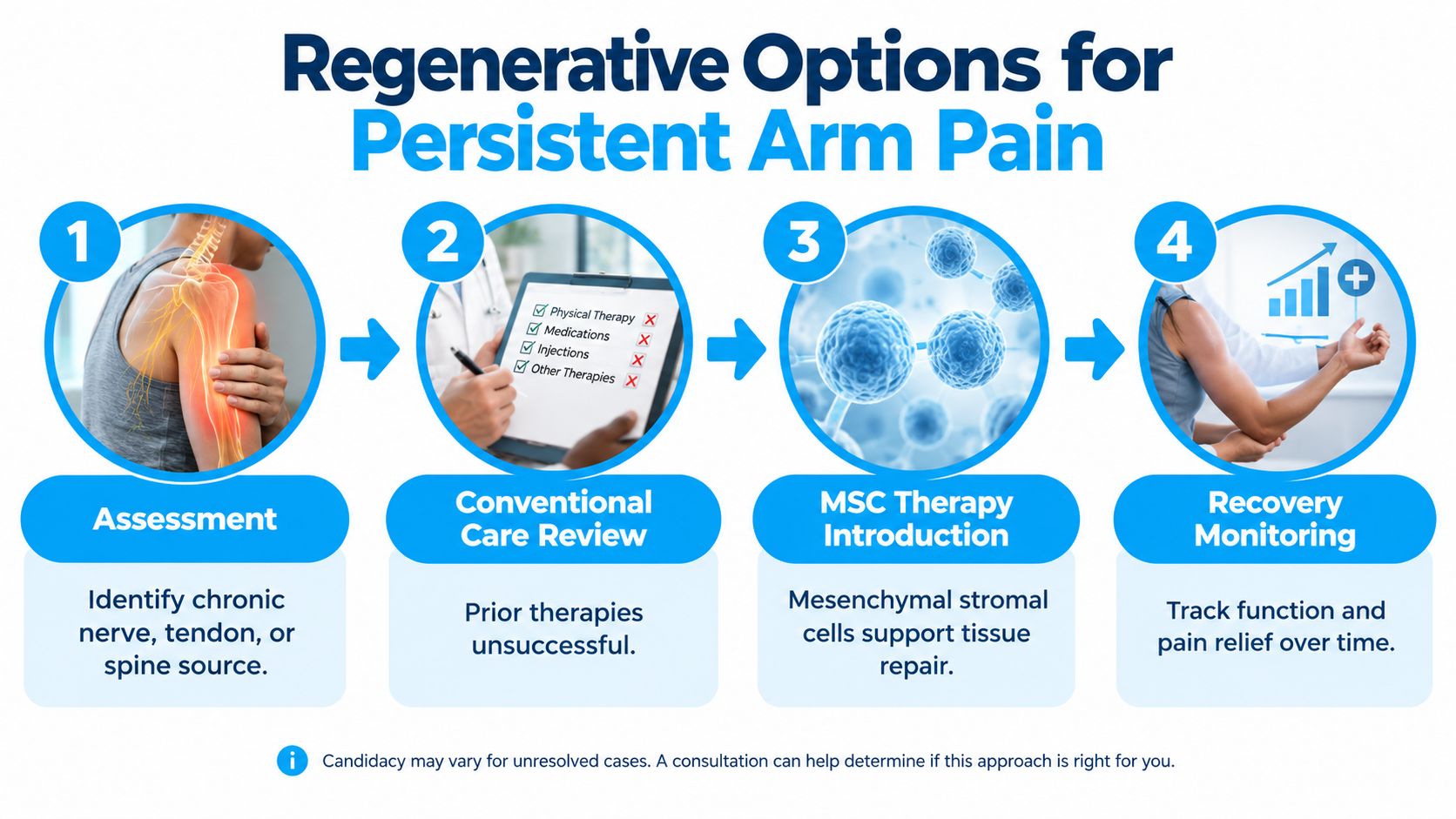
If the throb in your arm is a nerve pattern rather than a vessel or heart warning — pain that tracks down the arm with tingling, numbness, or a grip that fails after the serious causes have been ruled out — the next step is treating the irritated nerve, not only the sensation. Dream Body Clinic’s peripheral neuropathy stem cell treatment uses mesenchymal stem cells, given intravenously and by intrathecal injection, to calm inflammation and support nerve repair and survival through trophic signaling, immune modulation, and remyelination. It is aimed at chronic nerve pain that has not settled with rest and routine care, and it is planned only after a diagnosis. A free consultation can sort whether that approach fits your arm symptoms: call (888) 704-3977 or email info@dreambodyclinic.net, or read the treatment details at https://dreambody.clinic/peripheral-neuropathy-stem-cell-treatment-to-heal-nerve-pain/.
What the paracrine effect means
MSCs can act as temporary signaling centers. They release combinations of cytokines, growth factors, chemokines, hormones, microRNAs, and extracellular vesicles. These signals may influence inflammation, angiogenesis, protection of stressed cells, migration, epithelialization, fibroblast activity, and tissue remodeling (review of MSC paracrine mechanisms).
That model is different from the popular idea that injected cells travel to a damaged area and become new tissue. MSCs are frequently subject to lung sequestration and systemic clearance rather than permanent engraftment, which supports the view that temporary communication may be more important than long-term cell replacement (review of MSC fate and signaling).
The secretome contains multiple signaling components, including indoleamine 2,3-dioxygenase, stromal cell-derived factor 1, prostaglandin E2, interleukin-6, transforming growth factor beta, growth factors, chemokines, and extracellular vesicles. These signals may recruit or influence resident cells, regulate immune activity, support blood-vessel formation, and affect extracellular-matrix production in musculoskeletal repair models (review of the MSC secretome).
Keep expectations precise
One mechanistic review estimates that as much as 80% of the therapeutic effect attributed to adult MSCs may occur through paracrine actions (review of adult MSC therapeutic mechanisms).
A responsible evaluation should identify the pain generator, review prior treatment, consider imaging when appropriate, and define how function and symptoms will be monitored. Any regenerative option should be discussed as an evolving, condition-specific approach. It isn’t a replacement for emergency vascular or cardiac care, appropriate physical therapy, or surgery when those treatments are indicated.
Your Action Plan for Pulsating Arm Pain
Use this sequence today:
- Check both arms. Compare color, warmth, capillary refill, swelling, movement, and pulses. A cold or pale arm, absent pulse, numbness, or new weakness means you should call emergency services now.
- Run the heart and stroke screens. Arm pain with chest pressure, breathlessness, sweating, nausea, faintness, or lightheadedness is an emergency. So is sudden one-sided arm weakness or numbness with facial, speech, vision, or balance changes.
- Record the pattern if no emergency sign exists. Note when the sensation began, what you were doing, whether movement or exertion triggers it, whether rest changes it, and whether numbness or weakness appears.
- Use conservative care only when the pattern is mild and improving. Reduce the provoking activity, maintain gentle movement, and avoid testing the painful arm with heavy exercise.
- Arrange clinical assessment when the symptom persists or function changes. A clinician may recommend physical therapy, neurological testing, vascular assessment, imaging, or a regenerative consultation depending on the identified source.
Most arm symptoms are intermittent and manageable, but “pulsating” alone can’t tell you whether the cause is a muscle, nerve, artery, or heart. The useful skill is knowing what to check first and when to stop monitoring. If warning signs appear, don’t wait for the sensation to become more dramatic.
Peripheral Neuropathy Stem Cell Treatment to Heal Nerve Pain
Dream Body Clinic offers evaluations and regenerative medicine consultations for persistent orthopedic, spine, nerve, and peripheral neuropathy concerns, with treatment delivered in Mexico under COFEPRIS oversight and follow-up for international patients. If your arm pain has been properly assessed and may involve a chronic nerve or soft-tissue source, visit Dream Body Clinic to discuss whether a regenerative approach is appropriate for your situation.
Call us (888) 704-3977 or whatsapp +52 322 232 1055