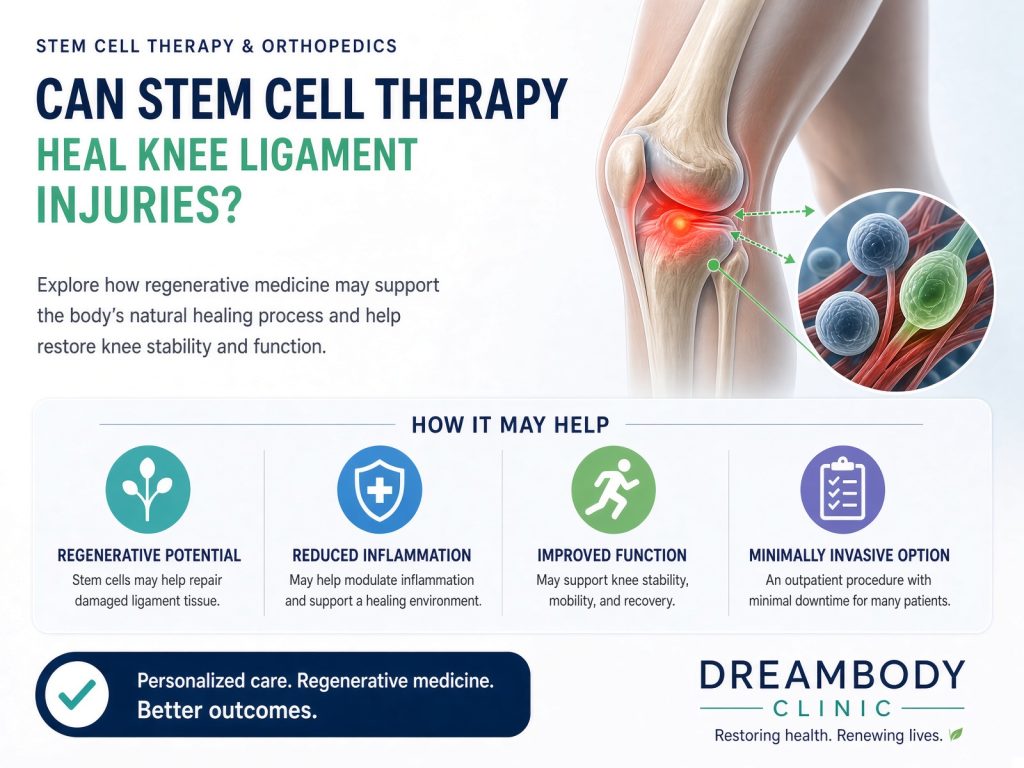
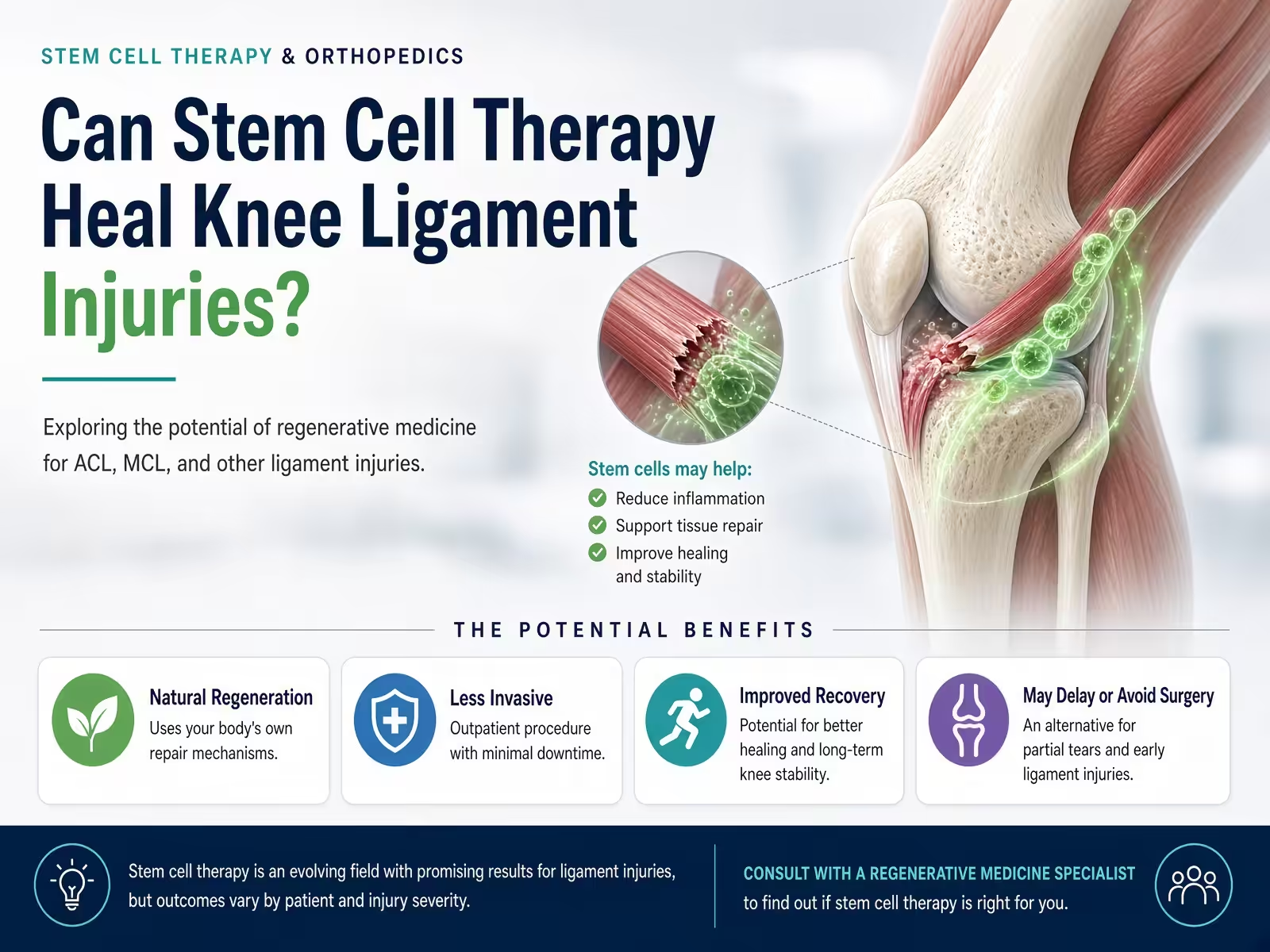
Can Stem Cell Therapy Heal Knee Ligament Injuries?
Knee ligament injuries are among the most painful and frustrating setbacks a person can face. Whether you are an athlete dealing with a torn ACL or an older adult struggling with years of wear on your knee joints, the road to recovery can feel long and uncertain. Many patients ask whether there is a way to heal ligament damage without going through surgery, and stem cell therapy for knee ligament injuries is increasingly becoming a serious answer to that question. At Dream Body Clinic in Puerto Vallarta, Mexico, regenerative medicine is helping patients from across the United States, Canada, and Europe restore knee function and get back to their lives.
Understanding Knee Ligament Injuries and Why They Are Hard to Heal
Why are knee ligament injuries so difficult to recover from? The answer comes down to biology. Unlike muscle tissue, which has a rich blood supply that delivers oxygen and nutrients needed for repair, ligament tissue is relatively avascular. This means it receives very little direct blood flow, which severely limits the body’s natural ability to heal tears or ruptures on its own.
The knee is stabilized by four major ligaments. The anterior cruciate ligament (ACL) and posterior cruciate ligament (PCL) run through the center of the joint and control forward and backward movement. The medial collateral ligament (MCL) and lateral collateral ligament (LCL) run along the inner and outer sides of the knee, protecting against sideways stress. When any one of these ligaments is damaged, the entire stability of the knee is compromised.
Common causes of ligament injuries include sudden pivoting movements in sport, direct impacts to the knee, awkward landings from jumps, and years of repetitive stress that slowly degrade tissue quality. Athletes are frequently affected, but so are older adults whose ligaments have naturally weakened over time. A study published in the American Journal of Sports Medicine noted that ACL injuries alone affect approximately 200,000 Americans each year, with reconstruction surgery being the most common intervention recommended.
Standard treatments like bracing, physiotherapy, and anti-inflammatory medication can help with mild sprains. For moderate-to-severe tears, however, these approaches often provide limited relief without actually repairing the underlying tissue damage. Surgery can restore mechanical stability, but it comes with a lengthy recovery, potential complications, and no guarantee of returning to full function. This is precisely why regenerative medicine is drawing so much attention as an alternative path.
What Is Stem Cell Therapy and How Does It Work for Ligament Repair?
Can stem cells actually repair a damaged knee ligament? The short answer is yes, at least for a meaningful portion of patients, and the science behind it is compelling. Stem cell therapy works by introducing cells with the ability to become specialized tissue types directly into the area of injury, triggering a biological repair process the body cannot achieve on its own.
Mesenchymal stem cells (MSCs) are the most widely used type in orthopedic regenerative medicine. These cells are derived from sources such as bone marrow or umbilical cord tissue and are known for their ability to differentiate into connective tissue cells, including the fibroblasts responsible for producing collagen in ligaments. When introduced into a damaged ligament environment, MSCs begin signaling the surrounding tissue to start a coordinated repair response.
Beyond their ability to become new tissue, MSCs also release powerful anti-inflammatory molecules that reduce swelling, calm immune overreaction, and create conditions more favorable to healing. Many patients experience noticeable pain reduction in the weeks following treatment, even before full tissue remodeling has occurred. This anti-inflammatory effect is one of the key reasons regenerative medicine for ligament damage is gaining traction in sports medicine and orthopedic research.
At Dream Body Clinic, stem cell therapy is combined with Human Growth Hormone (HGH) to create a more complete recovery protocol. HGH plays a significant role in tissue regeneration by stimulating cell growth, supporting collagen synthesis, and improving the overall repair environment in connective tissue. This combination approach is central to the clinic’s treatment philosophy and sets it apart from clinics that offer stem cells alone.
You can learn more about the full protocol on the Dream Body Clinic Stem Cell Knee Treatment page.
What Makes Mesenchymal Stem Cells Effective for Ligament Tissue?
MSCs are particularly well suited to ligament repair because of how they behave within the specific biological environment of connective tissue. When injected near or into a damaged ligament, they respond to local chemical signals called cytokines and begin a process of paracrine signaling, essentially sending messages to neighboring cells to activate repair functions.
One of the most critical actions MSCs perform is stimulating the remodeling of the extracellular matrix, the structural scaffolding that gives ligaments their tensile strength. They promote the secretion of growth factors including transforming growth factor-beta (TGF-β) and vascular endothelial growth factor (VEGF), both of which are essential for rebuilding collagen fiber networks and improving blood flow to ligament tissue. Research published in the journal Stem Cells Translational Medicine has shown that MSC treatment in ligament injuries can significantly increase collagen deposition and improve tissue organization compared to untreated controls. This cellular communication and matrix remodeling process is at the heart of why MSC-based therapy offers real, measurable biological repair rather than just symptomatic relief.
The Dream Body Clinic Approach to Knee Ligament Treatment
What does getting stem cell therapy at Dream Body Clinic actually look like? The clinic has built a structured, patient-centered journey that begins long before you board your flight to Puerto Vallarta and continues well after your treatment is complete.
The process starts with an initial consultation where the medical team reviews your diagnostic imaging, injury history, and overall health profile. MRI results and clinical assessments help the team determine the severity of your ligament damage and whether stem cell therapy is the right course of action for your specific situation. This evaluation is thorough because not every patient has the same injury, and the treatment needs to match the individual.
Once eligibility is confirmed, a customized protocol is built around your needs. This typically involves a carefully calculated dose of mesenchymal stem cells administered via targeted injection, combined with an HGH regimen designed to support tissue repair at a hormonal level. The combination is not accidental. Dream Body Clinic has developed this integrated approach based on clinical outcomes observed across a wide patient population seeking non-surgical knee ligament treatment.
Safety is a non-negotiable priority at Dream Body Clinic. The facility follows sterile processing standards, operates under internationally recognized clinical protocols, and uses cells prepared in controlled laboratory environments. Patients receive full transparency about the procedure, the science behind it, and what they can realistically expect.
After treatment, patients do not simply go home and wait. Dream Body Clinic provides post-treatment follow-up support and rehabilitation guidance to help the body get the most out of the therapy. Recovery is an active process, and the clinic’s team is accessible throughout it.
Can Stem Cell Therapy Replace Knee Ligament Surgery?
Many patients ask whether stem cell therapy can truly replace surgery, and the honest answer is: it depends on the injury. For a significant number of patients, particularly those with partial ligament tears, regenerative medicine offers a genuine non-surgical path to recovery. For complete ruptures where the ligament has fully separated, surgical reconstruction may still be the most appropriate first option, though stem cells can play a powerful supporting role in post-surgical healing as well.
Clinical findings published in journals including the Orthopaedic Journal of Sports Medicine and the American Journal of Sports Medicine have shown that MSC-based interventions in partial ACL and MCL tears produce meaningful improvements in pain, stability, and tissue quality. These findings support the use of regenerative therapy as a primary treatment for the right type of patient with the right type of injury.
The profiles most likely to benefit from ACL repair with stem cells or broader ligament regeneration include competitive and recreational athletes with partial tears who want to avoid long surgical recovery periods, older adults dealing with degenerative ligament damage that has developed gradually over years, and patients who have already tried conservative treatments without adequate results. Many of these patients have found that stem cell knee treatment in Puerto Vallarta provides the outcome they were unable to achieve through conventional medicine at home.
It is worth understanding that the distinction between a partial and complete tear is critical. A partial tear leaves some intact tissue that stem cells can anchor to and build upon. A complete rupture removes that foundation. This is why the diagnostic evaluation at Dream Body Clinic is so important before any treatment decision is made.
Key Takeaway: Stem cell therapy is a clinically supported option for partial ligament tears and degenerative ligament conditions. It is most effective when applied to the right patient at the right stage of injury, and Dream Body Clinic’s evaluation process ensures treatment is only recommended when it is genuinely appropriate.
What Results Can Patients Realistically Expect?
A common concern among patients considering stem cell therapy is how long it will take before they feel better. Recovery does not happen overnight, but the timeline is often faster and more comfortable than post-surgical rehabilitation.
In the first two to six weeks, many patients report a noticeable reduction in swelling and pain as the anti-inflammatory effects of MSCs take hold. This is the early symptom relief phase, and it is often what gives patients the first real sense that the treatment is working. Between weeks six and twelve, the biological remodeling process intensifies as stem cells continue differentiating and collagen networks begin to reorganize within the ligament structure. By three to six months, many patients begin experiencing meaningful improvements in joint stability and functional strength.
Realistic outcomes depend on several variables: how severe the injury is, how long ago it occurred, the patient’s age, overall health, and how consistently they follow rehabilitation guidance. Younger patients with recent partial tears tend to see the strongest outcomes, though older patients with degenerative damage also report significant quality-of-life improvements. Follow-up imaging at three and six months allows the medical team to assess tissue changes and adjust rehabilitation plans accordingly.
Why International Patients Choose Dream Body Clinic for Knee Treatments
Why do patients fly to Puerto Vallarta for stem cell therapy when there are clinics closer to home? The reasons are both practical and clinical. Puerto Vallarta is a well-connected city with direct flights from major North American hubs including Los Angeles, Houston, Dallas, Chicago, Toronto, and several Canadian cities. Traveling for treatment is genuinely straightforward, and the city offers a comfortable, welcoming environment for patients recovering in the days after their procedure.
Cost is also a significant factor. Knee ligament surgery in the United States can cost anywhere from $20,000 to $50,000 or more when you account for surgical fees, anesthesia, hospital stays, and post-op physical therapy. Stem cell therapy for knee ligament injuries at Dream Body Clinic is available at a fraction of that cost without any reduction in clinical quality. For many patients, the financial reality of American healthcare makes international regenerative medicine not just an option but a genuinely smarter choice.
Patient experiences shared through the Dream Body Clinic community consistently highlight improvements in mobility, reductions in chronic knee pain, and the ability to return to activities that had been off-limits for months or years. Many patients describe the experience as life-changing, not just because of the treatment outcome but because of the education and support they received throughout the process. The clinic prioritizes making sure every patient understands what is happening to their body, why the treatment works the way it does, and what they need to do to support their own healing.
The founders of Dream Body Clinic are also the bestselling authors of The Ultimate Guide to Stem Cell Therapy, a comprehensive resource that has helped thousands of patients and medical professionals better understand regenerative medicine. This level of expertise and commitment to public education is one of the clearest indicators of the clinic’s standing as a trusted authority in the field.
Who Is a Good Candidate for Stem Cell Therapy for Knee Ligament Injuries?
Not every patient with a knee ligament injury is the right candidate for stem cell therapy, and Dream Body Clinic is transparent about this. The goal is never to push treatment but to find the patients for whom it will genuinely make a difference.
Strong candidates typically share a few common characteristics. They have a confirmed partial tear or degenerative ligament condition based on MRI or clinical evaluation. They are in reasonably good general health, without active infections or untreated conditions that could interfere with cellular response. Non-smokers tend to respond better because smoking reduces blood flow and impairs the healing environment that stem cells need to work effectively. Patients with manageable body weight also see better outcomes, as excess mechanical load on the knee can counteract the repair process.
Prior treatment history matters too. Patients who have already tried physical therapy and conservative management without success are often good candidates because it confirms the injury is not resolving on its own. Patients with no prior treatment may also qualify, particularly if the severity of their injury makes it clear that conservative care alone will not be sufficient.
Dream Body Clinic conducts a thorough individualized assessment for every prospective patient. This is not a one-size-fits-all clinic. The treatment protocol is built around your specific injury, your biology, and your goals. That personalized approach is what makes the outcomes consistent and the patient experience genuinely supportive.
Frequently Asked Questions
Can stem cell therapy fully repair a torn ACL without surgery?
Stem cell therapy can repair partial ACL tears without surgery in many cases, and clinical evidence supports this as a legitimate treatment approach. For complete ACL ruptures where the ligament has fully separated, surgical reconstruction is often still recommended as the primary intervention. However, stem cells can be used post-surgically to accelerate tissue healing and improve the quality of the repair. Dream Body Clinic evaluates each case individually to determine whether a non-surgical approach is appropriate based on MRI findings and injury history.
How long does recovery take after stem cell treatment for a knee ligament injury?
Most patients begin to notice reduced pain and swelling within the first two to six weeks after treatment as the anti-inflammatory effects of mesenchymal stem cells take hold. Tissue remodeling, where the actual ligament fibers are being repaired and reorganized, progresses over three to six months. Full functional recovery, including a return to sport or demanding physical activity, typically occurs between four and nine months depending on the severity of the injury and the patient’s commitment to rehabilitation. Follow-up imaging at three and six months helps track progress accurately.
Is stem cell therapy for knee ligament injuries safe?
Yes, when performed by experienced clinicians in a properly equipped facility, stem cell therapy for knee ligament injuries has a strong safety profile. Mesenchymal stem cells derived from umbilical cord tissue are widely used because they are immunologically tolerant, meaning the body is unlikely to reject them. Dream Body Clinic follows strict sterile protocols and internationally accepted clinical standards. Patients are fully screened before treatment to ensure they are appropriate candidates, which further reduces the risk of adverse outcomes.
How does combining stem cell therapy with HGH improve ligament healing?
Human Growth Hormone supports tissue regeneration by stimulating cell growth, encouraging collagen production, and improving the hormonal environment that connective tissue needs to repair itself effectively. When combined with stem cell therapy, HGH essentially amplifies the repair signals that MSCs are already sending. The result is a more complete biological response, faster tissue remodeling, and better long-term structural outcomes than stem cells alone can typically achieve. This combination protocol is a defining feature of Dream Body Clinic’s approach to knee ligament treatment.
What types of knee ligament injuries respond best to regenerative treatment?
Partial tears of the ACL, MCL, and LCL respond particularly well to regenerative medicine. Degenerative ligament conditions, where tissue quality has declined gradually due to age or overuse, also show strong outcomes with stem cell therapy. Complete ligament ruptures are more complex and may still require surgical intervention as the primary treatment, though regenerative therapy plays a meaningful supportive role in recovery. PCL injuries, which are less common, are also being successfully treated with regenerative approaches in appropriate cases.
How many stem cell therapy sessions are needed for a knee ligament injury?
For most patients, a single treatment session at Dream Body Clinic is sufficient to initiate the healing process. The protocol is designed to deliver a therapeutic dose of mesenchymal stem cells in one targeted session, combined with HGH support over the following weeks. In some cases, particularly where ligament damage is extensive or the patient has other contributing joint issues, a follow-up session may be recommended after the initial tissue remodeling phase. This is assessed on a case-by-case basis during the consultation and follow-up evaluations.
Does Dream Body Clinic treat international patients with knee ligament injuries?
Yes, Dream Body Clinic is specifically built to serve international patients. The majority of its patients travel from the United States, Canada, and Europe to receive treatment in Puerto Vallarta, Mexico. The clinic’s team manages the full patient journey including pre-travel consultation, treatment scheduling, accommodation guidance, and post-treatment remote follow-up. Puerto Vallarta is easily accessible from most major North American cities, making the logistics of medical travel straightforward for most patients.
The Stem Cell Knee Treatment
If you are living with knee ligament damage and want to understand whether stem cell therapy is the right path for you, the best place to start is a direct conversation with the Dream Body Clinic team. You can review the full details of the protocol and patient journey at dreambody.clinic/stem-cell-knee-treatment.
Call us for a free consultation at (888) 704-3977 or reach us on WhatsApp at +523222321055. The team is ready to answer your questions, review your imaging, and help you make a fully informed decision about your knee health.