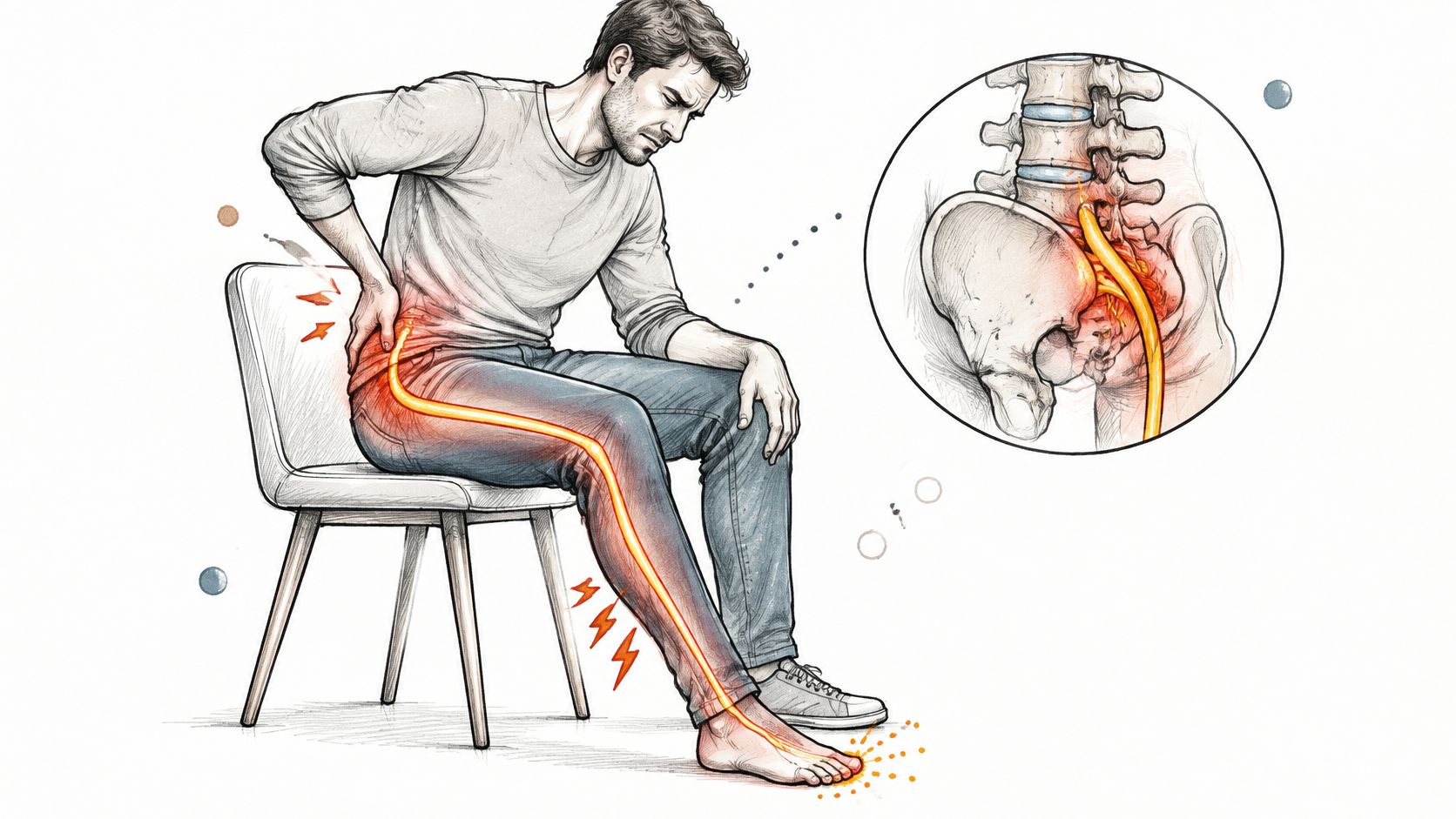
Knee replacement is generally considered when persistent pain and loss of daily function remain after at least three months of non-surgical care, not because an X-ray shows arthritis alone. The evidence that tips the decision is functional: what you've stopped doing, how often pain wakes you at night, and whether your knee responded to exercise, weight management and pain relief.
So why do so many people arrive at a consultation holding a radiology report and a grade from a staging scale, already convinced the picture has settled the question? Because a film is easy to point at, and a life is harder to describe in a ten-minute appointment. The honest answer to when is knee replacement necessary rarely fits on a single line, and it almost never hangs on how impressive the damage looks.
The gap between what an image shows and what your week feels like is where the decision lives. Closing that gap takes a set of checks read together, a clear record of what's already been tried, and a plain understanding of what each option can and can't deliver.
Table of Contents
- Signs That Make Knee Replacement Necessary
- Non-Surgical Options Compared Side by Side
- What Regenerative Injections Can and Cannot Do
- Recovery and Outcomes Across Each Path
- Matching Your Situation to the Right Path
- Get an Assessment Before Choosing Surgery or Injections
Signs That Make Knee Replacement Necessary
How do you tell a worn knee that still works from one that has stopped earning its keep? Surgeons answer that by stacking several signals, not by reading a single film.
The American Academy of Orthopaedic Surgeons describes a typical candidate as someone with severe pain or stiffness that limits walking, climbing stairs, or rising from a chair. Some people cannot walk more than a few blocks without substantial pain. Some need a cane or walker. Rest pain counts too: moderate or severe pain by day or at night, swelling that does not settle with rest or medicine, and a visible bow-legged or knock-kneed deformity all point the same way.
That guidance is also clear that surgery is usually considered only after conservative options have failed to deliver substantial improvement. Those options include anti-inflammatory medicines, injections, physical therapy, activity changes, and, where appropriate, earlier procedures. An implant becomes reasonable when the expected gain in pain and function outweighs the surgical risk and the recovery burden, because daily disability has become unacceptable.
The checks clinicians read together
No single row decides the case. Read together, these checks show whether the joint has stopped carrying its share of ordinary life. They work like warning lights on a dashboard: one light is a prompt to look closer, and several lights on at once change the plan.
| Criterion | Signal that points toward surgery | What it cannot prove alone |
|---|---|---|
| Pain at rest or at night | Pain wakes you or persists while sitting or lying | Can come from causes other than arthritis, so examine first |
| Walking distance | Pain limits walking to about three blocks | Depends on general health and personal goals |
| Mobility aids | A cane or walker is needed for daily walking | Ask whether aid use is recent or long established |
| Stairs and rising from a chair | Pain or instability on stairs or standing up | Can improve with a strength program |
| Swelling | Persistent swelling despite rest or medication | Needs checking for fluid build-up or infection |
| Deformity | Visible bow-legged or knock-kneed alignment | Must be confirmed on examination and imaging |
| Non-surgical care | Little relief after at least 3 months of exercise, weight management and pain relief | Time alone is not a decision rule |
| Imaging | Joint damage that matches the symptoms | Severe X-ray damage with mild symptoms may not need surgery |
The third column is where confusion usually starts. Night pain might be arthritis, or bursitis, a nerve problem, or pain referred from the spine. A cane shows that something changed. A stick that appeared last month means something different from one that has stood by the door for three years.
Each non-surgical step has a point where it stops being enough. Exercise and weight management are the base. If a full season of strength work still leaves stairs unmanageable, that base has done what it can. Anti-inflammatory tablets and activity changes come next. If pain still wakes you after a fair trial, symptom control no longer matches the problem. An injection that quiets a flare for days, then lets the same pattern return, has shown its limit. The question then shifts from another round of the same care to whether replacing the worn surface now offers more than another delay.
Why the X-ray gets too much credit
Adults should receive core non-surgical treatments for at least 3 months before referral for possible joint surgery, according to NICE guidance. The same guidance recommends considering referral when knee osteoarthritis causes significant pain, stiffness, or reduced function, and when therapeutic exercise, weight management, and pain relief are ineffective or unsuitable.
Two findings from that evidence review matter more than any staging grade. A longer duration of symptoms was not clearly associated with needing a joint replacement. Failure to respond to analgesics may be the more relevant signal. Scoring tools follow the same logic. The Oxford Knee Score or KOOS should not independently determine eligibility, because on their own they are unlikely to identify who should have surgery.
Knowing which of the knee arthritis stages your imaging shows explains why the joint behaves as it does. It makes a poor calendar. Damage on a film describes what already happened. Your function describes what is happening now.
A knee that looks terrible but carries you through a normal day is not an emergency. A knee that looks moderate but has taken your sleep, your shifts, and your stairs is the one that needs a specialist opinion.
Two knees, same grade, different answers
Severe imaging, comfortable life. A 68-year-old retiree has marked joint-space loss and bone spurs on the X-ray. She walks 40 minutes on flat ground, uses the handrail on stairs, and gets an ache after an hour of gardening that settles with paracetamol and a rest. Nothing in that picture demands an implant today. The sensible plan is to keep the strength work going, review pain relief, and set a review date rather than a surgery date.
Moderate imaging, unmanageable life. A 59-year-old nurse has moderate narrowing. She wakes twice a night, has cut her shifts, dreads the stairs at work, and 12 weeks of physiotherapy plus anti-inflammatory tablets have not changed the pattern. Her films look less dramatic than the first patient's. She is the one who needs an orthopedic assessment.
If part of the joint surface is still intact, surgeons sometimes discuss partial resurfacing rather than a full implant, and you can ask how recovery and suitability compare. The differences between knee resurfacing with Thermo Recovery Wear set out how the two procedures compare and what each recovery involves.
Keep a symptom log for three to four weeks before any appointment. Record:
- Pain scores at rest and on activity, one number a day, same time of day.
- Longest comfortable walk, in minutes or blocks, not in vague terms.
- Nights disturbed by knee pain, counted rather than remembered.
- Stair difficulty, and whether a handrail has become essential.
- Medicines used, dose, and whether the pain responded at all.
That log turns a bad week into a record a clinician can compare week to week. It also stops the appointment from being decided by whichever symptom you mention first. Necessary means the gain in pain and function you can reasonably expect outweighs the surgical risk and the months of rehabilitation. The comparison is about what you have lost, and about care that has already failed, not about how dramatic the joint looks.
Non-Surgical Options Compared Side by Side
It is often framed as a binary choice, an implant or nothing. In practice there are seven routes between those two points, and clinicians usually work through them in order rather than picking one at random.
Knee pain options compared by role, timing and fit
| Option | Role in care | Time to judge response | Best fit |
|---|---|---|---|
| Exercise and physiotherapy | Core treatment at every stage | About 3 months before referral | Mild to moderate pain; the first step |
| Weight management | Reduces joint load where weight adds to symptoms | Several months | Overweight patients with knee pain |
| Oral pain relief | Short-term symptom control under clinician advice | Days to a few weeks | Pain that stops responding is a referral signal |
| Corticosteroid injection | Temporary relief of a flare | Days to a few weeks | Flares; does not change joint structure |
| PRP injection | Adjunct for pain and function in some protocols | Several weeks to months | Evidence is mixed and protocol dependent |
| MSC injection | Symptom and function support for arthritis and some meniscal or ligament injuries | Several weeks to months | Patients who fit the criteria and want to defer surgery |
| Total knee replacement | Replaces the damaged joint surface | Weeks to months of rehabilitation | Severe, persistent symptoms after failed conservative care |
The first four options carry most patients through their first year. Exercise and physiotherapy is core treatment at every stage, and a supervised program deserves about three months before you judge it. It stops being enough when pain returns in the days after each session, or when the strength you've built no longer translates into easier walking. Weight management matters where body weight adds load through the joint, works over several months, and belongs inside treatment rather than being treated as a precondition for it.
Oral pain relief is short-term control taken on clinical advice, and its ceiling is informative. Once pain stops responding to it, that non-response is itself a finding worth handing to a specialist. Corticosteroid injection quiets a flare within days and holds for weeks to a few weeks for many people; it's a bridge across a bad month, not a change to the joint's structure. PRP works as an adjunct in some protocols, and results depend on preparation and patient selection. MSC injection supports symptoms and function in arthritis and some meniscal or ligament injuries, with benefit judged over weeks to months rather than days.
Every one of these earns its place only if it moves a goal you can name, which is why knee arthritis pain treatment planning starts with sleep, walking distance, work and stairs rather than with a single test result.
Guidance is clear that knee replacement isn't a first-line treatment for mild or moderate osteoarthritis. It's considered mainly when pain or impaired function substantially reduces quality of life despite an adequate trial of exercise, education, weight management and appropriate medication, as the German S3 osteoarthritis guideline describes.
The referral triggers patients rarely hear spelled out are practical: pain that prevents sleep, pain that limits walking to roughly three blocks, or pain that stops you working, particularly after conservative care has failed. Shared decision-making then compares expected gains in pain and function against surgical risk, rehabilitation demands, implant longevity and whether you're willing to have surgery now. For international patients, travel for follow-up and recovery support at home can change what "now" means.
Options get sequenced, not chosen once and forever. Each row above is a fit for a situation, and the situation can change twice in a year.
What Regenerative Injections Can and Cannot Do
Can an injection still help a knee that looks bad on film, and when does it stop being enough?
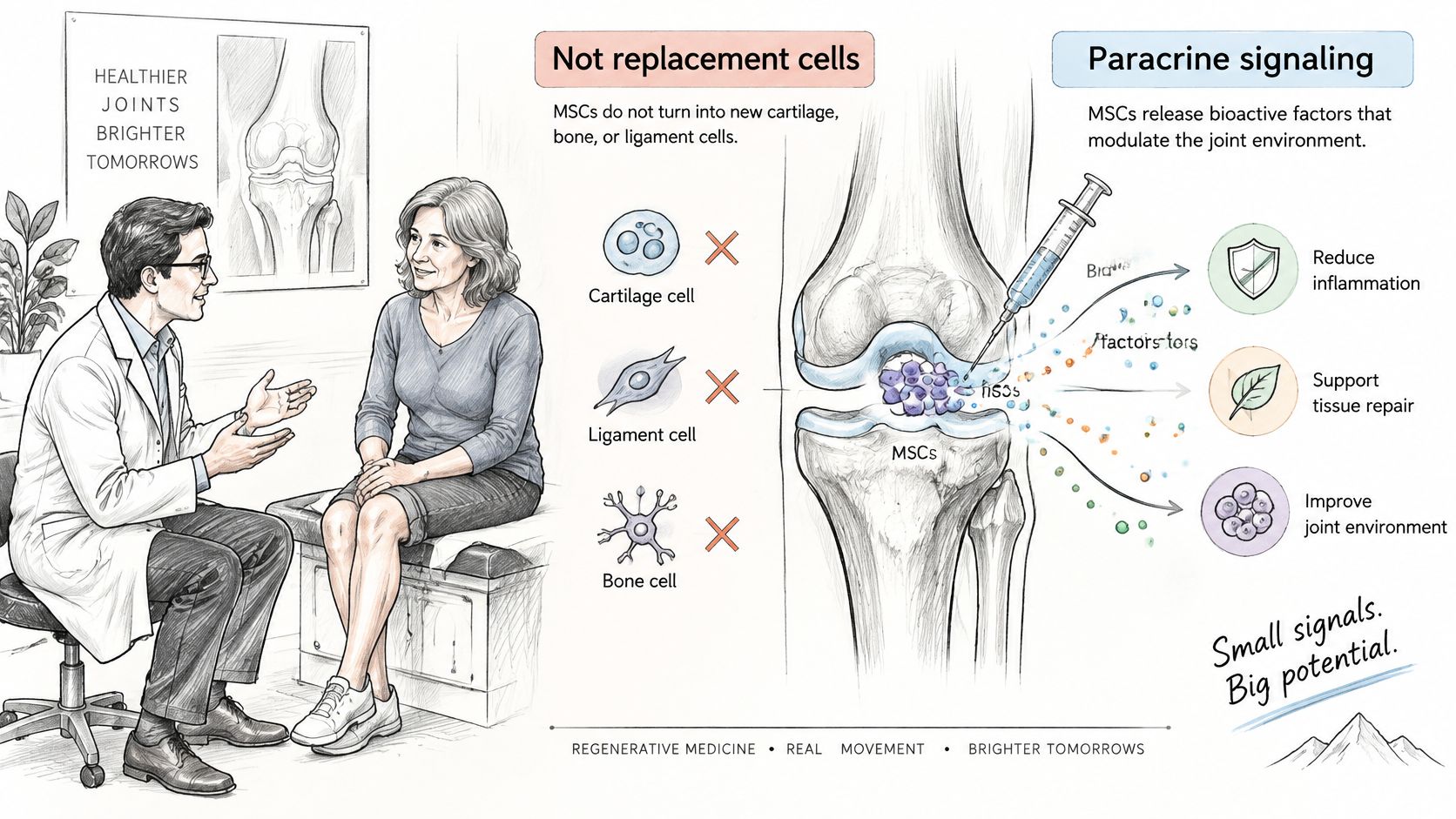
Start with the mechanism, because most marketing gets it wrong. Mesenchymal stem cells don't become replacement cartilage, ligament or bone after injection. They work through a paracrine effect, releasing cytokines, chemokines, growth factors and extracellular vesicles that influence inflammation, immune activity, pain pathways and local tissue repair. They act as temporary signaling coordinators, guiding the joint's healing environment rather than rebuilding it cell by cell. A useful comparison is a traffic controller at a damaged intersection: the controller doesn't pour new pavement, but the cars move again while the road is still the same road.
The randomized evidence is encouraging, and it tracks symptoms and function, not an X-ray grade. In a double-blind controlled trial of bone-marrow-derived MSCs for knee osteoarthritis, the MSC group improved by 5.0 points on WOMAC against 0.1 points in the control group (P = 0.02) at 9 months, with KOOS gains of 23.9 versus 7.2 (P = 0.028), and the investigators concluded that a single intra-articular allogeneic injection gave satisfactory pain relief compared with control at that point, as reported in this review of MSC trial outcomes. A separate phase II study that combined autologous bone-marrow MSCs with platelet-rich growth factor also reported lower mean pain at 12 months and no adverse effects during follow-up.
Pooled data point the same way. A 2025 meta-analysis of 8 randomized controlled trials covering 502 patients found significantly better WOMAC scores at 6 months (mean difference 7.44; 95% CI 1.45 to 13.42) and at 12 months (mean difference 10.31; 95% CI 0.96 to 19.67), with improvements in pain and KOOS outcomes and no statistically significant difference in adverse events.
Results vary by protocol, dose, cell source and study design, and what the trials show is symptom and function benefit, not regrowth of destroyed cartilage. Dose matters in a counterintuitive way: a 2025 dose-focused meta-analysis covering 8 treatment arms from 6 randomized trials and 300 patients found a pooled 12-month WOMAC standardized mean difference of -1.35 (95% CI -1.97 to -0.74), but the significant improvement came at doses of 25 million cells or fewer, while higher doses added nothing measurable.
That is the point where an injection stops being enough. If pain and stiffness ease and you can walk, work and climb stairs again, the option is still doing its job. If daily function stays poor after an adequate trial, a better-looking protocol will not substitute for a joint that no longer supports the life you need. Imaging grade alone does not make that call.
Judge the whole protocol, not the number on the vial. Cell characterization, delivery method, adjuncts such as PRP, the diagnosis being treated and the follow-up schedule all shape the result.
Regulatory context matters for anyone crossing a border. MSC injections aren't FDA approved for knee osteoarthritis, and stem cell therapy at Dream Body Clinic is approved by COFEPRIS, the FDA equivalent in Mexico. The clinic's stem cell knee treatment is a low-risk procedure with minimal chances of complications or infections, and it uses a single 50 million cell injection worth discussing against the dose evidence above. For a wider view of what injections can address, see this guide to stem cell injections for knee pain.
Recovery and Outcomes Across Each Path
Recovery is where the abstract choice becomes a scheduling problem. The timelines below are typical rather than guaranteed, and your own health, strength and work demands will shift them.
| Path | First phase | Typical return to daily life | What to judge |
|---|---|---|---|
| Exercise and physiotherapy | Supervised sessions over several weeks | Gains build over about 3 months | Walking distance and stair tolerance |
| Corticosteroid injection | Relief often within days | Relief for weeks to months, then reassess | Length of relief and number of flares |
| MSC knee injection | Single injection taking a few minutes | Most resume daily activities in about 6 weeks | Pain, stiffness and function over months |
| Total knee replacement | Hospital stay and early rehabilitation | Daily activities often within 6 to 12 weeks | Pain relief, function and rehabilitation progress |
Take the injection route first, since it's the one patients ask about most. The knee injection takes only a few minutes, and most knee treatment patients resume daily activities, including exercise and favorite pastimes, within approximately six weeks after treatment, though the exact timeline may vary. The benefit builds over months rather than days, so a single good week early on doesn't prove much, and a mediocre first month doesn't mean failure. Judge progress at a defined reassessment point, not at the kitchen table on a bad Tuesday.
Total knee replacement runs on a different clock. Expect a hospital stay, mobilization with a walker or cane in the first days, and a rehabilitation program that decides how much function returns. The surgery fixes the worn surface; the physiotherapy decides how confidently you use the new knee, which is why patients who arrive stronger and fitter usually find the recovery smoother.
Several variables move every timeline: age, body weight, other medical conditions, quadriceps strength before treatment, how faithfully you do the exercises, and the physical demands of your job. A roofer and a desk-based analyst with identical knees will not return to work on the same date.
The logistics catch people out more often than the pain does. Book the time off work before the procedure, arrange a caregiver for the first days after surgery, plan travel for follow-up if you're being treated abroad, and confirm there's physiotherapy within reach of home. Those four items decide whether a good clinical outcome becomes a good practical one.
Matching Your Situation to the Right Path
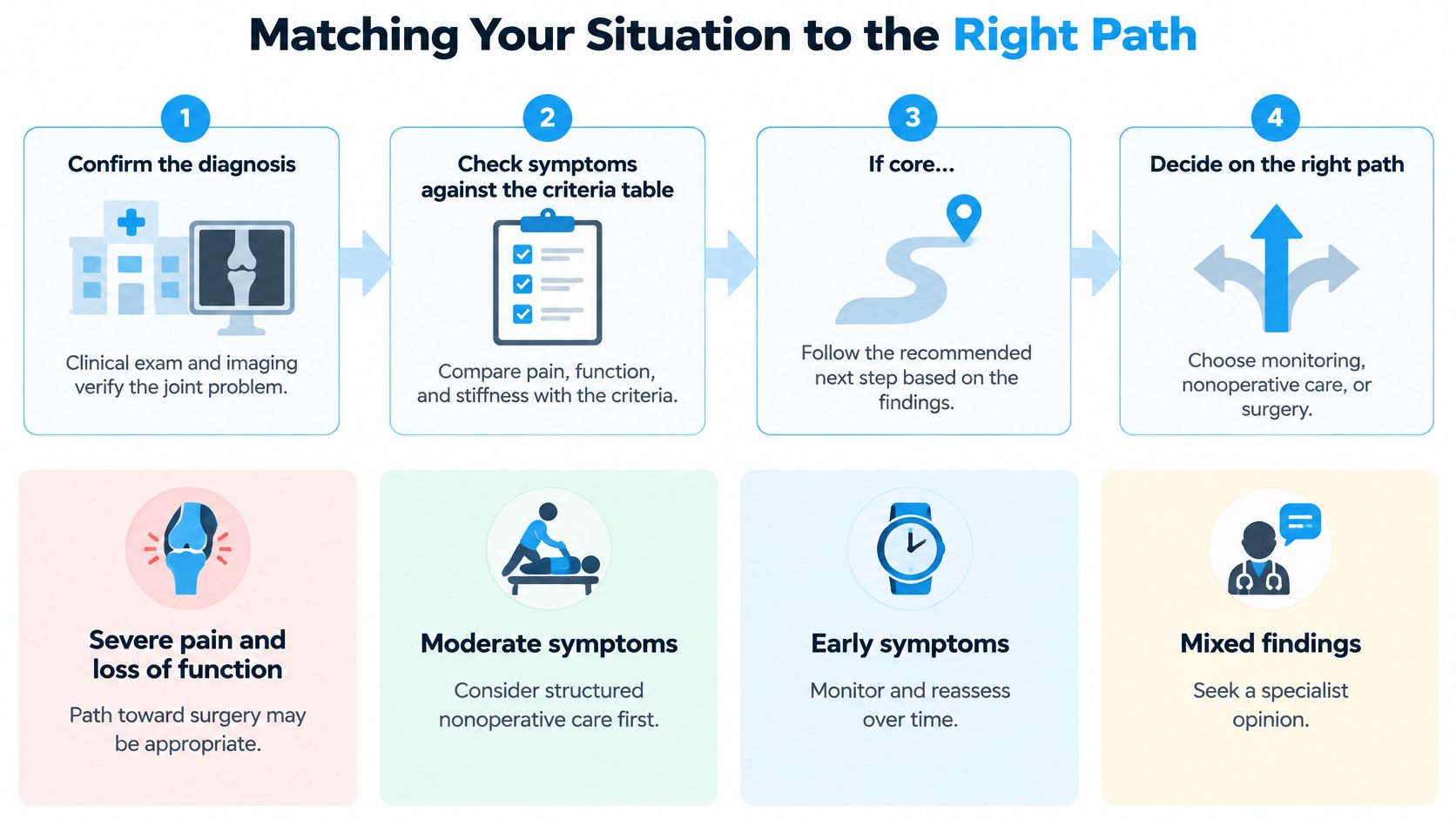
A rough-looking X-ray does not, by itself, book the operating room. The choice follows what the knee still lets you do, and whether simpler care has already failed.
Sort the decision the way you sort mail. Each step either keeps the current plan or moves the case forward. Five steps cover most cases.
- Confirm the diagnosis with a clinical examination and imaging, and ask what else could explain the pain. Imaging names the damage. It does not set the treatment.
- Check your symptoms against the criteria table, including nights disturbed and stairs avoided. Function, not the grade on the film, is the measure.
- Honor the conservative trial. If core non-surgical care has not run for about three months, continue it and set a reassessment date in the diary.
- Escalate if disability persists. Persistent pain and limitation after that trial justify an orthopedic assessment comparing surgery with a regenerative option.
- Recognize structural failure. A complete ligament rupture or advanced structural collapse may make surgery the only option for that injury, whatever else is available.
Then match your situation to the closest pattern, and notice where each option stops being enough.
Mild pain with a good walking distance usually calls for continued core care and a review date. That path stops being enough once night pain appears and walking shrinks to a few blocks. That pattern calls for assessment now. Partial meniscus or ligament symptoms in a stable knee can open the injection pathway. A complete rupture, or a knee that has collapsed, closes it. Severe deformity, cane use, and failed conservative care point toward candidacy for replacement, even if someone hoped one more injection would do.
Timing, not permission, is usually the main question. A 2024 analysis of 397 osteoarthritis patients found an appropriateness tool rated total knee arthroplasty appropriate for 77.8% and may be appropriate for 22.2%, with no patient rated rarely appropriate. The same body of work found that patients using a codesigned decision aid had 3.72 times higher odds of making a high-quality decision, which shows the quality of the conversation carries weight.
A deferred operation is a decision with a review date attached, made by someone who knows what they are waiting for.
If you defer, write the checklist down: confirmed diagnosis, options already tried and their results, two or three realistic functional goals, a review of comorbidities and infection risk, recovery logistics, and the date you will revisit the decision.
Get an Assessment Before Choosing Surgery or Injections
An X-ray grade can look severe while you still walk the grocery store. A milder film can sit beside a knee that has already failed therapy, medication, and a real change in activity. Imaging is a photograph of structure. Daily function is the test of whether that structure still does its job. Assessment sorts those two pictures before anyone books surgery or an injection.
Start with what you can no longer do, not the report header. Bring a short symptom log: how far you walk before you stop, whether stairs or nights are the problem, and which conservative steps you already finished. Ask the surgeon whether replacement is indicated now because function has collapsed and those steps have failed, or whether a dated reassessment fits better. A direct answer beats "we can do it whenever you feel ready."
The same standard applies to injections. Non-surgical care stops being enough when pain still limits walking, sleep, or work after a real course of therapy and activity change, not merely because the film looks advanced. If mesenchymal stem cells are one option, ask for the protocol before you agree: cell count, how the cells are delivered, whether PRP is added, whether an MRI is included, and when follow-up happens. Then name success in measurable terms at 3 months and at 6 months. Walking distance and nights without waking are clearer than "it feels better."
At Dream Body Clinic, patients are encouraged to consult the medical team before the Stem Cell Knee Treatment. That visit includes a thorough examination of the knee joint and a discussion of medical history and treatment expectations. The Knee Stem Cell Treatment uses 50 million mesenchymal stem cells and includes an MRI. Joint regeneration treatment for a knee, hip, elbow, shoulder, or ankle costs $3,500 USD. Follow-up appointments may be scheduled after treatment to monitor progress and address concerns. A complimentary case review is how you start that conversation without booking the injection.
Close the visit with two notes of your own: the date you will decide, and the functional findings that would move surgery forward. A bad pain week is a poor moment to lock in a choice you would want made in a typical month.
Dream Body Clinic treats knee osteoarthritis, meniscal and ligament injuries, and advanced joint damage with targeted MSC injections under COFEPRIS oversight in Bucerias, Mexico. The complimentary case review lets you discuss your symptoms, history, and expectations with the medical team. Visit Dream Body Clinic to request that review.