

Finding your knee arthritis stage is a useful first step, but an X-ray grade isn’t a pain score or a treatment prescription. Here, arthritis means knee osteoarthritis. At Dream Body Clinic in Bucerías, near Puerto Vallarta, the question isn’t only which grade you have, but how your imaging, your symptoms and your goals fit together.
The clinic’s stem cell knee treatment is an ultrasound-guided injection of 50 million allogeneic mesenchymal stem cells (MSCs) into the knee joint. It is offered as a non-surgical option for knee osteoarthritis (grades 1 to 4, with better expectations in grades 1 and 2), partial meniscus tears, partial ligament injuries, cartilage defects and chronic knee pain that hasn’t responded to rest, physical therapy or injections. Results vary, and it is not a guaranteed fix.
Table of Contents
- Knee Arthritis Stages by Kellgren-Lawrence Grade
- Symptoms and Daily Function at Each Stage
- Why Your X-Ray Grade and Your Pain Often Disagree
- Confirm Your Stage Before Choosing a Treatment
- Treatment Options Matched to Each Stage
- How Stem Cell Therapy Works Through Paracrine Signals
Knee Arthritis Stages by Kellgren-Lawrence Grade
The clinic doesn’t treat on the grade alone. Its own MRI, blood panel and physician review decide whether you are a candidate.
Reading the rest of your report
Look beyond the grade number. Check which part of the knee is involved (inner, outer or kneecap joint), whether the images were taken standing, and whether the report mentions bone spurs (osteophytes). The clinic notes that stem cells don’t remove bone and that large osteophytes can block healing, so spurs are one of the details the doctors look for. A complete ligament, tendon or meniscus tear is also not a fit, because stem cells don’t bridge a full-thickness gap.
If you already have an MRI from the last 6 months, email the written report to info@dreambodyclinic.net before you travel so the physician can review it in advance. A new MRI is still done at the clinic for accuracy and safety.
Symptoms and Daily Function at Each Stage
Symptoms are best understood as common patterns, not rules. Don’t use a table to assign yourself an X-ray grade. The clinic uses these conditions and symptoms as starting points for a conversation:
| KL grade | What the X-ray shows | Plain-language label |
|---|---|---|
| 0 | No radiographic osteoarthritis | Absent |
| 1 | Possible osteophyte of doubtful significance | Absent or doubtful |
| 2 | Definite osteophytes, joint space preserved | Early or definite |
| 3 | Definite osteophytes and moderate joint-space narrowing | Moderate or advanced |
| 4 | Large osteophytes, severe narrowing, sclerosis, possible deformity | Severe or end-stage radiographic |
Describe the task, not just the ache
Tell the doctors what the knee stops you doing: stairs, kneeling, standing through a meal, getting out of a car, or sleeping through the night. That is more informative than a pain number alone, and it gives you something to compare against at the clinic’s 3, 6 and 12-month follow-ups.
A snapshot, not a timetable
A grade is a snapshot of one day, not a prediction. Some knees change slowly and others decline faster. The clinic doesn’t claim to know how any one knee will progress. The injected cells stay active for about 8 to 12 months, aging continues, and for patients who want ongoing systemic support after the knee has responded, the clinic offers an optional annual 100 million MSC IV, sold separately. It isn’t required to improve a knee.
Why Your X-Ray Grade and Your Pain Often Disagree
A mild-looking X-ray with severe pain can feel invalidating, and a severe-looking film with little discomfort can be just as confusing. Neither means you’ve misunderstood your body. Pain comes from more than cartilage: inflammation of the joint lining, meniscal damage, weak muscles and how the knee moves can all contribute.
That is also why Dream Body Clinic’s injection aims at inflammation. The goal is to reduce joint inflammation and support repair of cartilage, meniscus, ligament and tendon tissue. It is not a knee replacement, it can’t heal a complete tear and it does not remove bone spurs.
Different knees, different explanations
One patient has borderline imaging but constant pain after failed physical therapy. The clinic’s open MRI shows a partial meniscus tear and an inflamed joint. That is the kind of picture the protocol is designed for.
Another patient has a complete tear or large bone spurs. The MRI shows that the injection isn’t the right tool. They aren’t treated, and they pay only the $500 MRI and $300 blood panel instead of the treatment fee.
Symptoms can precede visible arthritis
A normal X-ray doesn’t rule out a real knee problem. The clinic treats focal cartilage lesions, chondromalacia, patellar tendinitis, quadriceps tendon damage, partial ligament injuries (ACL, MCL, PCL and LCL) and incomplete healing after prior surgery, none of which depend on an advanced arthritis grade. Track your pain pattern (activity-related, resting or nighttime), your function and strength, and any giving way, so the doctors see the whole picture.
Confirm Your Stage Before Choosing a Treatment
Before an injection or any regenerative option, establish what is being treated. At Dream Body Clinic, confirmation comes from your history, your open MRI and a full blood panel, all reviewed by a physician before payment.
The clinical checks that matter
- History first. Describe when symptoms began, where the pain sits, and whether it follows activity or occurs at rest.
- Open MRI on site. The clinic uses an Esaote S-Scan open MRI, so the joint isn’t guessed at. Confirm your knee fits the coil before you travel. If it doesn’t, the clinic schedules a different machine.
- Blood panel. Included in the package.
- MRI review before payment. On Day 3 of your stay, the doctors review the MRI with you, then you decide.
- Cancer screening question. The clinic doesn’t treat anyone who has had cancer in the past 5 years, as a precaution.
- Medication review. Bring your prescriptions and supplements.
Prepare a useful appointment folder
Bring or send:
- Your latest X-ray and MRI reports (written reports, ideally with the images), emailed to info@dreambodyclinic.net
- Recent bloodwork, if you have it
- Your medication list
- A short symptom record: pain, stiffness, swelling and walking tolerance
- Previous care: exercises, physical therapy, braces, medicines and injections, and what changed
- A measurable goal, such as managing stairs, returning to a sport or sleeping without interruption
The free consultation runs 30 to 45 minutes by phone or video. Call (888) 704-3977 or WhatsApp +52 322 232 1055. If the written report is enough, a physician can say whether you are a candidate before you fly.
What to stop beforehand: Stop NSAIDs at least 1 week before treatment and stay off them for at least 2 weeks after, preferably 6. Stop prednisone at least 1 week before and for at least 2 weeks after. Don’t book within 3 months of a cortisone injection. Hold turmeric and ginkgo for at least 2 weeks after. Always check with your own doctor before stopping any prescribed medication, including aspirin.
Before agreeing to any treatment, ask: what diagnosis is being treated, what outcome is expected, and how it will be measured.
Treatment Options Matched to Each Stage
Treatment should reflect your symptoms as well as your structure. These are not a ladder every patient must climb.
| Stage (KL grade) | Typical symptoms | Effect on daily life |
|---|---|---|
| Grades 0 to 1 | Occasional ache after long activity, little swelling | Usually minimal |
| Grade 2 | Pain on stairs and long walks, brief morning stiffness | Stairs and standing tolerance reduced |
| Grade 3 | Pain under load, swelling after activity, stiffness | Shorter walks, difficulty kneeling |
| Grade 4 | Pain at rest in some people, deformity, instability | Marked limits, possible need for help |
Choose care for the problem you have
If you’ve tried rest, physical therapy or injections and still have chronic pain, the stem cell injection is the option Dream Body Clinic offers. It isn’t a same-day bone marrow or fat draw, with no liposuction and no bone marrow harvest. The cells are allogeneic, from Wharton’s jelly and placenta, expanded in the clinic’s ISO-rated lab on the same property, and never frozen or shipped in from another city. The injection is performed by one of three physicians: Dr. Arick Barba, Dr. Lizbeth Aguirre or Dr. Jaqueline Vega.
Make escalation deliberate
The clinic reports adverse events under 2%, mostly temporary soreness at the injection site, and no knee-injection infections in 9 years of stem cell use. About 5% of people are non-responders. The clinic’s recovery timeline: most patients walk out the same day and return to desk work in 2 to 3 days, avoid high-impact exercise in week 1, ease off major loading for the 6-week engraftment window, and see a typical peak at 3 to 6 months.
Seek urgent care for a suddenly hot, markedly swollen knee, fever, spreading redness, drainage from the injection site, or inability to bear weight. Don’t wait for a scheduled follow-up.
Dream Body Clinic isn’t a first-line replacement for exercise and rehabilitation. It is an option once those foundations have been tried.
Why Your X-Ray Grade and Your Pain Often Disagree
A mild-looking X-ray with severe pain can feel invalidating. A severe-looking X-ray with little discomfort can be just as confusing, but neither situation means you’ve misunderstood your body.
This diagram illustrates why imaging and symptoms shouldn’t be treated as interchangeable.

Pain comes from more than cartilage loss. Inflammation of the joint lining, bone-marrow lesions, meniscal damage, muscle weakness, and movement mechanics can contribute, while sleep, mood, and the nervous system’s processing of pain can influence its intensity, as discussed in this review of knee osteoarthritis assessment and management. These influences don’t make pain imaginary.
How Stem Cell Therapy Works Through Paracrine Signals
Dream Body Clinic explains that injected MSCs do most of their work by signaling, not by turning into a new knee. Think of a site foreman who sends instructions rather than laying every brick. The cells move toward inflammation and interact with nearby immune and repair cells, and your own tissues carry out any repair.
What the signals may do
In the joint, the clinic says MSCs:
- Release anti-inflammatory cytokines that calm joint swelling
- Signal chondrocytes, the cells that maintain cartilage
- Support new extracellular matrix, including collagen and proteoglycans
- Guide fibroblasts in partial ligament and tendon injuries and support collagen repair
- Support meniscal cells and matrix in partial tears
- Produce enzymes that help remodel scar tissue
- Promote small-vessel growth so injured tissue gets blood supply
- Modulate the local immune response so inflammation doesn’t stay switched on
This is also why the clinic asks you to avoid NSAIDs and cortisone around treatment: they mask the inflammatory signal the cells use to find damaged tissue.
Separate symptom relief from structural restoration
The injected cells remain in the body for about 8 to 12 months, and then the remaining donor cells are cleared. The clinic reports that this has not produced a systemic reaction in its knee series. Less pain, better function, visible structural change and avoiding joint replacement are different claims. The clinic judges the result at 3 to 6 months by how the knee works and feels, with follow-up surveys at 3, 6 and 12 months, and it doesn’t claim to rebuild an advanced joint. Stem cell therapy offers no guarantees and isn’t promoted as a cure. This is a clinic protocol, not an FDA-approved U.S. indication.
What it costs: One knee is $3,500 USD, and both knees on the same trip are $7,000 USD. The price includes the open MRI, blood panel, consultation, 50 million MSCs, the injection, a post-treatment rehab protocol and remote follow-up at 3, 6 and 12 months. Flights and hotels are up to you.
Where: DBC Medical Center, Carmen Serdán 22, Bucerías, Nayarit 63732, Mexico, across the bay from Puerto Vallarta. Fly into Puerto Vallarta International Airport (PVR). Most patients stay at least 5 days: arrive and rest, MRI and bloodwork, MRI review and payment, treatment, fly home.
Next step: Visit dreambody.clinic to request a case review, or call (888) 704-3977, WhatsApp +52 322 232 1055, or email info@dreambodyclinic.net. Bring your imaging reports and a description of what your knee pain prevents, so the discussion starts with your needs, not just your grade.
Results vary. This content is for education and is not medical advice.
| Stage | First-line care | Next options if needed | Refer to specialist when |
|---|---|---|---|
| Grades 0 to 1 | Strengthening, activity adjustment | Check for other pain sources | Pain persists despite a planned course of care |
| Grade 2 | Structured exercise, weight management, assessment of footwear or insoles | Topical or oral pain relief, selected bracing | Pain continues to limit work or sleep |
| Grade 3 | Supervised physiotherapy, sleeve or brace when appropriate | Corticosteroid injection for selected flares | Frequent flares, instability, or locking |
| Grade 4 | Ongoing physiotherapy, pain management | Assistive devices, activity pacing | Function is markedly limited and surgical options need consideration |
Choose care for the problem you have
For absent or doubtful radiographic disease, work on quadriceps and hip strength while checking whether another condition better explains the pain. Activity adjustment means changing the dose or type of loading, not automatically abandoning movement.
For early definite disease, a structured exercise program gives rehabilitation direction and a way to assess progress. Weight management, where relevant, can address loading, while footwear or insoles should be assessed for comfort and individual mechanics rather than prescribed only because arthritis appears on a film.
In moderate disease, supervised physiotherapy can help someone who struggles to exercise independently. A sleeve may improve comfort, while a more specific brace may be considered for instability or uneven loading; these aren't interchangeable devices.
A corticosteroid injection may be discussed for an inflammatory flare, but relief is often temporary. It's a symptom-management option, not evidence that damaged cartilage has been restored.
For advanced disease, specialist review can establish whether joint replacement or another surgical approach fits the person's limitations and health. Severe narrowing or deformity still needs to be considered alongside functional goals and response to conservative care, as explained in this review of osteoarthritis imaging and clinical progression.
Make escalation deliberate
These options aren't a ladder every patient must climb. Comorbidities, alignment, personal goals, medication risks, and the response to a workable rehabilitation program can change the order.
Topical NSAIDs may be considered where suitable, and oral medicines require an individual safety review. Paracetamol is another possible pain-relief option, but don't assume that either a nonprescription medicine or a familiar brand is appropriate for every patient.
If you're comparing supplements, Supplemynts joint support capsules from Supplemynts Inc. provide a product listing to review with your clinician. A supplement listing doesn't establish that the product relieves osteoarthritis pain or rebuilds cartilage, and supplements shouldn't displace rehabilitation.
Use our overview of knee arthritis pain treatment to prepare questions about available approaches.
- Arrange reassessment: Pain continues to prevent sleep, work, or ordinary walking despite care.
- Seek earlier evaluation: The knee locks, repeatedly gives way, or deteriorates rapidly.
- Seek urgent care: A suddenly hot, markedly swollen knee, fever, or inability to bear weight needs prompt assessment rather than routine staging.
Regenerative therapy isn't a first-line replacement for these foundations.
How Stem Cell Therapy Works Through Paracrine Signals
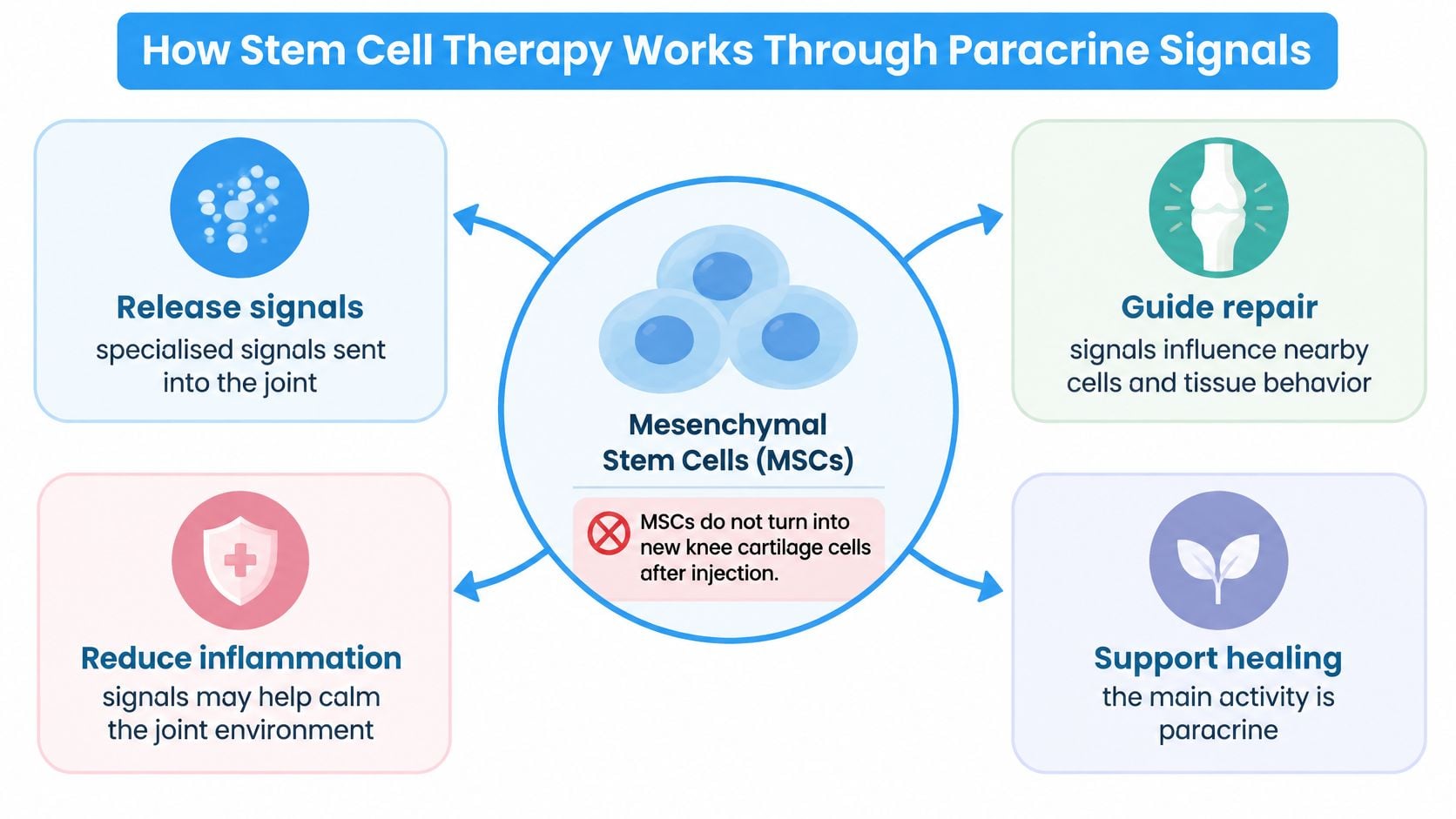
Mesenchymal stem cells, also called mesenchymal stromal cells or MSCs, don't turn into new knee cartilage cells after injection. Their principal proposed activity is the paracrine effect: sending out specialized signals to guide the local healing process, rather than differentiating into replacement knee tissues, as explained in this review of MSC mechanisms.
Think of a site foreman who sends instructions rather than laying every brick. MSCs communicate with nearby immune cells and existing joint cells; the patient's own tissues carry out any subsequent maintenance or repair.
The concept map illustrates that distinction.
What the signals may do
Reported mediators include prostaglandin E2, indoleamine-2,3-dioxygenase, hepatocyte growth factor, interleukin-10, and transforming growth factor-beta, according to this review of MSC signaling and immune modulation. These are biochemical messengers or signaling-related molecules, not ingredients that physically fill a cartilage defect.
Their potential effects include:
- Calming inflammation: Influencing immune activity within the joint.
- Changing macrophage behavior: Encouraging these immune cells toward a more tissue-supportive state rather than a predominantly inflammatory one.
- Protecting existing cells: Supporting cartilage-cell survival and influencing the surrounding tissue framework.
- Supporting local repair responses: Recruiting or stimulating the patient's own repair mechanisms.
Extracellular vesicles, including exosomes, can carry signaling material between cells without becoming those cells, as described in this review of MSC-derived signaling cargo. These biological mechanisms are plausible explanations for effects, not proof that a particular injection will produce a clinical benefit.
Separate symptom relief from structural restoration
Consistent engraftment, meaning lasting incorporation of injected cells into tissue, hasn't been demonstrated. That supports a temporary signaling mechanism rather than permanent replacement of the joint surface.
An early clinical report associated approximately 20 to 24 million MSCs with pain reduction lasting up to six months, but the clinical review summarizing that report also describes efficacy as controversial and structural restoration as uncertain. A small early report doesn't establish a reliable dose, predict an individual response, or prove reversal of advanced arthritis.
Keep the outcomes separate: Less pain, better function, visible structural change, and avoiding joint replacement are different claims.
For persistent symptomatic disease, stem cell therapy for osteoarthritis warrants a discussion of uncertainty, alternatives, risks, and measurable goals. It shouldn't be presented as a dependable way to rebuild an advanced joint or bypass a necessary surgical assessment.
Dream Body Clinic offers individualized orthopedic assessment and MSC-based knee treatment, with review of your condition, medical history, and functional goals. Visit Dream Body Clinic to request a case review, and bring your imaging reports and a description of the activities your knee pain prevents so the discussion starts with your needs, not just your grade.