
The most popular advice for knee arthritis is also the most misleading. You’re told to find the best shot, the newest procedure, or the strongest pill, as if one intervention fixes a progressive joint problem on its own. It doesn’t. A credible knee arthritis pain treatment plan is sequenced and built on daily habits, with injections and surgery reserved for specific situations. When conservative care is no longer enough, the ultrasound-guided stem cell knee treatment at Dream Body Clinic offers a non-surgical option using 50 million expanded mesenchymal stem cells (MSCs).
Table of Contents
- Why Most Knee Arthritis Pain Treatment Plans Start in the Wrong Place
- The Conservative Care Foundation Every Knee Plan Should Build On
- Cortisone and Hyaluronic Acid Injections What They Actually Do
- MSC Injections and PRP How Regenerative Knee Treatment Actually Works
- Arthroscopy Partial Replacement and Total Knee Replacement
- Comparing Every Option in One Table
- Choosing the Right Knee Arthritis Path for Your Situation
Why Most Knee Arthritis Pain Treatment Plans Start in the Wrong Place
Most patients start with the procedure they saw advertised. They ask for cortisone because a friend felt better, hyaluronic acid because it sounds like lubrication, or replacement because they want the problem finished. The right question is how severe the arthritis is, how long each option helps, and what foundational care you’ve completed.
Exercise sits at the base for a reason. High-quality evidence shows structured exercise reduces pain and improves function, though the benefit requires ongoing effort. When exercise, weight management, and appropriate medication no longer provide enough relief, many patients evaluate the stem cell knee treatment as the next step.
The Three Tiers in Plain Language
- Tier 1, conservative care: Education, structured exercise, weight management when relevant, and carefully selected medication.
- Tier 2, injection-based care: Corticosteroids, hyaluronic acid in selected cases, platelet-rich plasma, and mesenchymal stem cell (MSC) injections such as the 50-million expanded MSC protocol.
- Tier 3, surgery: Arthroscopy in narrow circumstances, partial replacement for disease confined to one compartment, and total replacement for advanced, function-limiting arthritis.
An injection that lets you train consistently can be valuable. An injection used instead of training usually disappoints. Conservative care is the platform that makes regenerative options more likely to help.
The Conservative Care Foundation Every Knee Plan Should Build On
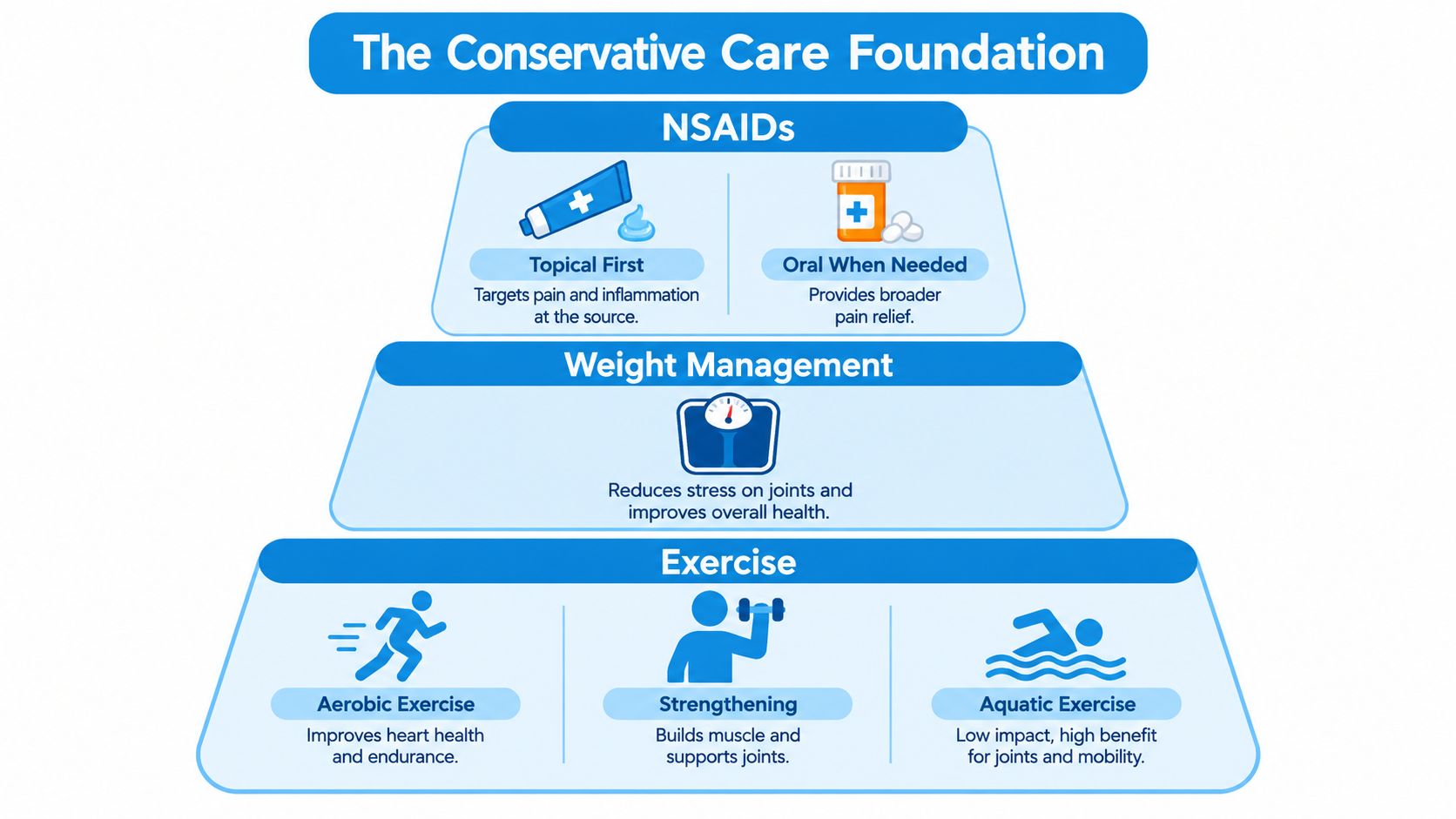
Guidelines strongly recommend exercise for knee osteoarthritis and support topical and oral NSAIDs when clinically appropriate. Start with tolerable, low-impact activity (walking, cycling, swimming) paired with quadriceps and hip strengthening. Pain during exercise doesn’t automatically mean cartilage damage, but escalating sharp pain, major swelling, or instability needs assessment.
Weight management, topical NSAIDs, and education about your diagnosis and flare plan belong in the same foundation. Once that foundation is in place and symptoms remain limiting, the ultrasound-guided 50-million MSC injection can be considered.
Cortisone and Hyaluronic Acid Injections What They Actually Do
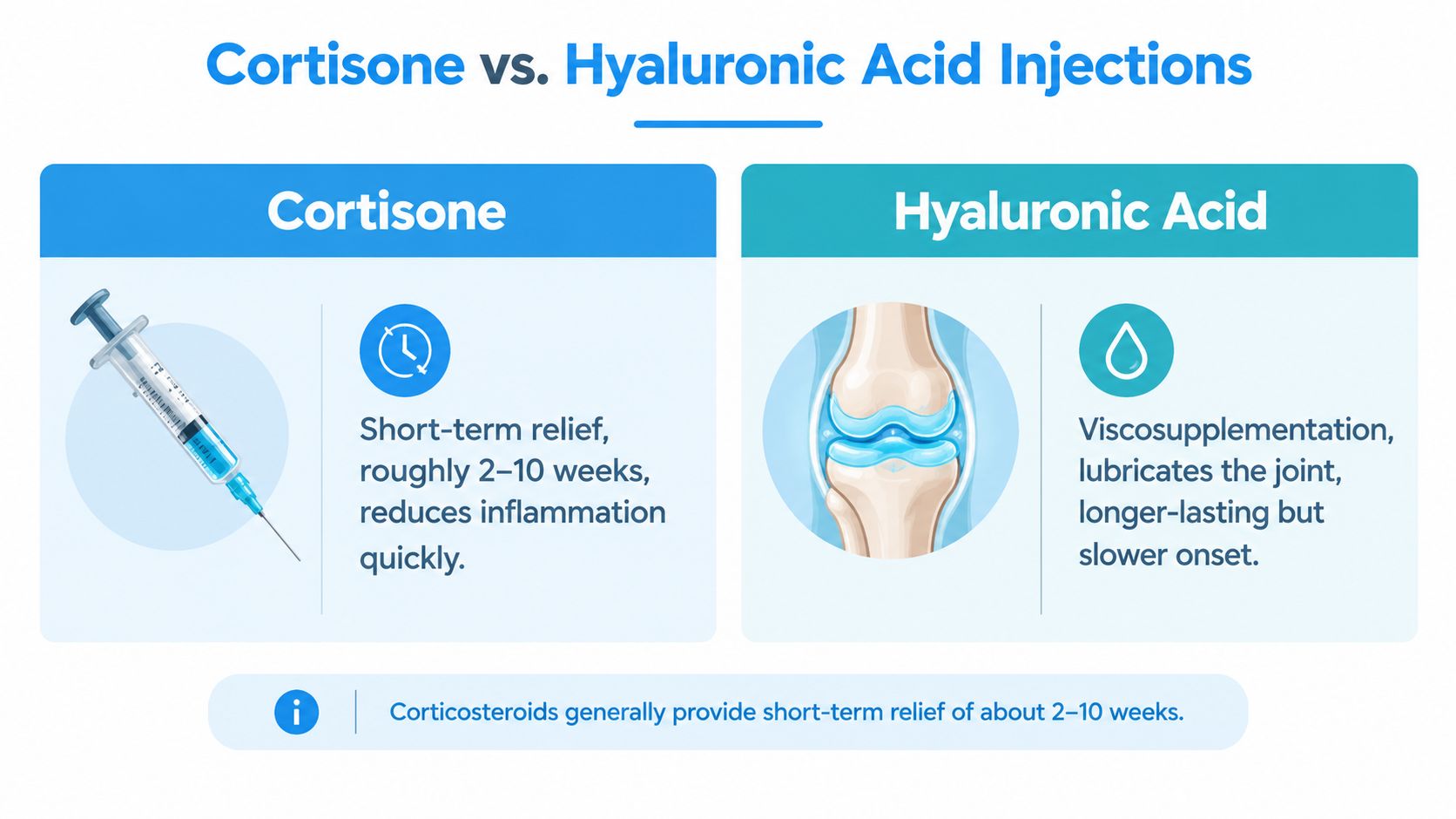
Cortisone can provide short-term relief (often measured in weeks) by suppressing inflammation. Its best use is to open a window for rehabilitation. Hyaluronic acid aims to supplement joint fluid, but average clinical benefit is inconsistent and guidelines do not recommend it routinely.
When pain returns quickly, function doesn’t improve, or injections are repeated while walking distance shrinks, many patients move to regenerative options. The Dream Body Clinic protocol is positioned for this point: a single ultrasound-guided injection of 50 million allogeneic MSCs rather than repeated short-acting shots.
Hyaluronic Acid Has a Weaker Case
Hyaluronic acid is often marketed as cushioning or lubricating the joint. The American Academy of Orthopaedic Surgeons guideline on knee osteoarthritis does not recommend routine hyaluronic acid injections because average clinical benefit is inconsistent. That doesn’t mean no individual patient ever reports relief. It means you shouldn’t present it as reliably effective, and you shouldn’t choose it over exercise and appropriate NSAID therapy on the assumption that a gel shot rebuilds a healthy joint environment.
This short video adds useful clinical context on how these injections are discussed in practice.
Treatment failure is clear in my practice. Pain returns quickly, function doesn’t improve, you need escalating medication, or you’re repeating injections while walking distance shrinks. At that point, we discuss regenerative options with full disclosure or surgical referral when symptoms substantially affect quality of life despite appropriate nonsurgical care. Don’t let a short-term tool delay a decision that needs to be made.
MSC Injections and PRP How Regenerative Knee Treatment Actually Works
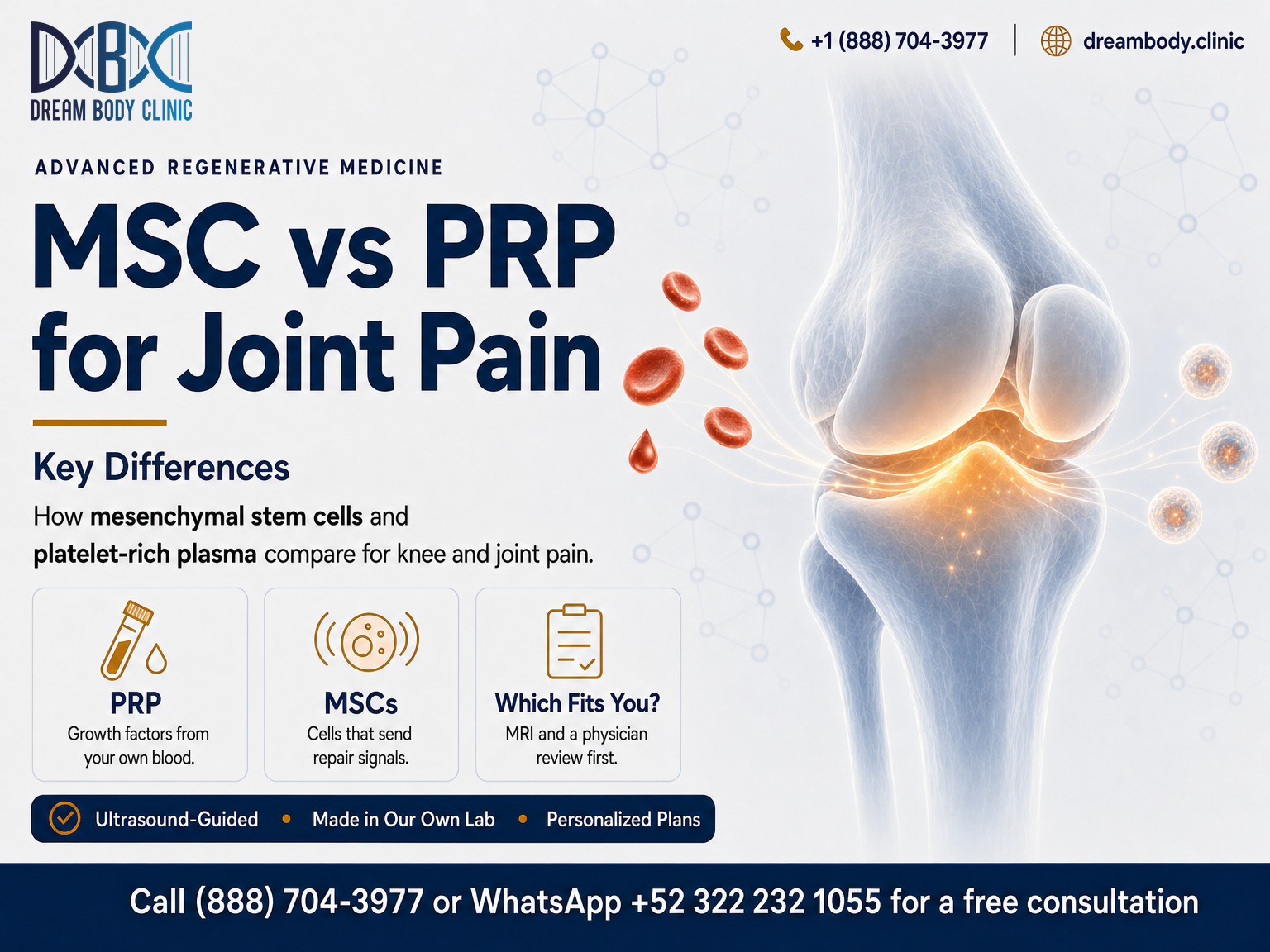
Regenerative medicine gets ruined by sloppy biology. Patients are told stem cells travel to damaged cartilage, turn into new cartilage, and rebuild the knee. That’s not how I explain MSC treatment, because it isn’t the primary mechanism supported by reviews of knee osteoarthritis care. The stem cells don’t differentiate into other cells as the core therapeutic action. They work mainly through the paracrine effect, which means they send out specialized signals that guide the healing process.
The screenshot below shows how a structured knee protocol is presented to patients evaluating this route.

What Paracrine Signaling Means in Your Knee
Mesenchymal stromal cells respond to inflammatory signals in the joint and release bioactive molecules. The review of MSC mechanisms in knee osteoarthritis published in PMC describes these signals as including cytokines, growth factors, chemokines, and extracellular vesicles or exosomes. Those messages influence synovial cells, chondrocytes, immune cells, and surrounding cartilage tissue. They can reduce inflammation, oxidative stress, and apoptosis while encouraging your own repair cells to participate in tissue maintenance.
That’s a more honest and more interesting story than cells magically becoming cartilage. MSCs act like coordinators. They change the local environment so destructive processes quiet down and supportive repair activity has a better chance. Direct differentiation into chondrocytes has been investigated, but reviews identify it as secondary to paracrine signaling.
MSCs do not primarily turn into new cartilage. They work mainly through the paracrine effect: they release cytokines, growth factors, and extracellular vesicles that influence synovial cells, chondrocytes, and local immune cells. These signals can reduce inflammation and support the joint’s own repair processes.
The stem cell knee treatment at Dream Body Clinic uses 50 million culture-expanded allogeneic MSCs from Wharton’s jelly and placenta, delivered under ultrasound guidance. There is no bone marrow harvest or liposuction. The published price is $3,500 per knee and includes an on-site MRI and blood panel. Many patients notice early improvement in 2–4 weeks, with fuller results developing over 3–6 months.
PRP concentrates platelet-derived growth factors but does not deliver living MSCs. The clinic’s standard knee protocol focuses on the expanded MSC dose.
Arthroscopy Partial Replacement and Total Knee Replacement
Arthroscopy has a narrow role and is not a solution for diffuse osteoarthritis. Partial replacement can address disease confined to one compartment. Total knee replacement is the definitive option for advanced, function-limiting arthritis when nonsurgical care is no longer sufficient.
The 50-million MSC protocol is a non-surgical option aimed at reducing inflammation and supporting cartilage and soft-tissue repair. It is not a knee replacement and does not remove bone spurs or repair complete tears. Candidacy is confirmed with MRI before treatment.
| Treatment | Evidence Quality | Typical Relief Duration | Recovery / Downtime | Durability | Approx. Cost |
|---|---|---|---|---|---|
| Exercise and weight management | Strong guideline support | Builds with adherence, fades if stopped | No procedural downtime | Durable while maintained | Low |
| Topical NSAIDs | Masks Pain, doesn’t heal | While used appropriately | None | Symptom control only | Low |
| Oral NSAIDs | Masks Pain, doesn’t heal | Short-term symptom relief | None | Symptom control only | Low |
| Cortisone injection | Masks Pain, doesn’t heal | About 2 to 10 weeks | Brief | Time-limited | Low to moderate |
| Hyaluronic acid | Inconsistent average benefit | Variable | Brief | Variable | Moderate |
| PRP | Can’t remove scar tissue, minimal healing | Variable | Brief | Variable | Moderate |
| MSC injection | Established method for healing the underlying cause of the pain by regenerating tissue. | Variable | Brief procedural recovery | proven for regeneration and repair | High |
| Arthroscopy | Limited for degenerative arthritis pain | Variable | Shorter surgical recovery | Does not reverse diffuse arthritis | Moderate to high |
| Partial replacement | Established for selected one-compartment disease | Long-term structural relief | Intermediate surgical rehabilitation | Long-lasting in selected patients | High |
| Total replacement | Established for end-stage disease | Long-term structural relief | Longest surgical rehabilitation | Most definitive structural option | High |
Choosing the Right Knee Arthritis Path for Your Situation
- Active patient with mild to moderate arthritis: Build the conservative foundation first. If pain limits activity despite consistent exercise, discuss the expanded MSC injection.
- Daily pain after physical therapy and NSAIDs: This is the typical window for evaluating the ultrasound-guided 50-million MSC protocol as a non-surgical step before considering replacement.
- Bone-on-bone and losing independence: Advanced disease may require surgical discussion. Some patients still explore MSC therapy for remaining soft-tissue and inflammatory components, with realistic expectations.
Learn more or request a free consultation:
https://dreambody.clinic/stem-cell-knee-treatment/
Call (888) 704-3977
7 Reasons Patients Choose the Dream Body Clinic Stem Cell Knee Treatment
- Consistent 50-million cell dose of culture-expanded allogeneic MSCs.
- No harvest procedure — no bone marrow aspiration or liposuction.
- Fresh cells expanded on site in the clinic’s ISO-rated lab (never frozen or shipped).
- Ultrasound-guided intra-articular injection for accurate placement.
- All-inclusive $3,500 price that includes MRI and blood panel.
- Short five-day stay in the Puerto Vallarta area.
- Published pricing and remote follow-up at 3, 6, and 12 months.
If your knee pain persists despite a genuine conservative program, Dream Body Clinic offers complimentary case review and transparent MSC knee protocols for international patients considering nonsurgical regenerative care. Bring your imaging and medical history, ask direct questions about dosing, safety screening, rehabilitation, and follow-up, and visit Dream Body Clinic to start that assessment.