A PCL tear treated without surgery typically reaches early recovery in about 4-6 weeks for a Grade I injury, 6-8 weeks for Grade II and 8-12 weeks for Grade III, while a knee that has had PCL reconstruction is commonly placed at around 6-9 months before it's described as recovered. Those are early recovery windows, not permission to cut, pivot or take a tackle.
So why does one person with a Grade II tear get told six weeks and another get told nine months for what sounds like the same injury? The calendar is answering a different question from the one most patients are asking. "How long until it's healed" and "when am I safe to play" have separate answers, and the second one is decided by testing, not by counting weeks.
The distinction that matters: a healing ligament and a knee cleared for sport are two different milestones, and they rarely land on the same date.
This walkthrough lays out the windows grade by grade, then shows what has to be true before each activity becomes safe again, so you can plan with a calendar and decide with criteria.
Table of Contents
- PCL Recovery Time by Grade and Treatment Path
- Non-Operative Recovery, Phase by Phase
- Non-Operative Care Versus Reconstruction Outcomes
- Readiness Milestones After Reconstruction and Non-Operative Care
- Stem Cell Therapy as a Regenerative Option for PCL Tears
- Confirm Your Recovery Plan With a Knee Specialist
PCL Recovery Time by Grade and Treatment Path
The fastest way to get a realistic answer is to find your row. The table below sets out the planning windows clinicians use, from a minor partial tear through to reconstruction.
| Injury or treatment | Recovery window | Sport milestone |
|---|---|---|
| Grade I, non-operative | 4-6 weeks | No earlier than about 3 months, once criteria are met |
| Grade II, non-operative | 6-8 weeks | No earlier than about 3 months, once criteria are met |
| Grade III, non-operative | 8-12 weeks | No earlier than about 3 months, once criteria are met |
| Isolated, non-operative, all grades | Early recovery within weeks to months | Sport-specific drills about 2-3 months, full clearance about 4-6 months |
| Combined ligament, meniscal or cartilage injury | Often longer than isolated timelines | Set by the treating specialist |
| Surgical reconstruction | About 6-9 months to recovery | Sport-specific training about 6-7 months, full return to sport about 9-12 months |
Read each row in two halves. The middle column describes early recovery, the point where the ligament has settled enough for normal daily loading and basic strengthening. The right-hand column is a sport milestone, and every one of those is gated by testing rather than by elapsed time.
Some published guidance casts a wider net than any single row. A 2025 Royal Cornwall Hospitals NHS guidance puts healing of a suspected PCL injury at approximately 6 to 12 months. That isn't a contradiction. It counts full healing in a knee that walked in as a suspected injury, which may involve more than the PCL, rather than the earlier functional milestones listed above.
Five things move you up or down the table:
- Injury grade. A partial tear with a firm endpoint behaves differently from a complete tear with a loose knee.
- Associated damage. ACL, meniscus, cartilage or collateral ligament involvement pushes every window out.
- Stability. A knee that gives way during ordinary walking needs a different plan than one that feels solid.
- Treatment choice. Reconstruction buys less residual looseness at the cost of a longer calendar.
- Activity goal. Walking to work, running, and pivoting sport are three different finish lines.
Find your row, then confirm the grade with your treating clinician before you book a return date or tell a coach you'll be back. If you're weighing a non-surgical injection route alongside these windows, the clinic's breakdown of stem cell knee injection recovery time follows the same phase logic and helps you line two calendars up.
Non-Operative Recovery, Phase by Phase
Non-operative care isn't a waiting room where you sit still until the knee feels better. It's a staged programme with a protective opening, a strengthening middle and a testing finish, and each stage exists to protect the one after it. For isolated injuries managed without surgery, rehabilitation is commonly organised into an initial protective phase of roughly 1-6 weeks, followed by a transitional functional-recovery phase from about 6-12 weeks, as described in this clinical review of PCL rehabilitation.
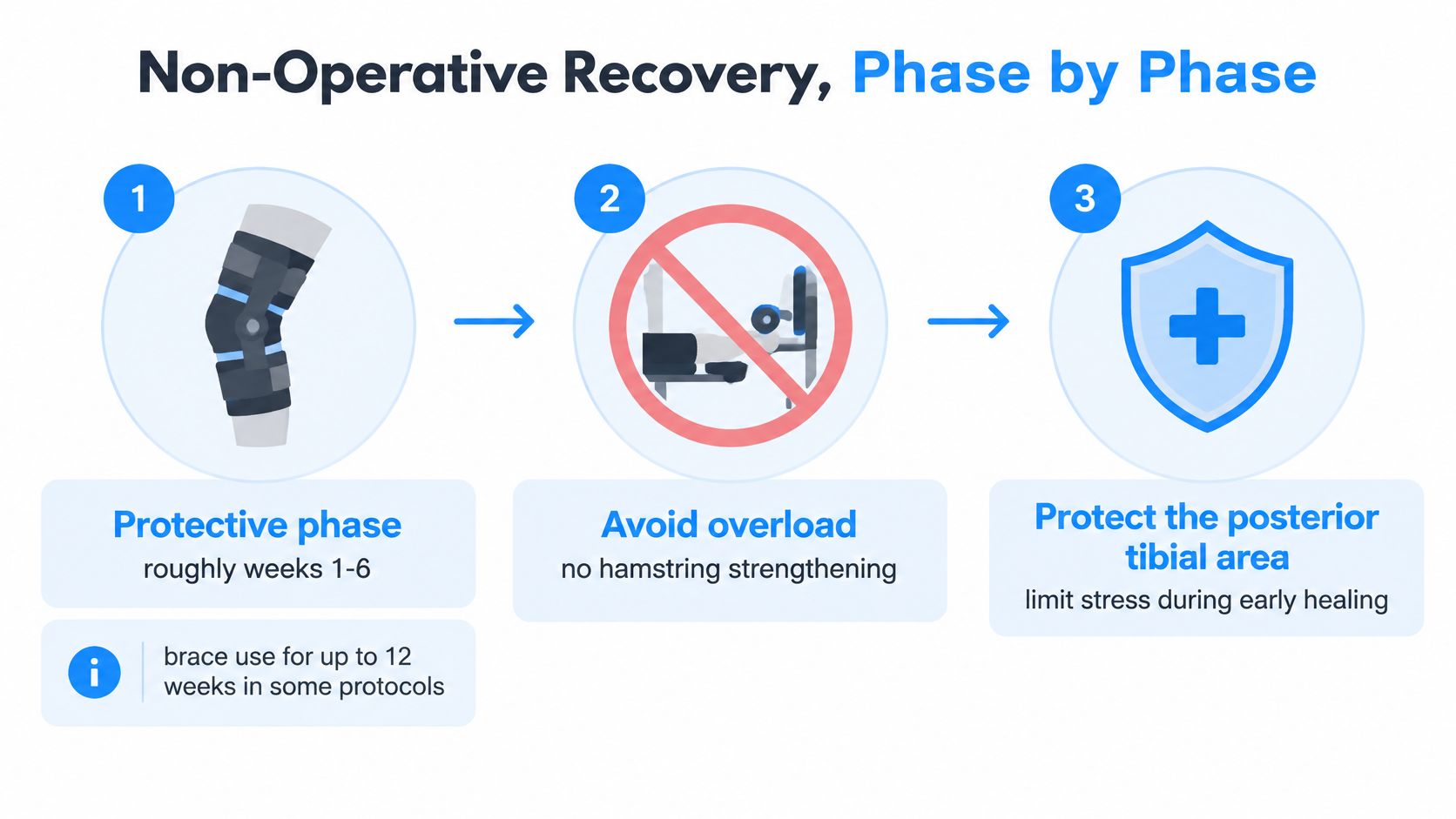
- Protective phase, roughly weeks 1 to 6. The job here is to let the ligament begin healing without stretching it. That means bracing, controlled range of motion, and deliberate avoidance of hamstring strengthening and posterior tibial translation, because a strong hamstring pull drags the shin backwards and loads the healing PCL.
- Transitional functional phase, roughly weeks 6 to 12. Quadriceps and lower-limb strengthening become progressive, and balance and gait work start. Quadriceps control is the priority because it pulls the shin forward and takes load off the PCL.
- The supervised block, about three months overall. A contemporary review describes nonoperative care as roughly three months of supervised physiotherapy covering range of motion, strengthening and a gradual return to activity. This is the stage where daily life should feel close to normal.
- Sport-specific drills, around 2 to 3 months. Change of direction, deceleration and running mechanics enter only once pain and swelling are controlled.
- Full sports clearance, often around 4 to 6 months. Clearance follows strength and functional testing, not the date on the referral letter.
A published case report of a partial PCL tear shows what the sequence looks like when it goes well. The patient completed an eight-week programme combining physiotherapy, eccentric-focused exercise and lumbopelvic treatment. At the eight-week review, knee flexion was pain-free at approximately 140 degrees, pain was reported as 0/10 during weeks 4 to 8, and the posterior drawer test showed a hard endpoint. He returned to tag rugby exactly 12 weeks after the injury, with minor medial quadriceps atrophy still present. That's one case, not a timetable for everyone.
Judge yourself by function at each phase, not by how the knee feels on a good day. Pain settles before control returns.
Outside the clinic, the phase you're in should look like this. In the protective weeks, walking on flat ground, sit-to-stand without hands and straight-leg raises are the daily work. In the transitional weeks, stairs, longer walks and light resistance become reasonable. By the sport-specific stage, you're hopping, landing and changing direction under supervision. Nutrition and sleep sit underneath all of it, and if you're curious how supplement ingredients fit into a joint-recovery plan, this UK guide to joint health ingredients explains what each one does, though nothing replaces the strengthening work.
Non-Operative Care Versus Reconstruction Outcomes
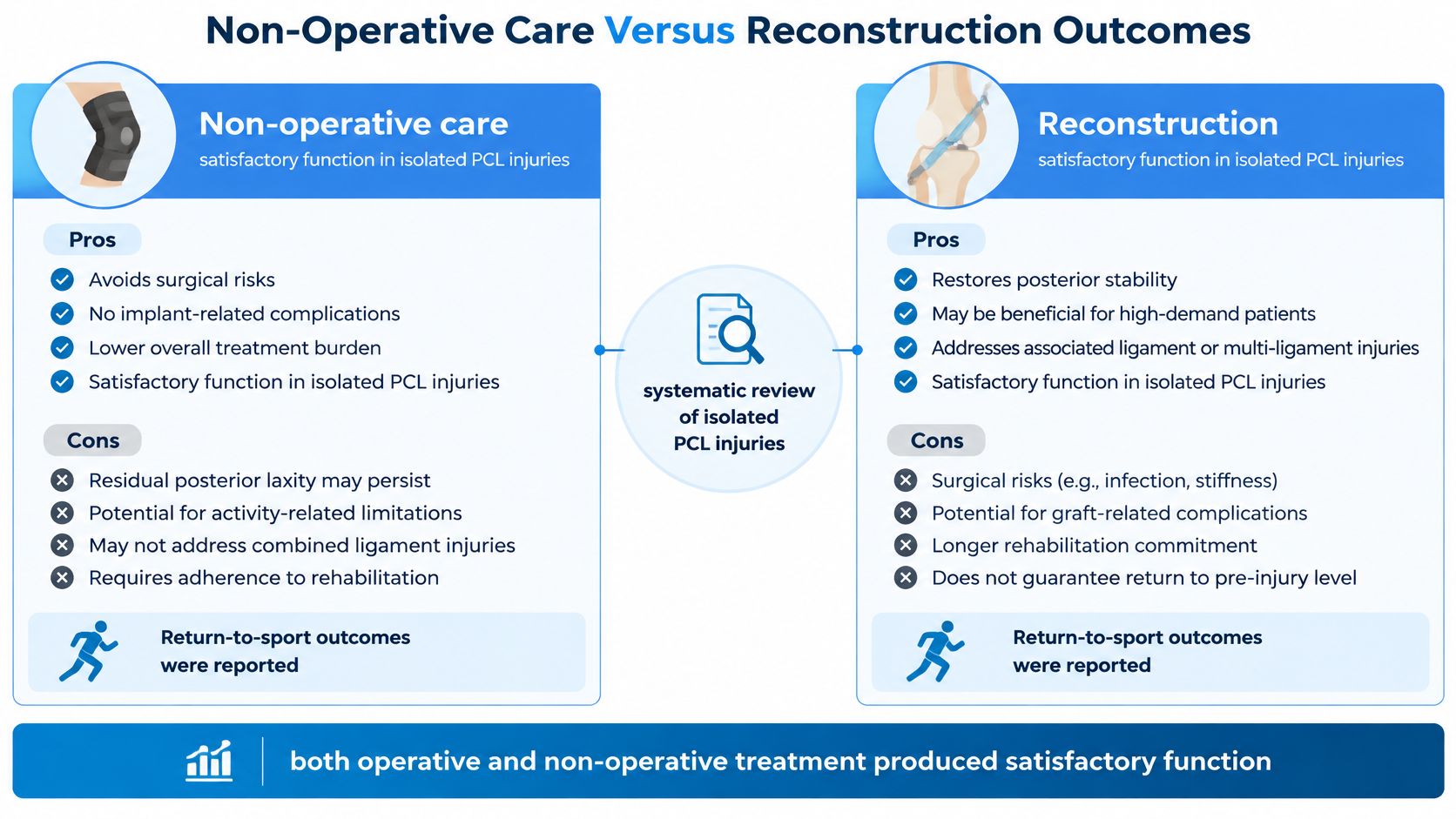
Comparing the two pathways on speed misses the point. On function, they land in similar territory. In a systematic review of isolated PCL injuries, both operative and non-operative treatment produced satisfactory functional outcomes and a return-to-sport rate of roughly 64-77%, with a mean of about 70%. What separated them was residual looseness.
| Pathway | Return to sport | Residual posterior laxity | Typical timeline |
|---|---|---|---|
| Non-operative care, isolated injury | 64-77% across both pathways (mean about 70%) | 5.47 mm | Sport drills 2-3 months, clearance 4-6 months |
| Reconstruction, isolated injury | 64-77% across both pathways (mean about 70%) | 3.43 mm | Sport-specific training 6-7 months, full return 9-12 months |
| Delayed reconstruction after functional bracing, grade III | Selected athletes may return at 16 weeks | Not reported separately in that review | Up to 12 months overall |
That 3.43 mm versus 5.47 mm difference is the whole trade-off in one line. Reconstruction gives a tighter knee. It doesn't automatically give a better-functioning knee, and it costs months. The same review notes that initial functional bracing and rehabilitation, with optional delayed reconstruction, can be reasonable even for some high-level athletes with grade III isolated injuries. Recovery in that pathway may take up to 12 months, although faster return at 16 weeks has been reported in selected athletes.
So: if you can function without surgery, does residual looseness still matter? Sometimes. Weigh your symptoms, the measured laxity, whether the knee gives way repeatedly, what your sport demands, what else is damaged, and what long-term joint wear might follow. A slightly loose knee that never buckles under your actual training load is a different problem from a loose knee that collapses on stairs.
Reassessment triggers: giving-way episodes, swelling that keeps returning, or progress that has stalled for weeks despite structured rehabilitation. Any of those three warrants a fresh look from a knee specialist rather than another month of the same exercises.
Two closing points. Surgery isn't automatically superior for every patient, and non-operative care isn't "wait and see". It is active, staged treatment with its own loading rules, its own progression and its own failure points.
Readiness Milestones After Reconstruction and Non-Operative Care
Surgery resets the clock. Published rehabilitation guidance commonly places sport-specific training at approximately 6-7 months after PCL reconstruction and full return to sport at about 9-12 months, with the actual date influenced by graft healing, strength recovery, associated injuries and the physical demands of your sport, as detailed in this review of PCL reconstruction rehabilitation.
The outcome data behind those windows is encouraging but thinner than it looks. In a systematic review of remnant-preserving PCL reconstruction, most of the patients tracked over several years did get back to sport. The catch is that only a handful of the included studies reported that outcome, so the headline return rate reads as a signal rather than a promise.
Function also keeps climbing after the return date. Comparative follow-ups of ligament-reconstruction patients show knee-related quality-of-life and sport-function scores still improving well after athletes are back on the field. Being cleared to play and playing at your old level are separate achievements, and the second one takes longer.
Why elapsed time can't clear you
Pain relief is the most misleading signal in knee recovery. A PCL that hurts less hasn't necessarily regained the stiffness to stop the shin sliding backwards under load, yet most patient guidance collapses everything into a single range, from about 10 days for a mild injury to 6-9 months after surgery, according to Cleveland Clinic's PCL injury overview. That range is honest about variability and useless as a decision tool.
Conflicting month counts online usually come from answering different questions. Time to comfortable walking, time to running and time to pivoting are three different recoveries sharing one label.
The better question is the one patients rarely see answered: how do I know I am ready, rather than how many months have passed? Readiness is a set of measurements.
The thresholds that decide each activity
| Activity | Functional threshold | Typical timing |
|---|---|---|
| Everyday walking and work | Pain-free walking, no giving-way episodes | Several weeks to months |
| Running and sport-specific drills | Full active range of motion, quadriceps strength close to the uninjured leg | About 2-3 months after conservative treatment |
| Pivoting or contact sport | Passed your clinic's return-to-play testing, stable knee, no giving way | Often about 4-6 months after conservative treatment |
| Sport after reconstruction | Full extension, near-complete flexion, restored quadriceps strength, satisfactory sport-specific testing | About 9-12 months |
Quadriceps strength is the number to watch most closely, and the pass mark is not universal. Clinics set their own cut-offs, but they all measure the same way: your injured leg against your uninjured one, never against a general benchmark. Ask which percentage your clinic requires and where you currently stand on it.
Isolated versus combined injuries
A PCL tear on its own and a PCL tear sitting alongside meniscal, cartilage, ACL or collateral ligament damage are different clinical problems with different rehabilitation rules. Combined injuries are also where a reconstruction decision usually gets made, because the surgeon is already inside the knee. If your imaging shows more than the PCL, expect your specialist to set your timeline rather than a table.
Questions to ask at each review
Three questions keep a review honest. How was my quadriceps strength measured against the other leg, and what was the percentage? Which specific test decides whether I can pivot, and what did I score? And what finding would send me back to an earlier phase rather than forward?
Practical rule: ask for the number, not the impression. "About the same as last time" tells you nothing about how close to the pass mark you actually are.
Between appointments, sleep, protein intake and hydration shape how much of each strengthening session your body keeps, and this guide to sleep and nutrition for recovery covers the basics that support the rehab work. If your knee clicks or pops as it heals, sound alone is not a failure sign, and this explainer on knee pop after ACL surgery covers why noise and stability are judged differently.
Stem Cell Therapy as a Regenerative Option for PCL Tears
Regenerative treatment sits alongside rehabilitation and surgery as a third path, and it earns the most consideration for partial tears that still cause symptoms after a solid course of physiotherapy. Knowing what the cells are proposed to do keeps expectations honest.
What the cells actually do
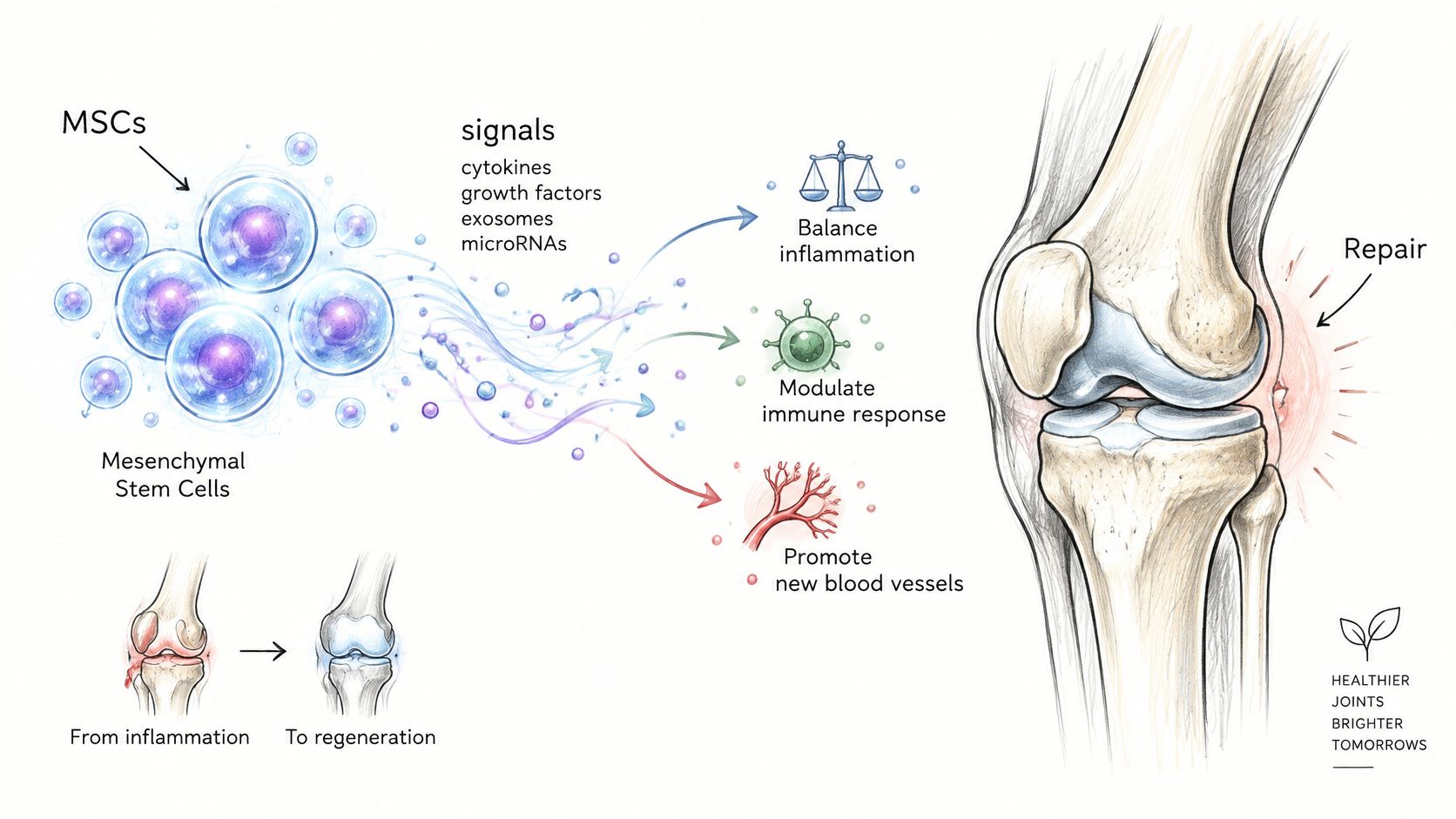
Mesenchymal stem cells (MSCs) are not construction material that gets installed as new ligament. A peer-reviewed review of MSC mechanisms identifies paracrine signaling as the predominant mechanism behind MSC-enhanced tissue repair: the cells release specialised biological signals and extracellular factors that influence inflammation, immune activity, blood-vessel formation and local repair behaviour. In plain terms, they coordinate the healing environment around the tear rather than reliably engrafting and becoming new PCL tissue.
That distinction shapes how you read any regenerative offer. The proposal is support for your body's own repair rather than a guaranteed rebuild of the ligament.
The regulatory picture
Regulators in the United States have not granted broad approval to stem cell therapies for ligament injuries, which is why this treatment happens outside that system. Dream Body Clinic delivers its treatments in Mexico under COFEPRIS, the country's federal health regulator, and patients can ask to review the clinic's current permits directly. The two systems are separate. A Mexican authorisation is not an American one, and vice versa.
What the clinic's knee protocol involves
Dream Body Clinic offers stem cell treatment for knee injuries, including partial ligament tears such as a partially torn PCL. Most knee patients resume daily activities, including exercise and favourite pastimes, within approximately six weeks after treatment, and the exact timeline varies from person to person. The cells continue their healing work for 8 months to a year after the procedure, so improvement is not confined to the first few weeks.
Read those windows the same way you would a surgical timeline: as ranges, not finish lines. Feeling better at six weeks means the symptoms settled early. It does not prove the PCL can handle pivoting loads, so the same objective tests that decide readiness after rehabilitation or reconstruction still decide it here.
Where the evidence stands
Outcome data for PCL-specific MSC protocols is limited, and results vary with tear grade, delivery route, cell preparation, rehabilitation and patient characteristics, so findings from broader MSC research should not be assumed to transfer to a knee ligament. The option fits partial tears that remain symptomatic after structured rehabilitation, in patients who want to avoid or defer an operation. Ask for the protocol in writing, including cell dose and delivery route, so you can compare it with what the rest of your team recommends.
Confirm Your Recovery Plan With a Knee Specialist
Everything above becomes useful only when it's applied to your knee. Three steps turn it into a plan.
- Confirm the grade and check for other damage. Imaging plus a hands-on examination tells you whether you have an isolated PCL injury or a combined one. Your grade determines which row of the table you're running.
- Measure function against the readiness thresholds. Range of motion, quadriceps strength compared with the other leg, stability testing and return-to-play scoring give you numbers instead of impressions.
- Choose a pathway and set review points. Structured non-operative rehabilitation, reconstruction or a regenerative option, with clear triggers to reassess: persistent instability, giving way, recurring swelling or stalled progress.
If you're considering treatment at Dream Body Clinic, verify the paperwork before you commit. Mexico's cellular-therapy oversight runs through COFEPRIS, the Federal Commission for the Protection against Health Risks, which the ClinRegs country summary from NIAID describes as the authority responsible for approving and monitoring human clinical studies, while Mexican law requires establishments handling cells to hold applicable licensing and authorisation. COFEPRIS oversight is separate from FDA approval, so ask to see current permits and regulatory documentation rather than taking a claim at face value.
Ask too about follow-up. The clinic schedules remote reviews at 3, 6 and 12 months, and treatments often take three to six months to fully resolve an issue and settle the pain, though some patients notice change within days or weeks. Get in writing whether those reviews are included and what each one covers. Then book a case review with a knee specialist and bring the recovery table and readiness thresholds from earlier in this article with you.
Dream Body Clinic treats partially torn PCL, meniscus, ACL and MCL injuries with mesenchymal stem cell protocols delivered under COFEPRIS oversight in Mexico, using cells that signal and support your own healing environment rather than replacing tissue. If your knee has plateaued in physiotherapy or you're weighing surgery, the team offers a complimentary case review to see whether a regenerative approach fits your grade and goals. Visit Dream Body Clinic to start that review and get your questions answered before you commit to anything.