
Most injection-site soreness or swelling settles within about 1 week, while pain and function are judged at 6 and 12 months, not on the day of the injection. The stem cell knee injection recovery time therefore has several clocks: the injection's immediate effects, the period of protecting and rebuilding strength, and the longer wait to measure whether daily function has changed.
A quieter knee doesn't prove new cartilage has formed, and a sore knee in the first few weeks doesn't automatically mean the treatment has failed. If you need to fly, walk through airports, or return to work, plan around a possible early discomfort period and ask the treating clinician for activity advice specific to your knee and treatment.
Table of Contents
- Stem Cell Knee Injection Recovery Time at a Glance
- Why the Knee Does Not Rebuild Overnight
- How to Progress the Knee Week by Week
- Pain and Function Checks at 6 and 12 Months
- Symptoms That Need Urgent Care
- Habits That Protect the Recovery Window
- What the Evidence Does Not Settle
- Plan Follow-Up Before You Fly Home
Stem Cell Knee Injection Recovery Time at a Glance
The practical starting point is about one week for possible injection-related soreness or swelling, followed by a much longer period before judging pain and function. A 2024 systematic review covering 1,924 patients found that 12.3% experienced transient adverse events, most commonly pain or swelling at the injection site. Most reported events resolved within one week, although some lasted less than four weeks. The studies didn't report major short-term complications such as infection, sepsis, cancer, embolism, or death, but the treatments and follow-up methods differed substantially.
| Phase | Usual symptoms | Activity limit | When it is judged |
|---|---|---|---|
| Procedure day | Numbness wears off into an ache | Short walking and same-day discharge, if the clinic permits | Hours |
| Days 1 to 7 | Injection-site pain, swelling, or mild effusion | Use crutches or shorter strides if limping; avoid impact | Most reactions resolve within 1 week; some last under 4 weeks |
| Weeks 2 to 4 | Irritability easing | Work on range of motion and quadriceps activation; skip previously painful tasks | At the end of the first month |
| Months 1 to 4 | Gradual strength gains and less swelling | Progress resistance; water exercise may come before land impact | About 4 months in a cited rehabilitation program |
| 6 months | Pain, stiffness, and function scores | Consider impact only when gait, swelling, and quadriceps control are normal | WOMAC mean difference of 7.44 points versus control |
| 12 months | Durability of pain and function | Reset work or sport goals based on measured function | WOMAC mean difference of 10.31 points versus control |
The first week is mainly about tolerating the procedure and managing local symptoms. A comfortable knee after a few days doesn't establish that tissue has repaired. Conversely, soreness at three weeks isn't automatic evidence of failure, because reactions and recovery vary with the treatment protocol and the person's condition.
Plan around your actual travel demands
For an international patient, “short walking” means more than getting from a clinic bed to a car. Airport queues, stairs, luggage, and long terminal walks can add up, so ask whether crutches are likely and how much walking is sensible before booking a flight home. If you need to work on your feet, include those demands in the plan rather than treating desk work and a full walking shift as equivalent.
The timeline also shifts with osteoarthritis severity, a partial meniscus or ligament injury, bone-marrow harvest, rehabilitation, and how much walking your work or travel requires. There's no standardized timetable that guarantees when any one knee will feel better.
Why the Knee Does Not Rebuild Overnight
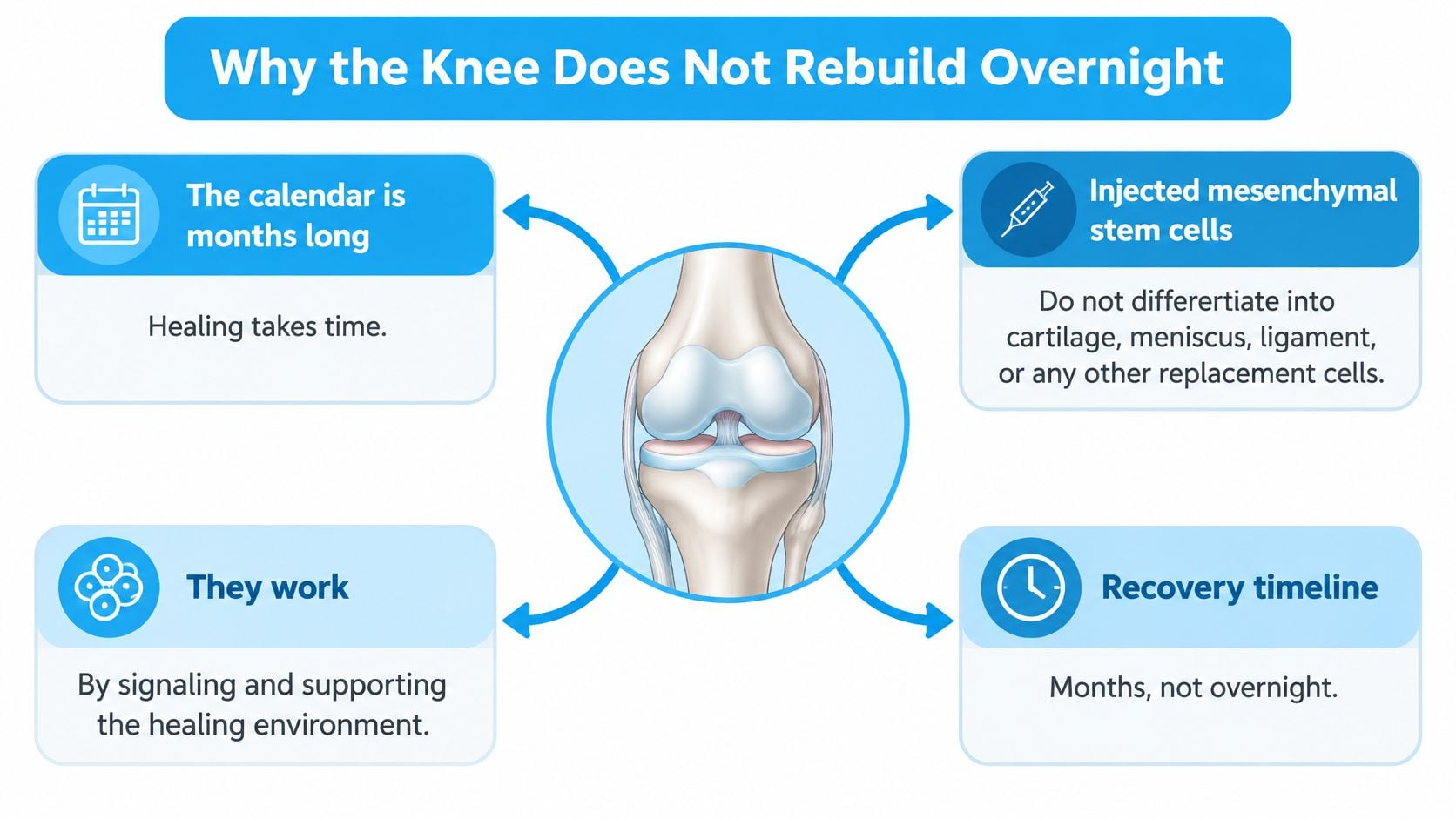
Injected mesenchymal stromal cells don't differentiate into cartilage, meniscus, ligament, or other replacement cells. Instead, they work through the paracrine effect: they send specialized signals that guide the healing environment. A review of knee osteoarthritis research describes these cells as influencing local inflammation, cell survival, and proliferation through signaling rather than reliably turning into new cartilage cells (peer-reviewed review of MSC mechanisms).
Those signals include cytokines, growth factors, and extracellular vesicles. Think of the cells as temporary biological coordinators, not replacement parts. They may influence the local immune environment and recruit the patient's own repair cells, but that doesn't mean they've rebuilt a meniscus or filled a cartilage defect. For a plain-language overview of this signaling approach, see how stem cell injections work.
Symptoms and structure are different measures
Pain can change as inflammation and signaling change, before an MRI shows any structural difference. Some studies have found no significant change in cartilage defects during follow-up, even when patients' symptoms may be assessed separately. That's why a reduction in pain is meaningful as a symptom change, but it isn't proof that cartilage has regenerated.
The same distinction helps make sense of the early recovery period. Injection-related soreness can happen while the knee is adjusting, and feeling better doesn't demonstrate that a specific defect has filled in. Neither response, by itself, tells you exactly what the tissue looks like.
Your pace of recovery can also reflect baseline arthritis, inflammatory state, activity level, and rehabilitation. Foot mechanics may affect knee discomfort during walking, too. If that's part of your situation, this guide to understanding knee discomfort with Insoles can help you consider how foot-related factors may contribute.
Score progress with practical measures: walking distance, stair tolerance, night pain, and pain-medication use. Those describe how the knee functions in your life without making an unsupported claim about new cartilage.
How to Progress the Knee Week by Week
A safe return to activity follows the knee's response, not a single calendar date. The first days focus on settling injection soreness; protected loading and strength work build over a longer stretch. Follow the treating clinic's instructions, especially if your procedure included bone-marrow aspiration or another intervention that changes loading advice.
For the first 48 to 72 hours, keep the knee quiet. Raise it when resting. Use ice only if the clinic allows it, and follow its pain-relief plan rather than adding medication on your own. The goal is to avoid irritating a knee that may already feel tender.
Through the first week, protect your walking. Use crutches or shorten your stride if you're limping. Skip stairs as exercise, squats, and long sightseeing walks. A limp is a cue to reduce the load, not push through it.
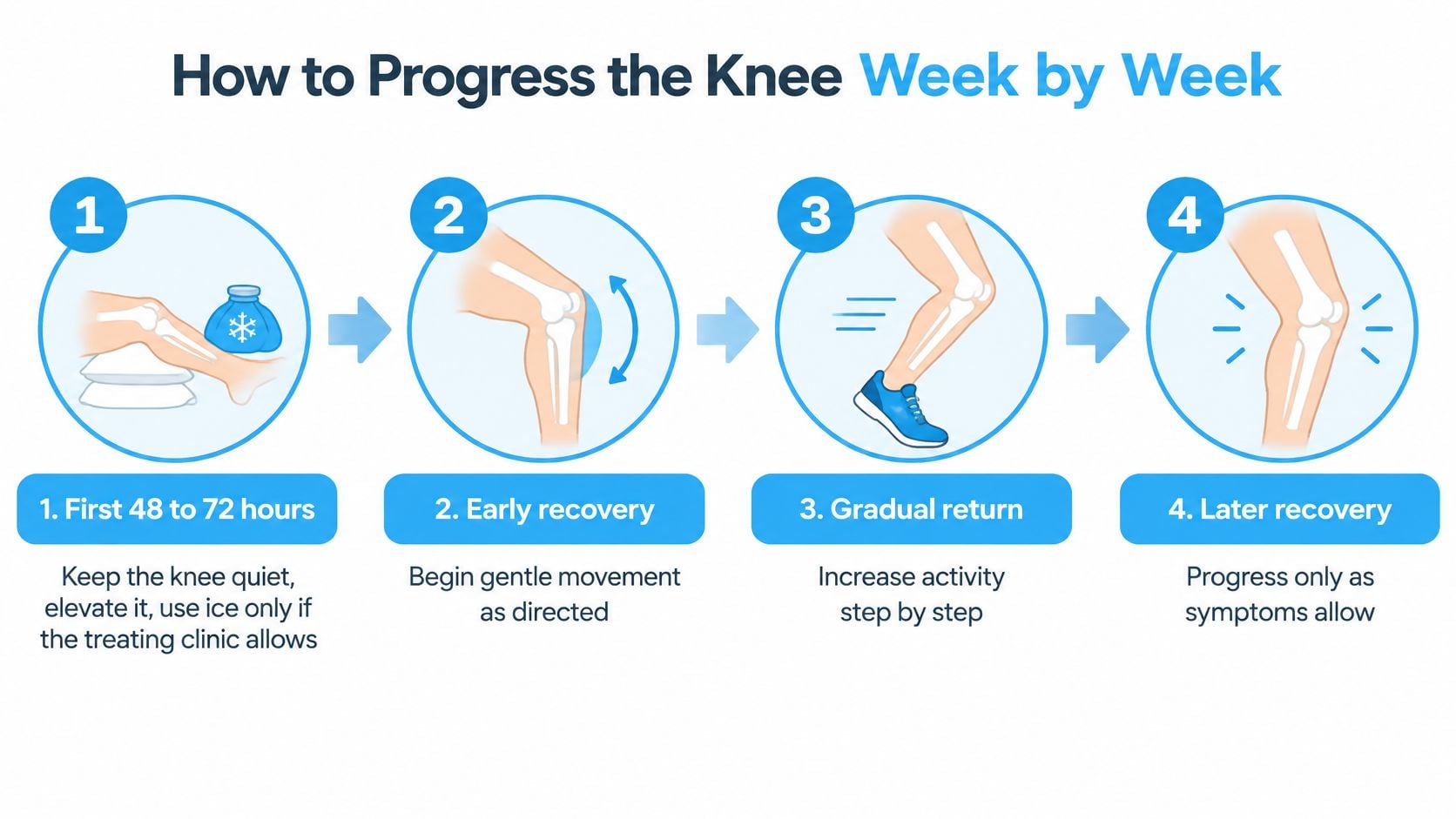
When swelling is stable, restore comfortable motion. Begin range-of-motion work and simple quadriceps activation as directed. This might include tightening the thigh muscle or doing straight-leg raises, if your clinician approves. Gentle movement works like easing a stiff hinge: it helps you practise control before demanding more from the knee.
As irritability settles, build strength gradually. Progress toward full weight-bearing, then resistance work, under guidance. One reviewed program used supervised progressive resistance training with water- and land-based exercise over approximately four months. A few easy days do not necessarily mean the knee is ready for hard training. Increase activity according to your clinician's knee-specific plan, using science-backed strategies for consistent muscle growth only as a general reminder to progress in steps, not as knee-recovery guidance.
Hold impact and heavy loading until the knee can control them. Wait on running, jumping, pivoting, and deep loaded knee bends until your gait is even, swelling is quiet, and your quadriceps can control the knee on stairs. Ask your clinician before returning to sports or heavy work.
Keep a simple function log. Record walking time, how stairs feel, and whether pain interrupts sleep. These concrete notes can help you and your clinician compare day-to-day function at follow-up. A quieter knee is useful information, but it does not by itself show that cartilage has regrown.
If you're flying home two days after treatment, arrange help with aisle access and bags, and avoid planning resort hikes that week. Sitting and walking during travel can both add demands, so plan a manageable trip and follow your clinic's advice about movement.
Pain and Function Checks at 6 and 12 Months
WOMAC scores, which cover pain, stiffness, and physical function, improved versus control by a mean of 7.44 points at 6 months and 10.31 points at 12 months in a 2025 systematic review and meta-analysis (systematic review of knee MSC outcomes). These are group averages, not a prediction for one person, and they do not show that cartilage regenerated. MSCs are understood to act through paracrine signals, so a quieter knee is not proof of new cartilage. Judge recovery by pain and function.
Studies commonly assess knee MSC outcomes at 3, 6, and 12 months, rather than judging the result in the first days after injection. A 2024 analysis found that follow-up was concentrated at these medium-term points, with fewer studies extending to 24 months. Use each checkpoint to compare daily function with a clear baseline.
| Checkpoint | What to record | What studies generally show |
|---|---|---|
| 3 months | Walking minutes, swelling trend, pain score | A 2024 Cochrane review found little to no pain difference at 3 to 6 months, with a weighted mean difference of −0.74 cm on a 10-cm pain scale. This checkpoint alone cannot settle longer-term function. |
| 6 months | WOMAC or KOOS, pain score, stair tolerance | WOMAC mean difference of 7.44 points versus control |
| 12 months | The same scores, plus work or sport tolerance | WOMAC mean difference of 10.31 points versus control; most trials followed patients for less than a year |
| 24 months | The same measures, if longer follow-up is arranged | Few trials extend this far, so the evidence is thinner |
Don't confuse outcome measures with cure rates
A review of randomized controlled trials found that 19 of 26 clinical outcome measures, or 73%, improved versus control at one year. This counts measured outcomes across reviewed trials. It does not mean that 73% of individual patients were cured, avoided surgery, or grew new cartilage.
Individual results can differ with arthritis grade, alignment, meniscus or ligament damage, cell product, dose, and rehabilitation. Those factors help explain why a group average cannot forecast one person's response.
At follow-up, pair a pain score with practical tasks: how long you can walk, how stairs feel, whether stiffness follows sitting, and whether pain wakes you at night. WOMAC or KOOS can help track changes in symptoms and function. Think of the scores as a dashboard, not a scan: they describe how the knee works and feels, not whether its structure has been repaired.
Symptoms That Need Urgent Care
A tourist on day three has a puffy knee, no fever, and an ache that's slowly easing. That pattern can fit ordinary post-injection irritability. A local ache, warmth, or mild swelling that stays steady or gradually improves is different from pain and redness that keep getting worse.
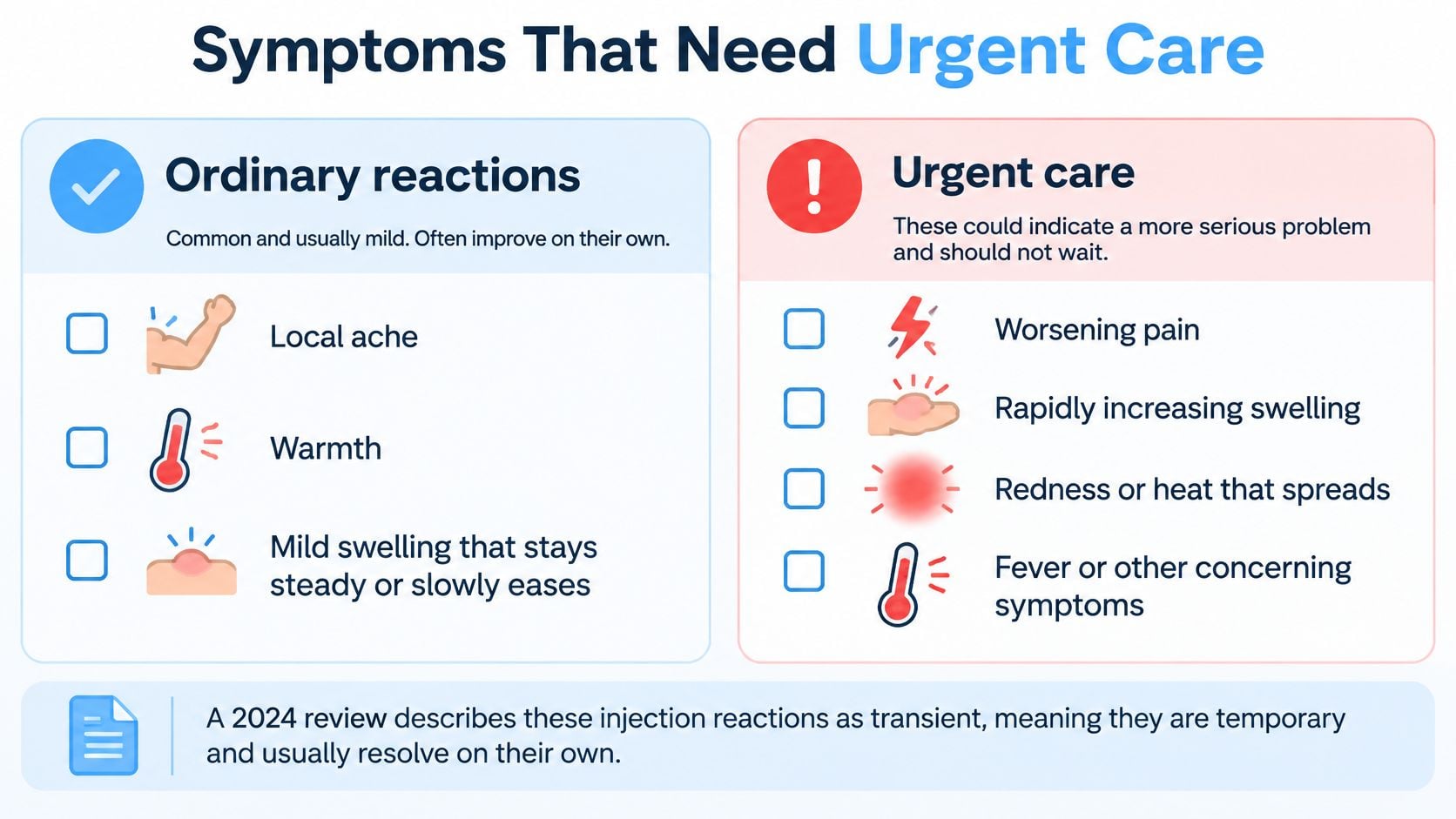
A patient on day five with rising pain, fever, and spreading redness shouldn't assume the cells are “working.” Contact the treating clinic the same day for urgent symptoms. Go to local emergency care if fever, marked calf swelling, chest symptoms, or inability to walk occurs, especially after a long flight.
Know what changes the plan
Contact the clinic promptly if you develop fever, spreading redness, escalating pain, drainage from the injection site, sudden inability to bear weight, or marked calf swelling or pain. These aren't typical symptoms to monitor at home, because they may need assessment for infection, a blood clot, or another complication. If you can't reach the treating team, use local urgent or emergency services.
A long trip can make calf symptoms particularly important to take seriously. Don't try to diagnose the cause yourself or wait for a scheduled remote check-in if a concerning symptom is getting worse. For more on responding to escalating discomfort, see this guide to worse pain after a stem cell injection.
Habits That Protect the Recovery Window
Recovery runs on more than one clock. Injection soreness may settle over days, while returning to protected loading and regular activity can take months. During this window, steady habits help you take part in rehabilitation without treating a quieter knee as proof that new cartilage has formed.
Use practical travel habits rather than trying to speed up the biology. Cap continuous walking, take elevators early, and break long airport routes into shorter bouts. After sitting or standing for a while, rest the knee before walking again. This can make getting through travel easier without asking the knee to handle one long stretch of activity.
Avoid adding several new approaches at once, such as supplements, another injection, or a protocol marketed as a healing accelerator. Changing multiple things together can make it harder to tell what is helping or worsening symptoms. If you are considering supplements, timing supplements for better recovery offers general context, but your medicines and procedure are specific to you.
Steady sleep, protein-containing meals, and not smoking support overall health and your ability to participate in rehabilitation. They do not set a fixed recovery schedule. Symptoms may feel worse for several days before improving; that can reflect local irritation, but it does not show whether cartilage has formed.
Make your goals measurable: Choose a walking distance, a set of stairs, and a pain-tablet goal for month six. Compare your progress with your walking, stair, and night-pain log, and discuss medication changes with your clinician.
What the Evidence Does Not Settle
The U.S. Food and Drug Administration has not approved regenerative medicine therapies for treating orthopedic conditions, including knee pain and osteoarthritis, in the United States. No stem-cell product has been approved there for those uses, according to the FDA's patient and consumer information. Regulatory rules differ by country, so ask what applies where you'll receive treatment.
The evidence is mixed. A 2024 Cochrane review found that, at three to six months, MSC therapy probably produced little to no difference in pain relief, with a weighted mean difference of −0.74 cm on a 10-cm pain scale (Cochrane review indexed by PubMed). A medical-policy review described one phase 3 trial with no significant advantage over intra-articular corticosteroid injections at 12 months, while another phase 3 randomized trial reported better pain, function, and patient-reported outcomes than placebo at six months. The same review characterized the overall evidence as low quality (medical-policy evidence review).
Cell sources, preparation methods, doses, comparison groups, and patient populations differ, so results from one protocol can't automatically be applied to another. Before booking, ask the clinic which product and dose it proposes, what evidence applies to your specific knee condition, and how the plan compares with established options your orthopedic clinician discusses. You can also review information about stem cell therapy for osteoarthritis as part of that conversation.
Plan Follow-Up Before You Fly Home
Before booking, ask the treating clinic how long walking is reasonable after your procedure, whether you're likely to need crutches, when exercise can restart, and which symptoms should prompt urgent care. Ask which cell product and protocol they plan to use, and whether your treatment includes a bone-marrow harvest that could change your loading or travel advice.
Clarify how follow-up works: will reviews be remote, in person, or both, and can you arrange checks around 3, 6, and 12 months? Put each appointment on your calendar and record walking minutes, stair tolerance, night pain, and medication use so you can describe function clearly.
Plan the first week as possible downtime, not a vacation workout. Build your flight, luggage arrangements, and work return around the clinic's instructions, rather than assuming that walking the same day means you're ready for long sightseeing days. Dream Body Clinic's website is dreambody.clinic, where you can begin asking practical questions about treatment and follow-up.
The cells don't differentiate into replacement cells; they guide the healing environment through paracrine signals. The honest goal is measured pain and function, not a guaranteed structural rebuild or a promise that surgery will be cancelled.
Dream Body Clinic offers MSC therapies, including knee treatment, and structured remote follow-up for international patients. If you're considering an injection, visit Dream Body Clinic to ask about the proposed protocol, travel planning, and how your pain and function will be reviewed after you return home.