
You feel the knee buckle during a turn, hear or sense a pop, and watch the joint swell before the day is over. Then come the MRI, the orthopedic appointment, and the late-night search for alternatives to reconstruction. Stem cell therapy for an ACL tear appears promising, but the useful question isn’t whether cells sound regenerative. It’s whether your specific tear still has enough viable ligament and mechanical stability for a biologic treatment to matter.
My position is direct: cells can support healing in selected partial tears and can augment reconstruction, but they can’t heal complete ruptures. The decision should begin with analysis, which is why we always start with an MRI then a consultation where our doctors show the images and really explain whether you are a good candidate or not for Knee Stem Cell Treatment – 50 Million Mesenchymal Stem Cells & and MRI
Table of Contents
- The Moment Everything Changes in Your Knee
- How MSCs Actually Help an ACL Heal
- Partial Versus Full-Thickness Tears and Who Qualifies
- What the Published Evidence Actually Shows
- Inside a Realistic ACL MSC Protocol
- Stem Cell Injection Versus Reconstruction Versus Rehab
- Costs, Travel, and Follow-Up for International Patients
- Safety, Regulation, and Questions Worth Asking
The Moment Everything Changes in Your Knee
An athlete plants a foot to change direction. There isn’t always contact. Sometimes the knee collapses inward during a landing, or a slow twist produces a sharp pop followed by swelling. The athlete tries to walk it off, then realizes the knee no longer feels trustworthy.
The next days become a cascade of decisions. A clinician orders an MRI. A surgeon discusses reconstruction. Friends recommend exercises, PRP, or stem cells. Online searches mix partial tears, complete ruptures, BMAC, culture-expanded MSCs, meniscus injuries, and postoperative graft healing into one apparently simple category.
That confusion has consequences. A minimally displaced partial tear with preserved fibers is biologically different from a fully ruptured, retracted ACL. A knee that hurts but remains stable is also different from one that gives way during pivoting. Those distinctions determine whether an injection is a reasonable experiment, a possible surgical adjunct, or a distraction from a mechanical problem.
The evidence does not support presenting cells as guaranteed ligament regeneration, but we have found that the majority of patients we deem candidates heal their ligament.
The practical question: Can the remaining ACL fibers be guided toward better healing, or has the knee lost the structure required for stability?
That is the question a responsible consultation must answer before anyone discusses an injection. This is why we start with an MRI then consultation for this treatment Knee Stem Cell Treatment – 50 Million Mesenchymal Stem Cells & and MRI
How MSCs Actually Help an ACL Heal
Mesenchymal stem cells, or MSCs, shouldn’t be described as replacement ligament cells. They do not just enter a torn ACL, differentiate into new ACL fibers, and rebuild the ligament on demand.
Their proposed role is more indirect. Think of injected MSCs as a veteran coach arriving beside a damaged team. The coach doesn’t become every player. Instead, the coach sends instructions that influence how the surrounding players respond.
The signal comes first
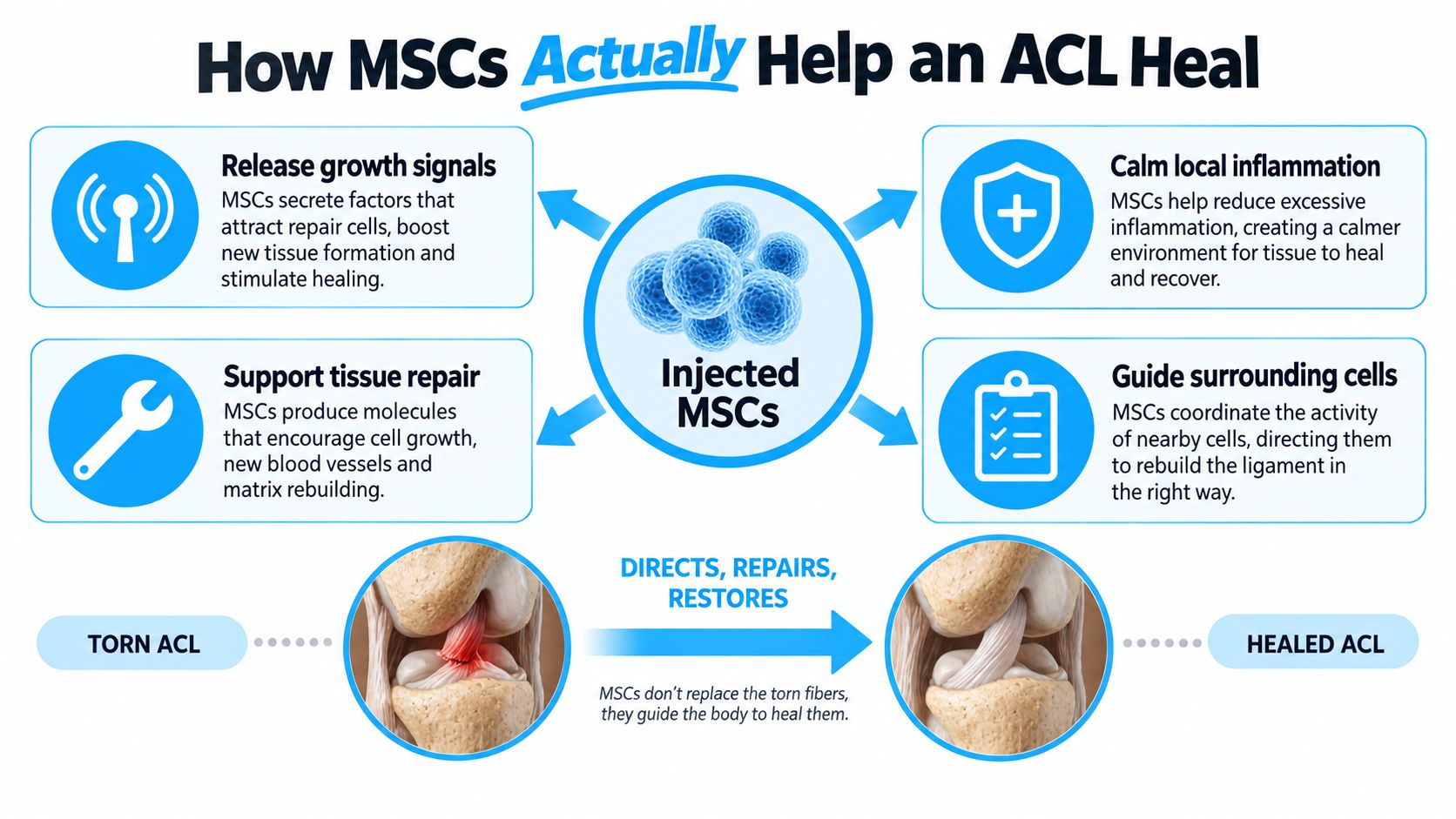
MSCs primarily act through paracrine signaling. They release growth factors, cytokines, chemokines, and extracellular vesicles that influence the local healing environment. Reported signals include PDGF, bFGF, and TGF-β, which may support native ligament-cell proliferation and migration, reduce excessive inflammation, recruit or activate the body’s repair cells, and encourage extracellular-matrix production (review of MSC mechanisms in ACL repair).
That mechanism changes the treatment promise. The injected cells guide the body’s response. They don’t differentiate into other cells to create a new ACL tissue on command, but they do guide the tissue repair and regeneration. If intact ligament fibers remain close enough to respond, improved signaling can support remodeling. If the ligament is fully separated and retracted, signaling alone can’t reliably recreate the missing mechanical bridge.
The playbook matters more than the headline
A protocol should therefore ask:
- What tissue remains? MRI should describe partial versus complete disruption, fiber continuity, and displacement.
- How stable is the knee? Lachman, pivot-shift, and instrumented laxity findings matter more than pain alone.
- What else is injured? Meniscal damage can change both treatment choice and rehabilitation.
- Can the patient complete rehabilitation? A biologic injection can’t replace progressive strength, neuromuscular control, and load management.
For patients exploring the biology behind this approach, this explanation of the knee extracellular matrix provides useful context. The central point remains simple: MSCs are signaling cells in this setting, not preassembled ligament tissue.
A short visual summary of that mechanism is shown below.
This video offers additional background on the treatment concept.

Partial Versus Full-Thickness Tears and Who Qualifies
Tear pattern is the first eligibility test. A clinic that discusses MSCs before reviewing MRI images and examining knee laxity is starting in the wrong place.
Partial tears with preserved fibers
A grade I or II partial tear, with visible continuity and limited instability, is the clearest injection pathway. The reasonable aim is not to promise a regenerated ACL. It is to support the remaining tissue while the patient follows a disciplined rehabilitation program. PRP may be considered as an adjunct, depending on the clinician’s protocol and the injury pattern.
A high-grade partial tear is more complicated. If the knee remains stable, a stem cell approach may still be considered. If the patient reports repeated giving way or testing shows substantial laxity, the case moves toward surgical stabilization.
Complete ruptures
A complete rupture in a low-demand patient isn’t automatically a surgical emergency. Some people can function well with rehabilitation if they don’t need pivoting sports or physically demanding activities. But the decision must be based on objective stability and daily demands, not on the word “stem cell.” We have helped many patients with complete ACL tears with the Knee Stem Cell Treatment – 50 Million Mesenchymal Stem Cells & and MRI , but it was to heal cartilage, meniscus or other ligament issues.
A retracted complete rupture is a poor candidate for injection alone. When the ligament ends are separated or no longer provide a functional scaffold, paracrine signaling can’t substitute for mechanical reconstruction.
Meniscus and associated injuries
A combined ACL and meniscus injury deserves a broader plan. Meniscal displacement, locking, cartilage damage, and recurrent instability can change the order of treatment. In those cases, an injection should never be used to postpone an orthopedic assessment just because it sounds less invasive.
Dream Body Clinic describes its knee protocols in the context of partial ACL, partial PCL, meniscus, and arthritis presentations, rather than treating every MRI finding as a full reconstruction alternative (published knee treatment context). That distinction is important for patients comparing providers.
The practical ACL standard is clear: define tear pattern, instability, meniscal injury, skeletal maturity, and rehabilitation status before considering cellular augmentation. BMAC remains investigational biologic support, not a guaranteed substitute for reconstruction in an unstable complete tear (ACL evidence review).
What the Published Evidence Actually Shows
The strongest evidence is less dramatic than many clinic advertisements suggest. It supports possible effects on graft remodeling and the local healing environment, but it hasn’t established reliable improvements in stability, return to sport, or avoidance of later surgery.
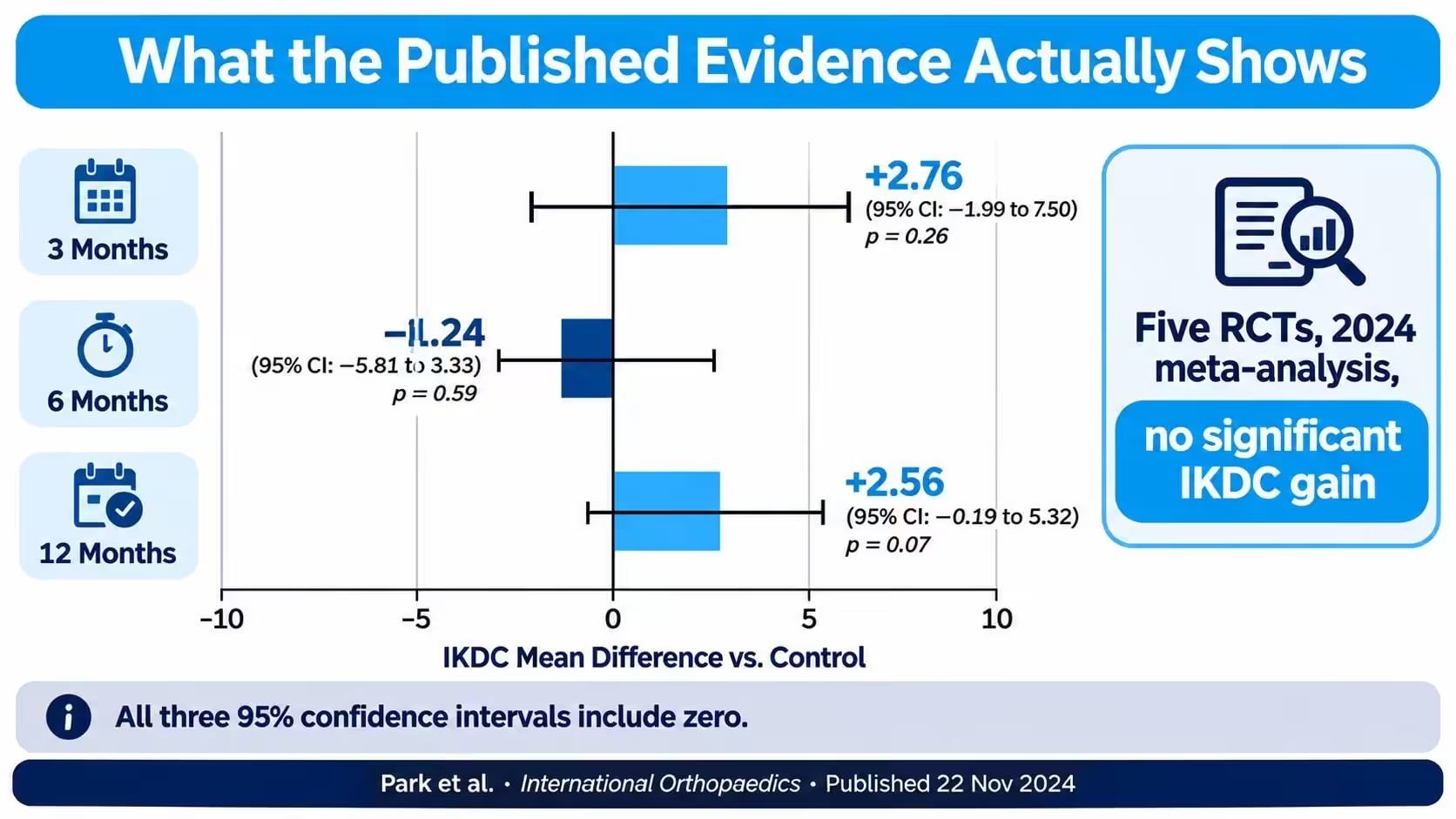
A 2024 meta-analysis evaluated five randomized controlled trials involving 221 patients and found no significant IKDC improvement when BMAC was added to ACL reconstruction at three, six, or twelve months (2024 BMAC meta-analysis). MRI findings suggested that graft recovery might improve, but complication rates were comparable, and the later IKDC difference was considered unlikely to be clinically important.
A positive number can still have limited meaning
One double-blinded randomized trial involving 80 patients receiving bone-patellar-tendon allograft reconstruction reported mean IKDC scores of 81.6 with BMAC versus 74.6 in controls at nine months, with a reported p value of .048 (randomized BMAC trial). However, the proportion reaching the minimal clinically important improvement was 89% versus 85%, and that difference wasn’t significant, with p = .7.
That distinction matters. A statistically different average score isn’t the same as a meaningful difference that patients consistently feel or that changes their ability to cut, land, compete, or avoid another operation.
A separate randomized pilot study combining BMAC with an amnion-collagen wrap found no significant two-year differences in graft MRI measures or patient-reported outcomes. It reported no infections, persistent effusions, stiffness, or reconstruction failures among 40 patients, but that finding doesn’t prove that the approach prevents failure in broader populations.
What the reviews say about replacement therapy
A synthesis of ACL stem-cell research identified only 11 eligible studies and concluded that clinical studies hadn’t demonstrated a significant advantage over hyaluronic acid or standard care (ACL stem-cell review). Another review found that partial-tear evidence consisted of case series rather than randomized trials, while reconstruction research included more randomized studies.
So define success correctly. MRI continuity, instrumented laxity, patient-reported function, return to pivoting sport, and avoidance of later reconstruction are separate outcomes. Cells may improve the healing environment, but they aren’t yet proven ligament regenerators.
Inside a Realistic ACL MSC Protocol
A responsible protocol begins before the injection. The clinician should review the original MRI, examine the knee, document instability, assess meniscal and cartilage findings, and determine whether the patient has completed meaningful rehabilitation.
Before treatment
Bring the full MRI study, not only the radiology summary. The images can reveal fiber continuity, retraction, associated injuries, and findings that alter candidacy. The physical examination should include ligament testing and a functional discussion about giving way, work demands, and sport.
The treatment plan should also state whether the cells are autologous or donor-derived, how they’re processed, what adjuncts are used, and how the clinic will reassess the knee. A cell number by itself doesn’t establish quality or effectiveness.
During and after the injection
Dream Body Clinic’s published orthopedic protocols describe MSC dosing commonly in the 25 to 100+ million cell range, often paired with PRP and pre- and post-treatment MRI to track changes in the knee (clinic knee protocol). Image-guided intra-articular delivery may help the clinician place the treatment appropriately, but guidance doesn’t turn an unstable complete rupture into a stable ligament.
A typical clinic visit may be organized as a short outpatient treatment window, with assessment and injection completed during the same visit. Patients should leave with written activity restrictions, warning signs, rehabilitation instructions, and a named contact for complications.
Follow-up must measure more than pain
A useful follow-up plan tracks symptoms, range of motion, strength, episodes of giving way, and rehabilitation progress. Repeat MRI can show structural changes, but it shouldn’t be treated as proof of mechanical success without examination or laxity testing.
Patients can review the clinic’s description of stem cell procedures for knees and then ask which elements apply specifically to their ACL tear. The correct protocol is the one matched to the injury, not the one with the largest advertised cell count.
Stem Cell Injection Versus Reconstruction Versus Rehab
These options solve different problems. Rehabilitation builds control and capacity. Reconstruction restores a mechanical stabilizer. MSC injection may influence the healing environment when viable tissue remains. None of those roles should be confused.
| Outcome | MSC Injection | Structured Rehab | ACL Reconstruction |
|---|---|---|---|
| Mechanical stability | May support selected partial tears, but isn't proven to stabilize an unstable complete rupture | Can improve control and function, but can't replace a deficient ACL in every patient | Directly addresses mechanical deficiency with a graft |
| Best fit | Preserved fibers, limited instability, and informed acceptance of uncertainty | Stable or functionally manageable knees, especially when pivoting demands are low | Recurrent giving way, high-demand pivoting activity, or associated injuries requiring stabilization |
| Return to sport | Highly variable and dependent on tear pattern and rehabilitation | Highly variable, with activity limited by stability and symptoms | Often involves a lengthy staged rehabilitation before pivoting sport |
| Re-tear and later surgery | Long-term prevention remains unproven | Surgery may still become necessary if instability persists | Graft failure and later problems remain possible, so rehabilitation remains essential |
| Main trade-off | Lower procedural burden, uncertain mechanical benefit | Avoids surgery but may not solve instability | More invasive, with substantial rehabilitation and surgical risks |
Reconstruction is the more defensible route when the knee repeatedly gives way, the patient wants to return to pivoting sport, or the ACL is fully disrupted with associated meniscal injury. An injection may be reasonable when MRI shows a partial tear, the knee remains functionally stable, and the patient understands that delaying surgery isn't the same as avoiding it.
Five-to-ten-year predictions about re-tear or osteoarthritis shouldn't be presented as settled benefits of MSC treatment. The current evidence doesn't establish that an injection prevents reinjury, later reconstruction, or degenerative change. Those outcomes require long-term follow-up, not an early improvement in pain or MRI appearance.
Costs, Travel, and Follow-Up for International Patients
Cross-border treatment adds logistics to a decision that is already medically complex. Before comparing prices, ask what the quoted package includes. Consultation, MRI review, PRP, injection guidance, imaging, rehabilitation support, flights, lodging, ground transfers, and physical therapy at home may be handled by different parties.
For a Mexico-based clinic, request a written treatment quote and ask whether the cost changes with cell source, dose, added PRP, imaging, or treatment of associated injuries. U.S. cash-pay biologic pricing can also vary by product and delivery method, so a low headline figure isn't meaningful until the inclusions are clear. The clinic's published information on stem cell knee injection cost should be treated as a starting point for a personalized quote, not a substitute for case review.
A practical Bucerias plan
Dream Body Clinic reports serving patients from more than 40 countries, with English-speaking coordination by phone and WhatsApp and remote follow-up at approximately three, six, and twelve months (international patient information). A sensible sequence is:
- Before departure: Send MRI images, reports, medication details, prior surgery records, and a clear description of instability.
- On arrival: Complete the clinical assessment and confirm that the planned treatment still matches the examination.
- After treatment: Follow the activity and rehabilitation plan, know how to report swelling or fever, and arrange local physical therapy before returning home.
Patients should also plan healthcare visits while traveling, including recovery time and backup communication, using planning healthcare visits while traveling as a practical travel-planning resource. Bucerias and the Puerto Vallarta area offer tourism infrastructure, which can make the trip easier to organize, but sightseeing shouldn't replace medical follow-up or appropriate rest.
Safety, Regulation, and Questions Worth Asking
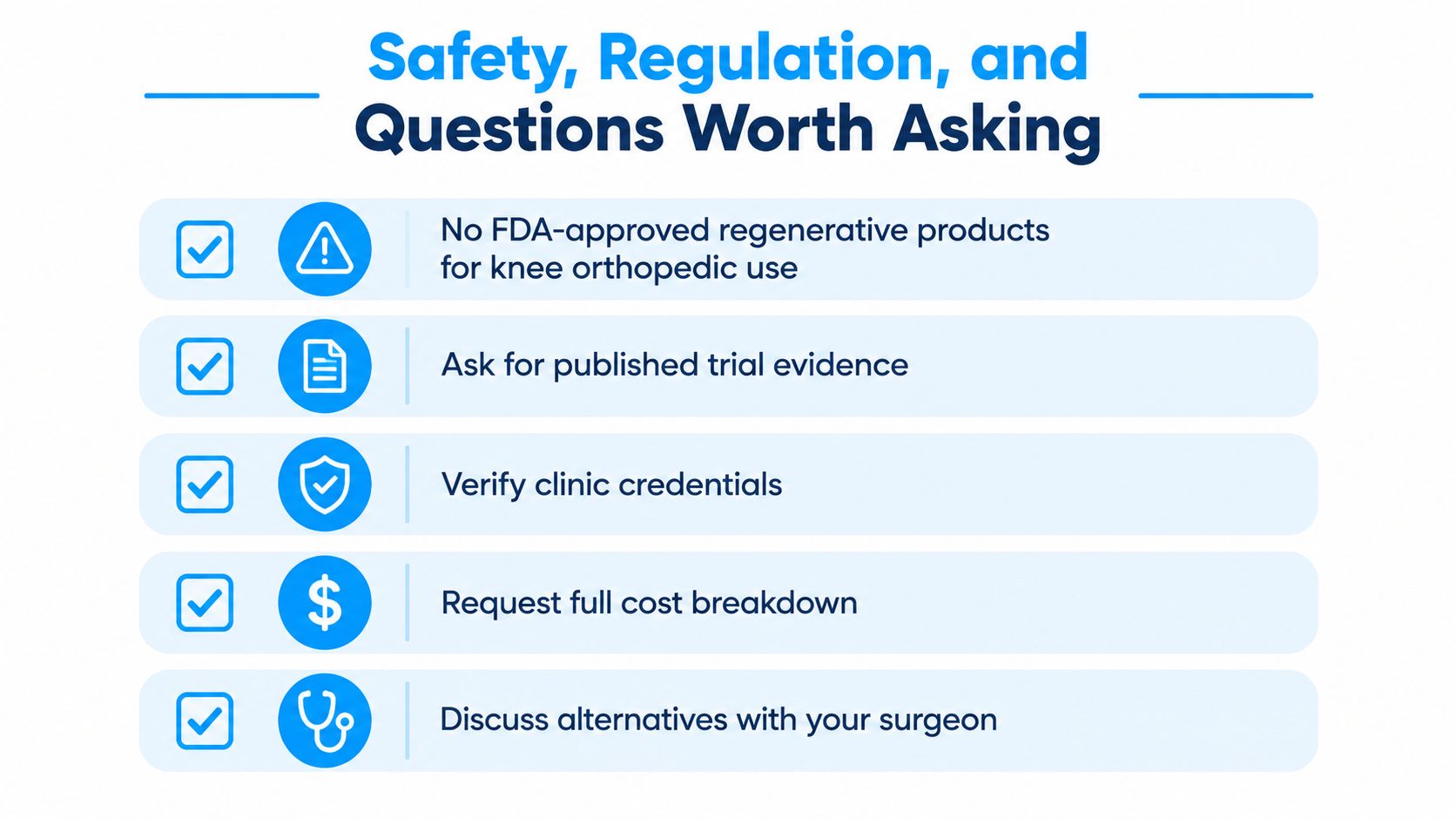
The regulatory label matters. The U.S. Food and Drug Administration states that no regenerative-medicine products have been approved for orthopedic conditions such as knee pain and other listed musculoskeletal conditions. A U.S. evidence review similarly describes orthopedic MSC therapy as investigational and reports that no engineered or expanded MSC products have received FDA approval for orthopedic applications (orthopedic MSC evidence review).
That doesn't mean every treatment outside the United States is automatically unsafe. It means patients must distinguish jurisdiction-specific access from FDA approval, and investigational treatment from established ACL care. Marketing language such as “regrow,” “replace,” or “guarantee” deserves immediate scrutiny.
Safety is a plan, not a slogan
The available safety literature doesn't justify vague claims that treatment is risk-free. A review of 89 MSC studies covering 2,992 patients found detailed complication reporting in 43 studies, and 36 of those studies documented at least one case of post-treatment swelling, effusion, or pain (MSC safety review). That finding doesn't establish that ACL injections are unsafe, but it does show why every patient needs an adverse-event plan.
Ask these questions before booking:
- What is the cell source? Clarify whether the product is bone-marrow-derived, adipose-derived, umbilical-derived, or another preparation.
- How was it processed? Ask about sterility testing, viability, handling, storage, and release criteria.
- What exactly will be injected? Confirm the cell product, dose, PRP or other adjuncts, delivery route, and image-guidance method.
- Who manages complications? Get written instructions for escalating swelling, pain, fever, reduced motion, suspected infection, or thrombosis.
- How will success be measured? Require a plan for examination, rehabilitation milestones, MRI when appropriate, and objective laxity testing.
A short-term reduction in pain isn't proof that the ACL has regained durable stability. Nor does a favorable MRI establish prevention of reinjury, osteoarthritis, or later surgery.
Four questions patients ask
Can a high-grade partial ACL tear be treated without surgery? Sometimes, particularly when fibers remain connected and the knee isn't substantially unstable. The decision requires MRI review, ligament testing, associated-injury assessment, and a rehabilitation plan. If the knee repeatedly gives way, injection-only treatment becomes much less defensible.
How soon might pain or instability improve after an MSC injection? There isn't a reliable timetable that applies to every ACL tear. Pain can change before tissue remodeling is complete, and symptom relief doesn't prove restored mechanical stability. Follow-up should measure giving-way episodes, strength, function, and laxity rather than relying on how the knee feels during an early window.
Can a clinic be a serious regenerative candidate without abandoning reconstruction as a backup? Yes. A credible plan should state when an injection is reasonable, what rehabilitation involves, which findings would trigger orthopedic referral, and how long the patient will be monitored. Preserving reconstruction as an option isn't failure. It's responsible decision-making when the evidence remains limited.
What should an international patient send before flying to Bucerias? Send the complete MRI images and report, prior operative notes, injury timeline, current medications, medical conditions, rehabilitation history, sport or work demands, and a description of instability. Ask whether the team needs updated imaging or an in-person surgical opinion before travel.
For most patients, the next step should be a complimentary case review, not a deposit based on a cell-count promise. Share the imaging first, then let the clinical team map the tear pattern to a regenerative path, a surgical path, or a structured combination.
Dream Body Clinic offers MRI-based case review, orthopedic MSC protocols, PRP-supported knee injections, and structured remote follow-up for international patients considering regenerative care for partial ACL injuries. Visit Dream Body Clinic to submit your imaging and discuss whether your knee fits a regenerative plan, needs surgical stabilization, or requires a combined approach.