A realistic 2026 out-of-pocket price for one knee stem cell injection is $3,500 usd at Dream Body Clinic while it can cost $5,000 – $15,000 at other clinics, while a 2018 U.S. market survey found a mean same-day price of US$5,156 per knee. The final bill can climb well beyond the advertised injection fee when imaging, cell processing, travel, follow-up care, and other add-ons aren’t included.
That spread is the story behind the search for stem cell knee injection cost. Patients aren’t comparing one standardized procedure. They’re comparing different cell sources, processing methods, physician expertise, regulatory environments, and billing models. A clinic quoting US$4,000 may be offering a point-of-care bone marrow concentrate injection, while another quoting US$15,000 may include laboratory processing, advanced imaging, PRP, and extended follow-up. At Dream Body Clinic we include 50 million mesenchymal stem cells derived from Wharton Jelly (umbilical cord tissue) and placenta. We also include a full blood panel and an MRI.
My advice is direct: don’t choose the lowest headline price for the sake of price, and don’t assume the highest price reflects better care. Ask what you’re buying, whether the treatment fits your knee, and what the all-in cost will be before you pay a deposit. At Dream Body Clinic we keep our prices as low as possible to help as many people as possible. Some other clinics advertise with celebrities and pro athletes then offer prices well over $10,000 usd for a single knee because you are paying for those celebrities free treatments and that is the worst because they can afford any treatment.
Table of Contents
- What a Knee Stem Cell Injection Actually Is
- What the 2026 Knee Stem Cell Market Is Charging
- How a Knee Stem Cell Quote Is Built
- Why Cell Dose, PRP, and Add-ons Exist
- Travel and Clinic Considerations That Change the Bill
- Surgery vs Regenerative Care for the Knee
- Insurance Coverage and Out-of-Pocket Value
- Putting the Cost Picture Together
What a Knee Stem Cell Injection Actually Is
A knee stem cell injection places a biologic preparation inside or around the joint to influence inflammation and its healing environment. Mesenchymal stem cells, usually called MSCs, may be collected from bone marrow or adipose tissue. The material is then concentrated at the clinic or processed in a laboratory before being reinjected during the visit or after processing is complete.
PRP uses concentrated platelets from your blood. An MSC protocol requires harvesting, processing, and delivering cells. Clinics may combine PRP with cells, but PRP does not replace the cell component. If a quote only says “regenerative injection” without naming the biologic, do not accept it as a usable treatment description.
The main clinical point is easy to miss in advertising. MSCs do not act like replacement parts that become cartilage and rebuild the knee. Recent reviews describe their primary activity as paracrine signaling and immunomodulation. The cells release signals, including cytokines, growth factors, and extracellular vesicles, that influence local healing and help regulate inflammation (PubMed review, Frontiers review).
Point-of-care versus expanded products
A point-of-care preparation is collected and processed during the treatment visit. Bone marrow aspirate concentrate, or BMAC, is a common example. Culture-expanded products require laboratory growth and added quality controls, which can increase processing complexity, regulatory considerations, and the quoted fee.
The cells generally do not remain permanently embedded in the knee. Their potential value depends on the signals they send, the joint’s inflammatory environment, the injection technique, and whether the patient’s diagnosis fits the protocol. The guide to stem cell knee treatment explains how this type of care is positioned clinically. Your consultation still needs to connect the proposed treatment to your diagnosis and imaging. BMAC is the worst source for MSCs as only less than 1% of the liquid they inject into a knee is actually mesenchymal stem cells. The other 99% or more is other types of cells. This means you are only getting tens of thousands of MSCs from a BMAc knee treatment compared to 50 million pure, isolated MSCs from the Dream Body Clinic Stem Cell Knee Treatment.
For budgeting, use US$3,000 to US$15,000 per knee as a practical U.S. same-day reference range. Treat that figure as a starting point, not a promise of benefit or a final bill. Ask whether the quote includes the cell preparation, PRP, imaging, follow-up, and other services before paying a deposit.
What a Knee Stem Cell Injection Actually Is — and Why Cell Source Matters
A knee stem cell injection places a biologic preparation inside or around the joint to change the inflammatory environment and support healing. Mesenchymal stem cells (MSCs) are the cells most clinics talk about. What they rarely say clearly is that “stem cell injection” is not one product.
Some clinics harvest your own bone marrow or fat during the visit, concentrate it, and inject it the same day. Others use laboratory-expanded donor cells. Those two approaches are not interchangeable. PRP is a third category: concentrated platelets from your own blood. PRP can be combined with cells, but it does not replace a true MSC dose.
The clinical point that advertising often buries is this: MSCs are not spare parts that turn into a new meniscus or a new articular surface overnight. Reviews describe their main activity as paracrine signaling and immunomodulation. The cells release cytokines, growth factors, and extracellular vesicles that influence local healing and help regulate inflammation.
That is why source, dose, processing, and delivery matter more than a generic “regenerative injection” label. If a quote never names the biologic, do not treat it as a usable treatment description.
Point-of-care versus expanded allogeneic products
A point-of-care preparation is collected and processed during the visit. Bone marrow aspirate concentrate (BMAC) is the usual example. Those products can be convenient. They also tend to deliver a mixed cell population and a lower MSC count than a cultured protocol.
Culture-expanded products require laboratory isolation, growth, and quality controls. That adds complexity. It also allows a clinic to specify a dose instead of hoping the harvest produced enough cells.
Dream Body Clinic’s stem cell knee treatment is not a same-day marrow or fat harvest. The clinic uses allogeneic mesenchymal stem cells derived from Wharton’s jelly (umbilical cord tissue) and placenta from live, healthy births. The cells come from screened donors, are isolated and expanded in the clinic’s on-site lab, and are administered as a defined intra-articular dose — 50 million MSCs per knee, with MRI and bloodwork included.
The clinic’s position is that perinatal MSCs have practical advantages over older adult tissue:
- They can be expanded to a high, countable dose.
- They are described as immune-privileged and lack HLA expression in the way that would trigger classic graft rejection.
- They are taken from young birth tissue after live, healthy deliveries, not from aborted tissue and not from the patient’s own aged marrow or fat.
- Treatment cells are taken out of culture the day before injection and given within 24 hours. Frozen cells are reserved for research storage, not for the injection itself.
The cells generally do not remain permanently embedded in the knee. Any potential benefit depends on the signals they send, the joint’s inflammatory environment, injection technique, and whether imaging supports the protocol. A consultation still has to connect the proposed treatment to your diagnosis and MRI.
What Dream Body Clinic actually includes
On the knee treatment page, the published protocol is:
- 50 million mesenchymal stem cells by intra-articular injection
- Full blood panel
- MRI
- Price: $3,500 USD per knee
Patients are asked to be in town at least five days. A typical sequence is arrival and rest, MRI and bloodwork, review and payment, treatment, then travel home. A new MRI is required with treatment even if you already have recent imaging. If MRI findings rule a patient out — commonly osteophytes or a complete tear — the clinic charges only for the MRI and blood panel.
That package is the comparison point, not a vague “international stem cell quote.”
What the 2026 knee stem cell market is charging
A 2018 survey of 65 U.S. centers found a mean price of about US$5,156 for a unilateral same-day stem cell knee injection, with a 95% confidence interval of US$4,550.
A newer 2025 NIH-hosted cross-sectional pricing study found a mean listed price of US$4,593.50 at alternative clinics versus US$10,451.75 at comparison sites. Price variability was greater at alternative clinics. That result matters because the same three words — “stem cell injection” — can describe BMAC, adipose SVF, PRP-plus-something, or culture-expanded allogeneic MSCs.
For U.S. same-day budgeting, US$5,000 to US$15,000 per knee is still a practical reference range. Treat it as a starting point, not a promise of benefit. Ask whether the quote includes cell preparation, PRP, imaging, follow-up, and facility fees before paying a deposit.
Against that backdrop, Dream Body Clinic’s $3,500 knee protocol is priced below the common U.S. same-day range while bundling MRI, labs, and a 50-million allogeneic MSC dose from Wharton’s jelly and placenta.
Read the quote by procedure type
In practical terms:
- BMAC often sits in the lower part of the U.S. market. It is same-day and autologous. Dose and purity vary with the harvest.
- Adipose / SVF adds a liposuction step. The nucleated-cell count can sound large; the actual MSC fraction is a small part of that mix.
- Expanded allogeneic WJ / placenta MSCs, as used at Dream Body Clinic, require a licensed lab, donor screening, isolation, culture, and sterility testing. The trade-off is a specified dose from young perinatal tissue instead of a same-day concentrate from the patient’s own tissue. Isolating and culturing of MSCs is not allowed for treatments in the USA. This is why Dream Body Clinic is in Puerto Vallarta, Mexico where it is legal.
A clinic should not expect a premium just because the language is more technical. It should name:
- Cell source (Wharton’s jelly and placenta vs marrow vs fat)
- Autologous vs allogeneic
- Processing method and whether cells are culture-expanded
- Dose
- Sterility and third-party testing
- Delivery method (ultrasound-guided intra-articular injection at DBC)
- What is bundled: MRI, labs, follow-up
International quotes can look lower because they bundle treatment with coordination. They can also look higher if you compare a U.S. “injection-only” number with a package that includes imaging. Compare line items, not slogans.
How to use this when you call
If you are evaluating Dream Body Clinic’s stem cell knee treatment, start with the written radiology report from any MRI done in the past year, then expect a new MRI on site. Ask the coordinator to confirm:
- Allogeneic MSCs from Wharton’s jelly and placenta after live, healthy births
- Never-frozen treatment cells from the on-site lab
- 50 million MSCs per knee
- MRI and bloodwork inside the $3,500 fee
- How the protocol maps to your specific imaging findings
That is a usable treatment description. “Regenerative injection” is not.
| Procedure Type | U.S. Low | U.S. High | International Low | International High |
|---|---|---|---|---|
| Same-day point-of-care or BMAC protocol | US$3,000 | US$6,000 | US$3,000 | US$8,000 |
| Adipose-derived protocol | US$5,000 | US$15,000 | US$3,000 | US$8,000 |
| Culture-expanded or higher-complexity protocol like at Dream Body Clinic | US$3,500 | Not Allowed | US$3,000 | US$15,000 |
The table is a buying framework, not a verified universal tariff. The verified survey data shows why published averages vary. Anchor your decision to an itemized, all-in quote, not an isolated mean or a promotional starting price.
How a Knee Stem Cell Quote Is Built
A legitimate quote should show where the money goes. The cost isn’t just the syringe entering the knee. It can include clinical assessment, imaging, harvesting, laboratory handling, reinjection, facility use, and follow-up.
The line items that deserve attention
Use the following ranges as a quote-audit template, not as a claim that every clinic charges each fee separately:
- Physician consult and candidacy review: US$200 to US$500 for history, examination, imaging review, and treatment planning.
- Imaging review or in-house MRI: US$300 to US$800, depending on whether new imaging is required.
- Bone marrow or adipose harvest: US$1,500 to US$3,000 for collecting the tissue used in an autologous protocol.
- Cell processing and counting: US$500 to US$1,500 for concentration, handling, and documentation.
- Same-day reinjection: US$1,000 to US$2,500 for image-guided delivery and clinical supplies.
- Follow-up and rehabilitation guidance: US$300 to US$800 for scheduled review and post-procedure instructions.
- Facility or surgical center fees: US$500 to US$2,000 for room use, nursing, equipment, and ancillary supplies.
A clinic can therefore produce a much lower or higher headline number depending on what it bundles. One US$6,000 quote may include the MRI and follow-up. Another US$6,000 quote may cover only the injection, leaving the patient to pay separately for imaging, a harvest procedure, and return visits. This is why Dream Body Clinic makes it easy be explaining all that is included with treatment on their treatment page with the price listed. This way everyone knows they are getting the same price. Be wary of clinics that don’t show the price on their website or fully explain what is included in treatment.
Practical rule: If a clinic doesn’ show what is included in the treatment or have the price listed then it is probably time to look elsewhere.
Before signing, ask these questions:
- What exactly is being injected? The answer should identify the source and preparation, not just say “regenerative cells.” Dream Body Clinic gives all patients a 3rd party lab analysis of the stem cells as seen here – Our Lab
- How many cells are planned? If the clinic uses a dose-based protocol, the dose should appear in the medical and financial paperwork.
- Is imaging included? Confirm whether the clinic requires a new MRI or accepts existing scans.
- Who performs the harvest and injection? Credentials and procedural responsibility should be clear.
- What happens after you return home? Ask who handles complications, progress questions, and repeat imaging.
If the clinic won’t itemize the bill, treat that as a commercial warning sign, not a minor paperwork issue.
Why Cell Dose, PRP, and Add-ons Exist
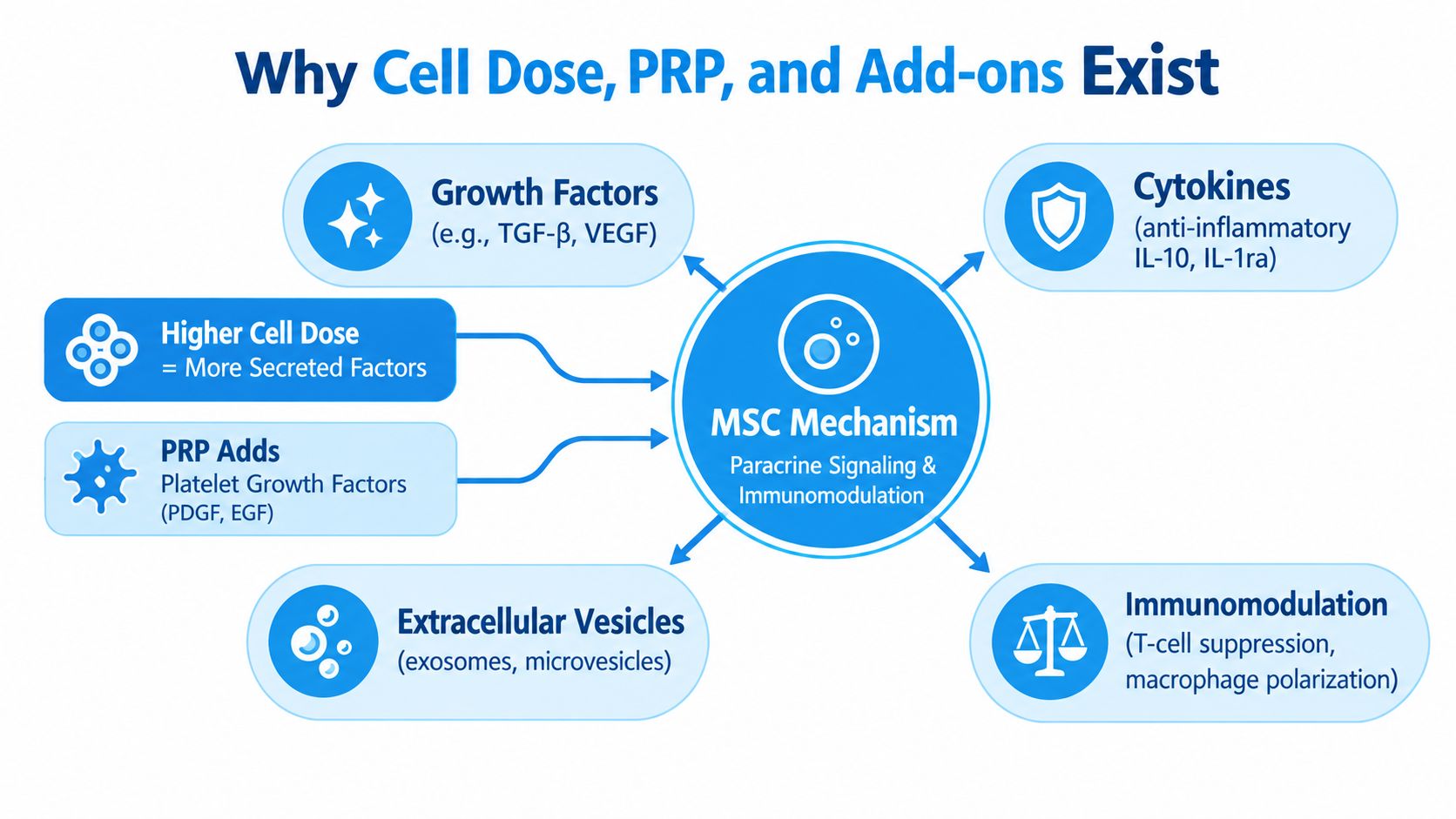
MSC therapy is priced around more than the word “stem cell.” The underlying idea is that MSCs release biologically active signals, including growth factors, cytokines, and extracellular vesicles, which influence inflammation and local repair. A review of intra-articular MSC treatment describes the paracrine effect of the MSC secretome as fundamental, with cells suppressing immune activation, reducing inflammation, and releasing trophic factors that support the extracellular matrix (PMC review).
The cells don’t differentiate into other cells in the simple way many advertisements imply. Their main role is to send specialized signals that guide the healing process. They may help recruit or influence local cells, but patients should be skeptical of promises that an injection will directly replace missing cartilage as they actually guide cartilage regeneration and don’t differentiate into cartilage.
Think like a construction site
A useful analogy is a construction crew. The MSCs aren’t necessarily the workers who permanently rebuild the entire structure. They act more like a mobile command team that sends instructions, materials, and signals to coordinate the local workforce.
That helps explain why clinics talk about cell dose. A higher dose may change the signaling environment, but the number alone doesn’t prove that a protocol is better. The source, viability, handling, injection target, diagnosis, and supporting care all matter.
PRP may be added because platelets carry their own signaling proteins. Other clinics offer hyaluronic acid, growth-factor preparations, or extracellular vesicle products. Those additions can be clinically distinct, and they should never be hidden inside a vague “enhanced stem cell” label. At Dream Body Clinic we don’t add any of the marketing hype or add ons. We deliver pure stem cells and as many as we can safely fit inside the knee. We tried using PRP when we first started 9 years ago, but it caused some patient’s knees to swell up because the knee is a hollow joint and can only fit so much extra liquid. The added liquid of the PRP created too much pressure. So we stopped offering PRP and stopped having that issue. PRP is just plasma that is already in your blood. If it was going to heal things it would have done it already.
When comparing a US$3,500 quote with a US$15,000 quote, ask what changed. Is the difference the harvest, laboratory expansion, imaging, PRP, physician time, follow-up, or the clinic’s pricing model? If the provider can’t connect the added cost to a specific clinical service, the premium isn’t justified by the label alone. Usually a higher price means you are paying for marketing hype like the term hypoxic stem cells or added exosomes. All stem cell cultures are hypoxic as it just means low oxygen. You want to get the environment to a certain level of oxygen as explain here Our Lab
We don’t offer exosomes individually because MSCs work by releasing exosomes. So you are better to get more stem cells than to add exosomes. MSCs are smart and know what exosomes to release at the correct place. Exosomes are not smart and you have to hope that you are delivering the correct exosomes to the correct place at the correct time. This is impossible to do because there are over 1,000 different types of exosomes and they are so small that we don’t even know what each one does yet. The filtration process is so rudimentary that the biologists compare it to taking a pile of dirt and using a screen to sift out the big rocks. They have to do this because when they were first used they found that a lot of patients were getting inflamed at the area of injection. This is because each exosome has a single payload of a cytokine, chemokine, trophic factor or growth factor. Some of these cause inflammation to force the body to react. If you don’t know what exosomes you are delivering to the area then you can cause issues instead of fixing them. I was at a conference a few years ago where Dr. Arnold Caplan explained this. In 10 years at the earliest we may be able to isolate exact exosomes for specific issues, but until then they are just hype. They offer what seems like huge amounts, “80 billion exosomes!”, but you will get far more than that from a solid dose of MSCs like we offer. This video explains further –https://rumble.com/v1hz410-exosomes-vs-mesenchymal-stem-cells.html
Travel and Clinic Considerations That Change the Bill
The advertised injection fee is only one part of medical travel. At dream body clinic the $3,500 usd includes everything for treatment, but flights and hotel are up to patients. This is because we are located in Puerto Vallarta, Mexico and all of our patients come from different places around the world. Every patient has a different preference on accommodations also so we allow them to choose and we provide all airport and clinic transportation if they stay in our zone – This link explains our transportation zone and the best accommodation options close to us – Accommodation Options – https://dreambody.clinic/hotels/
Compare the complete itinerary
| Cost Component | U.S. Same-Day Clinic | U.S. Lab-Expanded Protocol | Mexico COFEPRIS Bundle |
|---|---|---|---|
| Treatment quote | US$5,000 to US$12,000 | US$8,000 to US$20,000 | US$3,500 Dream Body Clinic Knee Stem Cell Treatment |
| Imaging and clinical review | May be separate or bundled | Often separately specified | bundled |
| Accommodation and transfers | Usually separate | Usually separate | Accommodations up to patients and airport and clinic transportation included |
| Follow-up logistics | Local in-person access | Local or scheduled visits | Remote after travel |
| Patient travel costs | Usually limited | Usually limited | Flights and companion costs remain separate |
Mexico can offer bundled arrangements through clinics operating within the country’s COFEPRIS-regulated framework. A bundle still needs scrutiny. Ask which services are included, which provider delivers the injection, what cell preparation is used, and what happens if you need care after flying home. The guide to verified stem cell knee clinics in Mexico offers a starting point for evaluating international options.
Travel adds practical costs that patients often overlook, including flights, companion travel, meals, missed work, and local transport. International patients should also plan reliable mobile connectivity for airport coordination and telehealth. A comparison of how much eSIM costs can help you budget that small but useful travel requirement.
Follow-up is part of the treatment
Be sure that the clinic has someone for you to contact for any questions. Make sure that post treatment rehabilitation protocols are provided. Follow up is a 2 way street. The clinic should be following up and patients should be following up with the clinic to provide information and milestones on their recovery. This helps the patient and future patients the most.
Surgery vs Regenerative Care for the Knee
A knee stem cell injection can cost less upfront than surgery, yet the financial comparison depends on more than the procedure fee. It avoids bone removal and an implant, but it is usually self-pay and results are not guaranteed. Surgery may receive insurance coverage, while still creating costs through anesthesia, rehabilitation, time away from work, and permanent structural change.
Use the figures below as an illustrative 2026 comparison framework only, not guaranteed market prices. Confirm every estimate with your surgeon and insurer before deciding.
| Procedure | Illustrative U.S. Cost (2026) | Recovery / Downtime | Reversibility |
|---|---|---|---|
| Stem cell knee injection | $3,500 usd at Dream Body Clinic to $15,000 usd at competitors | No real recovery. Walk out immediately after treatment | No bone resection or implant |
| Arthroscopy | US$5,000 to US$11,000 out of pocket after insurance | Recovery takes weeks | Surgical changes remain. Always leaves scar tissue |
| Partial knee replacement | US$15,000 to US$30,000 per knee | About 4 to 6 weeks of limited weight-bearing | Implant can require later revision |
| Total knee replacement | US$30,000 to US$50,000 or more | About 3 to 6 months of rehabilitation | Irreversible bone resection and implant |
Judge the quote against the full decision, not the injection price alone. Can you pay without cutting into essential care? How much income and mobility would surgery cost during recovery? Does preserving the natural joint matter if your orthopedic evaluation does not yet support replacement?
Regenerative care may fit a patient who wants to delay an operation and accepts variable evidence and response. It is a poor fit for severe structural failure, major deformity, or pain requiring definitive correction. In those cases, delaying surgery can add time and expense without solving the mechanical problem. The most common reasons that stem cell therapy won’t work is if the patient has severe osteophytes (bone spurs) or complete tears of a ligament, tendon or meniscus. Stem Cell Therapy to regenerate a knee is best to heal partial tears of meniscus, ligaments, tendons or osteoarthritis.
Before approving a costly protocol, question every add-on. Patients often ask about peptides and other adjuncts. Peptides are great workers for regeneration, but they are limited. PRP and peptides have the problem that they can’t get past fibrosis (scar tissue). When you are injured white blood cells rush to the area and patch up damaged tissue like cartilage, meniscus, ligaments and tendons with fibrosis. This prevents PRP and peptides from fully healing most damage. Fortunately mesenchymal stem cells can help guide the removal of fibrosis to expose the underlying tissue then guide the healing of that tissue to get it back to normal. Peptides can help a lot after the stem cells have removed the fibrosis to speed up healing which is why Dream Body Clinic often recommends the best peptide for healing, Human Growth Hormone (HGH). We offer it with our legal fly and buy program.
The right comparison is money, lost time, invasiveness, and the fallback plan if treatment fails. So do your research and feel free to call us anytime for a free consultation at (888) 704-3977
Insurance Coverage and Out-of-Pocket Value
Most patients should assume they’ll pay for the injection themselves. A neutral HHS Office of Inspector General report says Medicare generally doesn’t cover stem cell and PRP-type regenerative injections for orthopedic conditions because those products haven’t been approved for those uses (HHS OIG report).
That doesn’t mean every related service is automatically excluded. An office visit, diagnostic imaging, or treatment for another covered condition may follow different insurance rules. Ask your insurer about each billed service, but don’t build your budget around reimbursement for the biologic injection.
At Dream Body Clinic we have found that insurance won’t cover stem cell treatments, but Health Savings Accounts do work. We have also had many Canadian patients be able to write off their stem cell treatments with us for taxes.
Treat the quote like a retail purchase
A self-pay procedure deserves the same diligence as any major purchase. Before committing, request:
- Cell documentation: The clinic should identify the cell source, preparation, and stated dose like DBC does as seen here – Our Lab
- Separate biologics: PRP, hyaluronic acid, exosomes, or other products should appear as separate line items.
- Imaging details: Confirm whether MRI or ultrasound guidance is included and who owns the images. At Dream Body Clinic MRI and the newest deep field ultrasound guidance is included.
- Follow-up terms: Get the number, timing, and format of follow-up visits.
- Safety information: Ask about facility standards, clinician credentials and emergency arrangements.
- Cancellation terms: Understand deposits, refunds, rescheduling, and travel-related losses before booking.
Patients comparing U.S. insurance with international self-pay care should also understand how an annual out-of-pocket maximum works. It may protect against covered services, but it generally doesn’t transform a non-covered regenerative injection into a covered benefit.
Value isn’t the cheapest invoice. Value is a transparent protocol, an appropriate diagnosis, a realistic explanation of likely outcomes, and a follow-up plan that remains usable after treatment.
If your diagnosis is unclear, start with a qualified orthopedic or sports-medicine evaluation and current imaging. If you already have a treatment quote, compare it with the broader guidance on what stem cell therapy costs or check out the Knee Stem Cell Treatment page.
Dream Body Clinic offers knee MSC protocols in Bucerias, Mexico, with treatment planning that can include imaging, blood work, consultation, a stated cell dose, injection, and remote follow-up. Visit Dream Body Clinic to request a case review and compare the clinic’s Treatment with your local options before making a decision.