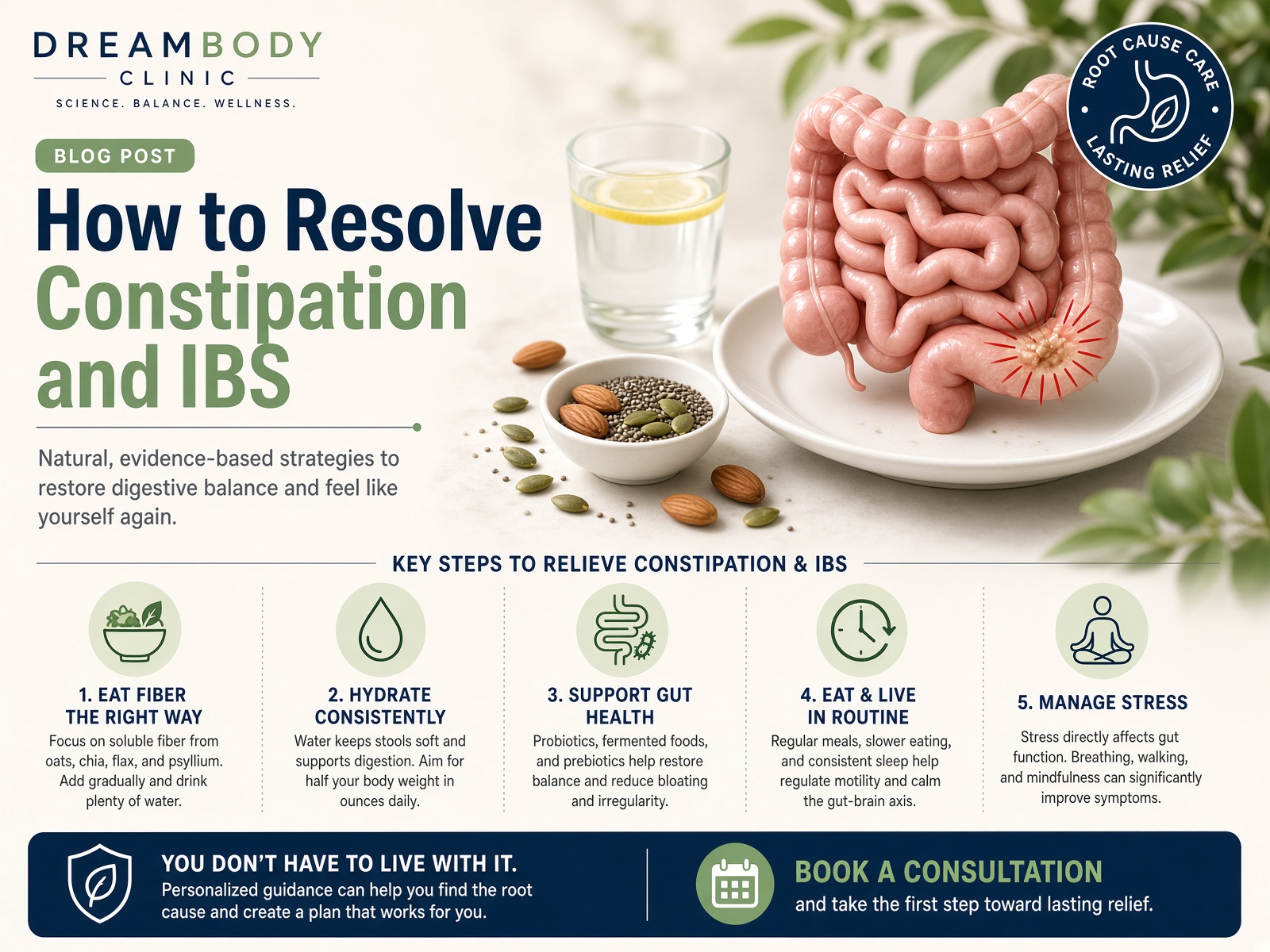
How to Resolve Constipation and IBS
Most people only worry about constipation when they go days without a bowel movement. A quieter problem is slow transit: food and waste take too long to move from mouth to toilet even if you still “go every day.”
When stool sits in the colon longer than it should, it dries out, microbes have more time to ferment it, and the gut lining and liver have to handle a heavier load. You may feel bloated, sluggish, foggy, or “backed up” without meeting the classic definition of constipation (fewer than three stools a week).
This article explains the difference, a simple at-home timing check, why motility matters, and practical steps people often use with their clinician. It is general wellness education — not a diagnosis, not a prescription, and not a replacement for care if you have blood in the stool, unexplained weight loss, severe pain, vomiting, or a sudden change in bowel habits. We will also go into how IBS can be related to slow transit and constipation and how Mesenchymal stem cells can be part of the road to recovery.
Slow transit vs. constipation
First we need to know the difference between slow transit and constipation to determine what your main issue is.
Transit time is how long a meal takes to travel the full digestive tract.
Constipation is about how often you go, how hard the stool is, and how much you strain.
You can have one without the other. Daily pellet-like or incomplete stools often point to slow movement even when the calendar looks “normal.” Constipation can also come from low fluid intake, low fiber, inactivity, medications (opioids, some iron and calcium supplements, some antidepressants), pelvic-floor problems, or structural issues. Slow transit is more about weak or poorly coordinated gut muscle and nerve signaling.
A useful mental model: constipation is the smoke alarm. Slow transit is the fire you might not see yet.
A simple at-home timing check
This is a rough estimate, not a lab test.
- Eat a clearly visible marker: 1–2 cooked beets, a generous serving of corn, or (if your clinician agrees) a labeled dose of activated charcoal.
- Write down the time.
- Watch for red/purple stool (beets), visible corn, or very dark stool (charcoal).
- Note when it first shows up.
Many clinicians treat about 12–24 hours as a typical window. Longer than ~30 hours often means slow transit. Faster than ~12 hours can mean rapid transit or loose stools. Color-blindness to beet pigment, mixed meals, and irregular eating make this imperfect. If results worry you, ask your doctor about formal motility testing.
Why lingering stool is more than an inconvenience
The colon is supposed to finish absorbing water and then empty. When waste stalls:
- Microbes shift. Slow flow can favor gas-producing and protein-fermenting organisms. In some people this overlaps with small-intestinal bacterial overgrowth (SIBO) or excess methane, which can slow the gut further.
- The barrier works harder. Longer contact with bacterial products such as lipopolysaccharide (LPS) is linked with more local irritation. That is one reason “gut inflammation” and fatigue show up in the same conversations.
- Nutrients and medicines absorb less predictably. Overgrowth and poor mixing can interfere with B12, iron, and fat-soluble vitamins.
- The liver’s “exit door” is the toilet. Bile carries waste the liver has packaged. If bowel movements are rare, more of that load can be reabsorbed.
- Hormones and thyroid status cut both ways. Low thyroid function is a classic cause of sluggish bowels. Slow elimination can also make it harder to clear used estrogen metabolites. Stress and poor sleep tighten the loop through the vagus nerve and cortisol.
- Comfort and life quality drop. Bloating, cramping, hemorrhoids, incomplete emptying, and avoiding meals or travel are common — even before rare emergencies (severe blockage, dehydration) enter the picture.
None of this means every slow week causes autoimmune disease or sepsis. It means chronic stasis is worth treating as a whole-body issue, not a joke about fiber.
A practical way to speed things up
Start with mechanics and food. Add supplements only if they fit your labs and medications.
1. Treat the top of the chain
Poor stomach acid and sluggish bile mean food is less broken down and more available to the wrong microbes. Clinicians sometimes use meal-time strategies (protein-focused meals, not slamming water mid-meal), ginger, artichoke, or — when appropriate — bile support or acid support. Coffee stimulates motility for many people; it is not a treatment plan by itself. Do not start betaine HCl or bile salts if you have ulcers, unexplained pain, or gallbladder disease without medical advice.
2. Fix the common nutrient gaps
Gut muscle needs electrolytes and cellular energy.
- Magnesium (often citrate or oxide) draws water into the bowel and helps muscle relax. Dose is individual; too much causes diarrhea.
- Vitamin D in a sufficient range supports muscle and immune tone in the gut.
- B vitamins, including niacin/niacinamide, support nerve signaling and cell energy.
- Carnitine is sometimes studied in constipation severity; it is not magic and can interact with thyroid or seizure medicines.
- Dietary calcium from food is not the same as high-dose calcium pills, which can bind stool.
Thyroid hormone (including T3) is a prescription issue. Cold hands, fatigue, and constipation together deserve labs — not self-dosed thyroid powder.
3. Choose fiber that holds water
Dry, bulky bran in a dehydrated colon can worsen cramps. Pair fiber with fluid.
Often better tolerated: psyllium or glucomannan taken with a full glass of water; cooked vegetables; kiwi (two a day is a studied food-level approach); prunes (sorbitol); a little extra-virgin olive oil. Wheat bran can speed transit for some and bloat others.
Lactulose is a prescription or pharmacy osmotic that also feeds beneficial bacteria. Doses for “prebiotic” vs “laxative” effects differ. Do not improvise high doses. Consult a doctor on this one.
4. Use strains with motility data — not a random bottle
Evidence is strain-specific. Names that appear in constipation research include Bifidobacterium lactis (including HN019 and BB-12), Lacticaseibacillus paracasei Shirota, Limosilactobacillus reuteri DSM 17938, and Lacticaseibacillus rhamnosus GG. Multi-strain formulas plus a prebiotic sometimes outperform a single strain. Typical study ranges are in the billions of CFU — quality and storage matter more than a huge number on the label.
5. Daily motility habits (these are free)
- 10–15 minute walk after meals
- Hip hinge and squat-friendly toilet posture (a low stool under the feet is enough; you do not need a circus squat)
- Regular meal times so the migrating motor complex can run between meals
- Sleep and down-regulation of stress (slow breathing beats another stimulant tea at midnight)
The gut is smooth muscle. Sitting all day trains it to sit.
6. Soothe the lining if it feels raw
People often use food-first options (oats, stewed fruit) and, with guidance, zinc-carnosine, glutamine, or anti-inflammatory culinary spices. These support comfort; they do not replace evaluation of IBD, celiac disease, or obstruction.
7. Short-term “rescue,” not a personality
Osmotic helpers (magnesium, lactulose) are generally kinder for repeat use than daily senna or cascara, which can train the bowel to wait for a stimulant. Aloe latex is a stimulant too. If you need rescue products every day, that is a signal to look at thyroid, meds, pelvic floor, and diet — not to raise the dose forever.
Castor oil is a strong stimulant laxative. Slippery elm is a demulcent (soothing gel). Combining capsules because a blog stacked them is not a protocol. Ask a pharmacist about interactions.
A conservative starting pattern (example only)
Food and routine first: water, walking after meals, kiwi or prunes, feet-elevated toilet posture, consistent meals.
If your clinician agrees, a simple add-on stack many adults tolerate:
- Magnesium at night
- Psyllium or kiwi in the morning with water
- Ginger with meals
Escalate only if that fails and someone has reviewed your medicines and labs. Skip self-prescribed T3, high-dose bile acids, and daily stimulant teas.
When to get medical care first
See a physician promptly for blood in the stool, black stools, fever, jaundice, vomiting, a swollen hard abdomen, new constipation after age 50, or constipation plus iron-deficiency anemia. Post-surgical, pregnant, and pediatric cases need personalized care. Stem cell and regenerative programs at a clinic are not a first-line constipation treatment; motility belongs with your GI or primary doctor.
Bottom line
Going every day does not guarantee healthy transit. Slow movement lets waste ferment, taxes the gut barrier and liver, and can drag on energy and hormones. The durable fix is usually motility + moisture + microbes + muscle use, not a harsher laxative.
If bowel sluggishness is part of a larger inflammatory or degenerative picture you are already discussing with our team, bring it up in consult so it is coordinated with the rest of your care — and keep a gastroenterologist in the loop for the gut itself.
Slow Transit, Constipation, and a Gut That Will Not Reset
Why stalled motility is more than “too little fiber” — and how Dream Body Clinic’s IBS stem cell protocol is built to work on microbes, immunity, gut muscle signaling, and the intestinal lining.
Most people treat constipation as a calendar problem: fewer than three stools a week. A quieter problem is slow transit. Waste takes too long to move even if you still go every day. Stools are dry, pellet-like, or incomplete. The abdomen stays tight. Energy drops.
That pattern sits in the same neighborhood as IBS — bloating, cramping, unpredictable bowels, a gut that overreacts to food and stress. Pills and fiber help some people. They do not rebuild an inflamed lining, calm a misfiring immune conversation in the colon, or restore the motility “software” when those systems have been angry for years.
This article is educational. Red flags (blood in the stool, black stool, fever, vomiting, sudden change after age 50, unexplained weight loss) belong with a gastroenterologist first. Stem cells are not a first-line laxative.
Four problems hiding under slow bowels
When stool lingers, four systems start to argue with each other.
1. Microbes
Slow flow favors gas-forming and protein-fermenting organisms. Some people slide toward overgrowth patterns (including small intestinal bacterial overgrowth, SIBO) or methane-associated sluggishness. The colon becomes a warm petri dish.
why overgrowth is a problem
The small intestine is a factory. The colon is a fermentation tank. When flow is slow, the tank backs up into the factory.
Bacteria eat leftovers and make gas (hydrogen, carbon dioxide, sometimes methane) and breakdown products from protein (ammonia, phenols, some amines). You feel that as bloating, pressure, odor, and stools that swing between hard and loose.
SIBO is the small-bowel version: too many organisms living where absorption should happen. They steal sugars and fats, irritate the wall, and can compete for B12. Methane-associated sluggishness (often discussed as IMO) is extra relevant to constipation: methane is linked with slower transit, so gas and stall reinforce each other.
A “warm petri dish” is not a metaphor for dirt. It is extra time, extra substrate, and a wall that is already inflamed. Killing everything with repeat antibiotics often fails because the reason they overgrew — slow clearance and a hot lining — is still there.
Where MSCs may help
MSCs do not wipe a microbiome like an antibiotic. They help indirectly:
- Less inflammation at the mucosa makes the surface less inviting for opportunistic blooms.
- If motility improves even modestly, mechanical clearance improves — the gut’s own broom.
- Barrier repair (below) means fewer bacterial fragments crossing, so the immune system stops pouring fuel on the fire that favors dysbiosis.
- MSCs release a lot of LL-37 which is a peptide that acts like a natural antibiotic that eliminates bad bacteria and keeps good bacteria.
Think “change the neighborhood,” not “sterilize the street.”
2. Immune tone
A longer dwell time means more contact between bacterial products and the wall. Local immune cells stay “on.” People feel this as bloating, urgency, pain after meals, or a gut that never fully calms.
The gut wall is the largest immune organ you have. It is supposed to sample microbes and stay mostly calm.
When stool and bacterial products sit against that wall for extra hours, immune cells see LPS and other patterns more often. They release inflammatory messengers. Blood flow, nerve sensitivity, and mucus all shift. That is why meals hurt, why a stretchy abdomen feels urgent, and why the gut never feels “finished.”
In IBS language this is often visceral hypersensitivity plus low-grade immune activation — not always the same as ulcerative colitis, but not “imaginary” either. Chronic activation is exhausting. It also feeds the next two problems: nerves fire too easily, and the lining does not seal well.
Where MSCs may help
This is the center of the clinic’s IBS write-up: immunomodulation.
MSCs release signals that can:
- Lower pro-inflammatory cytokines
- Support anti-inflammatory and regulatory T-cell tone
- Quiet overactive T cells and dendritic cells in inflamed gut tissue
The analogy on the treatment page is software, not sandpaper: re-teaching immune cells to protect the intestine instead of treating it like an infection. IV cells are also described as homing toward inflammation (chemotaxis), so the dose is meant to work systemically and at hot spots, not only in a dish.
If that signaling shift takes, bloating and pain after meals can ease because the wall is no longer running a constant alarm. That is the theory. Individual results vary.
3. Muscle and nerve
The gut is smooth muscle driven by the enteric nervous system and the vagus nerve. Inflammation, low thyroid function, inactivity, and chronic distention all make peristalsis weaker. A lazy wave does not empty the rectum cleanly.
Peristalsis is a coordinated squeeze. The enteric nervous system (the “gut brain”) and the vagus nerve time that squeeze. Smooth muscle has to be able to contract.
Inflammation makes nerves twitchy and muscles less effective. A colon that stays stretched (distention from gas or hard stool) loses mechanical advantage — like a rubber band left extended. Low thyroid function slows the whole machine. Sitting all day removes the extra push that walking gives.
If the wave is weak, the rectum never empties cleanly. Residue stays. Microbes and immune cells get another long shift. Constipation becomes the result of a tired pump, not only a lack of bran.
Where MSCs may help
MSCs are not a pacemaker implant. The hoped-for path is:
- Less inflammatory noise around enteric nerves → more normal signaling
- Healthier local tissue and microcirculation → muscle that can actually contract
- Paracrine growth factors that support repair in damaged wall, not a new set of intestines overnight
NAD+ after the 300 million cell IV is positioned as cellular energy support for that same visit. It does not replace walking after meals or treating hypothyroidism if labs show it.
You still have to use the muscle: movement, meal spacing so cleaning waves can run, toilet mechanics. Stem cells are aimed at the inflamed, under-repaired environment that made the muscle quit.
4. Barrier and lining
The epithelium is supposed to be a tight fence. When it is irritated, more microbial fragments get through. The liver and immune system pick up overtime. Nutrient absorption (B12, iron, fat-soluble vitamins) gets sloppier.
Lifestyle still matters: water, walking after meals, toilet posture, magnesium if your clinician agrees, kiwi or psyllium with enough fluid, sleep. Those are maintenance. They are not a reset if the immune and repair programs in the gut are stuck.
The epithelium is a single-cell fence with tight junctions, mucus, and immune sentries. Its job is to let nutrients through and keep microbial fragments out.
When the fence is irritated, more LPS and other debris enter the bloodstream (endotoxin load). The liver has to clear it. The immune system stays busy. People describe brain fog, aches, and “toxic” fatigue — not because stool is in the brain, but because the cleanup crew is overwhelmed.
Absorption gets sloppy. Bile-disrupting overgrowth can worsen fat-soluble vitamin handling. B12 and iron can fall. Medicines absorb less predictably.
A damaged lining also lets pain nerves see contents they were never meant to see. That is one reason slow transit and IBS pain travel together.
Where MSCs may help
The clinic describes three repair ideas that match this layer:
- Paracrine signaling: growth factors and matrix proteins that support epithelial growth and migration
- Immune calm: a quieter local battlefield so new lining cells are not shredded as they form
- Gene-expression / maturation signals: pushing lining cells toward a tighter, more mature barrier
If the fence improves, fewer fragments leak, the liver and immune system do less overtime, and the muscle and nerves are not bathing in irritation. That is how a lining therapy can show up as better stools weeks to months later, not the next morning.
Where the IBS stem cell protocol is aimed
Dream Body Clinic’s IBS program is an intravenous mesenchymal stem cell (MSC) protocol using cells isolated and expanded from Wharton’s jelly and placenta — not a same-day marrow draw and not a mystery “vial from a cooler.”
IBS Stem Cell Treatment:
- 300 million MSCs by IV
- NAD+ and high-dose vitamin C IV after the cells
- Bloodwork on site
- Typical stay 4 days (arrive and rest, labs/payment, treatment, fly home). Longer stays can spread those days.
Full protocol and booking: IBS stem cell treatment
MSCs in this setting are used as signaling cells. They release growth factors and cytokines, interact with immune cells, and are drawn toward inflamed tissue (chemotaxis). The clinic’s framing is not “a stronger laxative.” It is rebalancing the environment the bowel has to live in.
How that maps to the four problems
Microbes
You do not sterilize the gut with stem cells. You change the neighborhood. Less wall inflammation and a more intact lining make it harder for opportunistic overgrowth to keep winning. Motility that starts moving again also mechanically clears residue — the oldest antimicrobial the body has.
Immune system
The page’s core claim is immunomodulation: turning down excess inflammatory signaling, supporting regulatory pathways, and stopping the gut from treating every meal like an invasion. That is the difference between covering cramps for a day and giving the colon a quieter set point. Results are not guaranteed; the clinic states that plainly.
Muscle and motility
Smooth muscle needs a calm, oxygenated, innervated wall. Reducing inflammatory noise and supporting tissue repair is how a regenerative IV is supposed to help the pump, not just the contents. NAD+ in the same visit is there as cellular-energy support after the infusion. Walking, meal spacing, and squat-friendly toilet mechanics still do the daily work.
Gut lining
MSCs can support epithelial repair through paracrine signals — growth factors that encourage lining cells to close ranks. A tighter barrier means less leakage of bacterial products, which means less systemic “I feel toxic” load from slow transit. That is the loop constipation blogs describe and never treat at the tissue level.
The clinic describes circulating effects over months, with some cells remaining as supportive pericyte-like residents. That is why they talk in months, not weekend miracles. Peak change for gut programs is a conversation with the medical team, not a same-week promise.
What we do not claim
- This protocol does not replace colonoscopy when your doctor has ordered one.
- It is not for active cancer within five years (clinic screening rule).
- About 1 in 100 patients get a short headache or low fever; they typically use 500 mg of acetaminophen. IV work always carries a theoretical infection risk; the clinic emphasizes sterile technique.
- Stimulant laxatives (senna, cascara) every day can make the bowel lazier. Do not stack those on top of a regenerative visit and call it a protocol.
- Thyroid hormone, prescription motilides, and IBD workups stay with your prescribing physicians.
Who this article is for
People who already tried fiber, probiotics, and “just drink water,” who live in the IBS-C / mixed / slow-transit gray zone, and who want the next conversation to be about immune tone and lining repair, not another tea.
Send records to the team before you book flights. A free consult is (888) 704-3977, email info@dreambodyclinic.net. Protocol detail and itinerary live here: dreambody.clinic/irritable-bowel-syndrome-ibs-stem-cell-treatment/.
Keep the boring habits that protect a result: fluid, a walk after meals, regular meal timing, and a toilet stool under the feet. Regenerative care is not permission to ignore the muscle. It is an attempt to give that muscle a lining and an immune system that will let it work again.
Educational content from Dream Body Clinic. Not a guarantee of outcome. Not a substitute for emergency or GI evaluation.