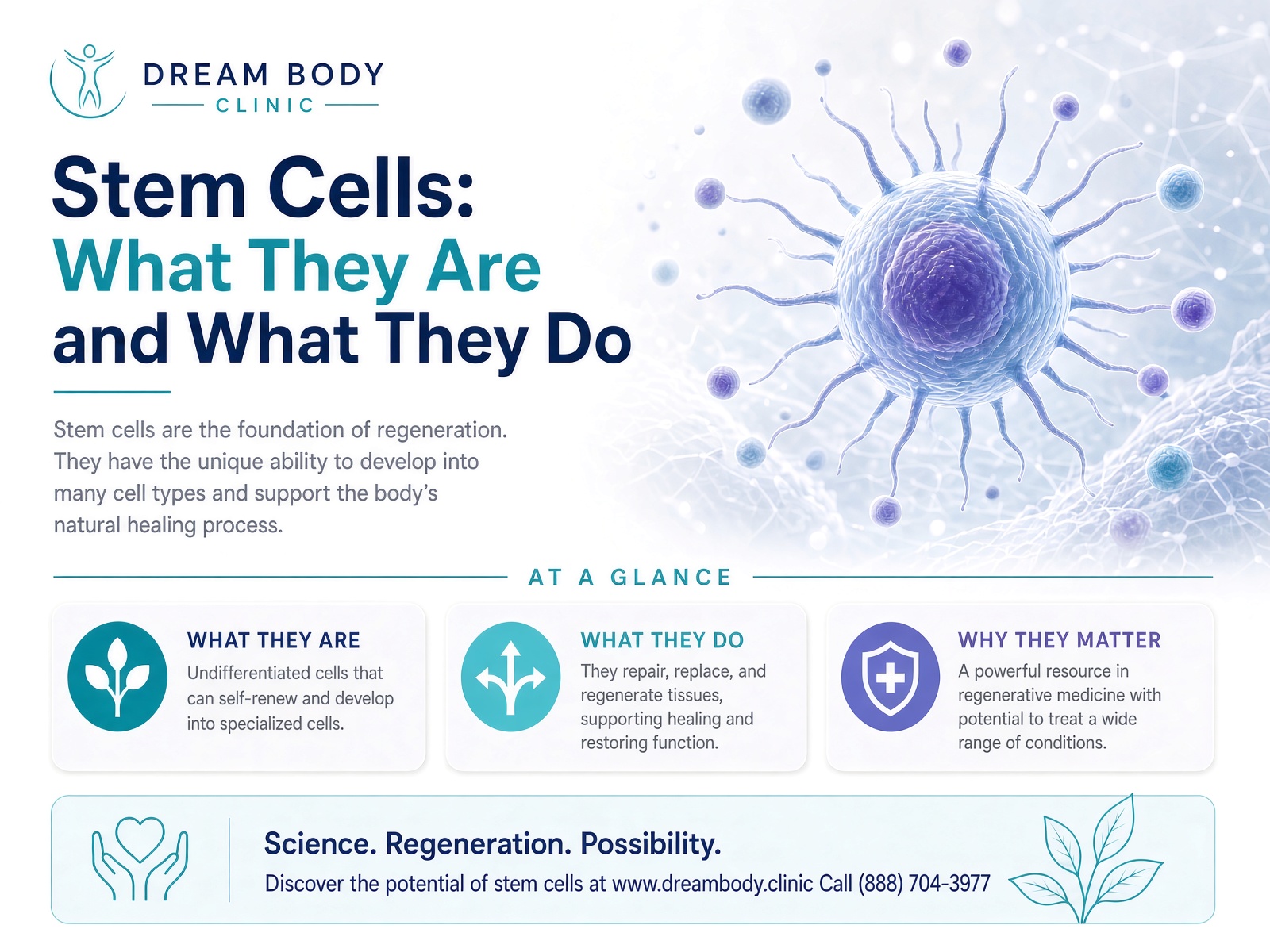
Stem Cells: What They Are and What They Do
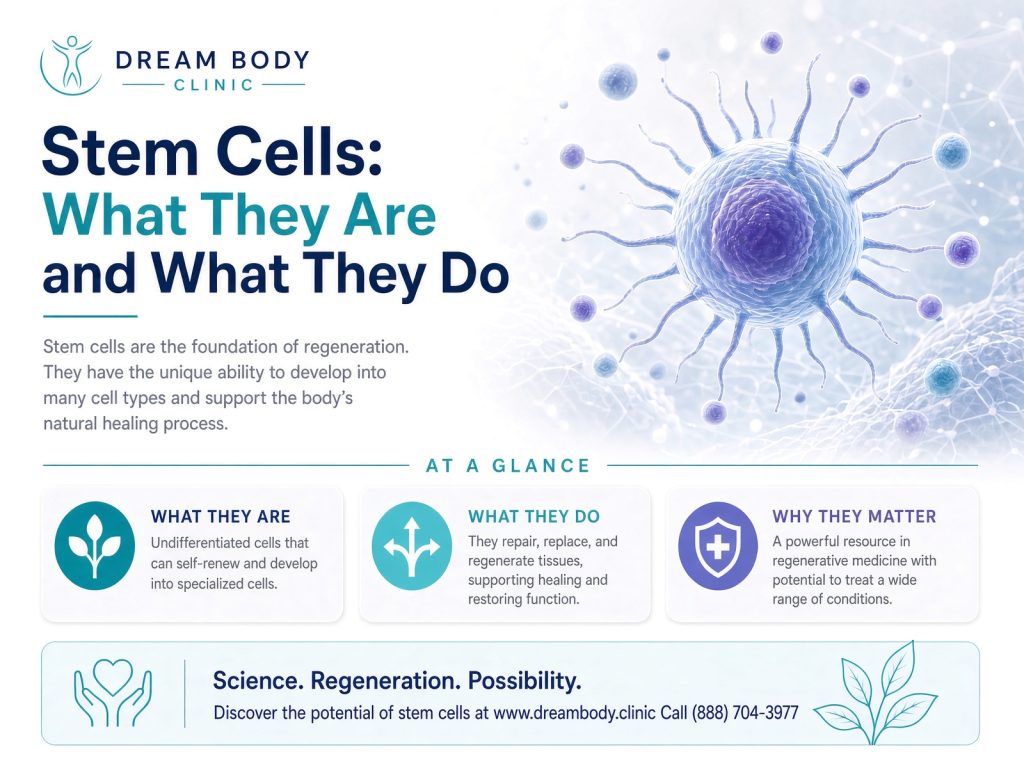
Stem cells are the body’s raw material. They are the only cells in the human body with the natural ability to develop into many different cell types, from muscle cells to brain cells to blood cells. This makes them central to how the body heals, rebuilds, and maintains itself over time. At Dream Body Clinic in Puerto Vallarta, stem cell therapy is at the heart of a regenerative medicine approach that helps patients with orthopedic, autoimmune, and neurological conditions find real, lasting relief.
What Are Stem Cells?
What Are Stem Cells? A Plain-Language Guide to the different types and why Mesenchymal Stem Cells are best.
“Stem cell” is one of the most used and least explained terms in medicine. The same words are used for a decades-old leukemia treatment, a controversial area of laboratory research, and the injections offered at regenerative medicine clinics around the world, including ours. These are very different things.
This guide explains what a stem cell is, the three main types you’ll hear about, and what current research says about how mesenchymal stem cells (MSCs), the type most people mean when they say “stem cell therapy,” actually work. At the end we explain the cells we use at Dream Body Clinic and why.
What Is a Stem Cell?
Most cells in your body are specialized. A heart muscle cell beats, a red blood cell carries oxygen, a skin cell forms a barrier. They do one job and generally can’t become anything else.
Stem cells are different in two ways:
- Self-renewal: they can divide and make more copies of themselves.
- Potency: they can give rise to more specialized cell types.
How many different cell types a stem cell can become is called its potency. This is the key to telling the types apart:
| Potency | What it means | Example |
|---|---|---|
| Pluripotent | Can become almost any cell type in the body | Embryonic stem cells |
| Multipotent | Can become a limited family of related cell types | Hematopoietic (blood-forming) stem cells; mesenchymal stem cells |
The US National Institutes of Health has a helpful overview of stem cell basics if you’d like to go deeper.
Embryonic Stem Cells
What they are
Embryonic stem cells come from the inner cell mass of an embryo a few days after fertilization, usually from embryos created during IVF that were donated for research. They are pluripotent: in principle, they can develop into any of the more than 200 cell types in the human body.
Why they aren’t used for routine treatment
That flexibility is exactly what makes them hard to use safely. When undifferentiated embryonic stem cells are transplanted, they can grow in an uncontrolled way and form teratomas, tumors that contain a jumble of different tissue types, such as hair, muscle or bone. Researchers regard this tendency to form tumors as one of the major safety barriers to using these cells in patients (Blum & Benvenisty, Adv Cancer Res, 2008).
Embryonic stem cells also raise significant and widely debated ethical concerns, because obtaining them destroys the embryo. Different countries regulate this research very differently.
Where they fit today
Embryonic stem cells are mainly a research tool, used to study human development and disease and as a starting point for experimental therapies that are tested in tightly controlled clinical trials. Dream Body Clinic does not use embryonic stem cells.
Hematopoietic (Blood-Forming) Stem Cells
What they are
Hematopoietic stem cells live mainly in your bone marrow. They are multipotent and produce all of your blood cells:
- red blood cells, which carry oxygen,
- white blood cells, which fight infection, and
- platelets, which help blood clot.
They are also found in umbilical cord blood and, in smaller numbers, in circulating blood.
An established, approved treatment
Hematopoietic stem cell transplants, often called bone marrow or cord blood transplants, are the most established form of stem cell therapy. They have been used for decades to treat leukemia, lymphoma, multiple myeloma and some other blood and immune disorders, usually to rebuild the blood and immune system after high-dose chemotherapy or radiation (National Cancer Institute).
In the United States, the only stem cell products the FDA has approved are cord blood-derived blood-forming stem cells, and they are approved for disorders of the blood-forming system (FDA). These transplants are performed in hospital transplant centers and are not what regenerative medicine clinics offer.
Mesenchymal Stem Cells (MSCs): The Type Behind Most “Stem Cell Therapy”
What they are
When you see “stem cell therapy” for joints, the spine, autoimmune conditions or wellness, it almost always refers to mesenchymal stem cells, also called mesenchymal stromal cells. They’re found in many tissues, including bone marrow, fat, umbilical cord tissue (Wharton’s jelly) and placenta.
MSCs are multipotent and can be grown (expanded) in large numbers in a laboratory. They are adult-type cells, not embryonic cells, and they don’t carry the teratoma risk associated with pluripotent cells.
What MSCs can do in a lab dish
Under the right laboratory conditions, MSCs can be coaxed to become bone, cartilage or fat cells. This ability is part of how scientists define them. For years, it led to a simple and appealing idea: inject MSCs into a damaged knee and they will turn into new cartilage.
What happens in the body is different
Research over the past two decades has changed that picture. When MSCs are injected or infused, most of them don’t stick around for long, and few, if any, turn into new tissue. Studies tracking infused cells have found that most are cleared within days (Eggenhofer et al., Front Immunol, 2012).
Yet benefits seen in some studies can last much longer than the cells themselves. This led researchers to a different explanation.
How MSCs Work: The Paracrine Effect
Rather than turning into new tissue, MSCs appear to work mainly by signaling to the cells around them. This is called the paracrine effect (from the Greek for “beside” and “to secrete”).
MSCs release a mix of biologically active substances, including:
- Growth factors, proteins that influence how cells grow, survive and repair,
- Cytokines, chemical messengers that help regulate inflammation and the immune response, and
- Extracellular vesicles, including exosomes, tiny packets carrying proteins and genetic material that other cells can take up.
Current research suggests these signals may:
- help regulate inflammation,
- modulate the immune response, calming overactive immune activity in some settings, and
- support the body’s own repair processes, for example by influencing local cells and blood vessel growth.
Dr. Arnold Caplan, the scientist who coined the term “mesenchymal stem cell” in 1991, later argued that the name was misleading for exactly this reason. He proposed calling them “medicinal signaling cells”, because their therapeutic effects appear to come from what they secrete rather than from becoming new tissue (Caplan, Stem Cells Transl Med, 2017). A widely cited 2019 review reached a similar conclusion about how MSCs act in the body (Pittenger et al., NPJ Regen Med, 2019).
What this means for patients
Understanding the paracrine effect helps set realistic expectations:
- MSC therapy is best understood as an attempt to influence the environment in a joint or the body, not to rebuild it.
- Responses are modest and variable. Some patients report meaningful improvement, others little or none.
- MSC therapy is investigational for most conditions and is not FDA-approved. Larger, well-controlled trials are still needed.
For safety, systematic reviews of clinical trials have generally found MSC therapy to be well tolerated, with transient fever and injection-site reactions among the most commonly reported side effects. Long-term data are still limited (Lalu et al., PLoS One, 2012).
Dream Body Clinic’s Approach
Our cell sources
We use allogeneic (donor) MSCs from Wharton’s jelly (the gel-like tissue inside the umbilical cord) and placenta, donated after live, healthy births. Collecting this tissue is non-invasive for the donor, since it would otherwise be discarded, and it means you don’t need a bone marrow or fat harvest. Donors go through medical screening, including a clinical history and blood tests for HIV, hepatitis B and C, syphilis and Chagas disease.
Our own licensed lab
We grow our cells in our in-house laboratory in Bucerías, Nayarit, which holds three licenses from COFEPRIS, Mexico’s federal health regulator: to produce stem cells, to store them as a cryobank, and to practice regenerative medicine. The licenses are published on our Certified Stem Cells page. A COFEPRIS license means our facility is authorized and subject to oversight; it does not mean any regulator has approved MSC therapy as effective for a specific condition.
Cells are expanded in a GMP-grade, xeno-free culture medium (no animal-derived components) in a cleanroom environment, and samples are tested by COFEPRIS-authorized third-party labs using flow cytometry (to confirm cell identity) and microbiological tests for mycoplasma and endotoxins.
Fresh, never frozen
The cells used in treatment are never frozen. We take them out of culture the day before treatment and administer them within 24 hours. Our cryobank is used for research only. Our physicians prefer fresh cells because freezing and thawing can affect cell viability and function; research comparing fresh and frozen MSCs is still evolving.
What to expect
Because MSCs appear to work through signaling, changes, when they happen, tend to be gradual. We typically assess how a patient has responded at around 3 to 6 months, and we follow up remotely at 3, 6 and 12 months. Results vary, and some patients see little or no benefit.
Frequently Asked Questions
Are the stem cells used at Dream Body Clinic embryonic?
No. We use mesenchymal stem cells from umbilical cord tissue (Wharton’s jelly) and placenta donated after healthy live births. No embryos are involved.
Do mesenchymal stem cells turn into new cartilage or tissue?
In a lab dish, MSCs can become bone, cartilage or fat cells. In the body, current research suggests most injected MSCs don’t persist long or become new tissue. Instead, they appear to work mainly by releasing signals that may help regulate inflammation and support the body’s own repair processes to regeneration cartilage and other tissues.
What is the paracrine effect?
It’s the way MSCs influence nearby cells by secreting growth factors, cytokines and extracellular vesicles such as exosomes, rather than by replacing damaged cells themselves.
If MSCs don’t stay in the body, how can any benefit last?
The results last because MSCs guide the repair then regeneration of tissue. The new tissue does not just go away. It will stay with you and so will the results.
Are hematopoietic stem cell transplants the same as what you offer?
No. Bone marrow and cord blood transplants for leukemia, lymphoma and myeloma are established hospital treatments that rebuild the blood and immune system. We don’t offer them. Our MSC treatments are investigational.
Will my body reject donor cells?
MSCs are immune priveleged. They don’t exhibit human leukocyte antigen (HLA) and they are immune evasive so your immune system just thinks they are your own and won’t reject them. This means no blood matching or other types of matching.
Is MSC therapy FDA-approved?
No. MSC therapies like ours are not FDA-approved and are considered investigational. We provide them in Mexico under COFEPRIS (FDA equivalent in Mexico.) licensing. Dream Body Clinic licenses listed here https://dreambody.clinic/certified-stem-cells/
Why Is There So Much Interest in Stem Cell Therapy?
Stem cell therapy has attracted serious attention from researchers and clinicians for three main reasons. First, studying stem cells helps scientists understand how diseases actually develop at the cellular level. Second, healthy stem cells can be used to replace or repair tissue that has been damaged by injury or illness. Third, stem cells can be used to test new drugs in a controlled setting before those drugs are given to patients.
The field of regenerative medicine takes these possibilities and applies them directly to patient care. Rather than managing symptoms with medication or removing damaged tissue through surgery, regenerative medicine works with the body’s own repair mechanisms to restore function. This is the foundation of what Dream Body Clinic offers to the many international patients who travel to Puerto Vallarta seeking an alternative to conventional treatment.
Conditions like osteoarthritis, Parkinson’s disease, and heart failure are among the most actively studied areas in stem cell research. According to the National Institutes of Health, ongoing clinical research continues to show promising results across a range of conditions where the body’s natural repair capacity has been overwhelmed or lost. For patients who have not found relief through standard medical approaches, this research translates into real hope.
How Does Stem Cell Therapy Work?
Stem cell therapy follows a clear process. First, stem cells are collected, either from the patient’s own body or from a donor source such as umbilical cord tissue. Second, those cells are prepared and, where appropriate, guided in a laboratory setting to begin differentiating toward the target cell type needed for the specific condition being treated. Third, the prepared cells are introduced into the patient’s body, typically at or near the site of injury or disease, where they can begin supporting the natural repair process.
At Dream Body Clinic, this process is shaped around each individual patient. The medical team begins with a thorough consultation to understand the patient’s condition, history, and goals. From there, a treatment protocol is built specifically around those needs. Patients receive clear guidance at every stage, from preparation through the treatment itself and into the recovery period that follows.
One of the distinctive aspects of the Dream Body Clinic approach is the combination of stem cell therapy with Human Growth Hormone (HGH). HGH supports cell regeneration and helps create a more favorable environment for the stem cells to function. When used together, stem cell therapy and HGH can produce better recovery outcomes than either treatment alone. This integrated approach is a key reason why patients from across North America and beyond choose to travel to Puerto Vallarta for treatment at Dream Body Clinic.
What Conditions Can Stem Cell Therapy Help Treat?
Stem cell therapy has a broad and growing range of clinical applications. At Dream Body Clinic, the primary focus areas are orthopedic conditions, autoimmune disorders, and neurological conditions.
On the orthopedic side, the clinic works with patients experiencing joint degeneration, osteoarthritis, cartilage damage, and chronic pain from injuries that have not healed fully through conventional means. Autoimmune conditions treated at the clinic include disorders where the immune system has turned against the body’s own tissue. For neurological conditions, the clinic works with patients living with conditions that affect the nervous system’s ability to function normally.
Beyond these core specialties, the broader research landscape includes conditions such as heart failure, type 1 diabetes, ALS, spinal cord injuries, and Crohn’s disease. Stem cell transplants have already been used successfully for decades in treating blood-related cancers and diseases like leukemia and lymphoma, which represents one of the most well-established success stories in regenerative medicine. This history gives credibility to the wider field and to the ongoing work being done at clinics like Dream Body Clinic.
Is Stem Cell Therapy Safe?
Safety is the most important question any patient should ask before beginning stem cell treatment, and it deserves a direct, honest answer. Stem cell therapy, when performed by qualified medical professionals using properly sourced and prepared cells, has a strong clinical safety record. The main risk considerations center on immune response, proper cell sourcing, and ensuring that treatment protocols are grounded in established science rather than unproven claims.
Dream Body Clinic follows strict safety protocols and maintains international certifications that reflect its commitment to patient protection. Every treatment protocol is reviewed by the clinic’s medical team with patient safety as the primary consideration. The clinic also places a strong emphasis on patient education, making sure patients understand what the treatment involves, what to expect, and how to support their recovery effectively.
Post-treatment follow-up is not an afterthought at Dream Body Clinic. It is a built-in part of the patient journey. The medical team stays in contact with patients after they return home, monitoring progress and addressing any questions that come up during recovery. This level of ongoing support is one of the reasons international patients continue to choose Dream Body Clinic for their regenerative medicine needs.
Why Choose Dream Body Clinic for Stem Cell Therapy in Puerto Vallarta?
Dream Body Clinic has built a strong reputation as one of the leading destinations for regenerative medicine in Mexico. Patients from the United States, Canada, and beyond travel to Puerto Vallarta specifically because the clinic combines clinical credibility, an integrated treatment approach, and a level of personalized care that is difficult to find elsewhere.
The clinic’s approach brings together advanced stem cell therapy and HGH in a coordinated protocol built around each patient’s specific condition. This combination, along with the clinic’s specialization across orthopedic, autoimmune, and neurological categories, means patients are not receiving a one-size-fits-all treatment. They are receiving a plan designed around their individual needs and goals.
Puerto Vallarta itself is an accessible and welcoming destination for international patients. Direct flights connect the city to major airports across North America, and the coastal setting supports a relaxed, comfortable recovery environment. Many of our international patients tell us that the combination of high-quality care and the surroundings in Puerto Vallarta made the experience far more manageable and positive than they had expected.
Why Get Stem Cell Therapy in Mexico and Not the USA?
This is one of the most common questions patients ask, and it is a fair one. The short answer is that the regulatory environment in the United States significantly limits what clinics there can legally offer.
In the US, the FDA enforces what is called the “minimal manipulation” rule. This means that stem cells cannot be fully isolated and cultured for therapeutic use. Clinics can offer minimally manipulated stem cells sourced from fat tissue, bone marrow, or umbilical cord tissue, but the resulting product is not a pure population of stem cells. Because the cells are not properly isolated, what is being injected is mostly a mix of cell types with only a small fraction being actual stem cells. The therapeutic value of that product is substantially lower than a properly prepared stem cell treatment.
The research gap between what the science shows and what US clinics can offer is even more striking when you look at the evidence. There are over 100,000 published studies on mesenchymal stem cells available on Google Scholar. The science supporting their use for conditions like knee osteoarthritis and joint repair is extensive. And yet, US clinics cannot offer these treatments in their most effective form because of how the FDA approval system works.
To get mesenchymal stem cells approved for even a single application, such as knee osteoarthritis, a clinic must pay a $2.5 million application fee just to enter the FDA trial process. That only covers one condition. A separate application, and another $2.5 million, would be required for meniscus repair. And another for each additional use case. Each application then leads into a multi-phase trial process that typically takes more than seven years and costs hundreds of millions of dollars to complete. At the end of that process, a clinic cannot patent a mesenchymal stem cell, meaning any competitor can immediately offer the same treatment. There is no way to recover the investment.
This is not a gap in the science. It is a structural problem within the approval system. It was designed in a way that favors large pharmaceutical companies with the resources to patent proprietary drug compounds and recoup massive development costs. Naturally occurring biological therapies like stem cells do not fit that model, and as a result, patients in the US are left with limited options. They are often steered toward long-term medication use or surgery when a regenerative approach could be far more effective.
In Mexico, Dream Body Clinic operates under a different regulatory framework that allows for the proper isolation, culturing, and clinical application of stem cells. This means patients receive a treatment that is far more aligned with what the actual science supports.
What Should You Expect During Your Stem Cell Treatment Journey?
The treatment journey at Dream Body Clinic is built around three principles: transparency, education, and ongoing support. From the first contact through to post-treatment follow-up, patients are kept informed and supported at every step.
It begins with a free consultation, where the medical team reviews the patient’s condition, medical history, and treatment goals. This is not a brief intake call. It is a genuine clinical conversation designed to determine whether stem cell therapy is the right fit for that individual patient and, if so, what the most appropriate protocol would be. Patients are encouraged to ask questions and to share any concerns they have before making a decision.
Once treatment begins, the clinic’s team is present throughout the process. Patients receive clear instructions on how to prepare, what to expect during the procedure, and how to support their recovery in the days and weeks that follow. The clinic’s combination of stem cell therapy and HGH is explained in detail so patients understand not just what is being done, but why.
After returning home, patients continue to receive follow-up support from the Dream Body Clinic team. Recovery timelines vary depending on the condition being treated and the individual patient, but the clinic’s commitment to long-term outcomes means the relationship does not end when the patient leaves Puerto Vallarta. Many patients report noticeable improvements in the weeks and months following treatment, and the clinic’s team is available to support them throughout that process.
Frequently Asked Questions
What are stem cells and why are they important for healing?
Stem cells are the only cells in the body capable of developing into other specialized cell types. They play a critical role in healing because they can migrate to sites of injury and differentiate into the specific cells needed to repair damaged tissue. Without stem cells, the body would have no way to replace worn-out or injured cells with new functional ones.
How does Dream Body Clinic use stem cell therapy to treat patients?
Dream Body Clinic collects stem cells from appropriate sources, prepares them for treatment, and introduces them into the patient’s body at or near the site of injury or disease. The clinic combines this with HGH therapy to improve the conditions for cellular repair and recovery. Every treatment is personalized based on the patient’s specific condition and goals.
What conditions can be treated with stem cell therapy at Dream Body Clinic?
The clinic specializes in orthopedic conditions such as osteoarthritis and joint degeneration, autoimmune disorders, and neurological conditions. Stem cell transplants have also been used for decades in treating blood-related cancers such as leukemia. Research into conditions including heart failure, type 1 diabetes, and ALS is ongoing.
Is stem cell therapy in Mexico safe and clinically credible?
Yes, when performed by a qualified and certified medical team using properly sourced and prepared cells. Dream Body Clinic follows strict international safety protocols and maintains certifications that reflect its commitment to patient safety. The clinic also provides thorough patient education and post-treatment follow-up as standard parts of the care process.
How is stem cell therapy combined with HGH at Dream Body Clinic?
Human Growth Hormone supports cell regeneration and helps create a more favorable biological environment for stem cells to function. When used alongside stem cell therapy, HGH can enhance recovery outcomes. Dream Body Clinic integrates both treatments into a coordinated protocol based on each patient’s needs.
What is the difference between adult stem cells and other stem cell types?
Adult stem cells are found in the body’s own tissues, most commonly bone marrow and fat. They are safe, well-established, and commonly used in clinical treatment. Induced pluripotent stem cells (iPSCs) are adult cells reprogrammed to behave like embryonic stem cells, giving them wider application potential. Perinatal stem cells come from umbilical cord blood and amniotic fluid, and they offer a middle ground in terms of flexibility and application.
How long does recovery take after stem cell therapy?
Recovery timelines vary depending on the condition being treated and the individual patient. Some patients begin noticing improvements within a few weeks, while others see continued progress over several months. Dream Body Clinic provides ongoing follow-up support to monitor recovery and address any questions that come up after treatment.
Who is a good candidate for regenerative medicine treatments?
Good candidates are generally patients with chronic conditions that have not responded well to conventional treatment, or those looking to avoid or delay surgery. People with orthopedic injuries, autoimmune conditions, or neurological disorders often benefit. A consultation with the Dream Body Clinic medical team is the best way to determine whether stem cell therapy is appropriate for a specific situation.
What makes Puerto Vallarta a suitable destination for medical treatment abroad?
Puerto Vallarta is well connected to major North American cities through direct flights, making travel straightforward for international patients. The city offers a comfortable, welcoming environment that supports recovery. Dream Body Clinic’s presence in Puerto Vallarta gives patients access to high-quality regenerative medicine in a setting that many find far more relaxed and personalized than large hospital systems.
How do I get started with a stem cell therapy consultation at Dream Body Clinic?
You can reach out directly through the clinic’s website, by phone, or via WhatsApp. The team offers free consultations to help prospective patients understand their options and decide whether stem cell therapy is the right path for them. There is no obligation, and the conversation is genuinely focused on what is best for the patient.
Ready to Take the Next Step?
If you are considering stem cell therapy and want to speak with a qualified medical team that specializes in regenerative medicine, Dream Body Clinic is here to help. Visit www.dreambody.clinic, call (888) 704-3977, or reach out on WhatsApp at +52 322 232 1055 to book your free consultation today.