
Your labs come back low on two separate morning draws, your clinician says replacement is reasonable, and the conversation moves straight to a choice you weren't prepared for. Gel or injection. Patch or pellet. Something you do every morning or something a clinician does every few months.
Most men arrive at that moment knowing only that their testosterone is low. They leave with a prescription and no clear picture of what the next year looks like: how often they'll think about the treatment, when their levels get checked, and what a bad week on the wrong regimen feels like. This comparison treats the choice for what it is, a scheduling and monitoring decision as much as a hormonal one.
Table of Contents
- Every Testosterone Delivery Option at a Glance
- Who Should Consider Testosterone Therapy and Who Should Not
- Injections and Pellets Mean Fewer Applications and Larger Swings
- Gels, Patches and Oral Options Compared on Daily Routine
- Monitoring Schedule and Safety Checks After You Start
- Cost, Insurance and Why Patients Switch Options
- Choosing a Testosterone Option With Your Clinician
Every Testosterone Delivery Option at a Glance
| Option | Typical schedule | Level pattern | Main practical drawback |
|---|---|---|---|
| Intramuscular injection (cypionate or enanthate) | 100 mg weekly or 200 mg every 2 weeks | Peaks soon after injection, falls toward hypogonadal levels before the next dose | Needle use or clinic visits; mood and energy swings |
| Transdermal gel | Once daily | Steadier daily exposure | Transfer to partners or children through skin contact |
| Transdermal patch | Once daily, rotated sites | Steady daily exposure | Local skin irritation |
| Buccal preparation | Twice daily, applied to the gum | Steadier than injection | Gum irritation and a twice-daily routine |
| Subcutaneous pellets | Every 3 to 6 months | Long, steady release | Minor insertion procedure; dose can't be changed quickly |
| Oral testosterone undecanoate | Twice daily with meals | Rises with each dose; food intake affects absorption | Blood-pressure labeling and product-specific monitoring |
Testosterone replacement therapy options are not a ladder with a best rung at the top. They're a set of delivery systems chosen on diagnosis, patient preference, pharmacokinetics, treatment burden and cost, as the Endocrine Society clinical practice guidance frames it. The same document sets the target that governs every row above: serum testosterone in the mid-normal range, not the top of it.
That target is what makes the schedule column matter more than the marketing. Injections ask for periodic administration and can produce larger peak-to-trough changes. Daily gels and patches smooth the curve but depend on consistent application and, for gels, precautions against transfer. Pellets buy longer duration at the price of a minor insertion procedure.
The Endocrine Society also sets the review rhythm that applies regardless of which row you pick: reassessment of response, adverse effects and adherence at roughly 3 to 6 months after starting, then at least annual monitoring, with serum testosterone and hematocrit checked and prostate-cancer risk evaluated during the first treatment year.
How to read this table: rank the options by two questions only. How much daily routine will you actually keep, and how much level swing can you tolerate without it showing up in your mood, your skin or your blood count? Everything else is detail.
Notice what the table does not tell you: whether you should be on treatment at all. That question comes first, and it's where most of the risk sits.
Who Should Consider Testosterone Therapy and Who Should Not
Low energy is not a diagnosis. Neither is a single afternoon blood draw, a fitness tracker score, or the general sense that you've slowed down since you turned 45.
The regulatory line is unusually clear here. In 2015 the U.S. Food and Drug Administration required testosterone-product labeling to state that therapy is approved for men with low testosterone associated with a medical condition, rather than routine age-related decline, and mandated labeling about a possible risk of cardiovascular events. The published guideline record notes that the FDA review found limitations in studies claiming a causal cardiovascular relationship, while still requiring warnings plus information about venous thromboembolism risk.
So the gate is a diagnosis, built from repeat morning testosterone measurements, luteinizing hormone and follicle-stimulating hormone, and a search for reversible causes. Obesity, sleep disorders, medications and pituitary disease all belong in that search, and correcting one of them sometimes removes the need for replacement entirely.
The fertility conversation belongs before the first dose, not after. Exogenous testosterone suppresses pituitary signaling and can significantly reduce sperm production, as the Cleveland Clinic's TRT overview explains. A man who wants children in the next few years should ask for semen analysis, discuss sperm banking as a precaution, and never self-switch between testosterone and fertility medication.
- Hematocrit before starting, because red cell mass is the side effect most likely to force a dose change.
- Prostate assessment and PSA where indicated, since the first treatment year is when prostate risk gets evaluated.
- Blood pressure and cardiovascular history, including any prior heart attack, stroke or clot.
- Clotting history, given the venous thromboembolism information carried in labeling.
Three situations should pause the decision outright: active plans to conceive, unresolved prostate findings, and symptoms with normal testosterone results. In the last case, the answer is a different workup, not a different product.
If you're weighing growth hormone at the same time, read whether you can take testosterone and HGH together before the appointment so the question is settled in the room rather than guessed at afterward.
Products sold as testosterone support from Pumpernickel Health Foods sit in a separate category. They don't shut down your own axis the way exogenous testosterone does, but they also don't correct a laboratory-confirmed deficiency, and taking one doesn't replace the two morning draws.
Injections and Pellets Mean Fewer Applications and Larger Swings
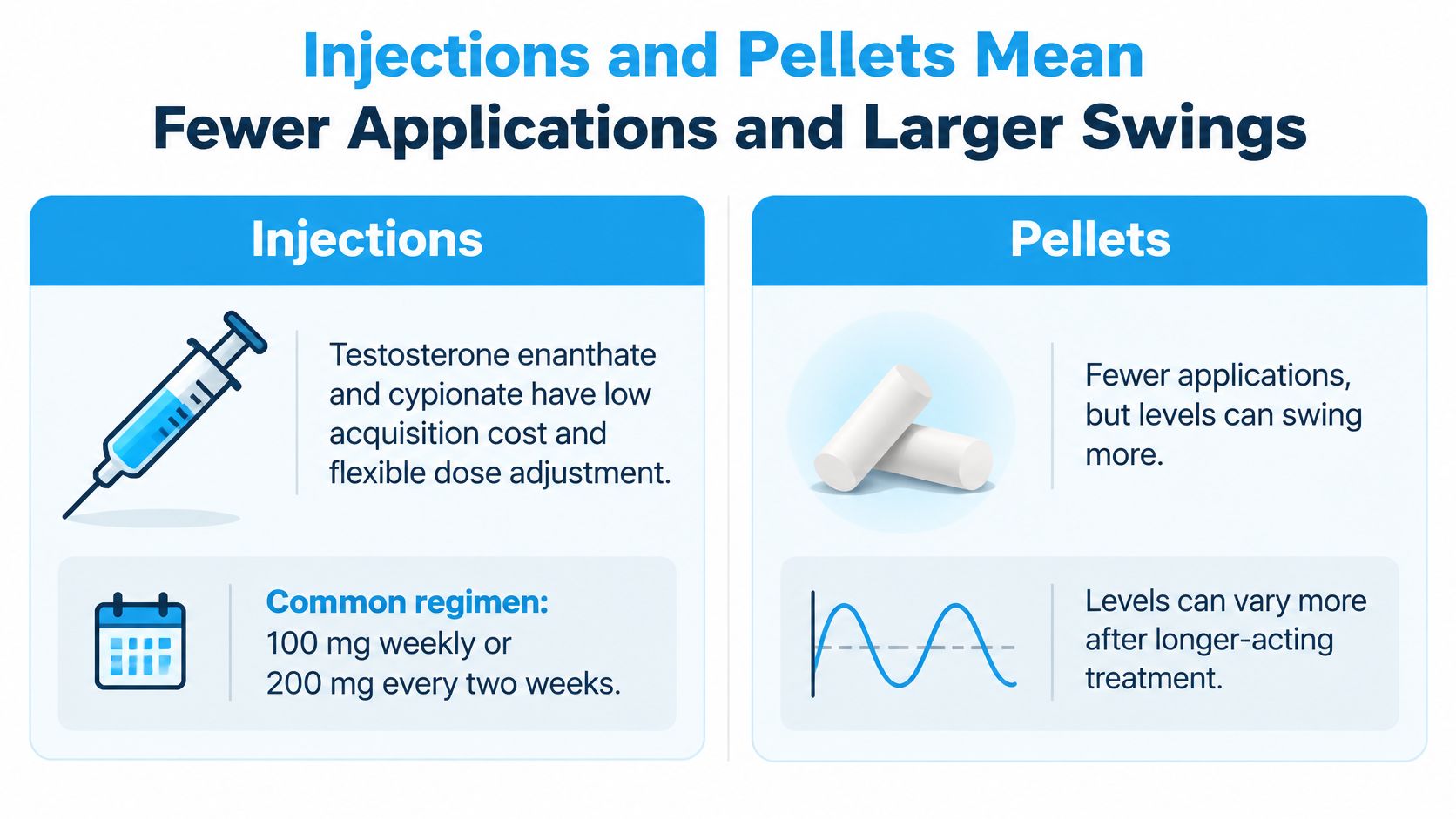
Fewer applications sounds like freedom until you see the curve it produces. Testosterone enanthate and cypionate are cheap to acquire and easy to adjust, which is why they remain the default in many clinics. The trade-off is pharmacokinetic: a commonly cited regimen of 100 mg weekly or 200 mg every two weeks can push serum testosterone above the physiologic range soon after injection, then let it decline toward hypogonadal levels before the next dose, according to the Endocrine Society's pharmacokinetic review.
That curve is why timing of the blood test matters more than the number itself. Serum testosterone should be measured midway between injections. Older Endocrine Society guidance suggests considering a dose or interval adjustment when that midpoint sits above 700 ng/dL or below 400 ng/dL, which is a far more useful signal than a level drawn the day after a shot.
Weekly lower-dose administration is often the more stable strategy than biweekly dosing, though individual response, adverse effects and local product labeling govern the final call.
A man on 200 mg every two weeks who feels irritable and flat in the second week doesn't necessarily need a higher dose. He needs a midpoint test and a conversation about splitting the same total dose into weekly injections.
The lifestyle costs are real and worth naming: self-injection or clinic visits, and fluctuations in mood, energy, acne, estradiol or hematocrit that can be noticeable enough to affect sleep, training and relationships. None of those are reasons to avoid injections. They're reasons to test at the right time rather than judging a regimen from one convenient result.
Pellets solve the adherence problem differently. Placed under the skin in a minor procedure every three to six months, they deliver a long, steady release with nothing to remember day to day. The limitation is control: once pellets are in, a dose change can't be made quickly, so a patient who responds strongly has to wait out the curve.
For the ester-level differences between products, XO clinician comparison of testosterone esters is a useful primer before you ask about switching.

Gels, Patches and Oral Options Compared on Daily Routine
Daily options trade convenience of delivery for a commitment you repeat every single day. Gels come first for most men because absorption is reliable and reversal is fast if side effects appear. The Endocrine Society recommends targeting the mid-normal range regardless of formulation, weighing pharmacokinetics, treatment burden, preference and cost, and the NIH-hosted summary of that guidance notes that gel levels can be assessed after at least one week of use, while patch levels are typically measured 3 to 12 hours after application. The AUA advises checking testosterone in users of topical gels, patches and intranasal products roughly 2 to 4 weeks after initiation.
The operational issue with gels isn't the hormone. It's the transfer. Secondary exposure through skin contact is the reason for site precautions and hand washing, and it's a genuine household risk when there are small children or a pregnant partner at home.
- Apply to clean, dry skin on the abdomen, upper arm or thigh as the product label specifies.
- Let it dry fully before dressing, or the dose ends up in your shirt.
- Wash hands immediately after application, every time.
- Cover the site with clothing, and avoid skin-to-skin contact with the area until the next wash.
Patches avoid transfer entirely, which makes them attractive in households with young children. The cost shows up on the skin: local irritation is the common complaint. Place them on clean, hairless skin on the torso and rotate sites so the same patch of skin isn't reused.
Buccal preparations apply to the gum twice daily. They dodge needles and skin transfer, and the typical complaint is gum irritation plus the discipline of a second daily dose.
Oral testosterone undecanoate is the newest route for men who want neither needles nor topical products. It isn't a monitoring-free option. The FDA's class-wide labeling statement treats blood-pressure increases as a concern across testosterone products following ambulatory blood-pressure studies, so oral therapy carries product-specific labeling and its own surveillance requirements.
The habit that breaks daily therapy: missed doses that go unreported. Tell your clinician about them before the blood draw, because a level taken after three skipped days tells a different story than one taken on schedule.
All topical forms can still raise hematocrit and affect prostate assessment. Adherence decides whether a steady level is real or theoretical, so choose a daily option only if the routine is one you'll keep for years, not weeks.
Monitoring Schedule and Safety Checks After You Start
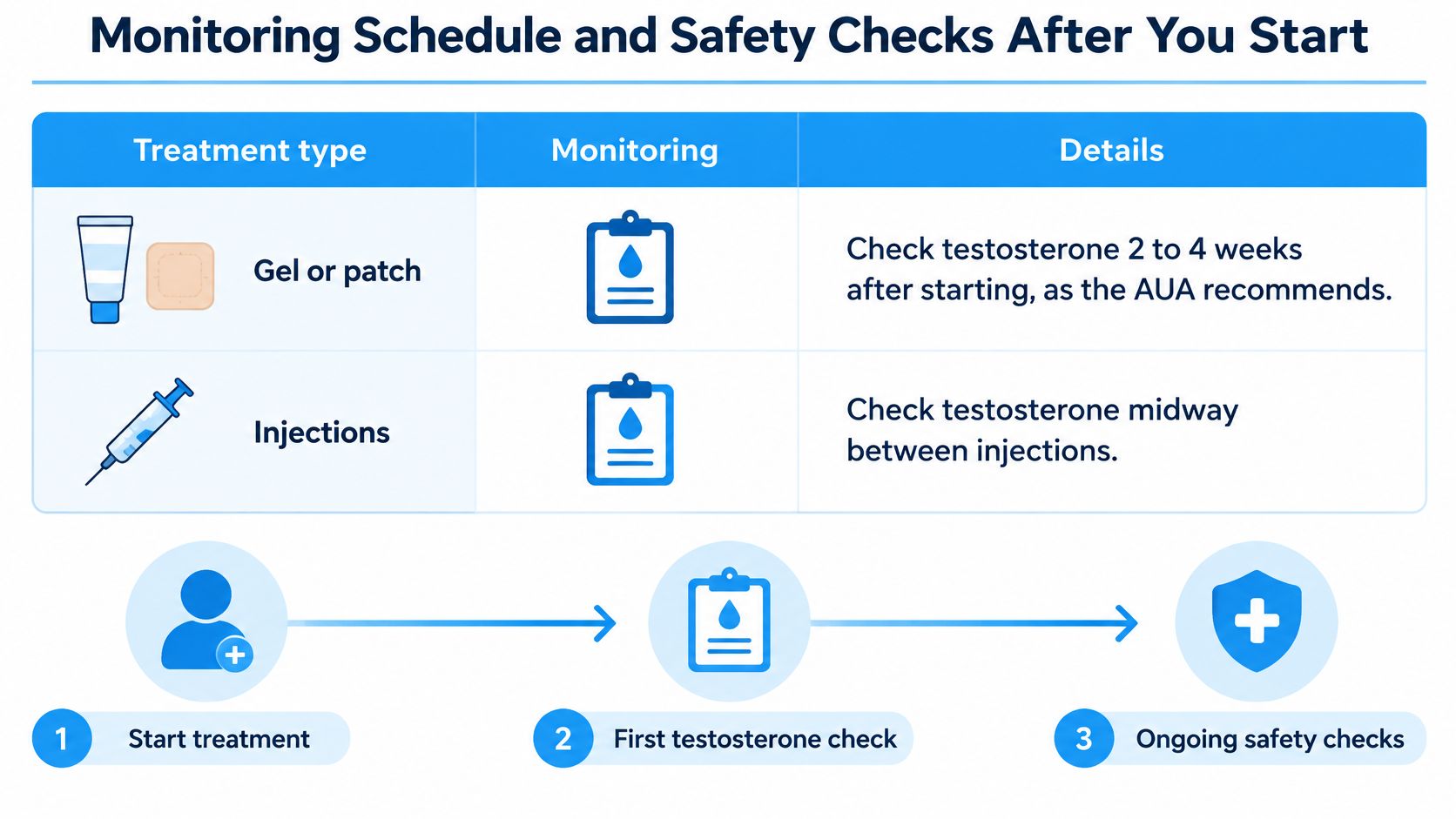
The prescription is the start of the work, not the end of it. Each check on the timeline below exists to answer a specific question, which is why skipping one leaves a gap you can't fill retrospectively.
| Timing | What is checked | Why it matters |
|---|---|---|
| 2 to 4 weeks after starting a gel or patch | Serum testosterone | AUA recommends an early check for topical products |
| Midpoint between injections | Serum testosterone | Shows the peak-to-trough swing |
| 3 to 6 months after starting | Testosterone, symptoms, side effects, adherence, hematocrit | Endocrine Society reassessment point |
| First treatment year | Prostate-cancer risk evaluation | Required prostate assessment window |
| At least once a year after that | Testosterone, hematocrit, blood pressure, symptoms | Ongoing surveillance |
The cardiovascular picture deserves the most careful reading, because it's the place where headlines outrun the data. In the FDA-reviewed TRAVERSE trial, more than 5,200 men received at least one dose of AndroGel 1.62% or placebo. Major adverse cardiovascular events occurred in 7.0% of testosterone-treated participants and 7.3% of placebo-treated participants, and the FDA's testosterone safety information reports that the trial did not demonstrate a new safety signal or trend in adverse cardiovascular outcomes. The same review required labeling changes adding or emphasizing warnings about increased blood pressure.
Read that combination properly. Reassuring trial data doesn't make therapy risk-free, and it doesn't make monitoring optional. It means the monitoring shifts toward the things an individual can control: blood pressure, hematocrit and symptom review.
What triggers a change. A midpoint testosterone outside the target band. A hematocrit above the level your clinician accepts. A blood pressure trend that's climbing visit after visit. A prostate finding that needs urology input. Any of these can prompt a dose adjustment, an interval change or a switch in delivery form, and each is easier to act on when you have data rather than impressions.
Keep a log that a clinician can use: dose, timing, symptoms, and home blood-pressure readings from the two weeks before each visit. Request an early check when symptoms change rather than waiting for the next scheduled draw. Men also ask whether therapy affects hair, and how testosterone affects hair loss covers the scalp question alongside the lab work. On the lipid side, testosterone and cholesterol myths is worth reading before you interpret a single panel.
Cost, Insurance and Why Patients Switch Options
Switching isn't a failure of the patient or the drug. It's the norm. A 2024 Endocrine News report stated that 66% of patients taking testosterone replacement therapy had switched therapy during the previous year, with insurance and administration route among the main drivers.
That number should change how you plan. Expect to evaluate more than one option in the first year, and build the comparison into your budget from the start rather than treating a switch as an unplanned expense.
- Price the full year, not the vial. Ask which delivery options your plan covers and what each costs annually, including visits, procedure fees and every blood test in the monitoring schedule.
- Log every dose and application time. Symptoms and side effects go in the same record, because the pattern is what identifies the problem.
- Name your switch trigger in advance. Persistent level swings, skin irritation, transfer concerns, missed doses or a coverage change are all legitimate reasons to revisit the choice.
- Bring the log to the clinician. They decide whether a switch needs a new baseline or just a new level check, and that decision changes the timeline.
Cross-border access adds a layer. Product availability and regulatory status vary by country, so a regimen that works well in one place may need review somewhere else. A traveling patient should carry a current prescription summary and recent lab results, since those two documents do more to prevent an interruption than any explanation at a pharmacy counter.
Switching without clinician review disrupts the one thing monitoring depends on: a stable, known level pattern you can compare against.
Choosing a Testosterone Option With Your Clinician
| Situation | Options to discuss | What to confirm |
|---|---|---|
| Needs steady daily levels and accepts a daily routine | Gel or patch | Partner contact with gel; skin irritation with patch |
| Wants few applications and accepts a minor procedure | Pellets | Dose changes take longer to take effect |
| Accepts injections, wants low cost and flexible dosing | Weekly low-dose injection | Mood and energy swings; midpoint testing |
| Wants to avoid needles and skin products | Oral or buccal | Blood-pressure monitoring; gum irritation with buccal |
| Wants to have children | Fertility evaluation before any testosterone | TRT can significantly reduce sperm production |
| Known heart, blood-pressure or clot risk | Discuss with clinician before any option | Blood-pressure and hematocrit checks; thromboembolism warning |
No row wins on its own. The right choice depends on your diagnosis, current labs, daily routine, cardiovascular and blood-pressure risk, fertility goals and cost, which is why a comparison table is a starting point rather than an answer.
Bring these five things to the consultation. Recent labs including morning testosterone and hematocrit. Your prostate history and any prior findings. Home blood-pressure readings from the past two weeks. A full medication and supplement list, since several common drugs affect testosterone. And a clear statement about plans to conceive, made before the first dose rather than after.
Then work through the decision in order. Write your top two options with their trade-offs side by side. Confirm the diagnosis and hold the fertility discussion before comparing any product. Ask the clinician to put the monitoring schedule in writing, including the date of your first level check and the results that would trigger a dose or delivery change.
If you're comparing clinic-based programs, Dream Body Clinic offers a Testosterone Cream 150mg 1 Year TRT Package, along with Sostenon 250 TRT and Primoteston Testosterone Enanthate TRT packages, each running for a year, all prescribed after consultation and bloodwork.
One distinction matters if you're also considering regenerative treatment. Mesenchymal stem cells don't differentiate into replacement tissue. Reviews describe them as acting through a paracrine mechanism, releasing a secretome of cytokines, growth factors and extracellular vesicles that signal nearby cells and influence immune regulation and tissue repair, as one mechanism review sets out. Stem cell therapy isn't FDA approved for these uses; at Dream Body Clinic, treatments are delivered under COFEPRIS, Mexico's equivalent regulator, which is what makes the protocols accessible to international patients. Hormone therapy and regenerative protocols are separate decisions, and neither substitutes for the other.
Switching later follows the same path. Any change in delivery form goes back through clinician review, with a fresh look at levels and the reason for the switch. For the questions men ask most often before that appointment, TRT questions and answers covers diagnosis, timing and what to expect in the first months.
Dream Body Clinic combines physician-supervised testosterone replacement therapy with regenerative protocols for men who want both handled under one clinical roof in Bucerias. Programs include a one-year testosterone cream package and injectable Sostenon 250 and Primoteston enanthate packages, each prescribed after bloodwork and consultation, with monitoring built into the follow-up. If you're weighing delivery options and want a schedule that fits your routine, visit Dream Body Clinic to start a case review.