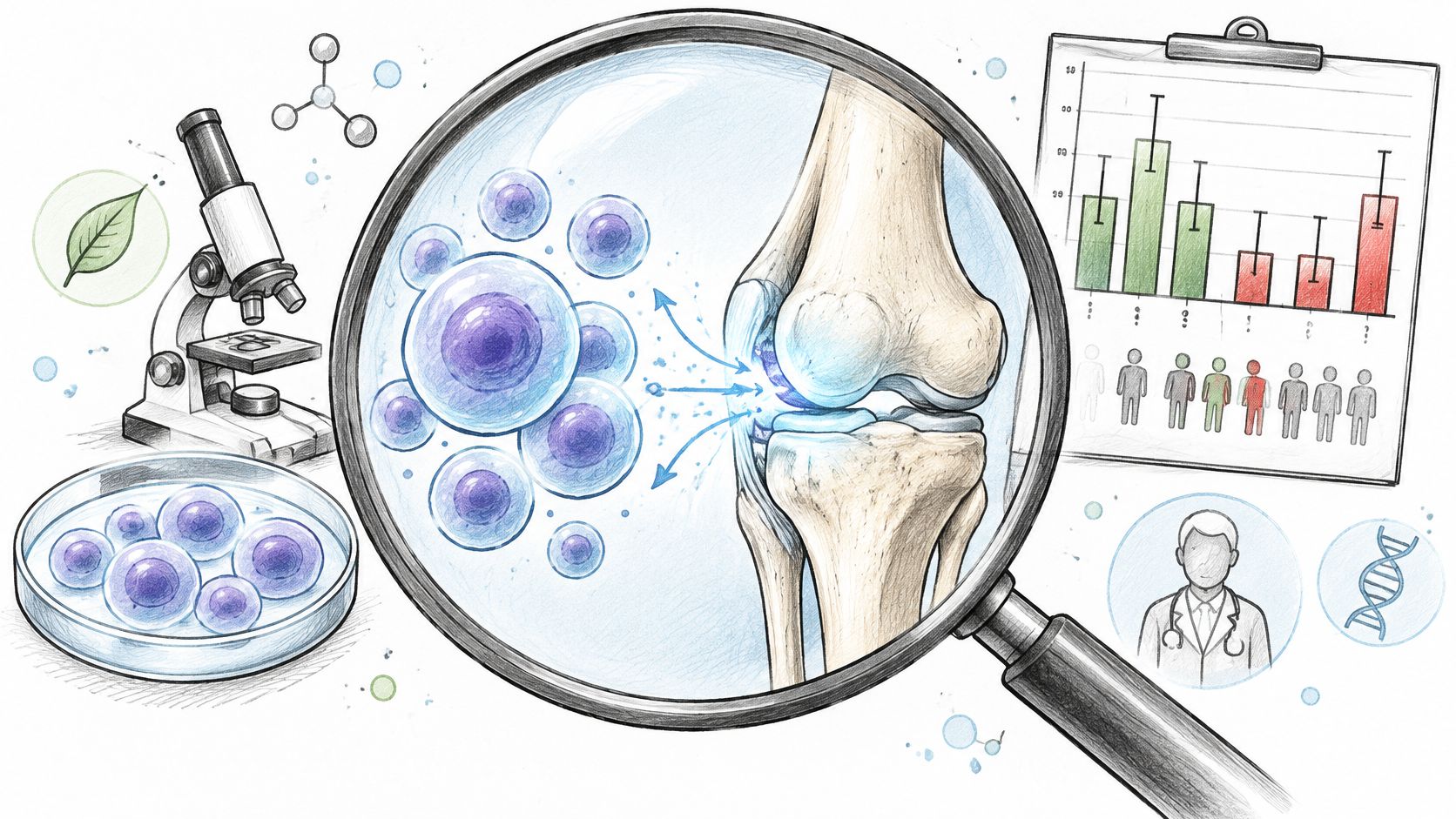
Stem cell therapy works for some conditions and not others, and the effect is usually smaller and more specific than the advertising around it. In knee osteoarthritis, pooled trial data against placebo show about 1.2 points of pain improvement on a 0 to 10 scale, while a 2025 analysis of 502 patients found WOMAC scores 7.44 points better than control at six months and 10.31 points better at twelve months.
The part that reframes every number in this article is simpler than most clinics make it sound. The injected cells aren't building replacement tissue. Mesenchymal stem cells signal. They release growth factors, cytokines and extracellular vesicles that change how the immune system and the cells already living in the joint behave. Once you hold that in mind, modest effect sizes stop looking like failures and start looking like the predictable output of a treatment that adjusts the healing environment rather than swapping parts.
What varies is not only the condition but the product. Two clinics can both say "stem cells" and deliver different cell sources, different viable-cell counts, different delivery routes and different follow-up schedules. That's why the same claim can be well supported in one setting and unsupported in another, and why the honest answer to does stem cell therapy work depends on which row of the evidence you're standing on.
Table of Contents
- Does Stem Cell Therapy Work? A Verdict by Condition
- How Stem Cells Help Healing Without Becoming New Tissue
- Knee Osteoarthritis Results Measured Against Placebo
- Back, Neck and Disc Results Where Evidence Is Mixed
- Parkinson's, MS and Conditions Without Trial Support
- Patient Selection Criteria Before Treatment
- Regulation, Risks and Choosing a Clinic Safely
Does Stem Cell Therapy Work? A Verdict by Condition
Stem cell therapy produces modest, condition-specific benefit in a few well-studied indications and no demonstrated benefit in several others. The distance between those outcomes is what a patient needs to understand before comparing clinics, because a result in one disease tells you almost nothing about another.
The sharpest contrast sits in two rows of the same evidence table. In children with steroid-refractory acute graft-versus-host disease, an approved mesenchymal product produced a 70% overall response rate at day 28, including a 30% complete response rate across 54 patients (FDA summary of the remestemcel-L approval). In multiple sclerosis, mesenchymal cells delivered into spinal fluid failed to beat saline on the primary outcome. Same broad cell family, opposite result.
| Condition | Strongest evidence | Key number | Verdict |
|---|---|---|---|
| Knee osteoarthritis | 2025 meta-analysis of 8 randomized trials, 502 patients | WOMAC up 7.44 points at 6 months and 10.31 points at 12 months versus control | Possible symptom benefit; certainty low |
| Lower back and disc pain | 2025 review of MSC studies; RESPINE randomized trial | RESPINE response 74% versus 69% with placebo (p=0.77) | Modest benefit in selected patients; not universal healing |
| Parkinson's disease | 2025 randomized trial, three allogeneic bone-marrow MSC infusions | 11.5% more patients with at least a 5-point motor gain than placebo at week 88 | Promising early signal from a single trial |
| Multiple sclerosis (intrathecal) | 2024 randomized trial versus saline | 33% versus 37% on the primary EDSS-plus outcome | No primary-outcome benefit shown |
| Acute graft-versus-host disease in children | FDA-reported results, 54 children, approved product remestemcel-L | 70% overall response at day 28; 30% complete response | Strongest data here, but an approved product used for a different purpose |
| Anti-aging, organ support, sexual health | No indication-specific trials in reviewed sources | Not available | Not supported; do not extrapolate from other diseases |
Two patterns hold across every row. First, none of these studies show cells turning into replacement tissue. The benefit runs through signaling, which is why pain can ease without a matching change on an MRI. Second, every result is tied to a named product, dose, route and patient population. A knee trial tells you about knees, in the patients that trial enrolled, with the cells that trial used.
The graft-versus-host result is worth pausing on, because it's the one place where regulators reviewed the data and approved a product. It also happens to be a disease of immune overactivity rather than structural damage, which fits the signaling explanation neatly. Approval there doesn't transfer to arthritis, and a strong arthritis result wouldn't transfer to graft-versus-host disease either.
Five variables decide how any of this goes for a specific person: the condition, the cell product, the dose, the delivery route and how carefully the patient was selected. Each one gets its own treatment below.
How Stem Cells Help Healing Without Becoming New Tissue
The mechanism explains the effect sizes, so it's worth getting right. The diagram below shows what the cells release once they're in a joint.
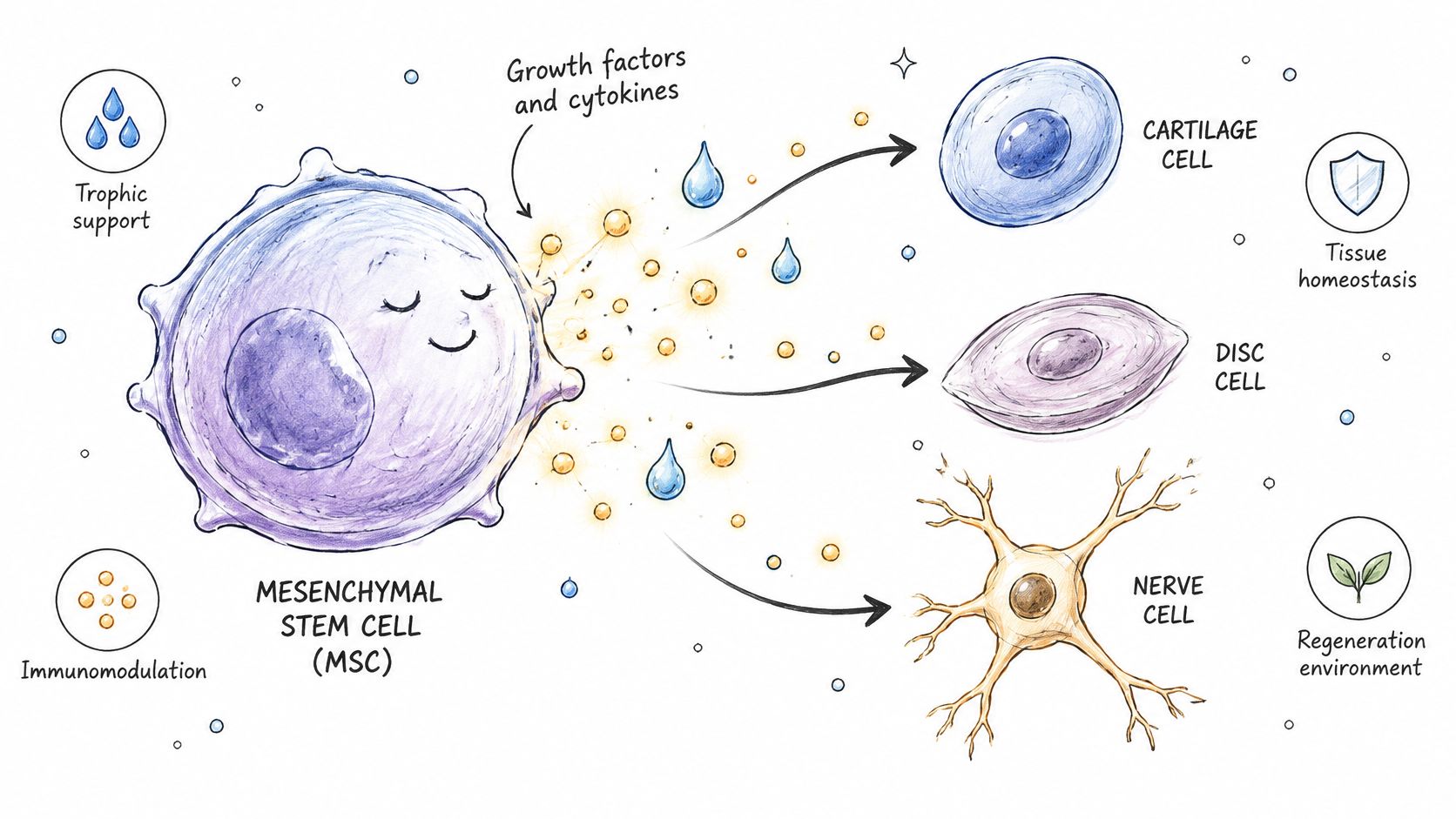
Mesenchymal stem cells work through paracrine signaling. They release soluble factors and extracellular vesicles that communicate with nearby immune, inflammatory and structural cells, and that conversation is what changes the local environment (phase II trial of bone-marrow MSCs in knee osteoarthritis). Durable engraftment and direct replacement of damaged cells aren't established as the usual mechanism.
Think of a site foreman with a radio. The foreman doesn't lay bricks. He tells the crews where to work, what to stop doing and when to pour. The crew is your own tissue, and he leaves once the job is set in motion.
Stem cells send signals. They don't become the tissue.
The trial data looks exactly like that model predicts. In a phase II randomized knee osteoarthritis trial, 100 million autologous bone-marrow MSCs combined with platelet-rich growth factor brought mean pain from 5.3 down to 3.5 over 12 months, against 5.0 to 4.5 in the control group, a statistically significant improvement in the treated group (p=0.01). The same study tracked inflammatory cytokines including IL-17α, IL-10 and TNF-α and reported shifts in them. Pain fell while immune signaling changed, which is what a signal-based mechanism should produce.
What a Signal-Based Mechanism Explains
A signaling treatment explains both the benefit and the ceiling. It accounts for pain and function improving without new cartilage appearing on imaging, and for a joint feeling different within months without being rebuilt (how stem cell injections work).
It also explains why the same label produces different outcomes. Dose, cell source and timing change the signal: how strong it is, how long it lasts, and what it tells the local tissue to do. A bigger cell count isn't automatically a better signal, and a number on a brochure tells you nothing about what those cells will release once they're in the joint. Carry that idea forward, because product choice is where most clinics diverge.
Knee Osteoarthritis Results Measured Against Placebo
Knees have the deepest evidence base of any orthopedic indication, and they're also where the gap between statistical significance and clinical meaning is easiest to see. The chart below shows the pooled result against placebo.
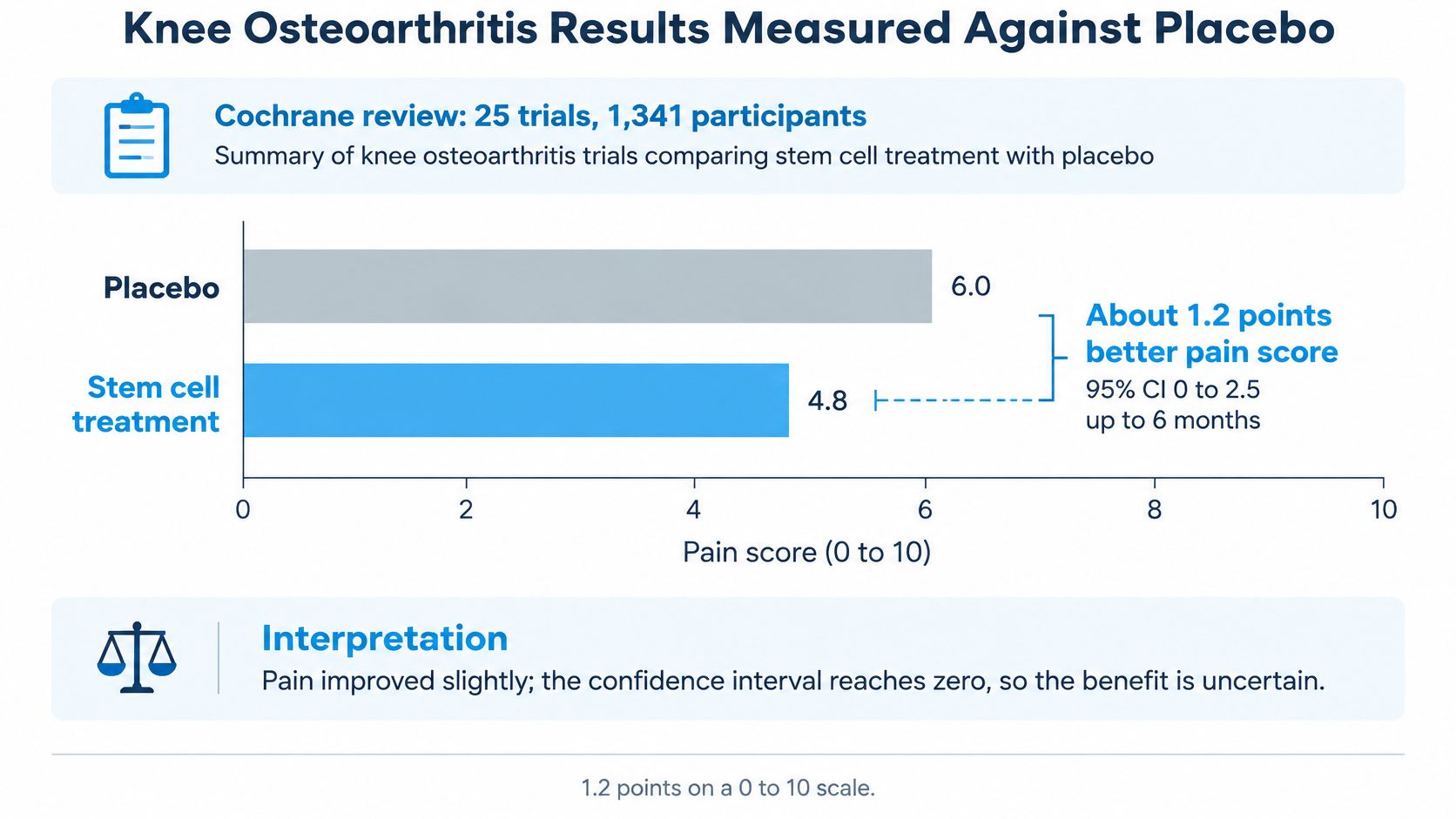
A Cochrane review pooled 25 trials with 1,341 participants who received stem-cell injections and compared them with placebo or other treatments. Against placebo at up to 6 months, pain improved by roughly 1.2 points on a 0 to 10 scale (95% CI 0 to 2.5) and function improved by about 14.2 points on a 0 to 100 scale (95% CI 3.1 to 25.3), with the reviewers rating that evidence as low certainty (Cochrane review of stem-cell injections for knee osteoarthritis).
The low rating reflects real problems, not caution for its own sake. Studies used different cell sources, different preparation methods and different doses, and publication bias was suspected, with as many as three larger randomized trials reportedly withdrawn before their results were published.
Read that pain confidence interval. It runs from 0 to 2.5, so it includes the possibility of no benefit at all. The range is what the data supports, not the 1.2 point estimate on its own.
A separate analysis of 8 randomized trials with 467 patients went further, estimating that contextual factors, meaning placebo and expectation, accounted for roughly 63% of pain reduction and 61% of functional improvement at 6 months. A 2024 systematic review reached a similar place: at 3 to 6 months, MSC injections probably produced little or no clinically important pain improvement, with a weighted mean difference of 0.74 cm on a 10-cm visual analogue scale in favor of treatment, against a predefined minimally important difference of 1.5 cm (systematic review of MSC therapy for knee osteoarthritis).
| Outcome | Effect versus placebo | 95% CI | Certainty |
|---|---|---|---|
| Pain (0 to 10 scale) | about 1.2 points | 0 to 2.5 | Low (Cochrane, 25 trials, 1,341 participants) |
| Function (0 to 100 scale) | about 14.2 points | 3.1 to 25.3 | Low (same review) |
| Share of pain reduction from placebo and expectation | about 63% | Not reported | Analysis of 8 trials, 467 patients, 6 months |
| Share of function gain from placebo and expectation | about 61% | Not reported | Same analysis, 6 months |
The procedure looks like this in practice at our clinic, so the numbers have something concrete to attach to.

The knee program is a single injection of 50 million stem cells into the knee joint, delivered under ultrasound guidance, and the injection itself typically takes only a few minutes. We don't offer guarantees and we don't present it as a cure. What we do offer is a defined protocol you can measure: WOMAC and KOOS scores, a pain score, a functional test such as a timed walk or stair climb, and MRI or radiographs at baseline and again at 6 to 12 months.
That measurement discipline is the whole point. A patient who walks into month six with a baseline KOOS score, a repeat pain score and a follow-up image knows what happened. A patient with only a memory of how the knee felt last summer doesn't.
Symptom improvement is a realistic goal in the right patient. Cartilage regrowth and avoiding a joint replacement are not things the current trial data can promise, and a clinic that promises them is telling you about its marketing, not about the evidence.
Back, Neck and Disc Results Where Evidence Is Mixed
Discogenic back pain is where the evidence turns contradictory, and the contradiction teaches more than a clean result would.
A 2025 review of mesenchymal stromal-cell studies for discogenic low back pain reported modest improvements in pain, disability and quality of life. Some MRI assessments also showed increased disc hydration or stabilization and improvement in Pfirrmann grade, with benefits reported in some studies for as long as 72 months (review of MSC studies for discogenic low back pain). That's a real signal from small studies.
Then the multicenter RESPINE trial ran a 12-month primary outcome and found 74% with bone-marrow MSCs versus 69% with placebo, a difference that wasn't statistically significant (p=0.77). Same condition, same broad cell family, no separation from placebo.
Why Two Trials Can Disagree
Three things separate them, and all three matter at the point of booking. Patient selection comes first: a disc with preserved height and hydration behaves differently from a collapsed, dehydrated one, and trials that enroll early degeneration tend to report better results. Injection target and method come second, since a needle that reaches the disc space and one that bathes the surrounding structures aren't the same treatment. Outcome definition comes third, because "responder" can mean a pain threshold, a disability score or an MRI grade.
Our spine programs are organized by diagnosis rather than by "back pain" as a category. The lower back treatment covers herniated discs, degenerative disc disease, facet joint arthritis and sciatica, and the neck treatment covers herniated discs, degenerative disc disease, facet joint arthritis and nerve pain or numbness (stem cell treatment for degenerative disc). Those are the diagnoses patients arrive with most often, and the fair framing for every one of them is pain and function gains in selected patients, not guaranteed healing.
The question before treatment isn't whether stem cell therapy works for backs. It's whether imaging has confirmed a disc or facet source that matches your symptoms.
If the MRI shows a bulge at L4-L5 but the pain runs down the front of the thigh, the source may be something else entirely. No injection corrects a diagnosis that was never right.
Parkinson's, MS and Conditions Without Trial Support
Neurological and autoimmune conditions attract the most confident marketing and the thinnest trials. Two randomized studies mark the current edges.
Parkinson's disease. A 2025 randomized trial reported that three infusions of allogeneic bone-marrow mesenchymal stem cells produced a 5% greater rate of at least 5-point motor-score improvement than placebo at week 62, and the gap widened to 11.5% by week 88 (randomized trial of bone-marrow MSCs in Parkinson's disease). That's an early signal from a single trial. It's also measured against a placebo group, which puts it ahead of most of what gets advertised to Parkinson's patients.
Multiple sclerosis. The 2024 intrathecal trial compared mesenchymal stem-cell treatment with saline and found 33% versus 37% on the primary EDSS-plus improvement outcome, no difference between the arms (randomized trial of intrathecal MSCs in multiple sclerosis). Any MS claim has to be read against that result, because it's the most direct test anyone has run.
Several conditions have no supporting trial evidence at all, and results from joint or immune studies don't carry over to them:
- Type 1 diabetes. Stem cell treatment doesn't work well here, and the autoimmune destruction of insulin-producing cells is a different problem from joint inflammation.
- ALS. Stem cell therapy isn't applicable, and there's no trial basis for offering it.
- A completely snapped Achilles tendon. Stem cell therapy isn't effective for a full rupture, where surgery may be the only option.
- Anti-aging, organ support and sexual health. There's no indication-specific randomized trial to match against your situation, so the honest position is that the evidence hasn't been generated yet.
The rule that ties all of this together is simple. Ask for the disease, the population, the comparator and the follow-up length, then check whether the trial enrolled someone like you.
Match the trial to your diagnosis before you accept the result as relevant.
Patient Selection Criteria Before Treatment
Candidacy isn't a feeling about your knee or your back. It's a set of documents and measurements that either line up with a studied population or don't.
- Imaging confirms a source that matches a studied indication. Knee osteoarthritis on weight-bearing radiographs, or a degenerative disc or facet joint identified on MRI. Pain alone isn't enough, and a clean scan with severe pain needs a different workup.
- Symptoms persist despite conservative care. Physical therapy, activity modification, weight management and appropriate medication, reviewed by the treating physician rather than self-reported.
- The stage of damage is recorded. Trials report better outcomes in early and moderate degeneration than in advanced disease, so the grade of cartilage loss or disc degeneration belongs in the file before any decision.
- The goal is symptom and function improvement. Not cartilage regrowth, not disc rebuilding, not avoiding surgery. Patients who need the second list will be disappointed by honest data.
- Baseline measures exist before treatment. WOMAC or KOOS for a knee, a validated pain score, a functional test, and MRI or radiographs, all repeated at 6 and 12 months so the outcome is a comparison rather than a recollection.
Conditions without trial support, such as type 1 diabetes or ALS, aren't candidates on this evidence regardless of how compelling a personal story sounds.
Patients who clear criteria 1 through 5 have something concrete to discuss with a physician. Patients who don't should get a second opinion before booking anything, and that second opinion should come with their imaging in hand.
Regulation, Risks and Choosing a Clinic Safely
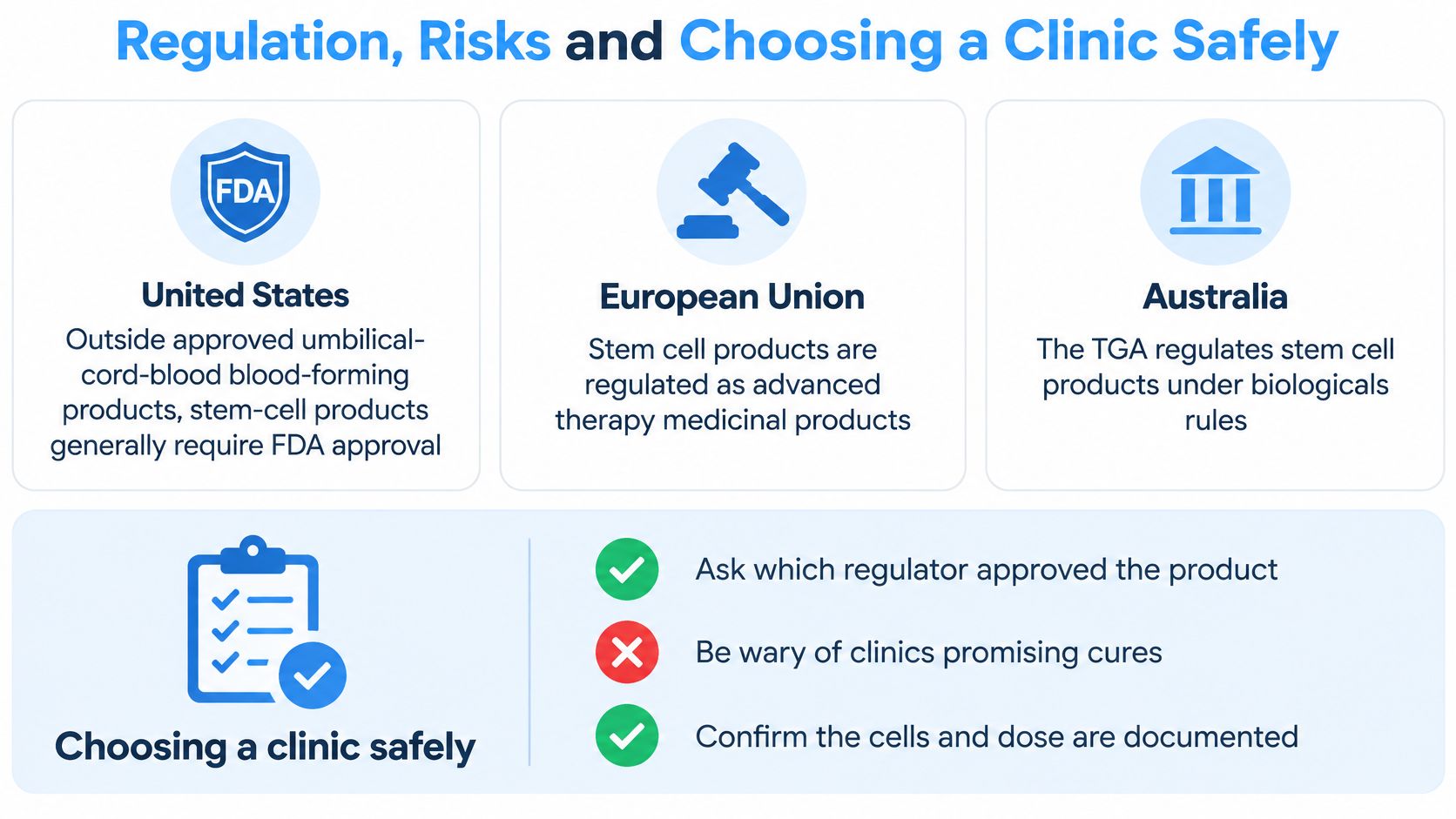
Regulation does not prove that a treatment works. It tells you which rules apply to the product and where it is being provided, so ask about both before considering treatment.
Three Regulatory Systems and Three Different Filters
In the United States, the FDA states that, outside approved blood-forming stem-cell products derived from umbilical cord blood, stem-cell products generally require FDA approval. It warns that many marketed products lack demonstrated safety or effectiveness and may carry significant risks (FDA consumer alert on regenerative medicine products). US regulators also state that no regenerative medicine therapy is approved for orthopedic conditions such as osteoarthritis, disc disease, back pain or knee pain, and warn that broadly marketed products may not have been studied under an investigational-new-drug process (analysis of long-term MSC outcomes and regulatory status).
In Mexico, COFEPRIS is the federal sanitary authority responsible for approving human clinical studies and monitoring approved studies under NOM-012-SSA3-2012 and COFEPRIS good-clinical-practice requirements (NIAID ClinRegs country profile for Mexico). Dream Body Clinic describes its treatments as operating within Mexico's COFEPRIS-regulated framework. That framework is not equivalent to blanket FDA approval. Ask which authorization, product and protocol apply to your specific treatment. Legal status and evidence of effectiveness are separate questions; the rules governing stem cell treatment legality depend on where treatment is provided and the indication.
If you are considering treatment in Canada, check Health Canada's guidance before making travel or treatment decisions.
For knee injections, reported risks include local pain and swelling that usually settle; serious complications are uncommon in the cited trials. These findings do not establish the safety of every cell product or dose. Ask the clinic what adverse events have occurred among patients treated for your condition and how those patients were followed up.
Clarify the treatment's expected duration and any possible maintenance. Dream Body Clinic describes stem cell therapy as lasting and one and done in most cases, with maintenance treatments every 12 to 24 months able to extend and enhance outcomes. Treatment costs range from $1,750 to $14,500 depending on the condition. Get the price and session details in writing.
| Question to ask | Strong answer | Red flag |
|---|---|---|
| Which cell source and product is used? | Named cell type with lab release testing | Vague "stem cells" with no source given |
| How many viable cells are delivered, and how are they verified? | Stated count with viability and sterility results | Only a headline cell count |
| Which route is used, and is it imaging-guided? | Injection route and guidance that match the diagnosis | Route chosen without imaging or diagnosis |
| Which outcome measures and follow-up points are planned? | WOMAC, KOOS, pain scores and MRI at 6 and 12 months | Promises of feeling better with no measures |
| Do randomized trials support this exact condition? | Cited trials for the same indication | Results extrapolated from a different disease |
Bring your diagnosis and imaging to a case review. Compare the clinic's answers with the table, then get the price and treatment details in writing. Clear answers make it possible to assess a clinic's claims against the evidence, rather than relying on promises.
Dream Body Clinic offers stem cell treatments across orthopedic, autoimmune, organ, neurological and anti-aging indications, with treatment routes and cell counts that vary by protocol. For a knee or back condition, a complimentary case review can help establish whether the proposed treatment matches your diagnosis and the available evidence. The clinic is based in Bucerias, Nayarit, Mexico, and provides Dream Body Clinic information.