
You’re sitting in a consultation room with an MRI report in your hand. The scan shows a worn disc, and suddenly years of intermittent back pain feel like a prediction about your future. You may be weighing physical therapy, another injection, spinal fusion, or stem cell treatment for degenerative disc disease.
The difficult part is separating a plausible biologic treatment from exaggerated promises. Mesenchymal stem cells, or MSCs, can reduce pain and improve function in some patients. They aren’t a universal answer for every type of back pain.

Table of Contents
- When the MRI Label Changes Everything
- What Degenerative Disc Disease Really Means
- Why Stem Cells Do Not Become New Disc Cells
- Intradiscal, Epidural, and IV Delivery Compared
- What the 2025 to 2026 Trials Actually Show
- Walking Through a Real Patient Journey
- Limits, Risks, and Honest Expectations
When the MRI Label Changes Everything
The word “degeneration” often carries more emotional weight than the radiologist intended. A patient sees it beside L4-L5 or L5-S1 and hears, “Your spine is wearing out.” The next fear is usually surgery, even when the MRI alone doesn’t establish that surgery is necessary.
An MRI is a map, not a complete diagnosis. Disc height, hydration, annular changes, bulging, nerve compression, facet joints, muscle function, and the pattern of your pain all matter. A dark disc can be incidental. A modest-looking disc can still contribute to discogenic pain in the right clinical context.
The decision is about the pain generator
Before considering any biologic, the clinician needs to ask whether the disc is producing the symptoms. Local low-back pain, pain associated with sitting or loading, and a history that matches the imaging may support discogenic pain. Leg weakness, progressive numbness, bowel or bladder changes, severe stenosis, fracture, infection, or instability point toward a different evaluation and sometimes a more urgent treatment path.
That distinction changes the conversation. A biologic injection may be reasonable when the target is localized disc-related pain after conservative care has failed. It’s much less persuasive when the main problem is severe nerve compression, advanced collapse across several levels, or pain arising from multiple unrelated structures.
Practical rule: An MRI finding deserves treatment only when it matches the examination, symptoms, and functional limitations.
The rest of this guide focuses on what MSCs can do for a degenerated disc, why their mechanism is often misunderstood, how delivery routes differ, and what recent clinical evidence can and cannot support. The useful question isn’t whether stem cells are a miracle or a scam. It’s whether a particular patient has a realistic opportunity for symptom improvement, with a clear understanding that pain relief and disc regeneration are different outcomes.
What Degenerative Disc Disease Really Means
Degenerative disc disease, or DDD, is gradual remodeling of the intervertebral disc, not one single injury. The nucleus pulposus, the disc’s softer inner region, loses hydration. The annulus fibrosus, its tougher outer ring, can lose structural integrity. Over time, disc height may decline as the tissue becomes less effective at distributing load.
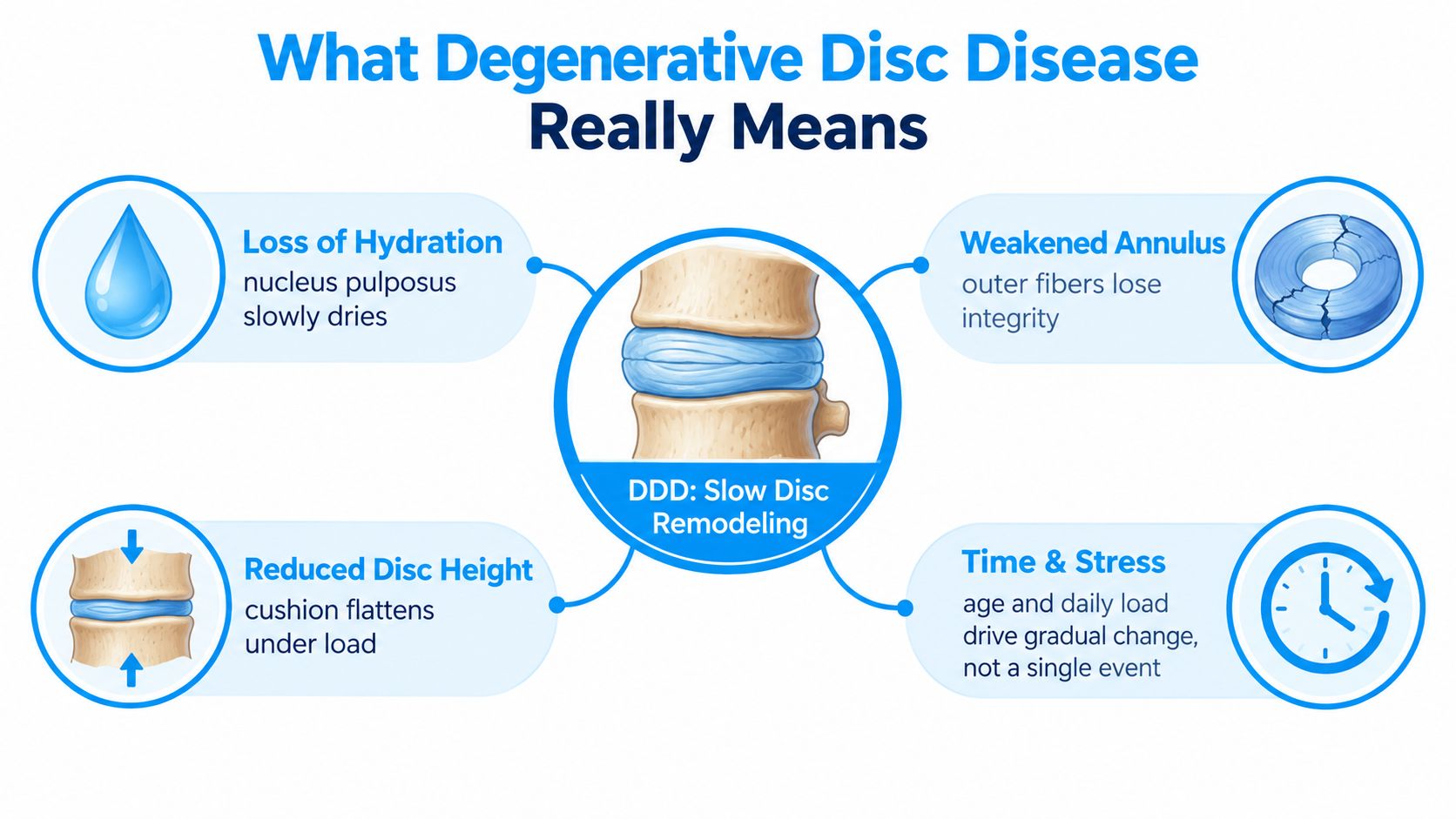
A disc is difficult to repair because its biology is difficult to access. It has little direct blood supply, a small population of resident cells, and a demanding mechanical environment. When proteoglycans and healthy matrix decline, the tissue has limited capacity to replace them. Every day of bending, lifting, sitting, and loading occurs in an environment that offers few repair resources.
A degenerative MRI does not prove pain
Many people have disc changes without significant symptoms. That’s why treatment decisions shouldn’t be based on the phrase “degenerative disc disease” alone. A clinician must combine the scan with pain location, aggravating activities, neurologic findings, physical examination, and the response to previous care.
The term regeneration also needs a precise definition. It could mean less pain, improved movement, better tolerance for activity, preserved disc structure, greater hydration, restored disc height, or a demonstrable change in matrix composition. Those outcomes aren’t interchangeable.
What repair would mean clinically
A patient may feel better even when the disc remains visibly degenerated. That can happen if inflammatory signaling decreases, pain-sensitive structures become less reactive, or surrounding muscles and movement patterns improve. Those are valuable outcomes, but they don’t prove that a collapsed disc has been rebuilt.
A 2025 review of stem cell therapy for DDD identified 13 clinical studies involving 1,299 patients, but concluded that the evidence remains limited and hasn’t established solid disc regeneration or disease-modifying structural repair in humans (2025 review of stem cell therapy for DDD). That distinction should guide consent, outcome tracking, and the language a clinic uses before treatment.
Why Stem Cells Do Not Become New Disc Cells
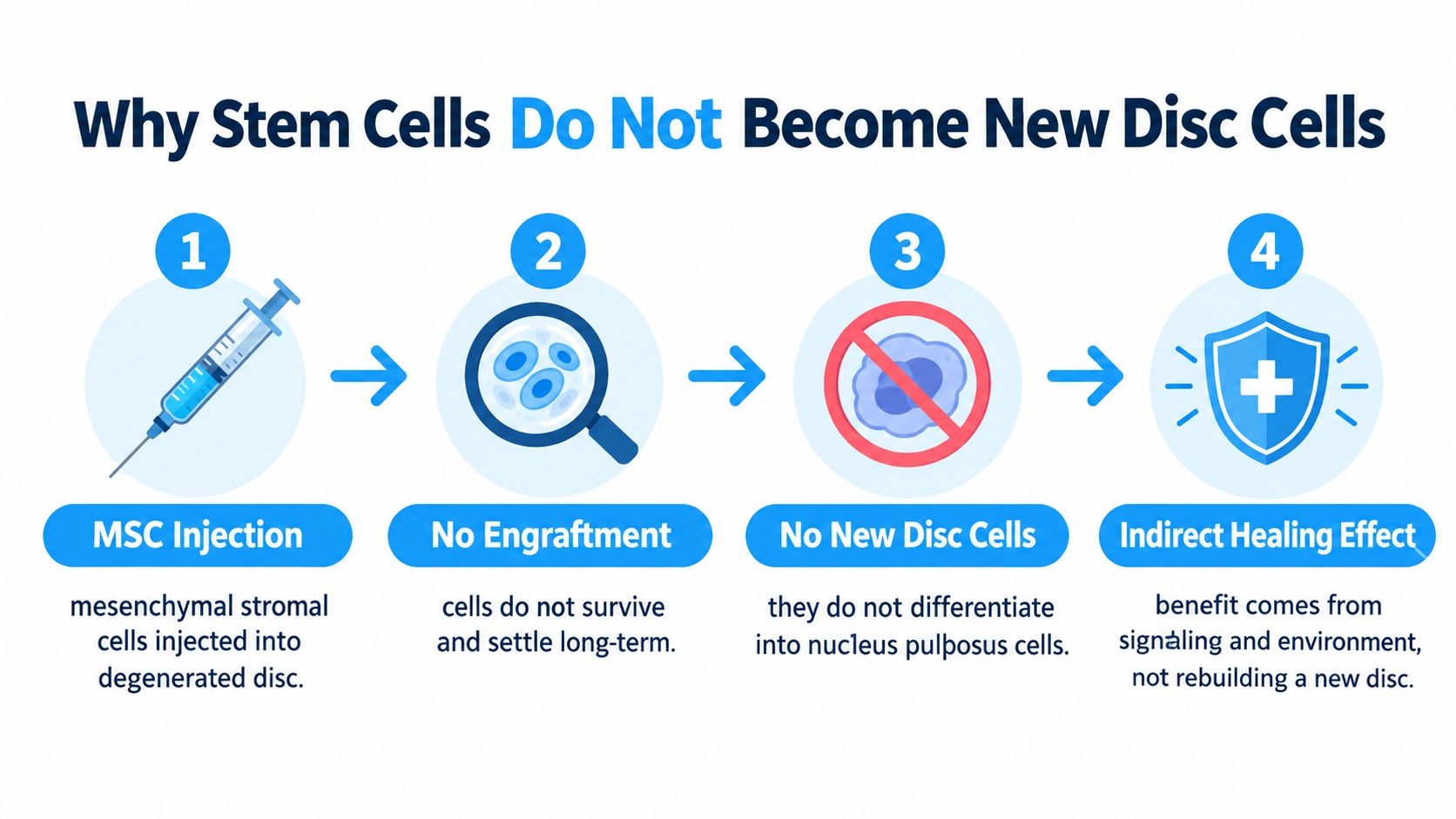
The most important correction is simple: the injected MSCs don’t differentiate into new nucleus pulposus cells and rebuild the disc. They aren’t tiny replacement parts that settle permanently into the nucleus and reconstruct its original architecture.
MSCs work mainly through the paracrine effect. That means they release specialized signals that guide the healing environment. These signals can include cytokines, growth factors, and extracellular vesicles. The signals interact with native disc cells, inflammatory pathways, pain-sensitive nerve structures, and the surrounding tissue.
What paracrine signaling can accomplish
The intended effect is indirect. MSCs can help calm an inflammatory microenvironment, support surviving native disc cells, influence matrix activity, and reduce pain signaling. A 2024 review describes MSC action in DDD as primarily paracrine, involving growth factors, cytokines, and extracellular vesicles, with direct differentiation treated as a secondary mechanism (review of MSC mechanisms in DDD).
This explains why symptom improvement can occur without dramatic MRI change. The treatment may alter signaling and pain sensitivity more readily than it restores disc height or recreates a normal collagen and proteoglycan network.
At Dream Body Clinic we target degenerative disc disease depending on what area of the spine it is affecting:
The Mesenchymal Stem Cells (MSCs) can guide the repair, regeneration and rehydration of discs. We have found that injecting around the disc is the most beneficial. We did try injecting into discs for a while and found that it did not produce as good of results as injecting around the disc. We believe this is because if you inject into the disc then the stem cells are trapped and can’t recruit help. They work via the paracrine effect which means it is the signals they send out that guide the repair process.
For a plain-language explanation of the injection process, see this guide to how stem cell injections work.

Intradiscal, Epidural, and IV Delivery Compared
The route determines where the cells go, how concentrated they are at the target, and which symptoms the treatment is designed to address.
| Route | Typical Dose | Best Candidate | Evidence Base |
|---|---|---|---|
| Intradiscal | Protocol-dependent, with a registered trial using 25 million allogeneic MSCs in 2 mL saline | Selected, contained disc degeneration at a target level | Most directly studied route in DDD trials, but not great results |
| Epidural | Varies by product and protocol | Radicular pain or symptoms associated with an affected nerve root | Less direct evidence for disc regeneration |
| Intramuscular | 4 shots of 25 million MSCs at Dream Body Clinic | Broader systemic or combined regenerative approaches | Over 9 years of success at Dream Body Clinic |
Intradiscal injection
A clinician places a needle into the selected disc under imaging guidance. The aim is a high local concentration in a small space, often with a low-volume carrier. This approach is technically demanding and carries procedure-specific risks. It requires a twilight sedation because being fully asleep on your stomach is not safe. The injection must be guided with fluoroscopy in the operating room and if the physician misses it could lead to spinal cord damage. Infection rates are also the highest with this type of injection. The worst part is that it never produces as good of results as injecting around the disc with intramuscular injections. The limited result this procedure provides is usually because of the smaller amount of cells they inject around the facet joints after the intradiscal injection. The stem cells injected into the disc are trapped and can’t signal for help. This matters because MSCs work by signaling for help as they don’t differentiate into new disc tissue or any other sort of tissue.
Epidural delivery
Epidural treatment places the product near the epidural space and affected nerve structures rather than inside the disc. That may make more sense when leg pain and nerve-root irritation dominate the presentation. It doesn’t deliver the same local exposure to the nucleus pulposus, so it shouldn’t be described as equivalent to intradiscal therapy.
Patients with sciatica need a careful distinction between discogenic low-back pain and nerve-root pain. This overview of stem cell therapy for sciatica discusses why the delivery target matters.
We have found that epidural delivery is inferior to intrathecal injection for spinal cord regeneration. The epidural delivery really only affects the spinal cord and nerves from the waist down. The intrathecal injection helps the whole spinal cord. Even then neither is an appropriate injection method for degenerative disc disease as these stem cells won’t get anywhere near the discs.
Intramuscular Injection plus Intravenous infusion
At Dream Body Clinic we inject 4 shots of 25 million MSCs around the most affected discs. This allows the MSCs to remove any scar tissue (fibrosis) in the area that is preventing full regeneration. This exposes damaged tissue and they can then guide the regeneration of that tissue. For the discs they are able to help them rehydrate at night when the spine is decompressed while sleeping. As we age we have fewer and fewer MSCs so these processes get less effective. By injecting large amounts of MSCs around the disc we allow them to heal like when we were little kids.
We also administer an IV of 100 million MSCs. This will not directly affect the discs, but there are so many muscles that support the back, we found that patients who combined intramuscular stem cells to the back with an IV always saw the fastest and most long lasting improvement.
What the 2025 to 2026 Trials Actually Show
Recent evidence is more encouraging than a dismissal of MSC therapy, but less dramatic than regenerative marketing often suggests. We believe this is because most studies have been done on intradiscal application instead of our approach. A 2026 systematic review and meta-analysis included seven randomized controlled trials and found greater pain relief and functional improvement with intradiscal MSC therapy than with sham or placebo (2026 MSC meta-analysis).
The pooled pain result was a Visual Analog Scale mean difference of 6.67 points, and the pooled disability result was an Oswestry Disability Index mean difference of negative 4.05 percentage points, both statistically significant in the review. Benefits were more apparent at 12 to 36 months of follow-up, while adverse events and mortality didn’t differ significantly from controls (Asian Spine Journal analysis of intradiscal MSC therapy).
Hopefully they will star studying our approach soon.
| Outcome Measure | 6-Month Result | 12-Month Result | Notes |
|---|---|---|---|
| Pain | Improvement favored MSC therapy in pooled randomized evidence | Benefit remained favorable, with stronger effects reported at longer follow-up | The 2026 pooled VAS mean difference was 6.67 points |
| Disability | Improvement favored MSC therapy | ODI improvement favored MSC therapy | The pooled ODI mean difference was negative 4.05 percentage points |
| Safety | No significant difference from controls in pooled analysis | No significant difference from controls in pooled analysis | Safety findings don’t eliminate procedure-specific risks |
| Imaging | No consistent proof of repair | Structural reversal remains unconfirmed | Pain improvement can occur without a rebuilt disc |
Walking Through a Real Patient Journey
A responsible evaluation begins before anyone discusses a stem cell treatment. The clinician reviews the history, examines the spine and nervous system, and checks whether the MRI findings match the symptoms. Candidates are usually considered only after conservative treatment has failed and after urgent surgical conditions have been excluded.
Screening and preparation
The decision may involve several practical questions:
- Imaging review: Is the MRI recent enough to represent the current problem, and does it show a contained target rather than advanced collapse or a different primary lesion?
- Conservative care: Has the patient tried appropriate rehabilitation, activity modification, medication, or other nonoperative options?
- Pain pattern: Does the history suggest discogenic pain, radicular pain, facet pain, or a combination?
- Readiness: Can the patient follow a graded rehabilitation plan and accept that improvement may be gradual and incomplete?
At Dream Body Clinic we are happy to review existing MRIs for patients and speak with them to see if they are good candidates. Whether they have a recent MRI or not we do require a new MRI to be done with our treatment. We don’t cut corners and we want to be sure that we can help.
Procedure and recovery
At Dream Body Clinic we administer 4 shots of 25 million MSCs around the most affected disc and administer an IV of 100 million MSCs. Each section of the back is a seperate treatement. So patients with issues at multiple areas can do cervical, thoracic and/or lumbar spine treatments.
For recovery it is very easy. The procedures are done in office and the patient will walk out feeling fine that same day. We then recommend they take it easy for the next 6 weeks. We recommend 2 weeks of no major exercise then 4 weeks of light rehab. We provide a simple rehab protocol to follow. The first 6 to 8 weeks post treatment are called the engraftment period. This is when the MSCs are really deciding on what to focus on healing. They are attracted to inflammation so we want them targeting the issues that are already inflamed.
Follow-up is part of treatment
Pain and function should be recorded at defined intervals, such as early review and later assessments over the first year. A repeat MRI may help compare hydration, disc height, or grading, but imaging should remain secondary to functional outcomes and should not be used to imply regeneration when the scan shows only stability.
Cost and insurance need discussion before travel or treatment. Patients should receive a written breakdown of the procedure, cell product, imaging, follow-up, rehabilitation, and what happens if the outcome is incomplete.
At dream body clinic flights and hotel are up to patients, but we provide all airport and clinic transportation if they stay in our zone – This link explains our transportation zone and the best accommodation options close to us – Accommodation Options – https://dreambody.clinic/index.php/hotels/
Limits, Risks, and Honest Expectations
A patient can have less pain after treatment without growing a new disc. That distinction shapes responsible expectations. MSCs act mainly through paracrine signaling, releasing factors that may influence inflammation and pain biology. They can also rehydrate and repair damage discs, but results vary from patient to patient.
A stem cell injection can address multiple sources of back pain. Stenosis, herniated disc, nerve compression, facet joint arthritis or other issues. This is because they seek out inflammation and work to resolve the cause. Improvement will emerge gradually rather than on a fixed two-week schedule. We usually see peak results 3 to 6 months post treatment.
A pooled safety analysis reported no significant difference in adverse events or mortality between MSC and control groups (2026 systematic review and meta-analysis). That finding is reassuring at the study level, not a guarantee of personal safety.
The majority of patients at Dream Body Clinic see the improvement and results they hoped for. A small amount of patients see improvement, but not full regeneration and those patients often come back a year later or further out to try treatment again to improve on the results they got. Then about 5% of patients are non-responders. This is super rare, but it is medicine not magic after all.
Misconceptions versus clinical reality
| Common Belief | What the Evidence Shows |
|---|---|
| MSCs become new disc cells | The clinically relevant mechanism is primarily paracrine signaling, not reliable cell replacement |
| One injection cures all back pain | Results depend on the pain generator, disease stage, product, delivery route, and rehabilitation |
| A better MRI proves success | Pain and function can improve without convincing structural regeneration |
| No significant safety signal means no risk | Trial-level findings do not remove risks from needle placement, infection, or patient selection |
| Fast improvement is guaranteed | Peak Results are usually 3 to 6 months post treatment and as with any medical treatment there is no guarantee of success |
Who should pause before treatment
Treatment should be reconsidered or deferred when symptoms do not match the disc, active infection or malignancy is present, or severe neurologic compromise needs urgent care. Progressive weakness, major bowel or bladder changes, significant instability, and severe stenosis call for conventional spine assessment rather than a biologic sales pitch.
Regulatory status depends on how an autologous or allogeneic product is processed, expanded, combined, and administered. Ask where the cells come from, whether they are cultured, what testing is performed, which authority oversees the treatment, and what follow-up is available if complications occur. In the USA and Europe you cannot fully isolate and replicate MSCs for treatment which leaves them very limited on treatments and results. In Mexico the FDA equivalent COFEPRIS has clear guidelines for MSCs and allows the isolation and replication of MSCs for treatment like done at Dream Body Clinic and their ISO rated lab.
MSC therapy may help selected patients with disc-related pain, but its clinical role remains developing.
Increased pain after an injection warrants prompt contact with the treating team. This guide to worse pain after stem cell injection explains why that communication matters.
Dream Body Clinic offers lower-back MSC protocols with targeted injections, MRI-based planning, and structured remote follow-up for international patients. If you are considering treatment, visit Dream Body Clinic to request a case review and discuss whether your symptoms, imaging, and treatment history support a responsible regenerative-medicine evaluation.
Call us at (888) 704-3977 or on WhatsApp at +523222321055 for a free consultation