
Stem cell therapy cost ranges from about $3,000 for a localized joint injection to more than $30,000 for a systemic IV protocol, with many private treatments falling between $5,000 and $50,000. The final bill depends on the cell dose, delivery route, clinic overhead, treatment scope, and what the package includes. At Dream Body Clinic we keep our prices as low as possible to help as many people as possible. We also list all of our prices on treatment pages at www.dreambody.clinic. This way everyone knows they are getting the same price and not paying for some celebrities free treatments.
You may be looking at three quotes right now. One clinic lists $5,000, another asks for $25,000, and a third won’t publish a price at all. That difference feels unreasonable until you look beneath the headline figure. These clinics may be offering different cell sources, doses, routes of administration, monitoring, imaging, adjunct therapies, and follow-up care.
The practical question isn’t just, “What does stem cell therapy cost?” It’s, “What biological product and clinical service am I receiving for this price, and is the proposed treatment appropriate for my condition?” A low quote can exclude important parts of care. A high quote can bundle services you don’t need. The useful comparison starts with the protocol, not the number.
Table of Contents
- Why Stem Cell Therapy Quotes Vary So Widely
- How MSC Therapies Actually Work Beyond the Hype
- The Four Pricing Drivers That Determine Your Final Cost
- Localized Injections Versus Systemic Protocols, Price Comparison
- How to Evaluate a Stem Cell Therapy Quote Like a Pro
- Financing Options and Making an Informed Decision
Why Stem Cell Therapy Quotes Vary So Widely
A patient with knee pain may receive a localized injection quote in the low thousands, while a systemic protocol may reach the tens of thousands. Both figures can be reasonable because the procedures, products, and clinical services differ. Published reviews place clinic injection prices between $3,000 and $12,000, with mean prices of $2,728 in one survey and $5,156 in another. Broader international treatment charges have been estimated at $10,000 to $60,000, excluding travel. These figures appear in this review of orthobiologic pricing and this analysis of stem-cell tourism pricing.
The headline number hides the protocol
A quote might cover one joint, several joints, or whole-body delivery. It may include consultation, MRI review, image-guided injection, PRP, laboratory processing, accommodation coordination, and remote follow-up. Another clinic may price only the cell procedure, then bill each service separately.
Four variables account for much of the difference:
- Cell dose: A smaller localized dose generally requires less product and processing than a higher-dose systemic program.
- Delivery route: A targeted joint injection differs from an intravenous infusion in procedure, monitoring, and clinical support.
- Clinic location: Rent, staffing, laboratory relationships, regulatory requirements, and medical infrastructure all shape overhead.
- Adjunct therapies: PRP, imaging, medications, repeat sessions, and rehabilitation support can raise the package price.
The treatment indication changes the scope as well. A focused orthopedic procedure is different from a protocol proposed for autoimmune disease, organ support, or neurological concerns. Cell source, indication, geography, and delivery method prevent private regenerative treatments from following one standard tariff. The 2024 pricing review describes this segmented pricing pattern.
The biological rationale also affects the quote. MSCs are generally expected to influence healing through paracrine signaling, releasing factors that affect inflammation and local tissue behavior, rather than merely replacing damaged tissue. A higher cell count or a different route does not automatically produce better results, so the proposed dose should have a clinical justification.
Practical rule: Before comparing prices, confirm the cell source, stated dose, route, treatment sites, monitoring, and included follow-up.
Transplant medicine provides a separate benchmark and should not be compared directly with commercial regenerative injections. In a U.S. study of children with sickle cell disease, the median healthcare-system cost of hematopoietic stem cell transplantation was $130,604, with an interquartile range from $111,667 to $2,234,007. A separate 2016 U.S. analysis reported median total costs of $289,283 for allogeneic myeloablative transplantation, $253,467 for allogeneic nonmyeloablative transplantation, and $140,792 for autologous myeloablative transplantation. The policy review of stem-cell therapy costs explains how inpatient care drives those established transplant costs far above many commercial offerings.
The Process Drives the Cost:
To understand the cost you need to understand the process. So let’s break down a few of the most common ways stem cell therapy is done. The 4 primary ways are as follows: Fat derived MSCs (no cultivation), Bone Marrow derived MSCs (no cultivation), Wharton Jelly (umbilical cord tissue) and placenta (no cultivation) or Wharton Jelly (umbilical cord tissue) and placenta (cultivated)
Fat derived MSCs (no cultivation) & Bone Marrow derived MSCs (no cultivation)
These 2 methods are the most common ways mesenchymal stem cells (MSCs) offered in the USA and Europe. They take a liposuction of your fat with a local anesthetic then centrifuge it with collagenase to separate the cells from the tissue or they chip a piece of bone to get into your hip bone to extract bone marrow then centrifuge it with collagenase to separate the cells from the tissue. The liquid that they then use for injection is 1% MSCs and 99% other types of cells. Dr. Arnold Caplan (Discovered and named MSCs) likened this to Coca-cola selling you an apple juice that said, “All Natural” then you read the back label and it is 99% sugar and water with 1% juice from concentrate. He would call it a cell therapy not a stem cell therapy. As you can imagine there is not much material cost or equipment cost. The main driver of cost here is the physician and his marketing expenses. Even with these limited costs clinics that offer Fat derived or bone marrow derived stem cells often charge as much or more than clinics with professional labs, producing pure, isolated MSCs. The cost to value for fat derived MSCs is very bad. In the USA they are not allowed to isolate and culture MSCs then administer them, but the non-cultivated MSCs from fat or bone marrow are allowed. So doctors in the USA offer what they can, which is better than nothing, but they rarely give the full story. There are a few clinics in places like the Bahama’s and Mexico that will isolate and culture the fat derived or Bone Marrow derived stem cells. The problem is that it takes months to culture these limited number of stem cells into tens of millions or hundreds of millions of stem cells. The older the donor is, the slower the MSCs replicate. A healthy 35 year old will take 8 to 12 weeks to culture 10 to 20 million MSCs with these methods. A healthy 65 year old may take many months to get to those same numbers. MSCs from yourself also have the disadvantage that if you have any immune system issues like an autoimmune disease or immunomodulatory issues the MSCs are compromised by that and won’t work as well as younger MSCs from a healthy donor.
The bottom line is that Fat derived or Bone Marrow derive MSCs offer very little for the high price they charge.
Wharton Jelly (umbilical cord tissue) and placenta (no cultivation)
In the USA labs like Utah Cord labs and a few others are allowed to take a whole umbilical cord and placenta then centrifuge it with collagenase to separate the cells from the tissue. This usually leaves them with a liquid that is 70% MSCs and 30% other types of cells. It is not a pure product, but the best way available in the USA or Europe to get larger numbers of MSCs. The can usually get between 10 million to 30 million MSCs from a whole umbilical cord and placenta this way. There are a few problems here. First to get enough umbilical cords and placenta is difficult and expensive. That drives the cost up. The lab costs millions of dollars to build and salaries for biologists add up fast. Then they have to use a lot of materials to cryogenically freeze the MSCs after processing and have many cryogenic freezers for storage. Then shipping a cryogenically frozen product costs a lot. All of these things add a lot to the price. They ship to doctors all over the USA and rarely train them on proper de-thawing procedures. If the MSCs are not thawed properly then there is usually a 50% or more die off of the MSCs as shown in this study. So you end up paying a high price for a product that might not even contain the number of MSCs promised. This option is the best in the USA or Europe, but it is severely limited and raises more risks as we don’t know what those 30% other cells are.
Wharton Jelly (umbilical cord tissue) and placenta (cultivated)
This type of stem cell is probably what most people are looking for and have heard the most about. The famous Joe Rogan interview with Mel Gibson where they brought on Dr. Riordan really opened people’s eyes to the potential of MSCs.
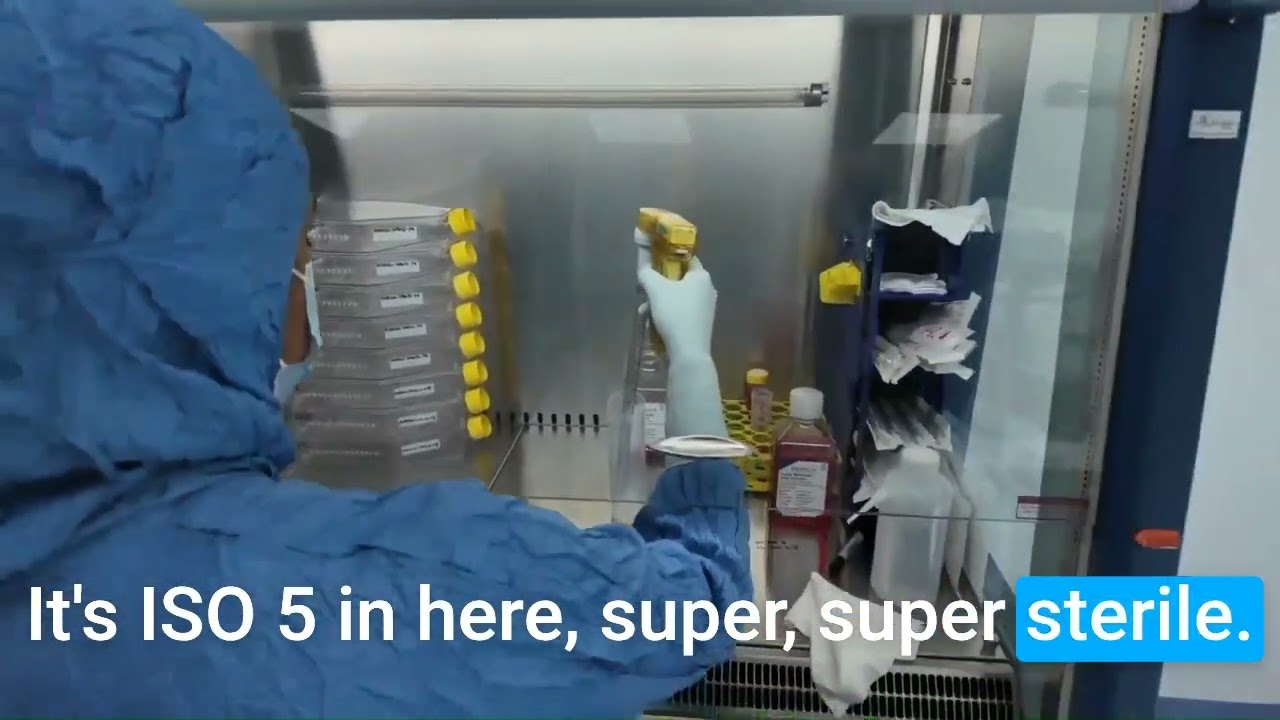
In places like Mexico, Panama and Colombia it is possible and legal to get pure, isolated MSCs from live healthy births. This avoids all the ethical questions of embryonic stem cells and offers people a way to get a pure stem cell product. The main costs for this type of procedure is as follows. The lab to process MSCs costs millions of dollars to build. We know, because we built Our Lab at Dream Body Clinic to above USA standards. The only other clinic that has done this is the stem cell institute in Panama. We are both ISO rated labs. Our advantage is that our lab is on site where treatments are done and we offer our stem cells at much higher doses and much lower prices. The cost of the lab is something that gets absorbed over time so it affects the price of treatment, but that cost is spread out over time to make treatment accessible to patients.
The next major cost are the biologists. At Dream Body Clinic we have 9 full time biologists cultivating MSCs in 18 incubators. There is also a full time cleaning staff of 3 people to make sure everything stays perfectly sterile. These are ongoing costs that factor into the price of treatments.
The next cost is lab materials. The MSCs must be fed. They eat through a lot of culturing medium and there are many other materials needed in the isolation and cultivation of stem cells. These costs affect the price and with inflation going the way it is, those costs will just continue to increase over the years.
Other costs factor into the treatment cost also. At Dream Body Clinic we help around 100 or more patients per month. We have a staff of 53 people to make everything function perfectly. This includes accountants, administrators, drivers, doctors, cooks, cleaning staff, maintenance staff, management, marketing and more. It takes a small army to do all that we do to help people.
Some clinics use celebrities to help market their clinic. At dream body clinic we keep our prices listed on the website so that everyone knows they are getting the same price. Our goal has always been to help as many people as possible at the lowest prices we can. That is why we keep all prices on our stem cell treatment pages so everyone knows they are getting the same price as everyone else.
How MSC Therapies Actually Work Beyond the Hype
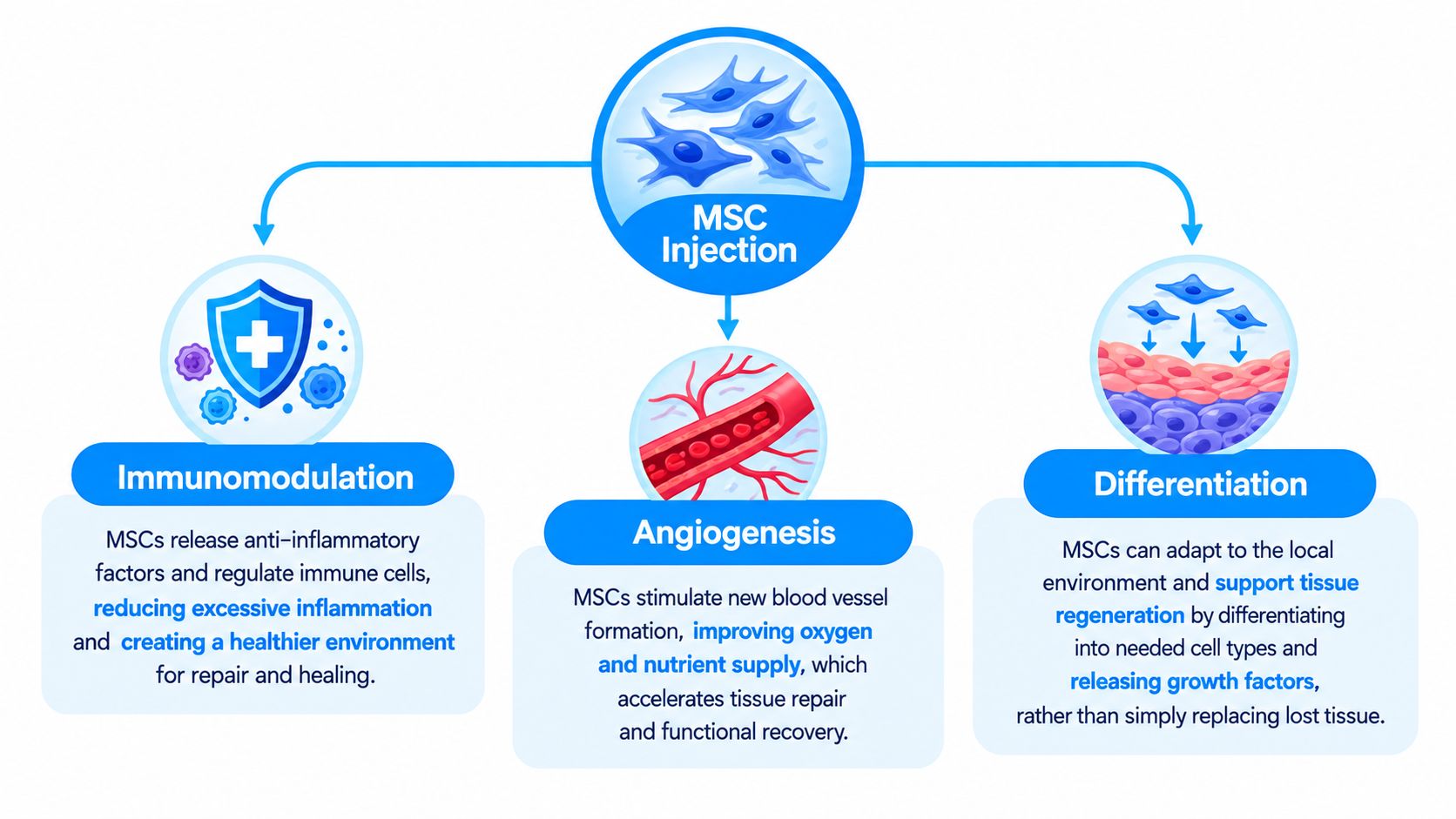
Price makes more sense when you understand what the cells are expected to do. A common misconception is that injected mesenchymal stem cells permanently turn into cartilage, bone, nerve, or other replacement tissue. That isn’t the main operating model for MSC therapy. MSCs generally work through the paracrine effect, sending specialized signals that guide the body’s healing environment rather than acting as replacement parts.
Think of the cells as a temporary signaling team at an injured site. They release biological instructions that can influence inflammation, immune activity, blood-vessel formation, tissue remodeling, and the behavior of local cells. Your own tissues still perform much of the repair work. The injected cells do not just become the missing structure.
A 2022 systematic review identified 234 factors directly released by MSCs and concluded that soluble factors likely mediate improvements in cardiac outcomes through paracrine activity. The findings are discussed in this systematic review of MSC-secreted factors.
Why signaling changes the pricing conversation
A second review in Signal Transduction and Targeted Therapy describes MSC effects as largely paracrine, involving secreted growth factors, cytokines, chemokines, extracellular matrix components, and metabolic products. These signals may contribute to immune modulation, tissue remodeling, and cellular homeostasis, as described in the review of MSC therapeutic mechanisms.
That matters because cell count alone doesn’t describe biological quality. A quote should also address the source of the cells, handling, viability, preparation, and route. A larger number isn’t automatically a better treatment, and a lower number isn’t automatically inadequate. The clinical question is whether the proposed dose and delivery method fit the target tissue and treatment objective.
For a patient evaluating the basics, this explanation of how stem cell injections work can help translate the mechanism into practical terms. The key point is simple: MSCs are signaling participants, not guaranteed replacement tissue.
The most honest pricing discussion connects the dose and delivery method to a clinical rationale. A clinic should be able to explain what the cells are intended to signal, where they will be delivered, and why that protocol fits your diagnosis.
The Four Pricing Drivers That Determine Your Final Cost
Once the mechanism is clear, the price drivers become easier to separate. A quote reflects more than the cells themselves. It reflects the amount used, how the team administers it, where the clinic operates, and which additional services surround the procedure.
Cell dose
The dose is one of the first details to request in writing. A localized protocol might specify a dose in the tens of millions of MSCs, while a systemic protocol can involve a substantially higher amount. Those are not interchangeable services, and the dose should be connected to the indication and route rather than presented as a marketing badge.
Ask whether the quoted number refers to total cells, cells per site, or a planned range. Also ask whether the clinic discloses viability or another quality-control measure. A headline such as “high dose” isn’t enough to compare two programs.
Delivery route
A targeted injection into one knee has a different procedural burden from an intravenous protocol. Local treatment requires accurate placement at the intended structure, while systemic administration can involve infusion time, observation, and broader clinical monitoring.
The 200-million-cell IV protocol overview illustrates why dose and route should be discussed together rather than priced separately in your mind. The relevant question isn’t whether IV treatment sounds more advanced. It’s whether systemic delivery is clinically justified for your condition and what monitoring the clinic provides.
Clinic location and overhead
A clinic’s location affects staffing, facilities, laboratory relationships, regulatory compliance, and patient coordination. Those costs can differ substantially between countries and between hospital-based and independent settings. A lower overhead structure may reduce the bill, but you still need to verify clinical governance, cell handling, physician qualifications, and aftercare.
Mexico’s regulatory environment, including COFEPRIS oversight, is one factor international patients may consider when comparing providers. Regulatory status doesn’t eliminate the need for due diligence, and it shouldn’t be treated as a guarantee of benefit.
Adjunct therapies and bundled care
PRP, imaging, medications, travel coordination, and follow-up may appear in the same package. Some additions can be clinically relevant for a particular case. Others may be optional services that increase the bill without changing the central treatment decision.
Don’t be fooled by clever marketing and add ons. A lot of clinics over hype adjunct therapies like hyperbaric chambers, exosomes and other things that really don’t change the way MSCs work or help heal.
We don’t offer exosomes individually at dream body clinic because MSCs work by releasing exosomes. So you are better to get more stem cells than to add exosomes. MSCs are smart and know what exosomes to release at the correct place. Exosomes are not smart and you have to hope that you are delivering the correct exosomes to the correct place at the correct time. This is impossible to do because there are over 1,000 different types of exosomes and they are so small that we don’t even know what each one does yet. The filtration process is so rudimentary that the biologists compare it to taking a pile of dirt and using a screen to sift out the big rocks. They have to do this because when they were first used they found that a lot of patients were getting inflamed at the area of injection. This is because each exosome has a single payload of a cytokine, chemokine, trophic factor or growth factor. Some of these cause inflammation to force the body to react. If you don’t know what exosomes you are delivering to the area then you can cause issues instead of fixing them. I was at a conference a few years ago where Dr. Arnold Caplan explained this. In 10 years at the earliest we may be able to isolate exact exosomes for specific issues, but until then they are just hype. They offer what seems like huge amounts, “80 billion exosomes!”, but you will get far more than that from a solid dose of MSCs like we offer. This video explains further –https://rumble.com/v1hz410-exosomes-vs-mesenchymal-stem-cells.html
| Quote detail | Why it affects cost |
|---|---|
| Dose and source | Determines the amount and type of cellular product being prepared |
| Route | Changes procedure time, equipment, staffing, and monitoring |
| Treatment sites | Affects injection time and image-guidance requirements |
| Adjuncts | Adds PRP, medications, imaging, or other services |
| Aftercare | May include scheduled assessments and remote follow-up |
A knee quote around $6,000 and a systemic program above $25,000 can therefore represent very different services. The comparison only becomes meaningful after the protocol is itemized. This why we keep everything transparent on our site. A knee treatment costs $3,500 usd and has everything explained on the treatment page – Knee Stem Cell Treatment – 50 Million Mesenchymal Stem Cells & and MRI
Localized Injections Versus Systemic Protocols, Price Comparison
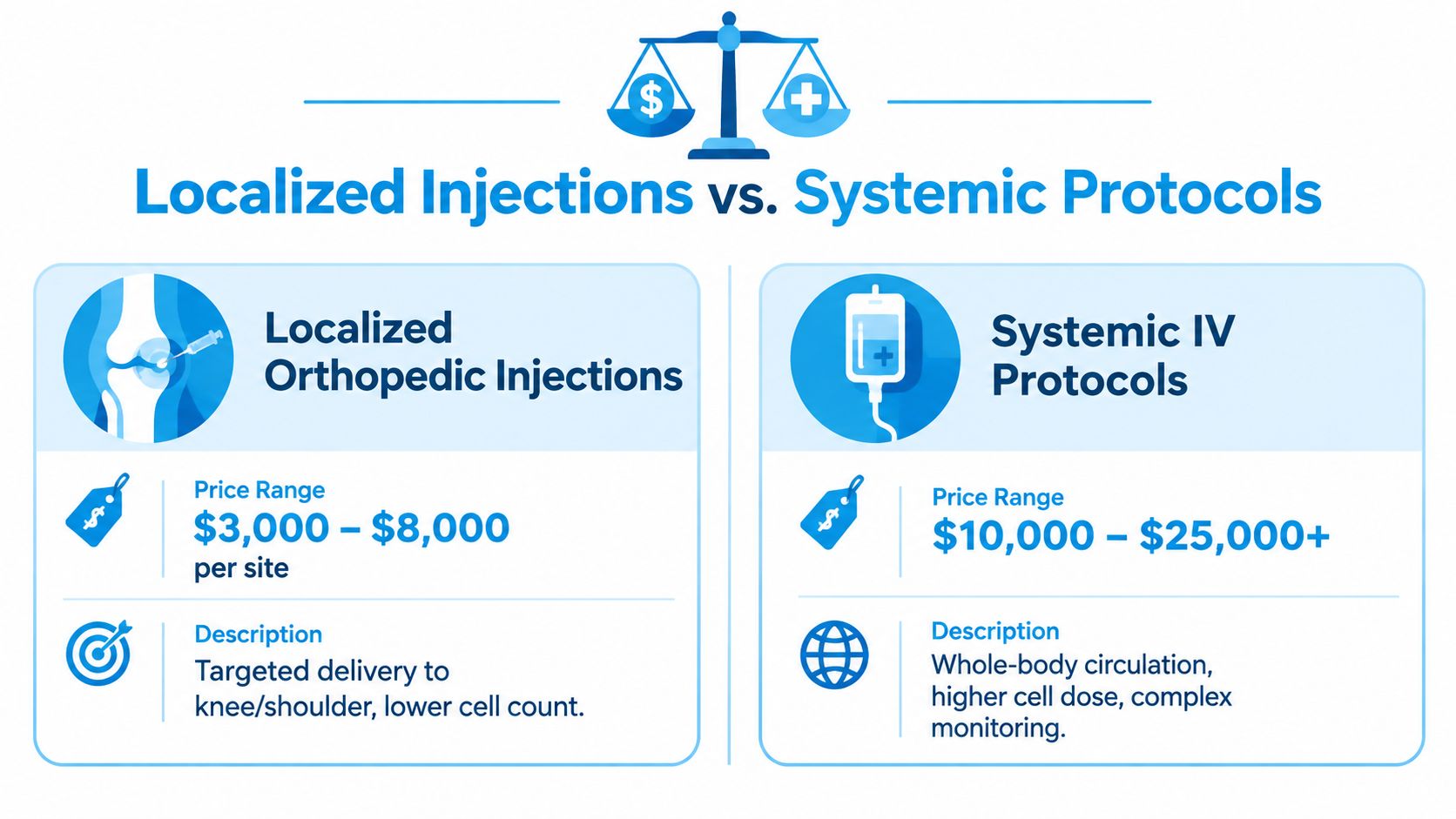
A patient seeking relief from one arthritic knee is evaluating a different service from someone considering a multi-session IV program. A localized injection delivers a cellular product to a defined structure, such as the knee, shoulder, hip, or spine. A systemic protocol circulates the product through the bloodstream and may involve a higher dose, several sessions, medical observation, and broader follow-up.
Localized orthopedic injections generally fall in the low-to-mid thousands per treatment site, although published prices vary widely. The relevant comparison is the service behind the number. Cell dose, preparation, delivery route, image guidance, clinician time, and clinic overhead can move a quote substantially. A price review of treatment-cost structures offers useful context without making a knee injection and an IV program equivalent.
Localized orthopedic treatment
Patients considering a joint procedure may encounter quotes around $5,000 to $10,000 per injection, while the wider market extends below and above that range. A single-site treatment may use a more modest dose and depend heavily on accurate placement. PRP, imaging review, ultrasound guidance, medications, and follow-up may be included or billed separately.
The biological rationale also matters. For many MSC-based treatments, the intended effect is largely paracrine. Cells release signaling molecules that may influence inflammation, immune activity, and tissue repair responses. That mechanism does not make a larger dose automatically better, and it does not prove that systemic delivery will outperform a targeted injection. The route must match the clinical question and the evidence supporting it.
Compare like with like. Check whether two clinics treat the same structure, use a comparable cell source and dose, provide image guidance, and include equivalent follow-up. A lower quote may reflect less product, fewer services, or lower facility and staffing costs rather than better value. A fair clinic like Dream Body Clinic will have it all listed an available for anyone to review:
Systemic IV treatment
Systemic programs often sit around $15,000 to $30,000 or more, while complex multi-session programs can exceed $50,000, according to the segmented pricing discussion in this recent review of treatment-cost structures. The total may include a larger cell dose, infusion logistics, monitoring, multiple treatment days, and coordination across a wider care plan.
We find those prices as crazy as you do. That is why we list our IV protocols with info and prices on www.dreambody.clinic
- 100 million MSC IV at Dream Body Clinic = $4,000 usd
- 200 million MSC IV at Dream Body Clinic = $8,000 usd
- 300 million MSC IV at Dream Body Clinic = $11,500 usd
The indication changes the financial analysis. An orthopedic patient seeking targeted relief should not compare a joint injection with an IV package as though they were interchangeable. Someone considering an autoimmune, organ-support, or neurological protocol should examine the evidence, regulatory classification, supervision, and follow-up in greater detail.
For a knee-specific starting point, review this guide to stem cell knee injection cost, then request an individualized quote. A published range cannot account for imaging findings, the number of structures treated, or your medical history.
How to Evaluate a Stem Cell Therapy Quote Like a Pro
A professional quote should let you reconstruct the treatment from the page. If it only says “stem cell package” followed by a price, you don’t yet have enough information to compare it with another provider.
Request the clinical specification
Ask for the following details before paying a deposit:
- Cell source: Is the product derived from bone marrow, adipose tissue, umbilical tissue, or another source?
- Total dose: How many cells are planned, and is that number total or per treatment site?
- Viability and handling: What quality information does the clinic provide, and who processes the product?
- Delivery route: Will the treatment be local, intravenous, intrathecal, or combined?
- Image guidance: What imaging method is used, and is it included in the quote?
- Adjuncts: Are PRP, HGH, medications, laboratory tests, or repeat procedures part of the package?
- Follow-up: Does the fee include scheduled clinical reviews, remote check-ins, or only the procedure day?
The clinic should also explain what happens if the proposed treatment isn’t appropriate after examination or record review. A transparent provider won’t treat a generic intake form as a substitute for medical assessment.
Separate included services from optional extras
Build your own comparison sheet. Put the total price at the top, then list the cells, route, sites, imaging, consultation, medications, travel support, accommodation, and follow-up. Mark each item as included, optional, or unknown.
Ask for the total cost of care, not just the procedure fee. Travel, lodging, repeat visits, rehabilitation, and follow-up can change the financial decision even when the treatment price itself is fixed.
Recognize weak quotes
Vague dosing is a warning sign because you can’t assess value without knowing what is being administered. Pressure to pay before receiving a clinical explanation is another concern. Be cautious with packages that promise broad results, avoid discussing limitations, or appear dramatically cheaper because they omit medical assessment and aftercare.
Regulatory status deserves a direct question. Ask which authority oversees the clinic, whether the treatment is established or investigational for your condition, and what documentation the provider can share. A procedure offered under a regulatory framework still requires informed consent and realistic expectations.
The cheapest option may reflect a smaller dose, limited monitoring, fewer treated sites, or no structured follow-up. The most expensive option may include unnecessary add-ons. Your task is to identify the clinical substance behind the quote.
Build a complete budget
For international treatment, calculate the cash required before you consider financing. Include the clinic fee, flights, local transportation, accommodation, time away from work, rehabilitation, local physician review, and monitoring after you return home.
| Budget item | Record before booking |
|---|---|
| Flights | Round-trip fare and changes |
| Accommodation | Nights required by the protocol |
| Contingency | Add 10-15% for extra nights or reassessment |
| Follow-up labs | Tests arranged after returning home |
Payment plans and medical credit can spread payments, but they do not make an unsuitable procedure appropriate. Read cancellation and refund terms. Do not borrow until the clinic has explained the indication, expected limitations, cell dose, delivery route, and follow-up requirements.
At Dream Body Clinic flights and hotel are up to patients, but we do provide all airport and clinic transportation if you stay in our zone. This link explains our transportation zone and the best accommodation options close to us – Accommodation Options – https://dreambody.clinic/index.php/hotels/
Choose value you can verify
A useful quote states the dose, cell source, delivery route, treated sites, imaging, monitoring, and follow-up. It identifies what is included and what costs extra. Dose and route matter because they affect the procedure, staffing, and monitoring, while the paracrine effects of administered cells may be central to the proposed biological rationale. A higher price can reflect clinic overhead or added services, not better outcomes.
Dream Body Clinic, based in Bucerias, Nayarit, Mexico, offers MSC protocols with specified delivery routes and doses, adjunct regenerative medications, travel coordination, and structured remote follow-up within its COFEPRIS-regulated operating framework. Compare those stated details with other providers, and treat them as information for review rather than proof that treatment is suitable.
Send your records for a written protocol review. Compare the recommendation with conventional care, clinical-trial options, and waiting before treatment. A sound decision protects your finances and your health.
If you want a starting point for comparing dose, route, included services, and follow-up, visit Dream Body Clinic to request a case review. Ask for a written treatment plan and complete cost breakdown before deciding whether an international MSC protocol fits your condition and budget.
Call us for a Free Consultation at (888) 704-3977 or on WhatsApp at +523222321055