
Worse pain after stem cell injection is common, usually temporary, and typically reflects an active inflammatory healing response rather than harm. A 2024 review found a 12.3% transient adverse-event rate among 1,924 patients, with swelling and injection-site pain the most frequent problems, usually lasting less than four weeks.
You may have expected relief as soon as you left the clinic. Instead, you wake up on the second day with a stiffer knee, a tender hip, or more aching in your back than before the procedure. That reaction can feel frightening, especially when pain has already disrupted your sleep, mobility, and confidence.
Pain alone, however, doesn’t tell you whether treatment has failed. Your body may be reacting to the injection, the physical pressure of the procedure, or the biological signals released by mesenchymal stromal cells. The important task is to distinguish a short-lived local flare from symptoms that need medical attention.
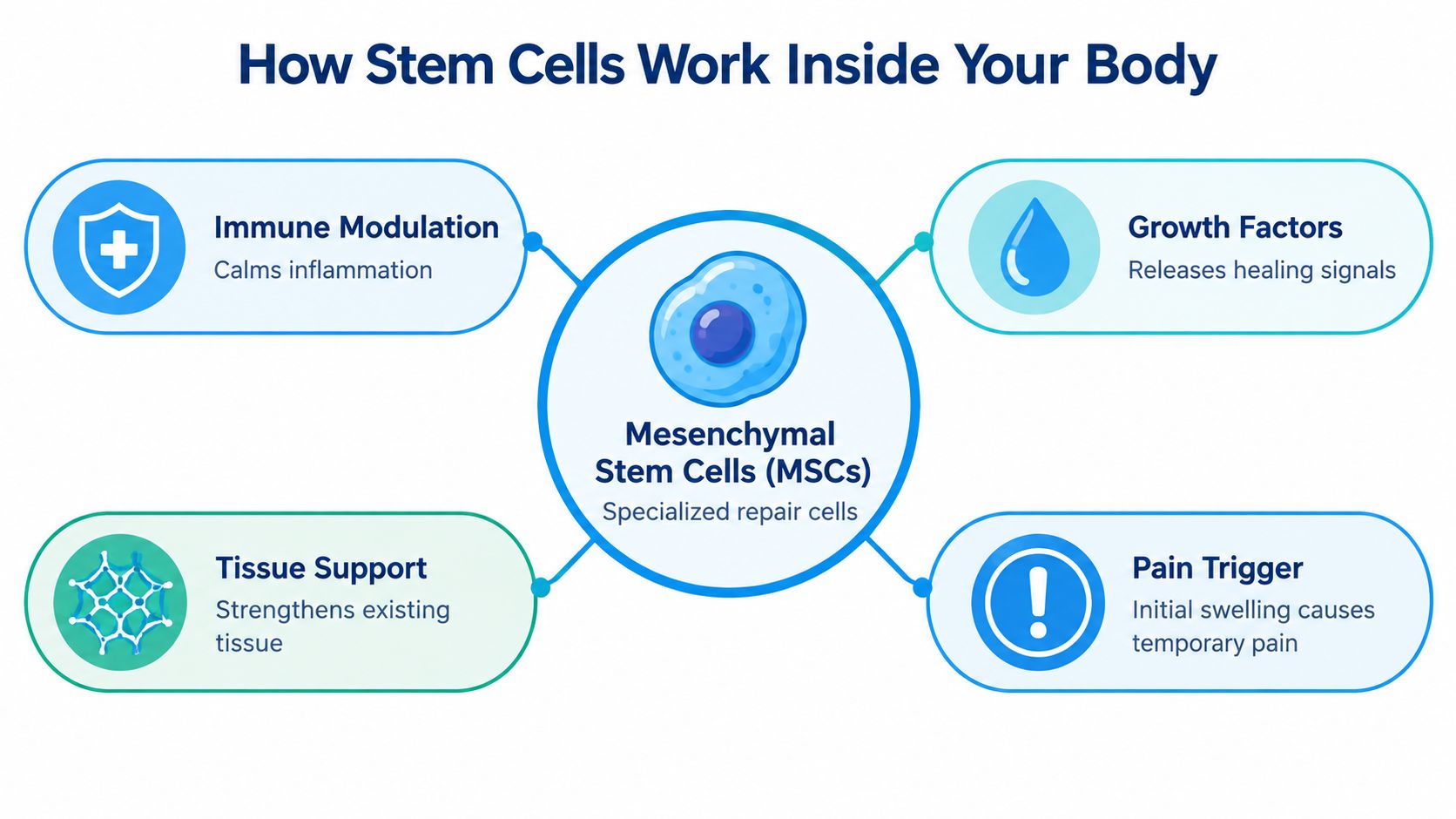
Mesenchymal stem cells work via what is called the paracrine effect, which is where they target inflammation then send out signals to guide the repair process. Some of those signals are pro-inflammatory markers. They are lighting up the area that needs the most help with inflammatory markers to bring in more help. This means you can be sore and feel very tight in joints post treatment for a few hours to a day or two, but the inflammation goes down and the repair begins in overdrive. It may not be fun while it is happening, but it is a great thing long term.
For faster pain relief we always recommend taking a Tylenol once every 8 hours if pain in the joint is felt. If pain persists once you get home then this topical gel has done wonders for pain and inflammation relief for many patients – DMSO + MSM Gel.
Table of Contents
- Why Your Pain Feels Worse Right Now
- What Stem Cells Actually Do Inside Your Body
- Safe Steps to Manage Post-Injection Pain at Home
- Normal Flare Signs Versus Red Flags
- When to Contact Your Clinic or Seek Urgent Care
- What to Expect as Healing Progresses
Why Your Pain Feels Worse Right Now
A patient with knee osteoarthritis may walk out of treatment feeling hopeful, then notice increasing soreness that evening. By the next morning, the knee feels tight, mildly swollen, and harder to bend. That pattern often represents a post-injection inflammatory flare, not immediate structural damage.
The injection introduces material into a sensitive joint and creates a local immune response. The surrounding tissues may become temporarily irritated as immune cells, signaling molecules, and fluid shifts change the environment. In a 2024 systematic review of autologous mesenchymal stem cell injections for knee osteoarthritis, the overall transient adverse-event rate was 12.3%, and the most frequent symptoms were swelling and pain at the injection site. The review found that these reactions typically lasted less than four weeks and reported no short-term major complications such as infection, sepsis, neoplasm, embolism, or death. The systematic review in Stem Cells International provides the detailed safety findings.

Why the second or third day can feel worse
Pain can increase after the immediate procedural effects wear off. The treated area may also respond to movement, swelling, and the early inflammatory environment. A person who expected instant relief may interpret that change as failure, even though the treatment was never designed to provide immediate symptom elimination in every case.
A 2025 meta-analysis reported that both single and repeated mesenchymal stem cell injections increased adverse events overall compared with conventional therapy in its pooled analysis. It reported an odds ratio of 5.72 for single injections and 5.72 for repeated injections, with 91 adverse-event cases in the single-injection group and 53 in the repeated-injection group. Most events were mild and localized, primarily post-injection site pain, while serious adverse events weren’t significantly increased. The supplied reference for this finding is a Research UK overview of stem-cell treatment side effects.
Practical rule: A temporary increase in localized pain is more reassuring when it remains near the injection site, doesn’t steadily escalate, and occurs without fever, spreading redness, or new neurological symptoms.
The phrase “active healing response” should still be used carefully. Pain doesn’t prove that the cells are working, and a comfortable recovery doesn’t prove that they aren’t. It means the symptom must be interpreted alongside timing, examination findings, baseline disease, and the injection location.
What Stem Cells Actually Do Inside Your Body
Mesenchymal stem cells, often called MSCs, aren’t best understood as replacement bricks that turn directly into new cartilage, bone, or nerve tissue. The more accurate clinical explanation is that they work mainly through the paracrine effect, releasing specialized signals that guide nearby cells and influence the repair environment.
These signals can include cytokines, chemokines, growth factors, and extracellular vesicles. Think of MSCs less like bricklayers and more like project managers at a complicated construction site. They don’t personally build every section of the structure. Instead, they communicate with local cells, immune pathways, and tissue-support systems so the body can coordinate its own response.
A review of MSC biology describes their beneficial effects as relying mainly on paracrine action rather than long-term engraftment and differentiation. Another review has linked as much as 80% of regenerative potential to paracrine activity. The review of MSC paracrine signaling explains why these cells are increasingly discussed as signaling and immunomodulatory agents.
Why the differentiation explanation matters
The statement that “stem cells don’t differentiate into other cells” needs precise wording. Differentiation isn’t considered the main therapeutic mechanism in most clinical MSC settings, although experimental studies may observe differentiation under particular conditions. A systematic review found no clear evidence that implanted MSCs consistently differentiate in vivo in preclinical or clinical settings, and noted that implanted cells often don’t survive longer than three weeks after injection. The systematic review of MSC differentiation supports the conclusion that signaling, rather than direct replacement, is the central explanation.
Researchers increasingly use the term mesenchymal stromal cells because the cells’ notable functions are secretory, immunomodulatory, and homing-related. An International Society for Cell and Gene Therapy-associated paper distinguishes “stem” from “stromal” terminology in this way, emphasizing the bulk population’s signaling and immune-regulating properties. The ISCT-associated discussion of mesenchymal stem and stromal cells offers useful terminology for patients evaluating treatment claims.
That biology explains why local soreness can occur. The cells and their signals interact with tissue that is already irritated or degenerated, and the resulting immune activity may briefly make the area feel more sensitive before symptoms settle. For readers comparing regenerative options with broader supportive approaches, information about fatigue relief therapies can also help clarify how regenerative medicine differs from symptom-focused care.
For a patient-friendly explanation of the procedure itself, review how stem cell injections work.
Safe Steps to Manage Post-Injection Pain at Home
Home care should support the treated area without trying to force a faster recovery. Your clinic’s instructions take priority because the correct plan depends on the joint, injection route, cell preparation, medications, and your medical history.
Use a calm, conservative routine
- Cool the area: Apply a cold pack wrapped in cloth for short periods if your clinician permits it. Cooling may reduce the sensation of swelling without placing pressure directly on the injection site.
- Keep moving gently: Perform only the range-of-motion exercises your clinic approved. Short, easy movement can prevent stiffness, while strenuous activity can add mechanical irritation during the early response.
- Protect the treated joint: Avoid heavy lifting, running, deep squats, aggressive stretching, and impact exercise until your treating team clears them. Pain that increases sharply during an activity is a reason to stop, not push through.
- Drink normally: Maintain ordinary hydration unless another clinician has restricted your fluids. Hydration won’t “flush out” the cells, but it supports general recovery and helps you avoid adding dehydration-related fatigue to the picture.
- Follow medication instructions: Use acetaminophen or another medicine only if your clinic says it’s appropriate for you. Don’t start, stop, or combine anti-inflammatory drugs without checking first, because some clinicians want to limit medications that could alter the early inflammatory response.
- Track the trend: Write down pain intensity, swelling, function, temperature, and new symptoms once or twice daily. A trend that gradually stabilizes is more informative than one difficult hour.
Don’t massage the area forcefully, apply unapproved creams or heat, or borrow medication from someone else. You also shouldn’t assume that stronger pain automatically calls for stronger medication. A clinician needs to consider bleeding risk, kidney health, stomach problems, drug interactions, and the exact procedure performed.
A useful question for your clinic: “What should improve first, pain, swelling, range of motion, or walking tolerance, and when should I call if it doesn’t?”
For faster pain relief we always recommend taking a Tylenol once every 8 hours if pain in the joint is felt. If pain persists once you get home then this topical gel has done wonders for pain and inflammation relief for many patients – DMSO + MSM Gel.
Normal Flare Signs Versus Red Flags
Pain after an injection needs context. In a large multicenter analysis described in a safety review, 3.9% of patients reported post-procedure pain and 3.8% reported pain attributed to progressive degenerative joint disease. Those nearly equal signals show why pain alone can’t identify treatment harm. The MSC safety review also describes localized pain, swelling, and effusion within 48 to 72 hours, with self-limited cases commonly managed conservatively.
Use the comparison below as a discussion guide, not as a substitute for an examination.
| Symptom | Normal Flare | Warning Sign |
|---|---|---|
| Pain | Localized soreness or aching that fluctuates and begins to settle | Severe, unrelenting, or rapidly escalating pain that doesn’t respond to the approved plan |
| Swelling | Mild swelling near the treated joint | Rapidly increasing swelling, swelling that spreads, or swelling that prevents movement |
| Skin warmth | Mild warmth close to the injection site | Spreading redness, marked warmth, red streaking, or drainage |
| Stiffness | Temporary stiffness that improves with permitted gentle movement | Sudden loss of function or inability to use the limb |
| General symptoms | Tiredness or mild discomfort without deterioration | Fever, chills, confusion, or feeling acutely unwell |
| Nerve symptoms | No new numbness, tingling, or weakness | New numbness, tingling, weakness, loss of balance, or radiating nerve pain |
| Duration | Symptoms that gradually stabilize and resolve within the expected window, sometimes less than four weeks | Symptoms that persist, worsen, or fail to follow the recovery plan |
Location changes the risk conversation
A knee or shoulder flare is usually assessed differently from new symptoms after a spinal or intrathecal injection. New weakness, numbness, loss of coordination, severe radiating pain, or changes in bladder or bowel control require urgent medical assessment, even if the injection site itself looks normal.
Rare but serious neurological harms have been reported after spinal or intrathecal stem cell injections, including inflammatory lumbar polyradiculopathy, persistent ataxia, cauda equina syndrome, and severe pain with loss of mobility. Reviews of chronic spinal pain trials have described neuropathic pain and headache among moderate adverse events, while the most alarming cases were associated with unproven or poorly controlled spinal injections rather than routine intra-articular treatment. The review of adverse events in spinal pain trials explains why neurological symptoms deserve a separate response.
For additional patient questions about treatment expectations and safety, consult the stem cell treatment FAQ, then contact your own clinic about symptoms that are specific to your injection.
When to Contact Your Clinic or Seek Urgent Care
Call the treating clinic when pain is not following the expected pattern, especially if it remains difficult to control, interferes with basic function, or continues beyond the recovery window your clinician gave you. Contact the clinic promptly if you aren’t sure whether a medication is safe, if swelling is increasing rather than stabilizing, or if you develop a new symptom that wasn’t present before treatment.
You don’t need to wait until symptoms become dramatic. A phone assessment can help the clinical team review timing, medication use, the injection site, and whether you need an in-person examination. Keep your discharge instructions nearby and tell the clinician the injection location, date, cell source if known, current medications, temperature, and the direction symptoms are moving.
At Dream Body Clinic we provide all patients with the main line (888) 704-3977, local number +523222321055 and the patient’s attending physician’s phone number. We have 8 drivers on staff and can attend to any patient’s needs. Dream Body Clinic is also next door to the largest ER in the area, the CMQ hospital. We have never had an adverse reaction from a stem cell treatment that required an ER visit, but we are prepared for any situation.
Seek urgent same-day assessment for
- Fever or systemic illness: A temperature above 101°F, persistent fever, chills, or a marked decline in how you feel needs prompt evaluation. If the injection site is swollen and feels much warmer than usual then you need to call the clinic.
- Rapidly worsening swelling: Seek same-day advice if swelling expands quickly, becomes tense, or prevents normal movement.
- Loss of function: Inability to bear weight or a sudden inability to move the treated joint shouldn’t be managed only at home.
- Possible infection: Spreading redness, increasing warmth, drainage, or escalating tenderness needs medical review.
- New neurological symptoms: Numbness, tingling, weakness, balance problems, or radiating nerve pain require urgent attention, particularly after a spinal procedure.
Treat neurological emergencies as emergencies
After a spinal or intrathecal injection, new weakness, loss of mobility, severe radiating pain, saddle-area numbness, or bladder or bowel changes can indicate a serious neurological problem. Conditions such as inflammatory lumbar polyradiculopathy and cauda equina syndrome are rare, but delaying assessment can increase the risk of lasting harm.
Don’t drive yourself if you feel weak, confused, faint, or unable to walk safely. Contact emergency services or go to an emergency department, and tell the team that you recently received a spinal or intrathecal injection. The same applies to severe allergic symptoms, chest pain, shortness of breath, or rapidly worsening general illness.
Don’t use reassurance as a reason to delay care. Most local reactions are self-limited, but red flags are defined by their pattern and associated symptoms, not by how often they occur.
What to Expect as Healing Progresses
Recovery rarely follows a perfectly straight line. One day may feel easier, followed by stiffness after more activity or a poor night’s sleep. The useful measure is the overall trend in function, walking tolerance, range of motion, and daily comfort, not whether every day is better than the one before.
As the initial local response settles, patients may gradually notice less swelling, easier movement, or improved tolerance for ordinary activities. The timing varies with the diagnosis, the condition of the joint or spine, the injection route, and the body’s existing inflammatory burden. Your clinician should define the milestones that matter for your case.
The paracrine model also explains why MSC therapy isn’t an instant replacement procedure. The cells send signals that influence the body’s repair environment. They don’t become permanent new tissue in a simple one-for-one way, so improvement depends on how your own tissues respond over time.
Keep scheduled follow-ups, record symptom trends, and report changes rather than trying to interpret every fluctuation alone. If pain is worsening instead of stabilizing, or if any red flag appears, contact the clinic rather than assuming it proves the therapy is working.
Dream Body Clinic provides mesenchymal stem cell therapies for orthopedic and other regenerative medicine indications, with clinical assessment, treatment planning, and remote follow-up for international patients in Mexico. If you’re concerned about worse pain after stem cell injection and want to discuss whether your symptoms fit an expected response, visit Dream Body Clinic to request a case review.