
Stem-cell treatments are not categorically illegal. Whether a treatment is lawful depends on the product, intended use, processing method, evidence, and country, and legal permission is not the same as proof that it works.
The popular advice to check whether a clinic is “licensed” is a start, not an answer. A clinic’s status doesn’t tell you by itself whether a specific cell product is approved for your condition, whether it’s being used in an authorized clinical trial, or what protections you’d have if you were harmed.
A person with knee pain might find an FDA warning about an unapproved treatment in the United States and a clinic offering a similar intervention in Mexico. Those statements aren’t necessarily contradictory: each country applies its own rules, and the products or uses may differ. The practical questions are which regulator oversees the treatment, what product is being used, which condition it’s intended to treat, and whether it’s approved, investigational, or marketed without required permission.
Table of Contents
- Are Stem Cells Legal Depends on the Rules
- How Stem Cells Signal Healing Without Becoming New Tissue
- How the US EU and Mexico Regulate Stem Cells
- Which Stem Cell Uses Have Real Approval
- How Dream Body Clinic Fits COFEPRIS Rules
- What to Check Before Traveling for Treatment
- What to Do After You Understand the Law
Are Stem Cells Legal Depends on the Rules
The useful answer to “Are stem cells legal?” is “sometimes, under specific rules.” A cell-based treatment may be permitted in one country and treated as an unapproved drug or biologic in another. That’s why a clinic’s location, or a general statement that a procedure is legal, can’t settle the question for an individual patient.
The United States provides a clear example. The FDA says regenerative-medicine products generally need FDA approval or licensure before they’re marketed, while investigational products require FDA oversight through a clinical trial. Whether cells are minimally manipulated and used in a closely related way can affect the regulatory pathway. A product outside those conditions may need an investigational-new-drug application and a biologics-license process. The FDA’s patient information on regenerative medicine explains why the product and its use matter.
Four questions that clarify the answer
Consider a patient who sees an American warning about a knee injection and a Mexican clinic page advertising cell therapy for joint pain. Neither page, on its own, answers whether the specific treatment is lawful for that patient. The clinic may be operating under a local framework, while the same product or intended use may not have authorization in the United States.
Use this four-part check before interpreting a clinic’s claims:
- Regulator: Which government authority oversees the treatment and the facility?
- Product: What cells or cell-based product will be administered, and how was it prepared?
- Indication: Is the product authorized for the condition being treated, rather than for a different purpose?
- Status: Is the treatment approved, being studied in an authorized trial, or being marketed without required permission?
Those questions also separate issues that are often blurred together. Facility licensing, product approval, clinical-trial authorization, manufacturing standards, informed consent, and advertising compliance are related but distinct. A clinic may make a statement about its establishment without establishing that a particular product has authorization for your diagnosis.
Practical rule: Treat “legal here” as the beginning of your questions, not the end of them. Legality concerns permission. It doesn’t establish effectiveness, safety for your condition, or a remedy if something goes wrong.
How Stem Cells Signal Healing Without Becoming New Tissue
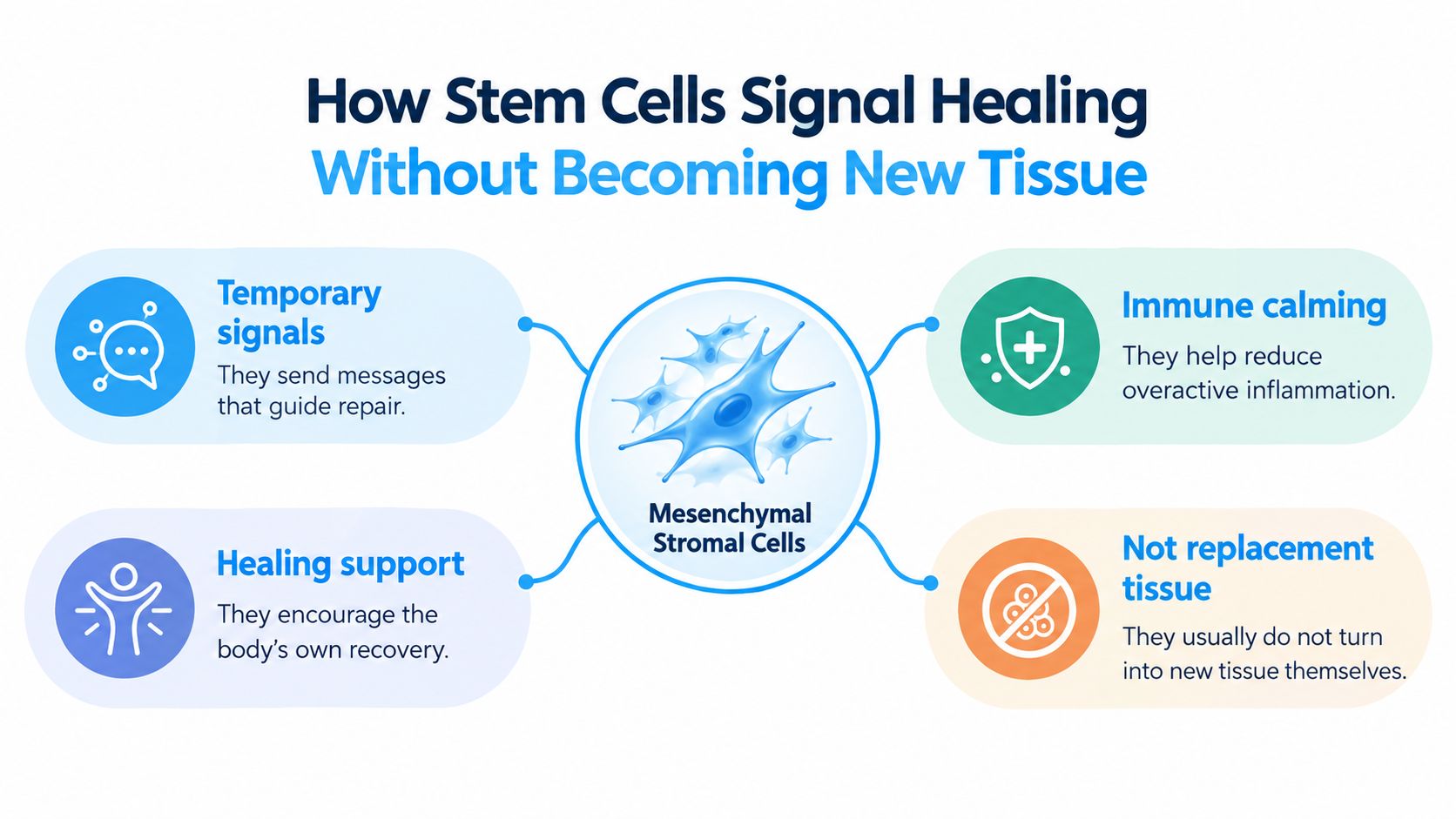
A common promise in regenerative medicine is that injected cells will turn into new cartilage, nerves, or another missing tissue. That’s not the usual explanation for how mesenchymal stromal cells, or MSCs, are thought to act.
Think of MSCs less like replacement bricks and more like temporary messengers at a repair site. They generally don’t permanently differentiate into replacement tissue after administration. Instead, their main proposed action is the paracrine effect: they release signals that communicate with nearby immune, blood-vessel, and tissue cells and help guide the body’s response.
What the signals do
Those messages can include cytokines, growth factors, and contents of extracellular vesicles. Reviews describe MSC signals as influencing inflammation, immune-cell activity, blood-vessel formation, cell survival, and the local tissue response. A review of MSC biology and paracrine activity explains why researchers study these cells as signaling agents, rather than assuming they become the damaged cell type.
In practical terms, the cells may influence the conditions around an injury. The body’s own cells then respond to those signals. MSCs don’t need to become heart muscle, neurons, or cartilage for that signaling to occur, but this proposed mechanism doesn’t prove that a treatment will improve a particular condition.
MSCs also don’t always remain where they’re administered. Lung sequestration and systemic clearance can limit permanent engraftment, yet secreted factors may still affect the body’s response. A review discussing MSC paracrine signaling describes how these signals can act on neighboring cells without the administered MSCs becoming specialized tissue themselves.
The signaling response can vary with the cell source, culture conditions, dose, delivery route, and tissue environment. That variability matters: a plausible biological explanation isn’t proof that every cell product is the same, that every use is effective, or that a regulator has authorized the treatment.
For a broader overview of the treatment process, learn about stem-cell therapy and how it works. Keep the distinction in mind: paracrine signaling describes a proposed mechanism; approval and clinical evidence address different questions.
Why Get Stem Cell Therapy in Mexico and not the USA?
In the USA they have a rule called minimal manipulation. This means they can’t fully isolate and culture stem cells for treatments. So patients can get minimally manipulated stem cells from fat, bone marrow or umbilical cord tissue, but only a small percentage of what they are calling stem cells is actually stem cells. It is mostly other types of cells due to the minimal manipulation.
There are a lot of studies on MSCs for knee repair, but even with all the evidence the hesitate to state that it really works. This is because even with over 100,000 studies done on mesenchymal stem cells (you can verify on google scholar), the FDA system gets in the way of approval. To get mesenchymal stem cells approved for knee repair each type of treatment requires a $2.5 million USD application feel. So knee osteoarthritis would be $2.5 million then meniscus repair would be $2.5 million and so on. That application fee just gets the clinic into the 4 phase FDA trials. Those typically take over 7 years and cost hundreds of millions of dollars to complete. Then at the end you can’t patent a mesenchymal stem cell so you would just be opening the market to your competition. You would spend hundreds of millions of dollars for each different type of treatment and would not be able to recover your costs. It is a flawed system designed to protect big pharmaceutical companies and keep people hooked on pills or resort to surgery.
How the US EU and Mexico Regulate Stem Cells
The United States, European Union, and Mexico don’t apply one shared permission system. Their rules illustrate why “stem-cell treatment” is too broad a label to tell a patient whether a specific product can lawfully be offered.
| Jurisdiction | Main authority | What permission usually requires | What it doesn’t automatically mean |
|---|---|---|---|
| United States | FDA | Approval or licensure to market most regenerative-medicine products; FDA oversight for investigational products in clinical trials | Approval for unrelated conditions, or proof that a clinic’s entire service list is authorized |
| European Union | European Medicines Agency and national authorities within the EU framework | Product-specific marketing authorization for advanced therapy medicinal products | Permission to use the product for every condition or by every route |
| Mexico | COFEPRIS | Relevant establishment licensing or authorization, with oversight of clinical research and cell-handling activities | FDA approval, proven effectiveness, or authorization based only on a clinic’s location |
In the United States, the FDA’s pathway can depend on how a product is processed and used. If it falls outside the conditions for a less complex regulatory pathway, an investigational-new-drug application and a biologics-license process may be required. A clinic’s registration or a claim that it handles cells doesn’t answer whether its product has the necessary status.
The EU uses a product-specific framework
The EU’s advanced-therapy medicinal-products framework covers gene therapies, somatic-cell therapies, and tissue-engineered products. Regulation (EC) No. 1394/2007 established that system, which entered into force on December 30, 2008, and created the EMA Committee for Advanced Therapies to assess quality, safety, and efficacy.
Authorization history reinforces the product-by-product approach. EU approvals included ChondroCelect, Provenge, Zalmoxis, Alofisel, and Ebvallo. The regulatory review supplied for these products reports that ChondroCelect, Provenge, and Zalmoxis were later no longer authorized, while Alofisel and Ebvallo remained available at the time of the review. An authorization attaches to a particular product and use; it isn’t a general license for all stem-cell treatments.
Mexico requires its own verification
COFEPRIS oversees human clinical research in Mexico. Establishments involved in collecting, conserving, analyzing, preparing, supplying, or disposing of cells require licensing or authorization under Article 315 of Mexico’s General Health Law. A regulatory review also notes that Mexico historically lacked a single, fully specific official norm for every therapeutic stem-cell use, which makes facility authorization, protocol oversight, processing, donor screening, traceability, and support for treatment claims important to verify.
Canada has a separate national system. A treatment’s status in the United States or Mexico shouldn’t be assumed to apply across that border. Across these systems, “legal” might mean an approved therapy, treatment within an authorized trial, or an intervention being marketed without required permission.
Which Stem Cell Uses Have Real Approval
The FDA identifies a narrow category of approved stem-cell products: hematopoietic progenitor cells derived from umbilical-cord blood. These products are approved for disorders affecting blood production. That approval doesn’t extend to a different product or to unrelated orthopedic, neurological, pulmonary, cardiovascular, autoimmune, sexual-health, or anti-aging uses.

The distinction is easiest to see with examples. FDA-approved cord-blood products for blood-production disorders don’t establish that a stem-cell injection is approved for knee pain, or that an infusion is approved for a neurological condition. The FDA lists osteoarthritis, disc disease, back pain, knee pain, neck pain, multiple sclerosis, Alzheimer’s disease, Parkinson’s disease, stroke, COPD, and heart disease among conditions for which regenerative products have not been approved.
How Dream Body Clinic Fits COFEPRIS Rules
Dream Body Clinic describes itself as a regenerative-medicine clinic in Bucerias, Nayarit, serving international patients under Mexico’s COFEPRIS-regulated framework. It offers MSC-based services across orthopedic, autoimmune, organ, neurological, anti-aging, and sexual-health uses. That description tells a patient what the clinic says it provides; it doesn’t, by itself, establish authorization for every product, protocol, or condition.
The clinic describes orthopedic injections for joints and the spine, immune-modulating protocols for conditions such as rheumatoid arthritis, lupus, Crohn’s disease, multiple sclerosis, psoriasis, and ulcerative colitis, and protocols for organ and neurological conditions. It also lists anti-aging and sexual-health services, with local, intravenous, or intrathecal delivery routes when indicated. These are the clinic’s stated treatment areas, not a claim that each use has FDA approval or established efficacy.
Dream Body Clinic’s medical team is led by Dr. Arick Lopez, works with a multidisciplinary team, and has experience with MSC and HGH protocols. We have an English-speaking coordination, remote follow-up, and a patient journey that can include case review, clinical assessment, travel logistics, and an in-clinic visit.
For orthopedic care, the clinic identifies knee, lower-back, and neck treatments among its commonly requested services. Our published material describes cell counts and possible adjuncts such as PRP and MRI for some protocols.
Mexico’s regulatory context makes product- and facility-level questions especially important. Ask what establishment authorization applies, who oversees the protocol, how cells are processed and screened, how they’re tracked, and what evidence supports the claims for your diagnosis. A clinic’s presence in Mexico or its reference to COFEPRIS shouldn’t be taken as proof that every treatment is approved for every use.
Review the clinic’s information about certified stem cells as one part of your research, then request documentation for the exact product and proposed treatment. Being lawful under a local framework isn’t FDA approval, and neither status alone proves effectiveness.
What to Check Before Traveling for Treatment
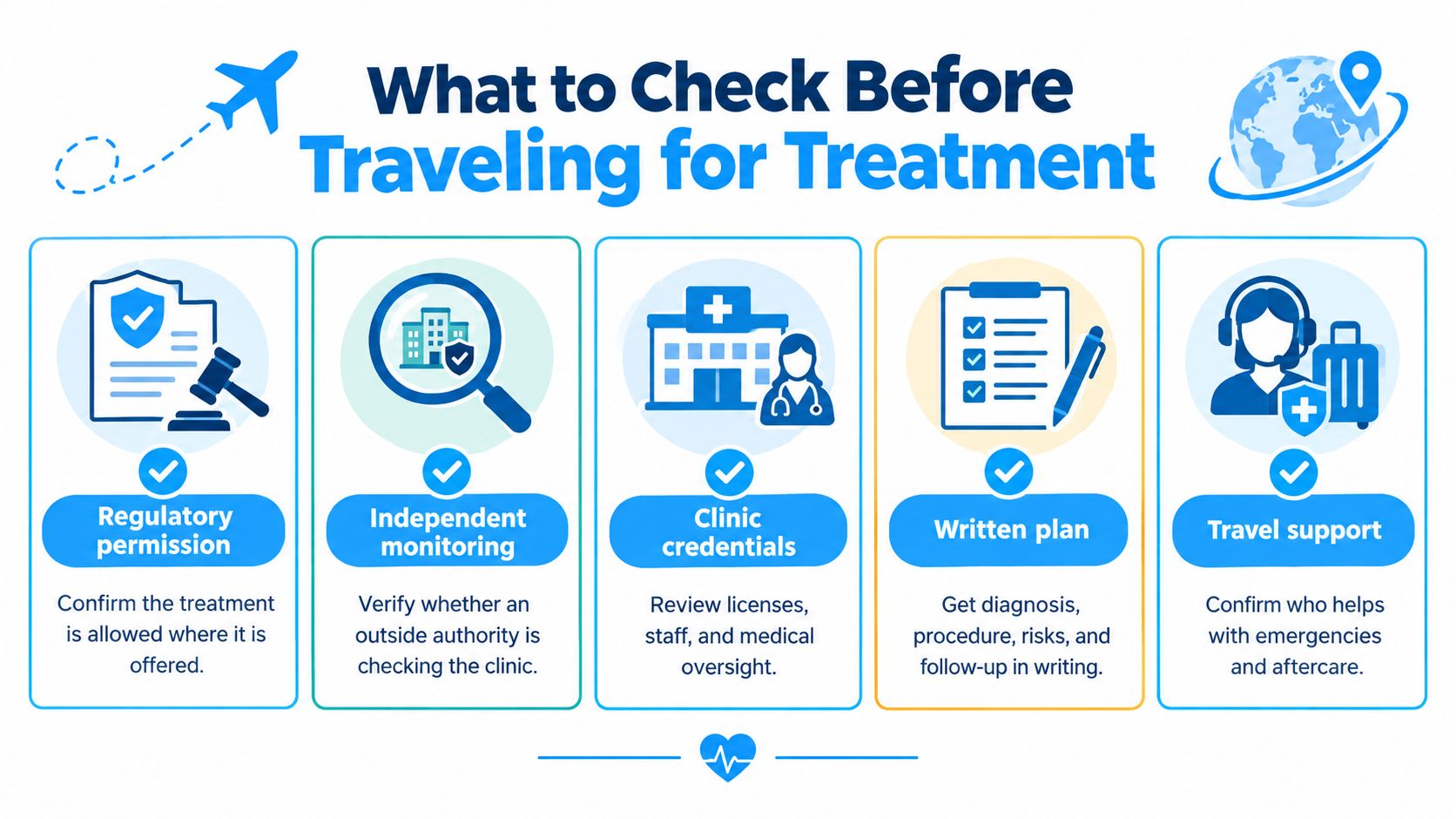
Regulatory permission doesn’t guarantee independent monitoring, strong evidence for your condition, or compensation if you’re injured. A National Academies review notes that clinics offering medical-tourism stem-cell interventions may not be required to report safety and efficacy information, leaving gaps in independent surveillance. It also explains why legal administration in a local framework may not guarantee access to compensation, malpractice remedies, or long-term adverse-event reporting in your home country. The National Academies’ review of stem-cell tourism is a useful reminder to ask who monitors outcomes after treatment.
Get the details in writing
Before booking travel to Bucerias, request the name of the regulator and documentation of the establishment’s authorization. Ask whether your proposed care is approved or investigational, what cells will be used, how they’re tested and processed, and what sterility documentation is available. The consent form should state the treatment’s uncertainties and risks in language you understand.
Clarify the practical arrangements too. Ask what the clinical assessment covers, how travel logistics work, how long the in-clinic visit is expected to take, and who owns or can access your medical records afterward. The clinic describes services such as complimentary case review, clinical assessment, logistics support, an in-clinic visit, and remote follow-up; confirm the details directly before relying on them.
A company’s registration or a listing on ClinicalTrials.gov doesn’t prove that a product is legally marketed or clinically effective. The FDA’s safety information on unapproved stem-cell and exosome products makes that distinction important when you’re evaluating a clinic’s claims.
Plan for complications and follow-up
Before you travel, find out who reports complications, whether your insurance excludes treatment abroad, and what refund terms apply. Ask how an emergency transfer would be arranged and whether a physician in your home country can receive your records and continue care. A treatment plan should include what happens after you leave, not just what happens in the clinic.
For travel preparation beyond the medical questions, Simsima’s Mexico eSIM recommendations can help you consider how you’ll stay connected while abroad. For the clinical side, use this preparation checklist for stem-cell therapy in Mexico to organize questions before you commit. None of these steps removes risk; they help you understand who is responsible and what support is available.
What to Do After You Understand the Law
Stem-cell treatments can be legal under a specific country’s rules, for a specific product, process, and use. That doesn’t mean the treatment is proven, that it’s authorized for every condition, or that injected MSCs turn into new tissue. MSCs are generally understood as temporary signaling cells whose proposed effects work through the paracrine process.
If you’re comparing restrictions in the United States with treatment offered in Mexico, focus on your own diagnosis and the exact protocol proposed for it. Confirm which COFEPRIS-level permissions apply, ask for evidence tied to that use, and involve a physician who can support your follow-up at home. A general cell-therapy explanation or a clinic’s service list can’t answer those personal questions.
If you want someone to review your records before you decide, Dream Body Clinic describes a complimentary case review for prospective patients. The clinic’s owners have also written The Ultimate Guide to Stem Cell Therapy for readers who want more background before considering travel. Use either resource as a starting point for questions, not as a substitute for independent medical advice or regulatory verification.
Dream Body Clinic offers MSC-based care in Bucerias, Mexico, with case review and treatment planning for international patients. If you’re weighing a locally offered intervention against the rules and evidence that apply to your condition, contact Dream Body Clinic to ask for the specific protocol, regulatory details, and follow-up plan in writing.