Many patients with sciatica from a herniated disc improve without surgery. Treatment choice depends on neurological status and daily function, not imaging alone. A tablet, an injection, a cell protocol, and an operation have different intended roles: controlling symptoms, reducing inflammation, influencing tissue signaling, or physically removing compressive material. Symptom relief does not show that a treatment changed the disc, and a treatment that does not decompress a nerve cannot be expected to remove mechanical pressure.
Dream Body Clinic offers region-specific MSC protocols designed for the signaling role:
Each uses high-dose allogeneic MSCs from Wharton’s jelly and placenta, expanded on site, with peri-spinal placement around the affected levels plus systemic support.
Table of Contents
- Why Symptoms and Imaging Shape Your Options
- Conservative Care and Physical Therapy Timelines
- Side-by-Side Comparison of Six Treatment Paths
- How Injections and MSC Therapies Actually Work
- When Surgery Becomes the Better Choice
- Matching Treatment Options to Your Situation
- Choosing Your Next Step With a Clinical Assessment
Why Symptoms and Imaging Shape Your Options
A herniated disc is a structural event. Soft inner disc material pushes through or beyond the tougher outer layer, and symptoms follow only when that material irritates or compresses a nearby nerve root. Two forces then drive what you feel, direct mechanical pressure and the inflammation that gathers around the nerve. That distinction explains why pain can ease before a scan looks normal, and why a large finding on imaging doesn’t always produce severe symptoms.
Radicular pain travels along the path of an irritated nerve root, often down the leg. When that pattern affects the sciatic distribution, clinicians call it sciatica. Back pain alone, leg dominant pain, numbness, and objective weakness are different clinical signals, and they don’t carry equal weight. New weakness matters more than pain intensity because it suggests the nerve is losing function, not just sending pain signals.
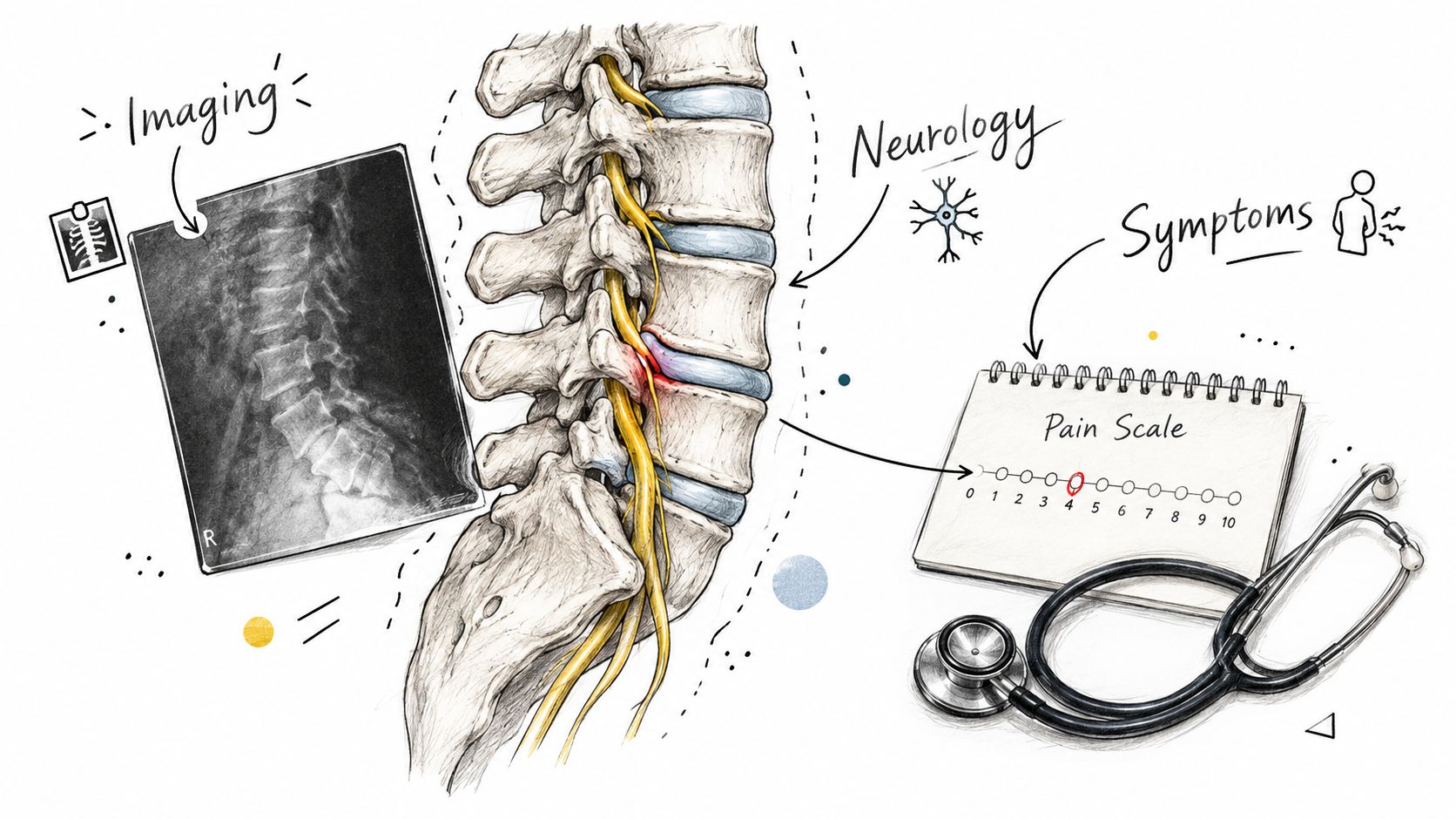
What Clinicians Weigh Before the MRI
Your assessment starts with where the pain travels, how long it’s lasted, whether strength and reflexes are intact, and what you can and can’t do at work or at home. Imaging then confirms whether a herniation matches that picture. Patients whose disc problem sits within broader wear and tear will also want to understand how degenerative disc disease and spondylosis differ from an acute herniation, because background degeneration changes the long term plan even when it isn’t today’s pain source.
Practical rule: Treat the nerve findings and the functional loss, not the picture. An MRI can help determine the best route of action.
Warning Signs That Override Watchful Waiting
Some findings end the debate about a trial of nonsurgical care and require urgent specialist assessment instead.
- Progressive weakness: Strength that’s measurably worsening, impaired walking, or difficulty lifting the foot
- Bowel or bladder change: New loss of control or inability to pass urine
- Saddle numbness: Numbness in the groin and inner thigh region
- Severe motor deficit: A major loss of power in the affected limb
The six paths compared below, conservative care, physical therapy, epidural steroid injections, PRP, MSC therapy, and surgery, only make sense once those warning signs have been screened out and your symptom pattern is clear.
Conservative Care and Physical Therapy Timelines
Conservative care is an active, monitored treatment pathway. It aims to control symptoms, maintain function, and give inflammation time to settle while the body may resorb some herniated disc material. For uncomplicated cases, this is generally the starting point, with reassessment guiding whether care should continue or change.
What the First Line Pathway Actually Includes
The American Association of Neurological Surgeons overview of herniated disc treatment describes common nonoperative measures: staying active within a tolerable range, briefly reducing activities that worsen pain, using nonsteroidal anti-inflammatory medicines for mild to moderate pain, and participating in physical therapy. Spinal injections may also be considered in selected cases. Activity is adjusted, not stopped: keep moving within your symptoms’ limits and temporarily reduce the specific loads that provoke leg pain.
Physical therapy is the active rehabilitation component. A therapist selects movements according to your response, builds trunk and hip strength, and works on how you sit, lift, and walk. The aim is to improve movement and load tolerance, not mechanically decompress the nerve. Medication may make that work more tolerable; it controls symptoms rather than repairing the disc.
The Recovery Window and How to Read It
There is no single recovery deadline that applies to everyone. Symptoms and function may improve over time without surgery, but the pace varies, and improvement does not mean that imaging must show the disc has returned to normal. Conservative care is therefore judged by changes in leg pain, strength, walking, and daily function, not by a fixed number of weeks or complete absence of pain.
- Early phase: Check for warning signs, address pain and inflammation, and maintain gentle activity as tolerated.
- Middle phase: Progress therapy according to symptoms and monitor leg pain, strength, and walking tolerance.
- Reassessment: Compare current function with your starting baseline and decide whether the treatment is helping.
A gradual return to activity can be more meaningful than a quick drop in pain alone. If function is improving and strength remains stable, the plan may continue with adjustments. If it is not, reassessment helps determine whether another option is appropriate.
Signs a Trial Has Stalled
A conservative trial may have stalled when leg pain remains disabling, function stops improving or declines, or medication needs remain high at follow-up. Persistent mild numbness alongside improving strength differs from worsening weakness. The latter calls for prompt clinical reassessment, because it signals a change in neurological function rather than pain alone.
Side-by-Side Comparison of Six Treatment Paths
Read the table by intent first and invasiveness second. Each row answers what the option is designed to do, what timeline and evidence the research describes, and what you trade away. Options that look adjacent on an invasiveness ladder often have nothing in common once you sort them this way.
Herniated Disc Treatment Options Compared
| Treatment | Primary intent | Timeline and evidence noted | Main trade-off |
|---|---|---|---|
| Conservative care | Symptom control while inflammation settles and disc material resorbs | Improvement commonly assessed over the first several weeks | No structural intervention, so progress depends on natural recovery |
| Physical therapy | Restore movement, strength, and load tolerance | Runs alongside conservative care with milestone based progression | Requires sustained participation and doesn’t decompress a nerve |
| Epidural steroid injections | Temporary inflammation control around the nerve root | Used in selected cases within nonoperative care | Relief doesn’t prove the disc has structurally healed |
| PRP | Deliver concentrated platelet derived signals to injured tissue | Discussed as a separate biologic adjunct rather than established disc repair | Evidence base is less developed than for standard care |
| MSC therapy | Tissue signaling and immune modulation through the paracrine effect | Typically the best and fastest way to heal herniated discs | Cannot substitute for decompression when weakness progresses |
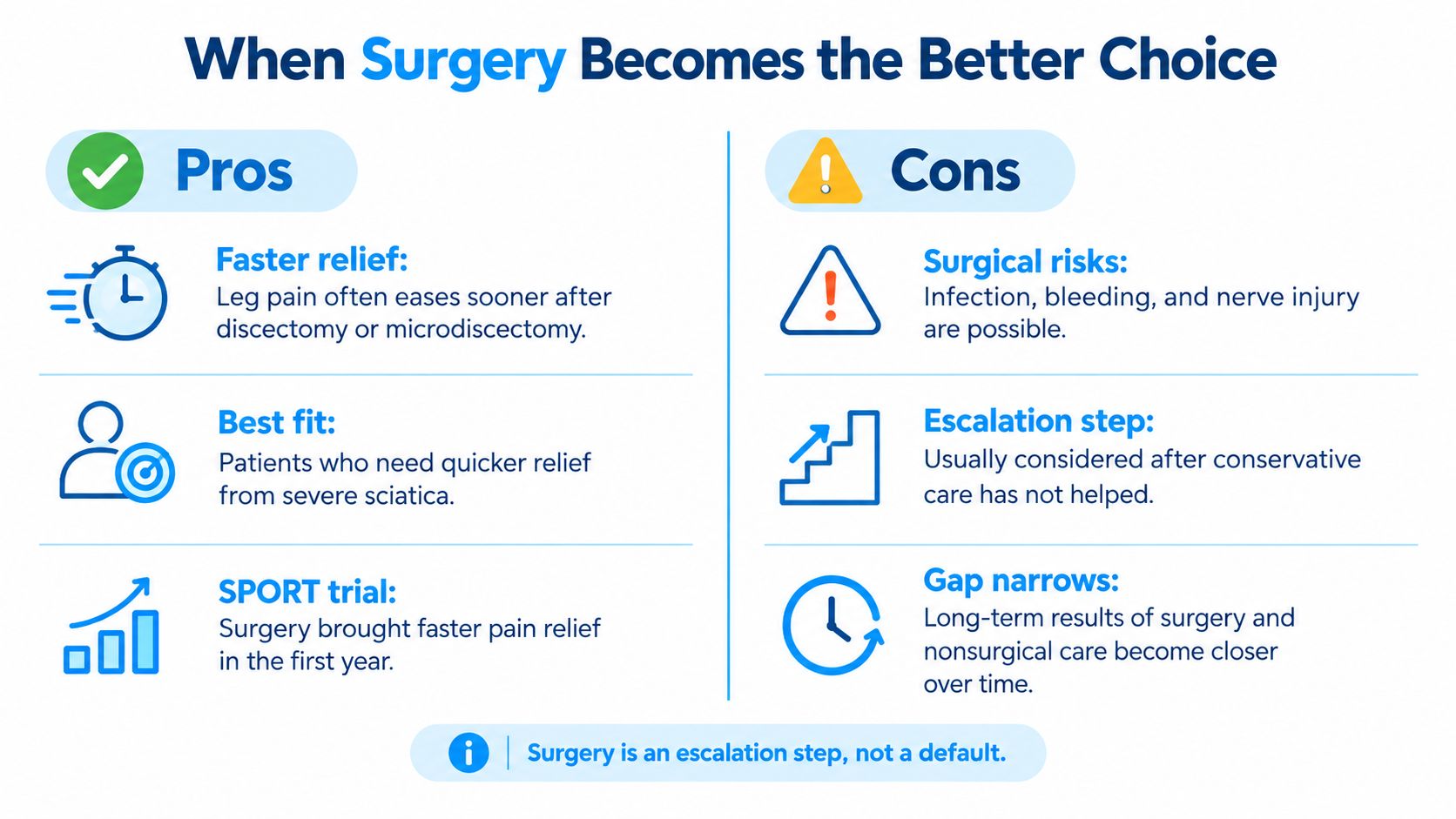
| Surgery | Mechanical decompression by removing herniated material | Faster early relief in trial data, but not a guarantee of relieving pain | Operative risks and a meaningful reoperation rate over time |
The pattern in the table is the article’s central point. Conservative care and surgery carry the most outcome data. Injection and cell based options sit in a different category, not because they’re less invasive, but because their proposed job is biological modulation rather than removal of compressive material. Dream Body Clinic’s MSC protocol belongs in the signaling row, and it should be judged by the criteria for that row, defined functional outcomes and honest disclosure of uncertainty, rather than by comparison with an operation it doesn’t replicate.
A less invasive treatment is not automatically a disease modifying treatment. Reducing radicular pain does not prove that a herniated disc has structurally healed.
Dream Body Clinic offers region-specific MSC protocols designed for the signaling role:
Each uses high-dose allogeneic MSCs from Wharton’s jelly and placenta, expanded on site, with peri-spinal placement around the affected levels plus systemic support.
How Injections and MSC Therapies Actually Work
An epidural steroid injection delivers anti inflammatory medication near the irritated nerve root. Its job is temporary inflammation control, which can reduce radicular pain and open a window where rehabilitation becomes tolerable. It does not remove herniated material and it does not rebuild the disc. Judged as symptom control it can succeed. Judged as structural repair it was never designed to pass.
PRP is a different tool again. It concentrates signaling proteins from your own blood and delivers them to a target area, and in clinic protocols it’s best understood as a separate biologic adjunct rather than as part of any cell product itself. PRP can’t get past fibrosis so it is very limited in results.
The Paracrine Effect Explained Plainly
Mesenchymal stromal cells, or MSCs, should not be described as replacing a herniated disc by transforming into new disc tissue. As research on MSC tissue repair activity sets out, their direct differentiation and long term engraftment are limited because relatively few transplanted cells survive at the injury site. They do not reliably differentiate into new disc, cartilage, or other tissue cells. Their therapeutic activity is instead attributed mainly to the paracrine effect, in which MSCs release specialized signals that guide the healing process, regulate inflammation, and support your own repair response. In practical terms they’re temporary biological coordinators, not permanent replacement cells.
Those signals travel as soluble proteins and as extracellular vesicles, including exosomes carrying regulatory microRNAs and other molecular cargo, a mechanism detailed in work on the MSC secretome and extracellular vesicles. The signals can affect cell survival, proliferation, migration, gene expression, and macrophage behavior in nearby tissue.
For disc disease specifically, a review of MSC communication with resident disc cells describes secreted molecules including transforming growth factor beta, insulin like growth factor, hepatocyte growth factor, fibroblast growth factor, prostaglandin E2, and indoleamine 2,3-dioxygenase. These may reduce inflammatory activity, protect cells from apoptosis, and encourage surviving disc or progenitor cells to produce extracellular matrix. The herniated material isn’t necessarily dissolved by the injected cells. The proposed action is improving the environment around injured tissue.
- What MSCs do: Send specialized signals that guide the healing process and calm inflammatory reactions
- What MSCs don’t do: Reliably turn into replacement disc cells or physically decompress a nerve
- What to ask any clinic: What outcome will you measure, pain, strength, function, medication use, or avoidance of surgery
Where the Evidence Boundary Sits
A systematic review of MSC studies in degenerative disc disease describes a substantial gap between strong preclinical regeneration and human trials, where results have generally been modest or inconclusive. That doesn’t invalidate the mechanism. It means honest counseling separates a plausible signaling rationale from a guaranteed cure. Understanding how stem cell injections work at the delivery level helps you ask sharper questions about route, target, and follow up.
Applied to that standard, Dream Body Clinic states its orthopedic protocol parameters openly. Cell counts run at 100+ million MSCs via intramuscular injection plus a 100 million stem cell IV, protocols are often paired with PRP and pre and post treatment MRI, and delivery routes and dosing are published.
When Surgery Becomes the Better Choice
Surgery is an escalation step, not a default and not a failure. Discectomy and microdiscectomy remove the herniated fragment pressing on the nerve root, which makes surgery the only option on the list whose intent is mechanical decompression. That single fact explains both its speed and its limits. Stem Cells are amazing, but they are medicine, not magic. If you let the issues progress too far then sometimes surgery is the only option. This is why we recommend looking into stem cell therapy early in hopes to avoid surgery.
Matching Treatment Options to Your Situation
Three patients can share a similar MRI and need three different decisions. What separates them isn’t the image. It’s symptom duration, strength, and what the pain stops them doing.
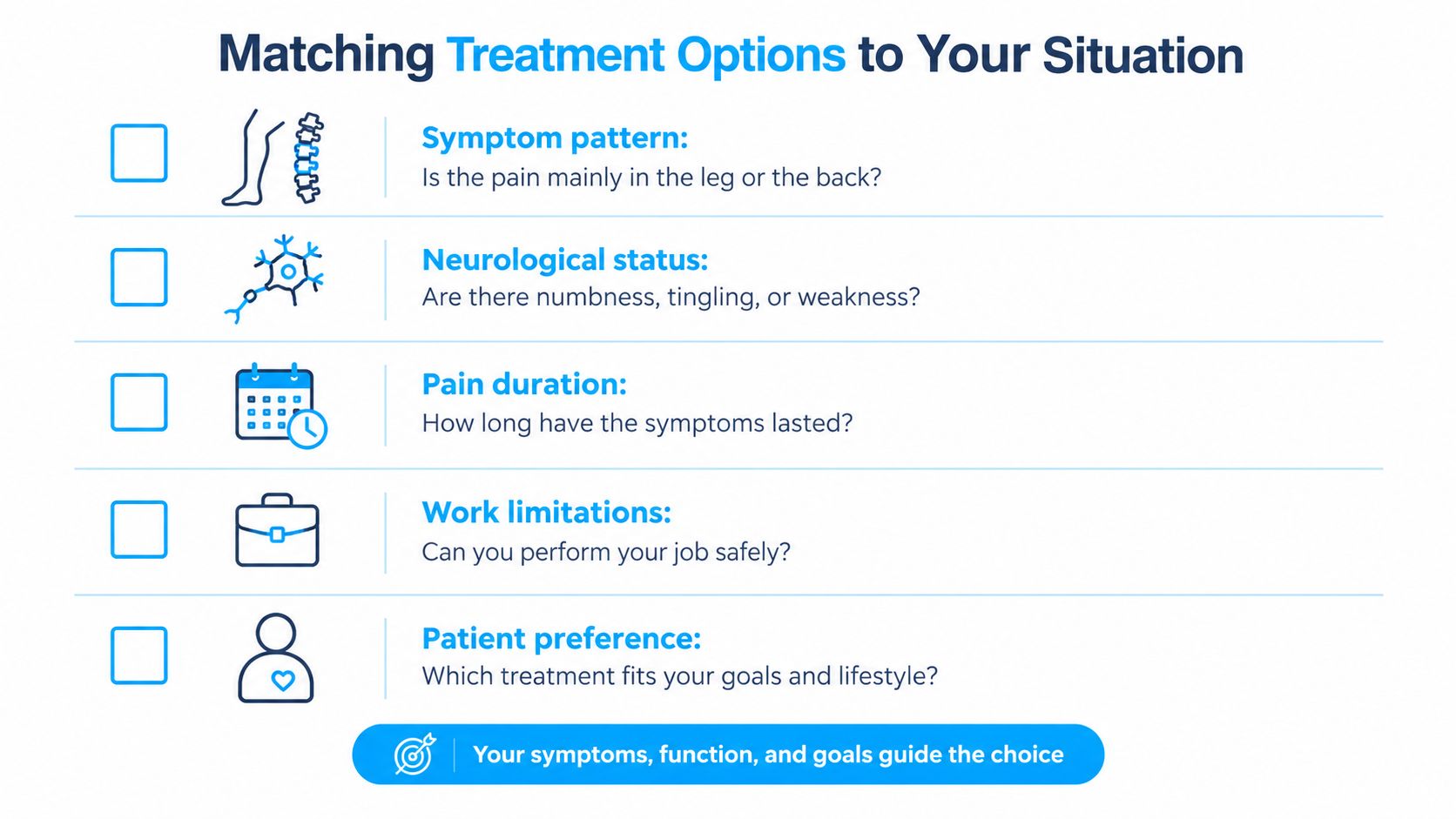
New leg pain, stable strength. A patient three weeks into sciatica with intact strength and no red flags belongs in structured conservative care with reassessment dates set in advance. Reaching for a procedure here treats a problem that recovery is already addressing. Patients exploring regenerative routes for this pattern should understand where stem cell therapy for sciatica fits relative to first line care before sequencing it ahead of that trial.
Persistent pain, declining function. A patient past the conservative window whose leg pain still blocks work and whose walking tolerance is shrinking has a genuinely open decision. This is the scenario where the speed advantage of surgery and the signaling rationale of biologic options get weighed against continued nonsurgical care, using functional milestones rather than pain scores alone.
Progressive weakness or red flags. A patient losing strength week to week, or showing saddle numbness or bladder change, doesn’t have an options menu. That patient needs urgent specialist assessment, and no injection substitutes for decompression if decompression is what’s required.
The following video walkthrough helps you visualize how those situation factors get applied in a treatment discussion.
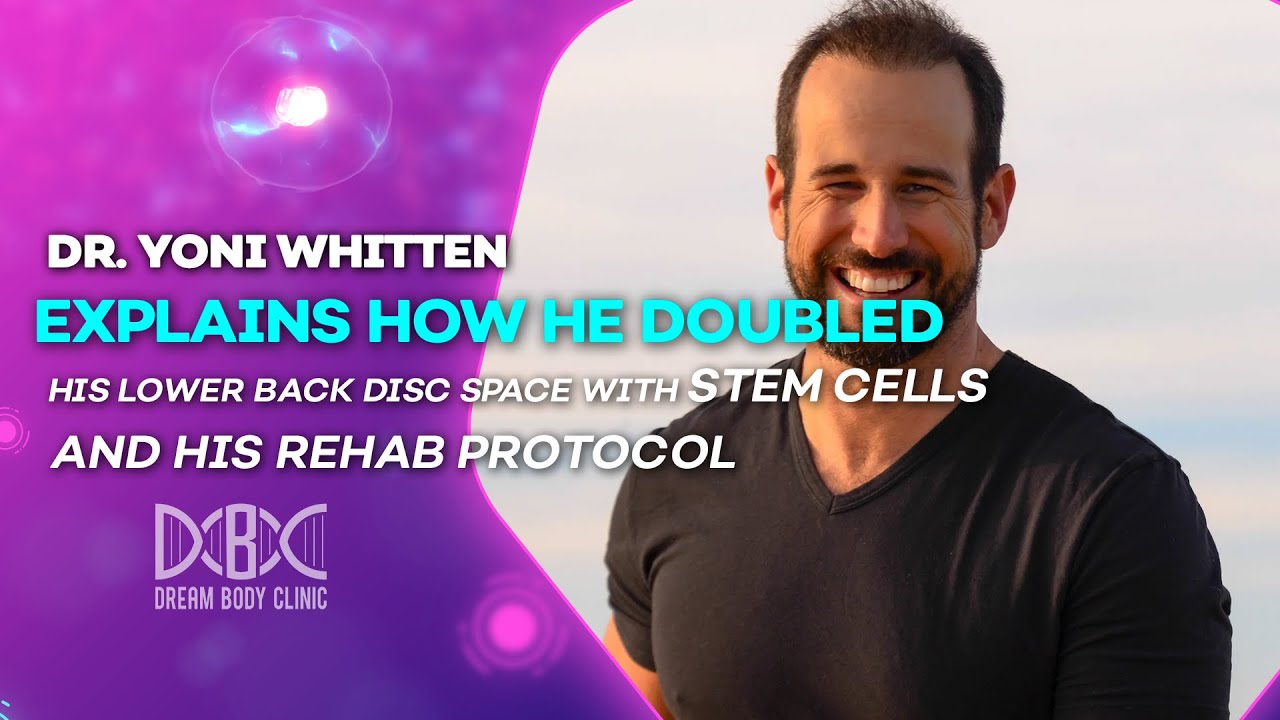
A 2025 systematic review of surgical indications for lumbar radiculopathy found imaging confirmed nerve root compression and severe or refractory pain were the most consistent surgical indications, while definitions of sensory deficit and failed conservative treatment varied substantially across studies. That’s precisely why your own escalation criteria need to be explicit before treatment starts, rather than improvised when frustration peaks.
Choosing Your Next Step With a Clinical Assessment
Treatment choice should follow clinical findings. A structured assessment checks for red flags, tests strength, and records functional measures. Before a procedure, specify what it is meant to change: pain, strength, function, medication use, or MRI findings. Record a baseline so the result can be assessed against the same measure.
Patients considering the spine protocols can request a complimentary case review. Bring current imaging, a dated symptom history, medication list, and any documented neurological findings.
Review the specific protocols:
Call (888) 704-3977 or email info@dreambodyclinic.net
7 Reasons Patients Choose Dream Body Clinic’s Spine Protocols After Conservative Care
- Region-specific protocols for neck, middle back, and lower back with published details.
- High-dose peri-spinal MSC placement plus systemic IV support.
- No harvest procedure — allogeneic cells from Wharton’s jelly and placenta.
- Fresh cells expanded on site in an ISO-rated lab (never frozen or shipped).
- All-inclusive packages that include MRI and blood panel.
- Image-guided delivery matched to the affected levels.
- Short five-day stay in the Puerto Vallarta area with remote follow-up at 3, 6, and 12 month