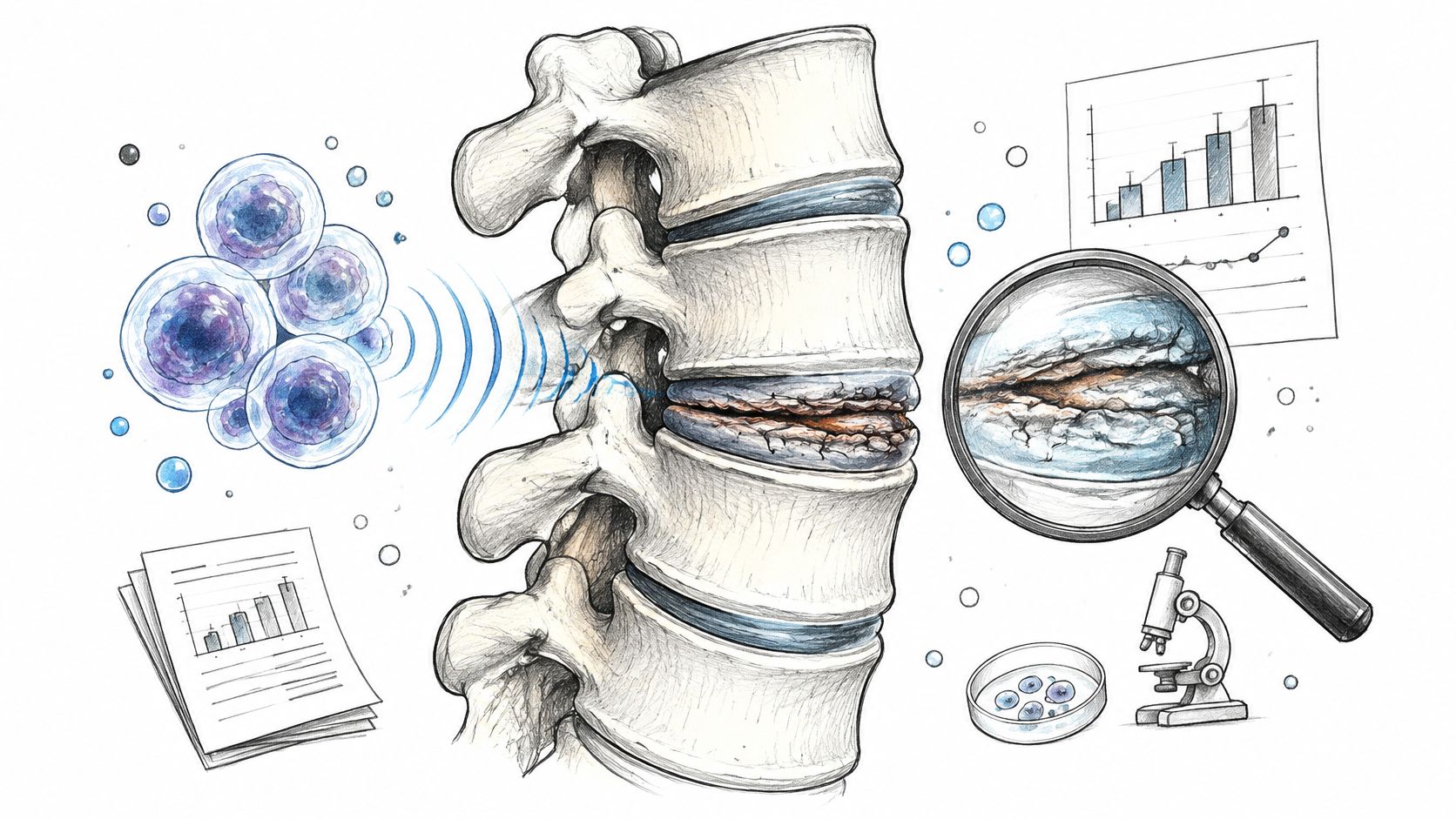
Your knee has been sore for two years. You've got an MRI report in a folder, a cortisone shot that helped for six weeks, and a surgeon who used the phrase "eventually you'll need a replacement." Then you find a clinic offering stem cells, and the first thing the website tells you is a cell count: 25 million, 50 million, 100 million. Bigger number, better treatment, right?
That's the wrong question, and it's the most common one patients ask. The number matters far less than whether the plan was built around your imaging, your inflammatory status, your medication history and a baseline you can measure again in six months. Personalized regenerative medicine is that matching work, and it's what separates a thoughtful protocol from a syringe with a price tag.
Table of Contents
- What Personalized Regenerative Medicine Means
- What Inputs Shape a Personalized Plan
- What Joint Studies Show and Where They Stop
- Safety, Limits and Regulatory Status
- Comparing Cross-Border Care With Standard Options
- How Protocols Change Across Three Common Cases
- Book a Personalized Case Review Before You Decide
What Personalized Regenerative Medicine Means
Say two people walk into a clinic on the same afternoon with the same diagnosis label: knee osteoarthritis. One is 44, plays weekend football, has a partial meniscus tear on MRI and normal blood work. The other is 68, has bone-on-bone changes in two compartments, takes a blood thinner, and has kidney function that limits which medications are safe. Same diagnosis, two completely different plans. The target tissue, delivery route, follow-up schedule, and realistic goal all shift.
Think of a custom-fitted suit. The fabric can be identical for two customers, but the fit comes from measurements taken before the first cut: shoulder slope, sleeve length, chest, stance. A tailor who skips the measurements and hands you the largest size in the shop isn't personalizing anything. Regenerative care works the same way. The cells are the fabric. Your diagnosis, history, imaging and baseline function are the measurements.

The cells send signals, they don't turn into new tissue
Here's the part most patient-facing pages get wrong. Mesenchymal stem cells (MSCs) don't differentiate into replacement cartilage, ligament or nerve tissue. Injected into a knee, they don't become a new meniscus. They work through the paracrine effect, which means they release specialized signals that calm local inflammation, influence nearby immune cells and guide your body's own repair processes.
That single fact changes how you should read every protocol. If the cells are messengers rather than building blocks, then putting them next to the right target, in a body environment that lets those messages land, matters more than stacking up a bigger cell count. A larger dose isn't automatically a more individualized treatment, and it isn't automatically a stronger one.
A cell count tells you how many messengers arrived. It doesn't tell you whether they were sent to the right address.
Personalization is the matching step
So personalization means matching a signal-based approach to one patient's biology, imaging and measurable starting point. It's diagnosis confirmation, medication review, comorbidity screening and baseline function scores, not a menu of dose sizes. Everything that follows tests that idea: which inputs a clinician should collect, what the published joint results show, where those results stop, and how to compare an offer abroad against the care available at home.
What Inputs Shape a Personalized Plan
A well-built plan starts with a lookup table, not a syringe. These are the inputs a clinician reviews before anyone talks about dosing, and what each one changes.
| Input | What to review | How it changes the plan |
|---|---|---|
| Diagnosis confirmation | MRI or X-ray showing the target tissue | Confirms the target and rules out structural causes that need other care |
| Medication and prior treatment | Current drugs, injections, physical therapy and surgery history | Flags interactions and shows what has already been tried |
| Comorbidities | Kidney, liver, heart and lung function | Sets safety limits and the delivery route |
| Baseline inflammation | C-reactive protein and lymphocyte count | Helps estimate responsiveness and gives a later comparison point |
| Baseline function | Pain score (VAS) and WOMAC or another validated scale | Creates measurable endpoints at about 3, 6 and 12 months |
| Cell product record | Identity, purity, viability, sterility and potency assay | Shows the dose reflects biological activity, not only a cell count |
Why a cell count alone doesn't tell you potency
The ISSCR guidelines on clinical translation of stem cell-based interventions specify that an MSC product should be characterized by cell identity, purity, viability, sterility, genomic stability and a validated potency assay matched to the intended mechanism, whether that's immunosuppression, trophic signaling, angiogenesis or anti-fibrotic activity. Standardized identity, purity and potency measurements are what make studies comparable and let anyone establish a dose–response relationship or spot toxicity risk.
Without those controls, a nominal dose of 25 million or 100 million cells doesn't reliably represent biological potency, because donor source, tissue origin, culture conditions, passage number, cryopreservation and the patient's own inflammatory environment can materially change MSC behavior. That's why traceability from donor and manufacturing lot through to the route of administration and your follow-up results belongs in the plan.
Blood work carries similar weight. A review in the Journal of Hematology and Oncology identifies pretreatment lymphocyte counts and inflammatory-marker levels as candidate predictors of MSC responsiveness, which makes them useful context, not a guarantee. If you want a plain-language primer on why individual lab panels matter more than generic reference ranges, Lola's explainer on the role of personalised blood tests is a sensible read before your next draw.
The seven steps, in order
- Confirm the diagnosis with imaging that matches the symptoms. An MRI of the knee when the pain is coming from the hip tells you nothing useful. Common mistake: treating imaging as optional paperwork.
- Review medications, prior injections, therapy and surgery at the same site. A previous meniscectomy changes the joint you're treating. Common mistake: leaving out an old surgery because it "was years ago."
- Run baseline labs, including inflammatory markers and organ function. These set safety limits and give you a comparison point later. Common mistake: skipping them to save a visit.
- Record baseline pain and WOMAC scores on paper, with a date. Memory drifts toward how you feel today. Common mistake: relying on recall at the six-month call.
- Choose the target tissue and route. Ultrasound-guided injection puts cells next to a defined joint structure; IV delivery suits systemic conditions. Common mistake: picking the route before seeing the images.
- Confirm release criteria and dose documentation before administration. We count cultured stem cells with a special meter before dosing, so the delivered dosage is exact rather than estimated, and our board-certified physicians with regenerative medicine specialization review each plan. Common mistake: accepting a cell count with no release record behind it.
- Schedule follow-up at about 3, 6 and 12 months with response thresholds set in advance. Decide beforehand what counts as a meaningful change.
Practical rule: if the plan can't be written on one page as diagnosis, baseline, target, route, dose record and follow-up dates, it isn't a personalized plan yet.
Cell source belongs in that same conversation, and our comparison of allogeneic versus autologous stem cells walks through why donor tissue and your own tissue behave differently in culture and in the body.
What Joint Studies Show and Where They Stop
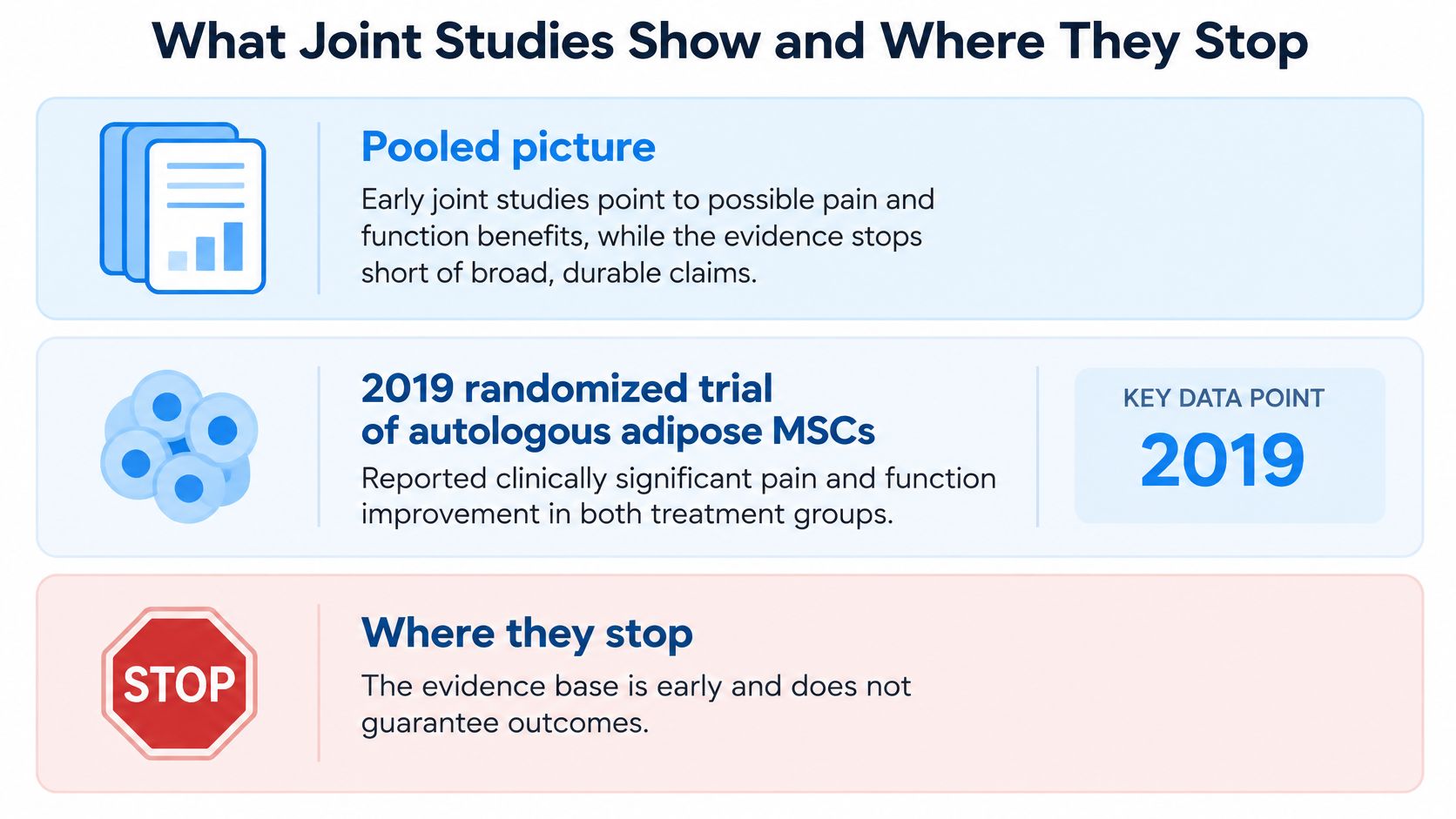
Start with the pooled picture, because single studies flatter and mislead in equal measure. A 2025 systematic review and meta-analysis in Stem Cell Research and Therapy pooled eight randomized controlled trials involving 502 patients with knee osteoarthritis and found statistically significant WOMAC improvements versus control of 7.44 points at six months (95% CI 1.45 to 13.42) and 10.31 points at 12 months (95% CI 0.96 to 19.67).
Those are pain and function gains measured on a validated scale. They aren't a report of rebuilt cartilage, and the confidence intervals are wide enough that you should read them as a direction, not a promise.
The individual trials behind the pooled number
| Study | Design | Reported result |
|---|---|---|
| 2019 adipose MSC study | Randomized controlled trial, autologous adipose MSCs, 12-month follow-up | Clinically significant pain and function improvement in both treatment groups, with numerical pain-rating scores improving 69% from baseline in the 2019 randomized trial |
| 2020 phase II study | Multicenter randomized trial, bone-marrow MSCs plus PRGF vs PRGF alone | Median VAS pain reduction 39.2% vs 12.5% at 12 months in the phase II multicenter trial; median WOMAC reduction 37.3% vs 23.4%, between-group difference not statistically significant |
| Dose-comparison study | Multicenter phase I/II randomized trial, two MSC doses vs hyaluronic acid | Higher dose group: median 4-point improvement, and 25% of those patients improved by 22 points, in the phase I/II dose-comparison trial |
| 2025 meta-analysis | Eight randomized trials, 502 patients with knee osteoarthritis | WOMAC mean difference 7.44 at 6 months and 10.31 at 12 months |
Read the second row twice. The pain difference looks large, the WOMAC difference wasn't statistically significant, and both facts belong in the same sentence when anyone quotes that trial to you.
Where the evidence stops
The pooled knee results don't establish healing of every meniscus, ACL, PCL, MCL, spine or neck condition, and they don't verify any particular clinic's outcomes. A 2025 clinical review indexed on PubMed found that MSC injections can reduce osteoarthritis pain but the benefit doesn't consistently exceed placebo, and disease modification remains unproven. Across MSC trials, efficacy has been inconsistent and many studies failed to meet their primary efficacy endpoints, even though safety has generally looked favorable.
Our own knee treatment protocol uses 50 million culture-expanded allogeneic MSCs from Wharton's jelly and placenta, delivered under ultrasound guidance, and we state plainly that results vary. That's a description of the protocol as published, not an independently audited outcome claim. For a longer look at how to weigh published findings against a clinic's own description, we've laid out the reasoning in does stem cell therapy work.
Safety, Limits and Regulatory Status
A patient sitting across from a regenerative medicine specialist often hears two very different sentences in the same conversation. One is honest: what you're considering is not FDA approved for your condition. The other needs scrutiny: some version of "approved abroad" that sounds like a guarantee but isn't one. Knowing how to tell these apart matters more than any single statistic.
Most MSC uses for the conditions discussed here aren't FDA approved. Approved regenerative products in the United States cover narrowly defined diseases and injuries, not broad claims about orthopedic pain, aging or autoimmune disease generally. Interest in the field is clearly growing: FDA's RMAT records show annual designation requests rising from 31 in fiscal year 2017 to 91 in fiscal year 2025, and a peer-reviewed review of U.S. FDA data reported 25 cell and gene therapy products approved between 2020 and 2024, with 36% of those approved during 2024 alone. Growth in research activity is not the same thing as established effectiveness in every indication, and a 2021 ISSCR update flagged growing reports of inappropriate uses and exaggerated claims alongside the rise in trials.
Dream Body Clinic delivers treatments in Bucerias, Nayarit within Mexico's COFEPRIS-regulated framework and under COFEPRIS oversight, the regulator often described as Mexico's FDA equivalent. Ask what any oversight framework covers: facility and laboratory standards are one thing, a reviewed determination that a specific therapy works for your diagnosis is another. Those two are easy to confuse on purpose, so read carefully before accepting any single word like "approved" on its own.
What safety screening should include
- Injection-site reactions: soreness, swelling and a short-lived flare at the target joint are ordinary local responses to plan around.
- Infection risk: sterile technique and a documented sterility release on the cell product are the baseline requirement.
- Active infection or active cancer: both need screening before any cell therapy, not after.
- Imaging confirmation: without it, nobody has verified that the needle is going where the pain is coming from.
Think of this list the way you'd think of pre-flight checks. Each item looks small, but skipping one means nobody caught the problem it exists to catch. A clinic that personalizes well will have done the imaging and the labs before dose ever enters the conversation, because the dose decision depends on them.
The limits worth saying out loud
Results vary. Not every patient responds. Biomarkers such as lymphocyte count are still being studied as predictors of response, not used as a switch that guarantees success. This is the heart of honest personalization: matching a signal-based MSC approach to your biology, imaging and measurable baseline, rather than choosing a higher cell count and hoping the number does the work. A higher dose isn't automatically better, and no honest clinician will tell you a meniscus will be structurally normal on a follow-up MRI because you received a particular cell count.
Ask your own doctor: for this exact condition, does physical therapy, a disease-modifying medication or surgery have stronger evidence than what's being offered, and what would we measure to know which one worked?
Bring that question to your physician before you book a flight, not after. A good regenerative plan survives that conversation, and the way a clinic responds to it tells you nearly everything you need to know.
Comparing Cross-Border Care With Standard Options
Price and a promised outcome are the two worst reasons to choose treatment abroad. Use a written framework instead, and fill it in for both options side by side.
- Name the condition and the standard care at home. Physical therapy, medication, injections or surgery, each with its evidence for your specific diagnosis, not for "joint pain" in general.
- Check the evidence for the proposed protocol. How many randomized trials, how many patients, and are there published results for this indication rather than a neighboring one?
- Check regulatory status in both countries. Has the product completed review for this disease, and what does the clinic's approval cover? A comparative review of international regulation describes major differences between countries in terminology, risk perception, evidence standards and oversight, with fragmented rules creating patient-safety risks.
- Check product documentation. Release record, identity, potency assay, storage conditions, and traceability from donor to lot.
- Check continuity of care. Who sees you after you fly home, how imaging and labs reach your home physician, and what happens if a complication appears at week three.
- Check total burden. Flights, time off work, and the cost of follow-up visits at home, added to the treatment price.
The same review concluded that unresolved clinical and manufacturing questions remain before MSC therapy can be considered routine care outside clinical trials, which is exactly why steps two and four deserve more of your attention than step six.
Our page on why Mexico for regenerative medicine explains the regulatory and access context we work in, and it's meant to be read next to your home-country options, not instead of them. Write the one-page comparison before any booking. The common mistake is comparing only the price or the promised result, then discovering the follow-up gap after you've paid.
How Protocols Change Across Three Common Cases
These are illustrative scenarios, not patient stories. They show how the same signal-based approach gets planned differently once the inputs change.
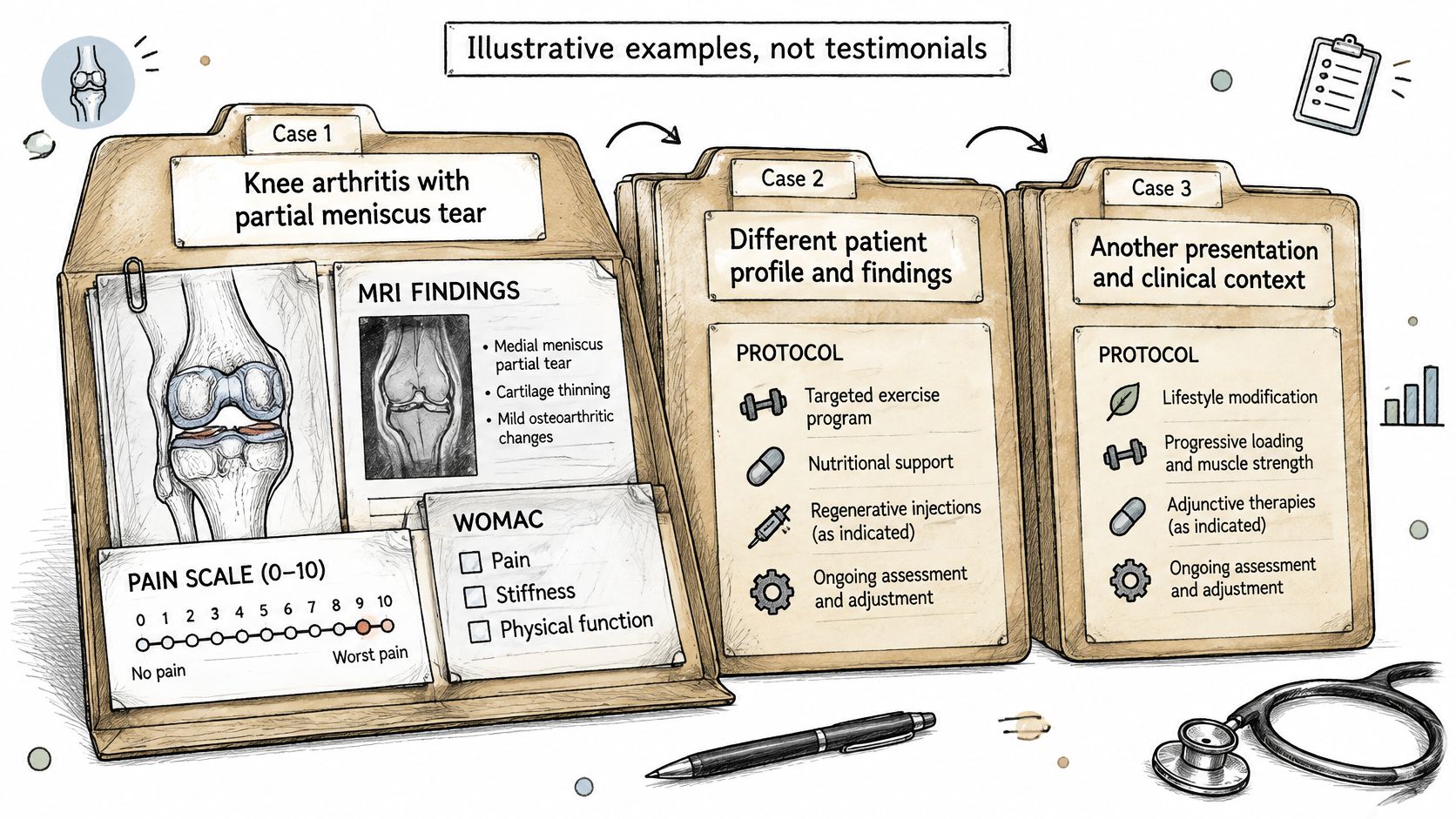
Knee arthritis with a partial meniscus tear
The clinician reads the MRI for compartment involvement and tear location, records VAS pain and WOMAC at baseline, and asks about every previous injection into that knee. The target is a defined joint structure, so image-guided local delivery makes sense, and the approach described on our knee treatment page is the starting reference. What would change the plan: a prior meniscectomy at the same site, high systemic inflammation on blood work, or imaging that doesn't match the reported pain.
Herniated lower-back disc with sciatica
Here the disc level has to be confirmed on MRI and correlated with the nerve symptoms, because leg pain and back pain can come from different structures. Baseline measures shift toward neurological findings and a functional scale rather than a joint score, and the relevant protocol description sits on our lower back treatment page. What would change the plan: progressive weakness or unclear imaging, which need a spine surgeon's opinion first, or kidney disease that limits medication options around the procedure.
Neck pain with arm numbness
Numbness means the neurological exam carries the most weight: which dermatome, which reflex, which muscle group. Imaging confirms the level, and the protocol on our neck pain treatment page is the reference point for that region. What would change the plan: signs of cord compression, prior fusion at the same level, or an inflammatory profile that suggests the symptoms aren't purely mechanical.
Three targets, three delivery decisions, three sets of baseline measures. Results vary in all of them, and no outcome is guaranteed.
Book a Personalized Case Review Before You Decide
A case review works like a good first consultation with any specialist: the quality of the answer depends entirely on the quality of what you bring. Arrive with scattered memories of your symptoms and you will get a generic opinion. Arrive with organized records and the physician can do the matching work, comparing your imaging, blood work and measured baseline against the protocol options for your target.
Gather these before the review:
- Recent imaging: MRI or X-ray reports for the symptomatic region, with the images themselves if you have them.
- A complete medication list: including supplements, blood thinners and anything you take intermittently.
- Prior treatment records: injections, physical therapy notes and any surgery at the same site, with dates.
- Recent blood work: inflammatory markers and organ function, ideally within a few months.
- A short written pain and function history: what hurts, when it started, what changed, and your dated baseline scores.
Then ask for the plan in writing: baseline measures, target and route, dose, and follow-up at about 3, 6 and 12 months. Ask how the dose gets verified. At our clinic, cultured cells are counted with a special meter before dosing so the delivered amount is exact, and treatments are delivered under COFEPRIS oversight in Bucerias. Our medical professionals are licensed with advanced stem cell training, our physicians are board-certified with regenerative medicine specialization, and Dr. Arick Francisco Barba Lopez holds a graduate certificate in regenerative medicine.
Take that written plan to your own doctor before you commit. If physical therapy or surgery has stronger evidence for your specific diagnosis, you want to hear that from someone who isn't selling the alternative. One sentence here matters more than any other. Make the decision only when the imaging, the baseline and the follow-up schedule are all in your hands. Results vary, and no outcome is guaranteed.
We build each MSC plan around your imaging, blood work and measured baseline, then deliver it under COFEPRIS oversight in Bucerias with scheduled remote check-ins at about 3, 6 and 12 months. Send us your recent MRI report, medication list and lab results for a case review, and we'll tell you whether the target and route fit your situation. Start by reading the treatment pages at Dream Body Clinic and request your personalized case review before you book anything.