If the cells in a facial stem cell treatment never turn into skin cells, what is doing the work?
Stem cells are often pictured as replacement parts, small biological bricks placed into a face to rebuild it from the inside. That picture is wrong, and holding onto it makes every later decision harder, from comparing clinics to judging whether a result was worth the money. Mesenchymal stem cells (MSCs) work by sending signals, not by becoming tissue.
The distinction matters because it changes what you should expect, how fast you should expect it, and which questions are worth asking before you pay a deposit.
Table of Contents
- What Stem Cell Facial Rejuvenation Treats and Who May Qualify
- How Stem Cells Guide Skin Repair Without Becoming Skin Cells
- The Facial Treatment Session Step by Step
- What the Studies Report and Where the Evidence Stops
- Questions to Ask About the Product Before Treatment
- How Long Results Last and What Maintenance Involves
- Side Effects, Complications and Safety Follow-Up
- Deciding Whether to Book a Consultation
What Stem Cell Facial Rejuvenation Treats and Who May Qualify
Say a woman in her early fifties sits down for a consultation. She points to the fine lines around her mouth, the dullness across her cheeks, and the flattening that has crept in under her eyes over three years. Her question is practical. What would this treatment do to her face?
A facial stem cell treatment is a regenerative procedure that uses mesenchymal stem cells, often harvested from a patient's own fat tissue, combined with platelet-rich plasma (PRP) and placed into the skin. The aim is better skin quality and fuller facial contours without surgery. Dream Body Clinic's facial stem cell treatment regenerates the fat under the skin, which restores the shape of the face, and the clinic's stem cell procedures are non-surgical and minimally invasive.
Each concern below has a different biological target, and each attracts a different kind of patient.
| Concern | Biological signal the treatment aims to influence | Who may consider it |
|---|---|---|
| Fine lines and wrinkles | Fibroblast activity and collagen production | Adults with early texture or line changes |
| Uneven pigmentation and dullness | Inflammatory signaling and skin tone balance | Adults with dull or uneven-looking skin |
| Dehydration and rough texture | Hydration and barrier-related signals | Adults with dry or rough skin |
| Volume loss | Regeneration of the fat layer under the skin | Adults with facial hollowing or flattening |
The table describes targets, not guaranteed results. A treatment aimed at collagen production won't fill a hollowed cheek, and a treatment aimed at volume won't fade a pigment patch. Candidacy usually comes down to adults who have one or more of these concerns, understand that improvement arrives gradually, and accept a clinical assessment to confirm suitability.
Practical rule: if you can't name which of the four concerns you want addressed, you're not ready to book. A clinician can only target what you can describe.
Between treatments, at-home care does real work on barrier health. A gentle retinoid alternative such as Wallaby Wellness bakuchiol moisturiser supports skin without the peeling that stronger actives can trigger in the weeks after a procedure.
One regulatory point deserves precision. Stem cell treatments are not FDA-approved in the United States. Dream Body Clinic's treatments are approved by COFEPRIS, Mexico's federal health regulator and the FDA equivalent in Mexico.
How Stem Cells Guide Skin Repair Without Becoming Skin Cells
The most common misunderstanding about this treatment takes one sentence to fix. The injected cells do not permanently differentiate into new facial skin cells. They behave like a site foreman who walks onto a job and directs the crew already standing there, rather than a bricklayer who lays every brick himself.
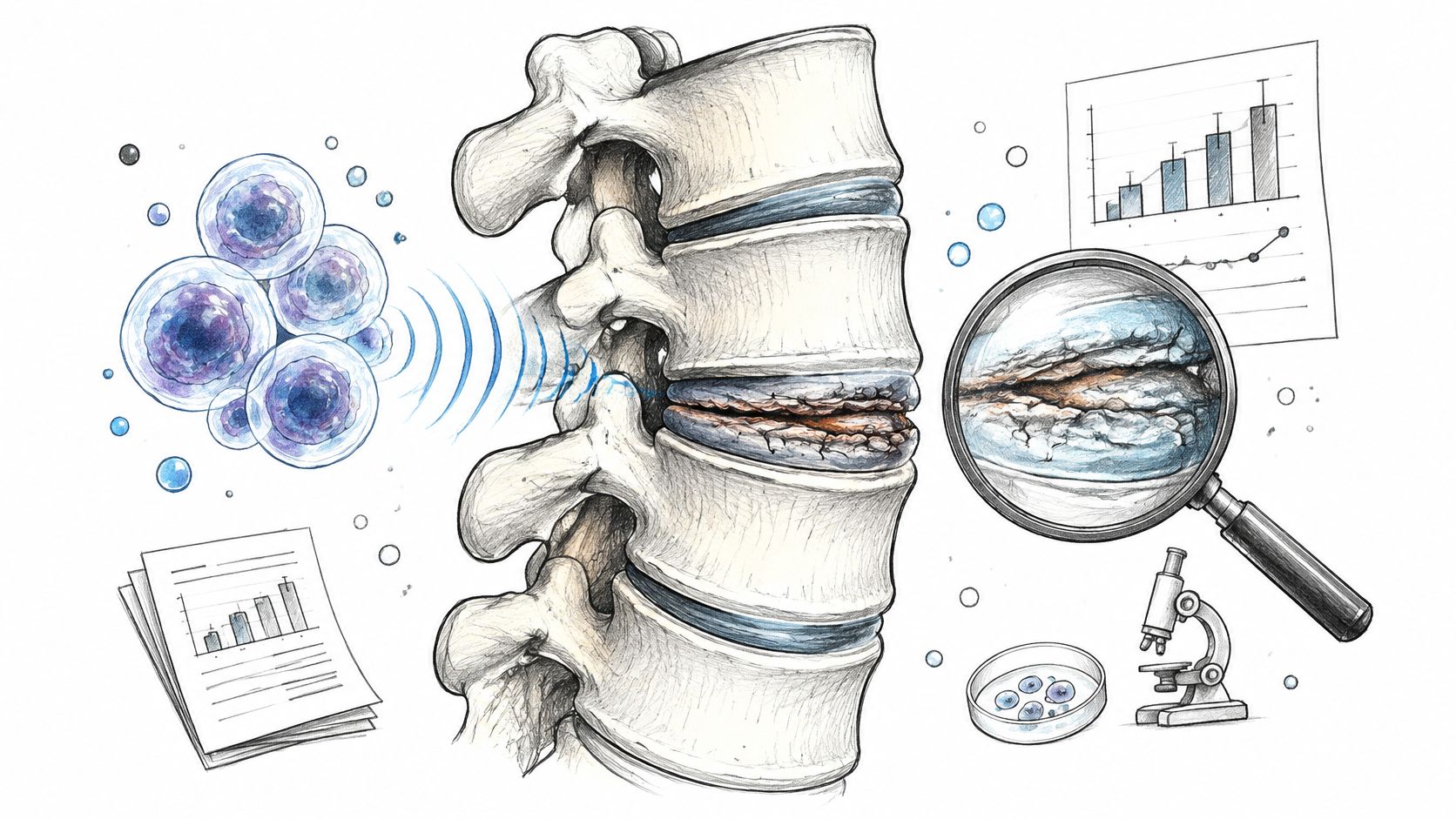
That foreman model is the paracrine effect, and it's how the treatment produces change. The cells release a package of specialized messages into the surrounding tissue, and those messages tell local cells what to do.

A 2024 review in Stem Cell Research & Therapy identifies paracrine signaling as a principal MSC mechanism in cutaneous aesthetics, and names VEGF, bFGF, PDGF and exosomes among the mediators the cells secrete.
What each signal does for the face
- Growth factors such as VEGF, bFGF and PDGF prompt local fibroblasts to increase their activity and step up collagen production, which is what supports firmness and line smoothing over time.
- Cytokines shape the local inflammatory environment, dialing down the signaling that leaves skin looking red, irritated or dull.
- Extracellular vesicles and exosomes carry cargo between cells, amplifying the repair instruction rather than replacing any tissue.
Your own fibroblasts, the cells that build collagen and elastin, do the actual construction work. They already live in your dermis and respond to more forceful instructions than aging skin has been sending them.
That's not theory alone. A prospective, randomized, double-blind, split-face trial of a topical human MSC growth-factor preparation reported mean improvements of 34% in wrinkles, 40% in skin texture and 29% in skin firmness over three months, with a second comparison showing 38% for wrinkles, 49% for texture and 41% for firmness. The differences versus the comparator did not reach statistical significance, but the visible numerical change fits the paracrine model exactly.
For background on how growth factors behave in skin, Mesoderm RX on growth factors is useful reading before a consultation.
Why does the signal matter for product choice? Because benefit depends on which signals are present and how they reach the skin. Cell type, preparation method and delivery route all change what arrives, which is why the explanation of what stem cell therapy is and how it works is worth reading before comparing offers.
Signals are released over a limited period and act on tissue over months, not minutes. Facial improvement is a biological process unfolding gradually, not an instant change.
The Facial Treatment Session Step by Step
The session itself is shorter and less dramatic than many expect. Here is the sequence, with the reason behind each step so you can picture where you are in it.
The process below follows a full appointment from assessment to follow-up.
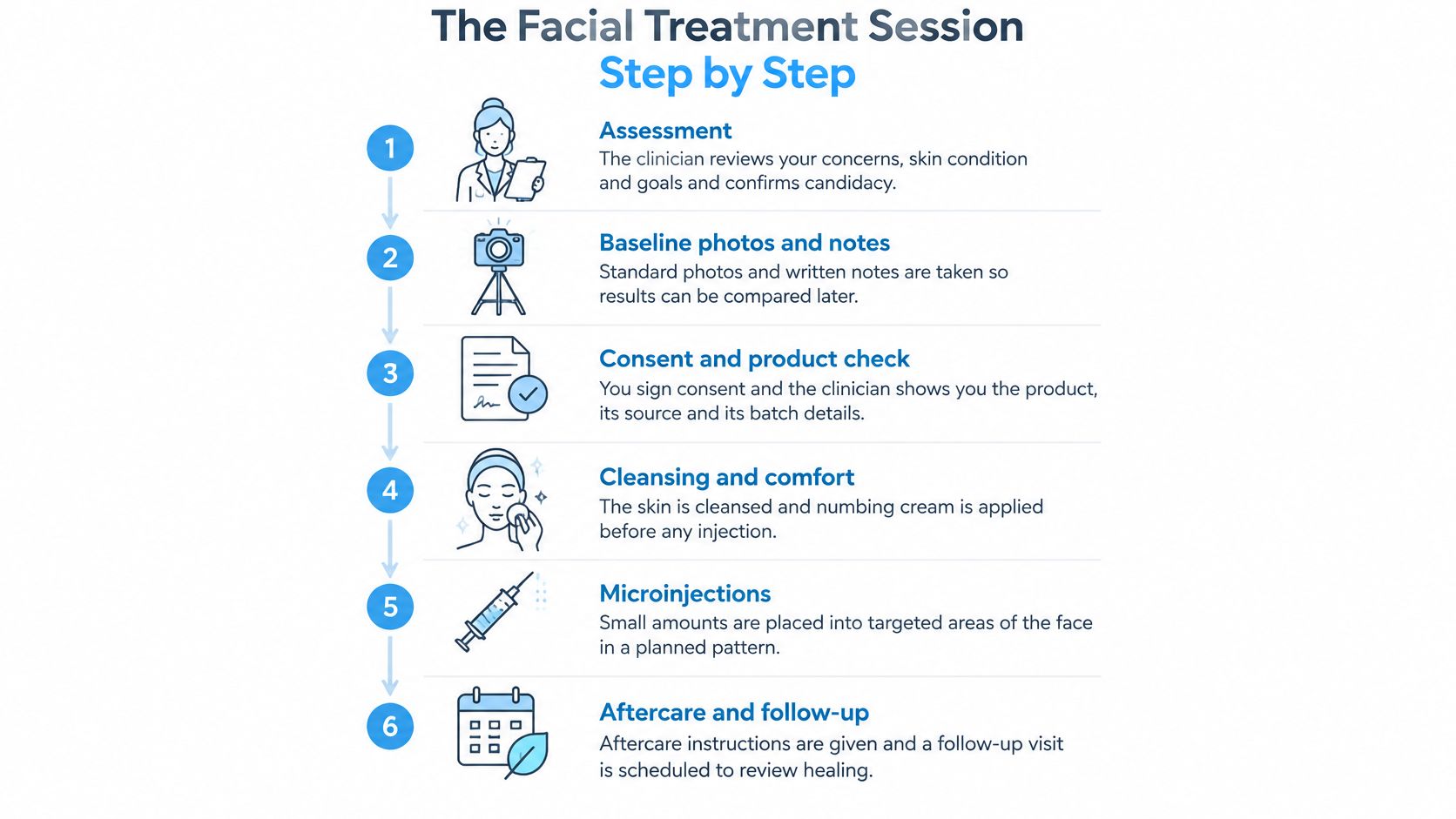
Assessment and product check. The clinician reviews your concerns, skin condition and goals, confirms candidacy, and shows you the product with its source and batch details. This is the moment to raise any previous filler, thread lift or laser work, because each one changes how your skin will respond.
Baseline photos and written notes. Standard photographs are taken before anything is injected. Without a baseline, a six-month comparison becomes a memory exercise.
Cleansing and comfort. The skin is cleansed and numbing cream applied. Comfort matters here because the next step involves many small needle entries.
Direct microinjections with an insulin needle. Small amounts are placed across the face in a planned pattern using a fine insulin needle. Injecting directly puts the mixture where it's needed instead of relying on it to spread from one spot.
Stem cells and PRP applied, then micro-needled in. The stem cells and PRP are squirted onto the face and worked into the skin with a special electric micro needle. PRP adds growth factors and cytokines to the local environment, and the micro-needling drives the mixture into the skin layers.
Aftercare and follow-up. You leave with written aftercare instructions and a scheduled follow-up. Follow the aftercare list exactly, because the days after treatment are when the healing response sets up the months that follow.
The clinic says the cells stay in the face for eight months to a year, and facial rejuvenation is best treated as an annual event rather than a one-off purchase.
Patients can have Botox and the stem cell facial both, and the two don't conflict. If you already keep a Botox schedule, the practical question is sequencing around your visit date, not whether combining is allowed.
A clinician here walks through the treatment in their own words.
Recovery is short. Many patients return to normal activity quickly with minimal downtime, and the visible needle marks settle before the deeper remodeling has even started.
What the Studies Report and Where the Evidence Stops
The figures below come from published human studies, and the 2026 systematic review of stem-cell skin rejuvenation that searched five biomedical databases through February 2026 is the source for every number in this table.
| Outcome | Reported range | Study group |
|---|---|---|
| Skin elasticity | 26% to 34% improvement | Human-derived cell studies |
| Collagen synthesis | 35% to 45% improvement | Human-derived cell studies |
| Inflammatory cytokines | 38.9% to 50.5% reduction | Umbilical-cord MSC interventions |
| Wrinkle reduction | 16.8% to 25.4% | Four human exosome studies (148 participants) |
| Sustained improvement at 3 years | 78.8% of patients | One prospective cohort |
| Sustained improvement at 5 years | 52.9% of patients | One prospective cohort |
Read each row with its own design in mind. The review identified only 9 eligible primary studies of stem-cell-based skin rejuvenation in people, and 6 of those used human-derived cells or derivatives, made up of 5 randomized controlled trials and 1 prospective cohort study covering 703 participants. The elasticity and collagen ranges come from those individual human-derived studies. The cytokine reductions come specifically from umbilical-cord-derived MSC interventions. The wrinkle range comes from four exosome studies, not from cell injections.
Why a conditioned medium study isn't the same as an injection study
A separate 2022 systematic review and meta-analysis examined five randomized trials of topical conditioned media, a product containing signaling molecules released by cultured cells rather than living cells. Across four trials with usable data, the treatment significantly reduced wrinkle severity (P = 0.0006), pigmentation (P = 0.004) and pore appearance (P = 0.01), and improved overall skin condition (P < 0.0001).
Those are strong results inside a controlled setting. They don't automatically transfer to every MSC injection, exosome product or facial protocol, because the thing tested was signaling molecules applied to the surface, not transplanted cells.
What the long-term figures really show
The longest durability data in the review came from a single prospective cohort, where 78.8% of patients reported sustained improvement at 3 years and 52.9% at 5 years. The review cautioned that these findings still require confirmation. One cohort is a lead worth following, not a rule you can apply to your own face.
For home maintenance between appointments, building a consistent LED routine is a low-risk way to support collagen without adding another clinical procedure.
What the numbers can tell you: rough expectations across a year, and evidence that controlled research keeps finding positive signals in several measures. What they can't tell you: how your skin will respond, because the populations were small, the products varied from study to study, and follow-up rarely stretched far enough to describe long-term outcomes.
The honest summary is a promising area of controlled research with real positive signals, not a settled equivalent of conventional cosmetic procedures.
Questions to Ask About the Product Before Treatment
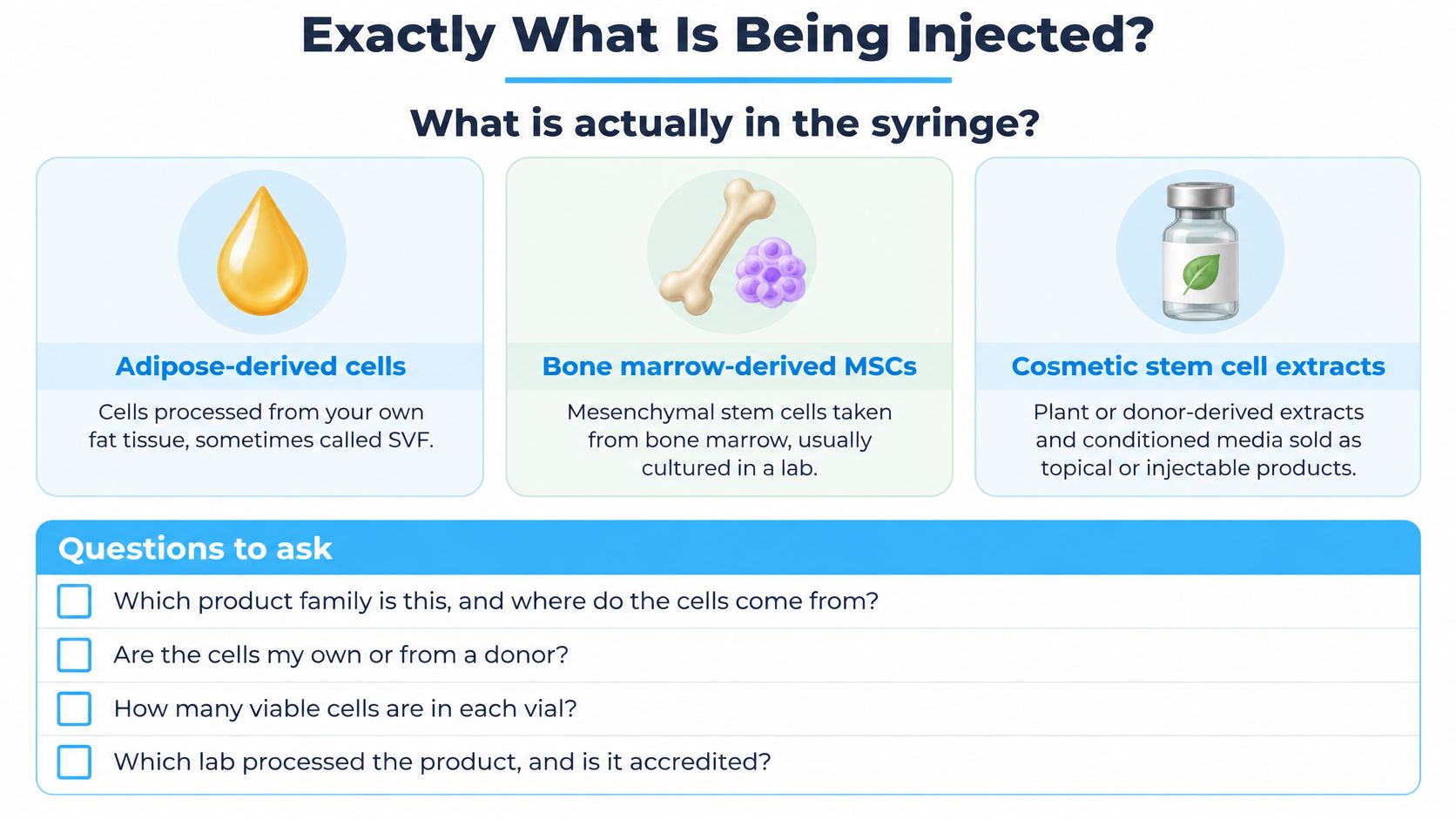
Two clinics can both say stem cell facial rejuvenation and mean entirely different things. One is injecting living cells harvested from fat tissue. The other is applying a vial of growth factors to the surface and microneedling it in. Same marketing phrase, different product, different evidence base. So the question that decides what you receive is the one most patients skip: what is in the syringe?
Human studies cover at least three separate product families under that single label.
| Product family | What it contains | Living cells present | Delivery reported |
|---|---|---|---|
| Adipose-derived cells or stromal vascular fraction | A mixed cell population harvested from fat tissue | Yes | Injection |
| Mesenchymal stem cell conditioned media | Growth factors, cytokines and extracellular vesicles released by cultured MSCs | No | Topical application, microneedling, injection |
| Extracellular vesicles or exosomes | Purified cell-derived vesicles carrying signaling cargo | No | Microneedling, laser-assisted delivery, topical application |
A 2025 review of these products described early evidence as promising while emphasizing major shortcomings in manufacturing and application standardization. Direct clinical evidence for any single product family remains thin, which is exactly why the label on the vial matters more than the name on the website.
The eight questions to bring to a consultation
- Product identity. Which of the three families is this, named exactly on the vial or label?
- Origin. Are the cells yours (autologous) or donor-derived?
- Viable cells. Are living cells present, or only signaling molecules?
- Independent testing. Can you see sterility and potency documentation from a third-party lab?
- Regulatory status. Which specific authorization does this facility hold, and can you show the document?
- Delivery route. Injection, surface application, microneedling or laser-assisted delivery?
- Cell count and concentration. How many cells per vial, and how many will reach my face?
- Adjuncts. Is PRP, microneedling or laser being used alongside, and how will we know which one produced the result?
That last question catches more than patients expect. If a protocol combines cells, PRP and microneedling in one session, an honest provider will admit the result cannot be cleanly assigned to any one ingredient. A vague answer here tells you the protocol was assembled, not designed.
Write each answer down. Then compare answers across clinics rather than prices. You will quickly see who is describing a specific, characterized product and who is repeating a category name with confidence. The assumption worth challenging is that a biological label signals a stronger treatment. A defined product with third-party testing and a stated cell count is a stronger position than a premium label with neither.
For international patients comparing clinics across jurisdictions, the legal side deserves the same scrutiny as the biology. Whether stem cell treatment is legal where you're considering it depends on the regulator, the license and the paperwork, not on the clinic's own summary.
How Long Results Last and What Maintenance Involves
Durability is the weakest part of the evidence base, and it's the part promotional pages skip. A systematic review of regenerative facial injectables covered 30 studies and 879 participants, but only 8 were randomized trials and follow-up rarely exceeded six months.
That ceiling explains why nobody can hand you a reliable five-year forecast. The only longer-term durability signal comes from a single prospective cohort following patients to 3 and 5 years, and that finding still needs confirmation.
One session isn't a permanent reversal of aging. Change builds as collagen production and remodeling proceed, so the 3, 6 and 12 month check-ins are where improvement gets assessed, not the week after treatment.
The clinic describes facial rejuvenation as an annual event, with maintenance treatments every 12 to 24 months to extend and enhance outcomes. Botox can sit alongside that schedule where you want it.
Before booking, ask which follow-up visits are included and what counts as a reason for retreatment.
Side Effects, Complications and Safety Follow-Up
Is it safe? The short-term picture looks reassuring. The review of regenerative facial injectables reported no major short-term safety signal, and concluded that these treatments should remain adjunctive until larger randomized trials with validated outcomes and longer monitoring establish efficacy and safety.
That conclusion deserves a plain translation. Early tolerability does not establish long-term safety, and a temporary change in hydration, texture, pigmentation or wrinkles doesn't prove durable remodeling underneath.
Here are the complications worth naming in advance, each with the question that should accompany it.
- Nodules. Who examines them, with what imaging, and what's the removal protocol if they don't resolve?
- Inflammation. What's the first-line treatment, and how quickly should it be started?
- Infection. Which clinic or hospital manages it if you've already flown home?
- Pigment alteration. Who assesses it, and at what point does it count as a complication rather than a variation?
- Asymmetry. What's the correction policy, and is it included in the price?
- Unexpected immune reaction. Which specialist is on call, and is there a written escalation number?
Outcome measures aren't interchangeable either. Clinician-rated scores, standardized photography, instrument measurements of hydration and elasticity, and your own satisfaction each answer a different question. Ask which ones the clinic uses, because "improved" means something different in each.
Reassuring early results and lasting benefit are separate claims. Ask for evidence of both, and accept that only one of them currently has much data behind it.
The clinic runs scheduled remote check-ins to review healing. Request the written schedule, the escalation contact, and the retreatment criteria before you pay anything.
Deciding Whether to Book a Consultation
Suitability has two more conditions worth confirming rather than guessing. There should be no active infection in the treatment area, and you need genuine commitment to the follow-up schedule across the first year, because the treatment's results are assessed over months.
Here's the sequence that turns interest into a decision.
- Gather your records. Collect previous facial treatments, including fillers, threads, laser and any skin conditions under treatment, so the clinician sees the full picture.
- Rank your top two goals. Put them in order, so the clinician can say plainly whether this treatment targets them or whether something else would serve you better.
- Bring the eight-point checklist. Ask for written answers rather than verbal reassurance, and keep the page.
- Request the current COFEPRIS authorization documentation. Read the distinction precisely. Mexico's Federal Commission for the Protection against Sanitary Risks (COFEPRIS) is the country's federal health-regulatory authority and is commonly described as the Mexican counterpart to the U.S. Food and Drug Administration, and facilities providing stem-cell therapy in Mexico should hold multiple forms of authorization, including a regenerative-medicine license. Availability in Mexico is not U.S. FDA approval, and Dream Body Clinic's treatments are approved by COFEPRIS.
- Ask about combining with Botox. Confirm whether it suits your goals and how the timing around your visit would work.
- Take the plan to your own doctor. This matters most with an autoimmune condition or an existing skin disorder, where a second opinion protects you.
Our facial treatment uses 20 million MSCs mixed with PRP, and the PRP itself is loaded with six different cytokines and six different growth factors. Dream Body Clinic is based in Bucerias, Nayarit, Mexico, and coordinates international patients in English. You can review the esthetic and anti-aging stem cell therapy cost and details before the call.
The consultation is where candidacy, product details, the follow-up schedule and the escalation contact all get confirmed in writing. Everything before it is preparation for that conversation.
Dream Body Clinic offers facial stem cell treatment built on mesenchymal stem cells and PRP, aimed at the concerns this article walked through one by one, from fine lines and dullness to facial volume and skin quality. If you want to know whether your goals fit the treatment, the team reviews cases in English and answers the product questions directly. Visit Dream Body Clinic to start that conversation.