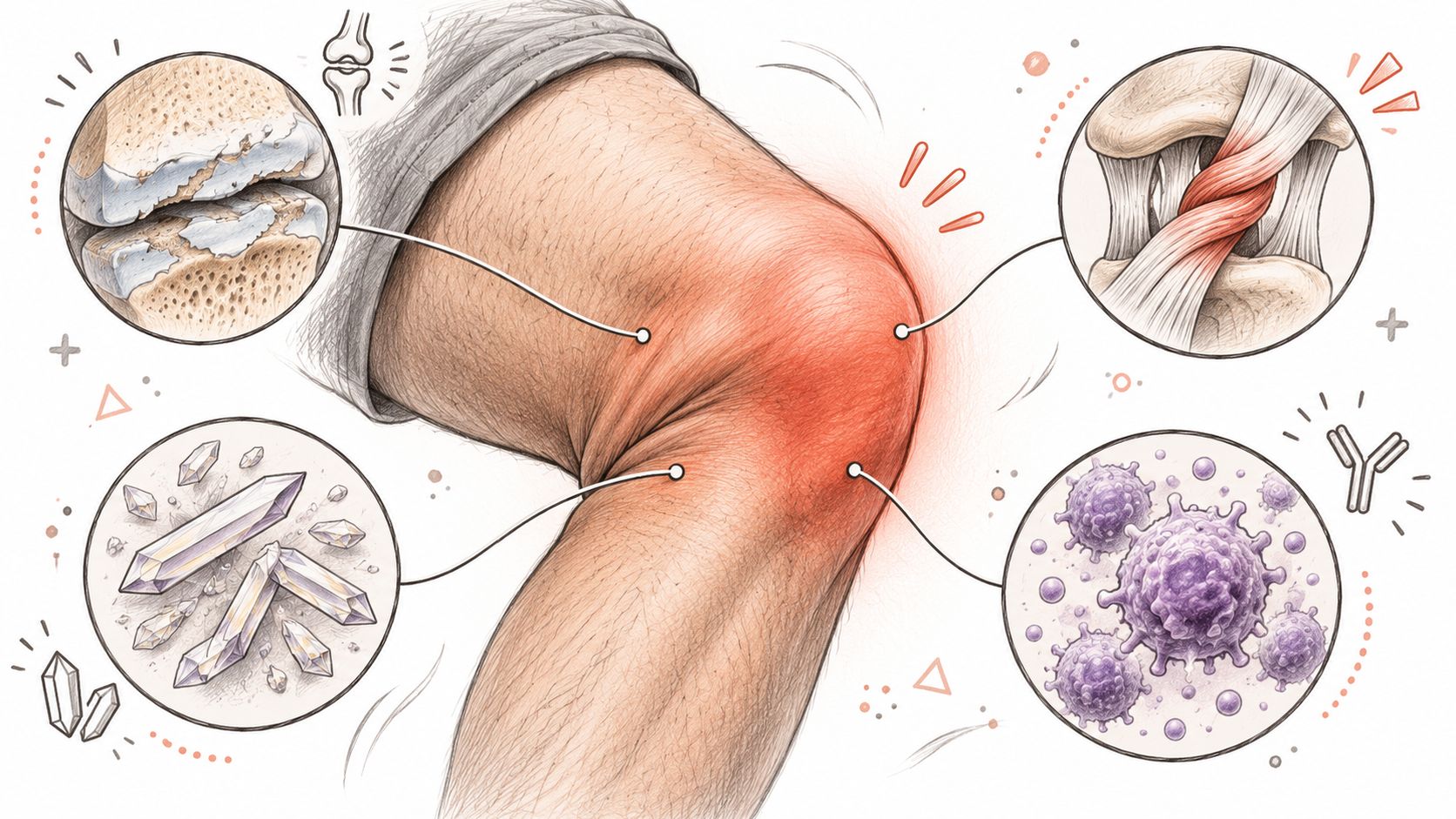
If two treatments both use stem cells, does evidence for one tell you whether the other works? With MS and stem cells, that assumption can lead patients toward the wrong conclusion, because an intensive immune-system transplant and an infusion of mesenchymal cells are different treatments.
There are meaningful transplant results, encouraging early findings for some mesenchymal cell approaches, and controlled trials that haven't shown benefit. Understanding which finding belongs to which treatment is the starting point for a useful conversation with your neurologist.
Table of Contents
- Which Stem Cell Treatment for MS Is Being Discussed
- Why Stem Cells Work as Signals Rather Than Replacement Parts
- What the Transplant Trials Show for Highly Active MS
- Early MSC Trials Show Encouraging Signals and Null Results
- Established MS Therapies to Compare Against
- Risks, Monitoring and a Pre-Treatment Checklist
- How Dream Body Clinic's MS Protocols Are Structured
- Decide With Your Neurologist and the Clinic
Which Stem Cell Treatment for MS Is Being Discussed
Autologous hematopoietic stem-cell transplantation (AHSCT) and mesenchymal stem-cell therapy (MSC therapy) aren't interchangeable. They use different cells, have different purposes, and require different judgments about benefits and risks.
The scale of the need is substantial. The 2020 Atlas of MS analysis estimated that 2.8 million people worldwide were living with MS, corresponding to 35.9 cases per 100,000 people, with women about twice as likely as men to have the disease. That population includes people with very different disease patterns, so no single treatment claim applies to everyone.
AHSCT and MSC therapy compared
| Feature | Autologous HSCT (AHSCT) | MSC therapy |
|---|---|---|
| Cell source | The patient's own blood-forming stem cells, collected before treatment | Donor-derived mesenchymal cells, including umbilical cord and placenta tissue; some trials used the patient's own bone marrow |
| Main purpose | Suppress or ablate the immune system, then support its rebuilding with the patient's own cells | Immune-modulating and signal-based support |
| Setting | Hospital-based transplant program with intensive immune suppression | Infusion or injection protocols, including IV and intrathecal delivery, in clinical or research settings |
| Best-supported patient profile | Younger, walking patients with highly active relapsing MS | No established profile that reliably predicts benefit |
| Evidence strength | Randomized trial and cohort evidence showing reduced progression and relapse in selected patients | Mixed findings; controlled evidence hasn't established consistent disability benefit |
| Key risk profile | Serious early and late complications, with prolonged infection monitoring | Mostly mild, temporary effects reported in reviews, but long-term safety remains unresolved |
Cleveland Clinic's stem-cell therapy guidance identifies favorable AHSCT features that include age around 55 or younger, disease duration around 10 years or less, preserved walking ability, and recent relapse or MRI activity. These aren't a self-assessment test or a guarantee of eligibility. A transplant team must consider prior treatment, general health, and whether inflammatory activity is still driving the disease.
What the distinction means for you
Say someone has worsening walking despite little recent inflammatory activity. Their situation isn't equivalent to that of someone experiencing repeated relapses and new MRI lesions despite high-efficacy treatment. The reason for worsening matters, not just the diagnosis of MS.
Before accepting any stem-cell claim, establish:
- Which cell product? Blood-forming stem cells and MSCs aren't substitutes.
- Which MS type and stage? Active relapsing disease and progressive disability require different reasoning.
- Compared with which approved therapy? Improvement alone doesn't establish that a treatment is the best available option.
Why Stem Cells Work as Signals Rather Than Replacement Parts
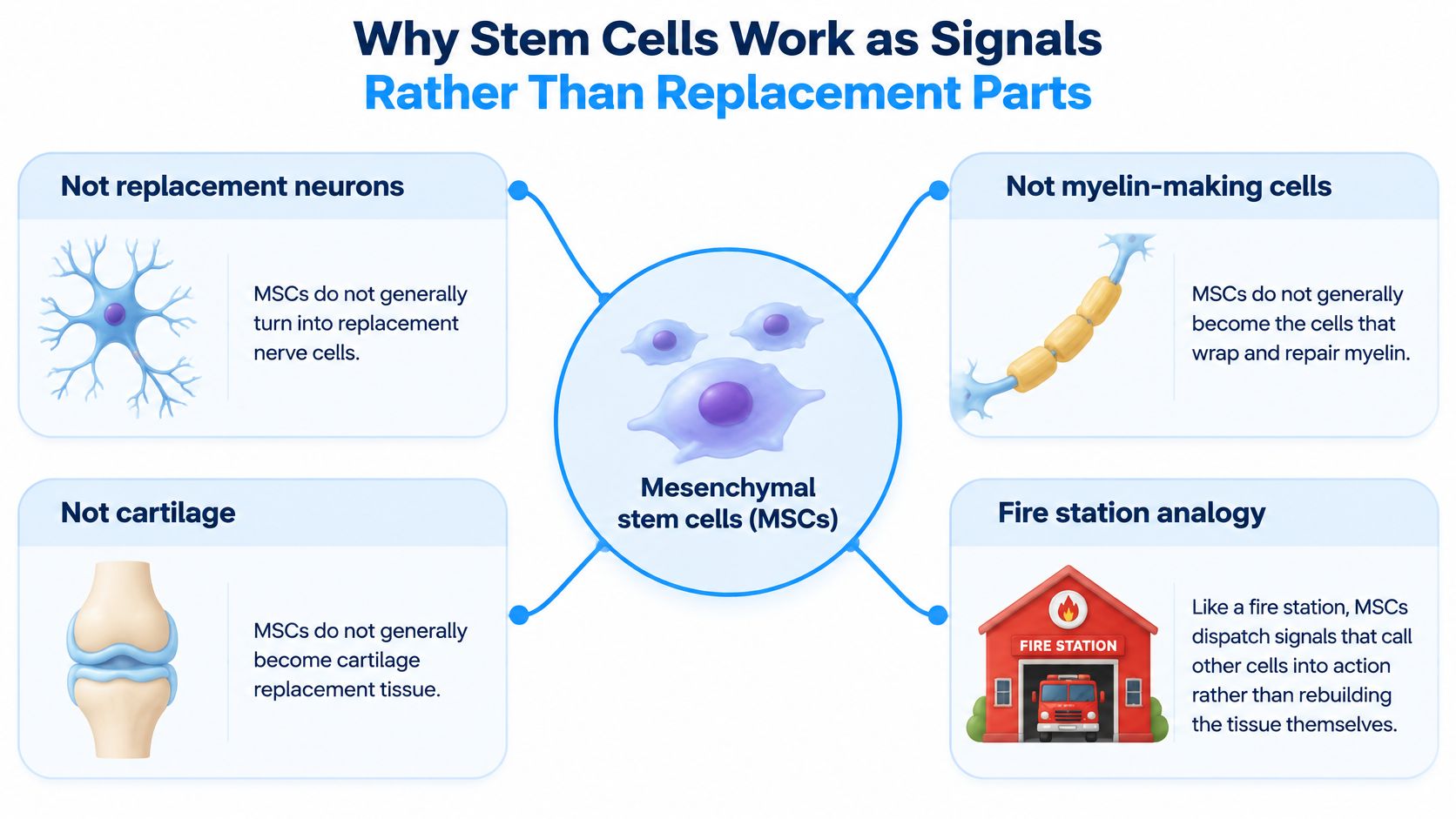
For MSCs, the useful analogy is a fire station that dispatches instructions, not a construction crew that rebuilds a house. Their proposed contribution comes mainly from the messages they release, rather than from becoming replacement nerve tissue.
This is called the paracrine effect. MSCs release signaling molecules, growth factors, and extracellular vesicles, small packages carrying biological messages, that can influence surrounding immune cells and tissue-support cells.
What the cells may communicate
A randomized phase II MS study described no observed neural-lineage differentiation after transplantation in vivo and discussed suppression of microglial activation through paracrine signaling. Microglia are immune cells within the central nervous system. Influencing their behavior doesn't require transplanted MSCs to become neurons.
An earlier mechanistic and clinical investigation describes pathways relevant to this proposed activity: CXCL12/CXCR4 signaling may help cells move toward inflammation; regulatory T cells may help restrain immune responses; and suppression of Th17 responses may reduce harmful immune activity. Neurotrophic factors such as BDNF, GDNF, NGF, and HGF may also support nerve survival and the environment needed for repair.
These are proposed biological actions, not proof that an infusion restores damaged myelin or reverses disability. A plausible mechanism tells researchers what to test. It doesn't tell an individual patient what outcome to expect.
Why mechanism isn't an outcome
MSCs don't generally become replacement neurons, myelin-making cells, or cartilage tissue in these treatment approaches. That statement concerns MSC therapy, not the different role blood-forming cells play in AHSCT.
Transplanted MSC persistence can be limited, making their released signals particularly relevant. Whether those signals produce a lasting, measurable clinical benefit must still be established for each product and protocol.
Our explanation of how stem-cell injections work provides additional background on this signaling-based approach. Keep the distinction between a proposed mechanism and demonstrated clinical improvement clear.
MSCs send instructions; they do not become the tissue.
What the Transplant Trials Show for Highly Active MS
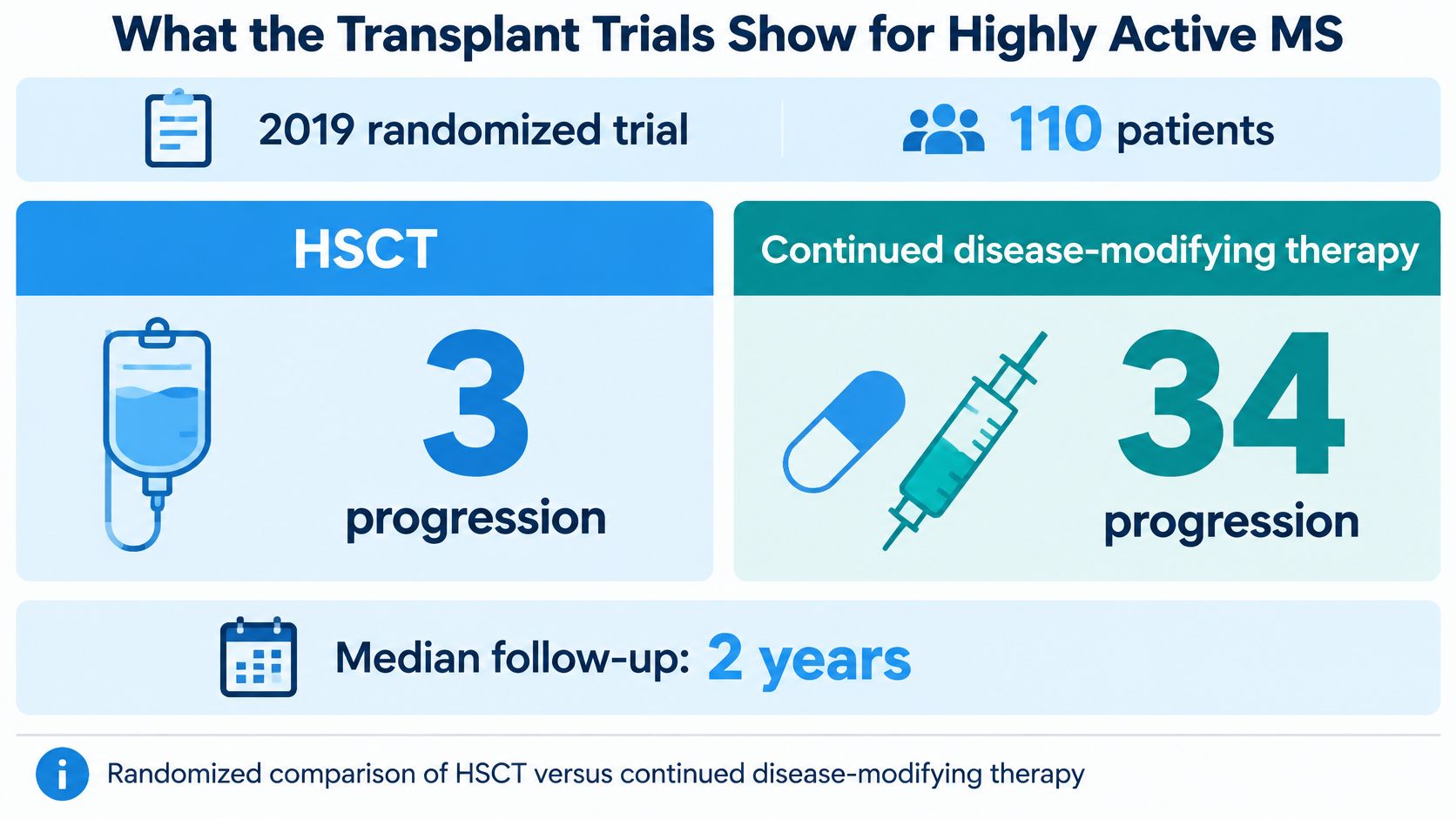
The strongest transplant findings concern selected people with highly active relapsing-remitting MS, not everyone with MS. In the 2019 randomized clinical trial published in JAMA, 110 patients were assigned to nonmyeloablative HSCT or continued disease-modifying therapy; progression occurred in 3 transplant patients versus 34 comparator patients over a median follow-up of 2 years.
The reported hazard ratio for progression was 0.07, with a 95% confidence interval of 0.02 to 0.24. During the first year, mean Expanded Disability Status Scale scores improved from 3.38 to 2.36 after HSCT, while comparator scores worsened from 3.31 to 3.98.
Reported AHSCT outcomes in MS
| Study | Population | Key result | Caveat |
|---|---|---|---|
| Randomized transplant trial | Highly active relapsing-remitting MS | Substantially fewer progression events with HSCT than continued treatment | Selected population and limited median follow-up |
| Single-center cohort, 2025 | Relapsing MS | Three-year annualized relapse rate of 0.028 after AHSCT versus 0.073 after ocrelizumab | Observational design cannot eliminate treatment-selection differences |
| Long-term cohort | People with relapsing-remitting and progressive MS | Better progression-free outcomes in relapsing-remitting disease | Serious transplant risks must be weighed alongside disease control |
| MS Association of America report, 2025 | Participants followed after AHSCT | 89% relapse-free at four years, compared with 94% at two years | Summary without a disclosed sample size; not a like-for-like comparison |
A hazard ratio describes a comparison of event rates over follow-up. It isn't the percentage of patients cured or a personal probability of success. For a worked explanation of the terminology, PlotStudio AI's hazard ratio examples can help separate relative comparisons from individual outcomes.
What these findings don't establish
Randomization strengthens a comparison because investigators assign treatment rather than observe who received it. A single-center cohort can add useful information, but differences in age, disease activity, previous therapies, and treatment selection can affect its results.
The larger BEAT-MS study was designed to compare AHSCT with best available high-efficacy therapy, addressing an important practical question: how transplantation compares with strong contemporary alternatives. Its design isn't itself evidence of a completed outcome.
The MSAA summary also shouldn't be read as a precise trend without the underlying denominators and follow-up details. Transplant outcomes cannot validate an IV or intrathecal MSC protocol. AHSCT includes intensive immune suppression followed by reinfusion of blood-forming cells, a treatment sequence that MSC administration doesn't reproduce.
Early MSC Trials Show Encouraging Signals and Null Results
An encouraging symptom report and a negative MRI trial can both be genuine findings. They answer different questions, and neither should be hidden to make MSC therapy look uniformly successful or uniformly ineffective.
In the MESEMS phase 2 trial, 144 people with active MS received intravenous autologous bone-marrow MSCs or placebo in a randomized, double-blind crossover design. MSCs did not significantly reduce gadolinium-enhancing brain lesions during the 24-week assessment period: the rate ratio was 0.94, the 95% confidence interval was 0.58 to 1.50, and p=0.78.
Adverse events were similarly distributed between groups. That supports a limited conclusion about short-term tolerability, not a conclusion that the treatment controlled inflammatory MRI activity.
MSC studies in multiple sclerosis
| Study | Design | Participants | Result |
|---|---|---|---|
| MESEMS phase 2 | Randomized, double-blind, placebo-controlled crossover | Active MS population described above | No significant reduction in enhancing MRI lesions |
| Umbilical-cord-tissue feasibility study | Clinical feasibility study | People with MS; sample size not specified in the available summary | Mean EDSS reductions of 0.48 points at one month and 0.68 points at one year |
| Placenta-derived MSC phase I study | Early-phase study in secondary progressive MS | Secondary progressive MS; sample size not specified in the available summary | Significant EDSS reduction and sustained improvement over six months, P < 0.0001 |
| Umbilical-cord MSC study, 2024 | Clinical study | Responding treatment subgroup; total sample size not specified in the available summary | Average 2-point EDSS improvement at 12 months in that responding group |
| Pooled analysis | Randomized-trial synthesis | Multiple MSC protocols | No statistically significant pooled improvement in disability or T2-lesion burden, or difference in treatment-emergent adverse events |
How to read improvement fairly
The favorable findings deserve further investigation. They don't establish that every patient will improve, that the average effect applies outside the studied population, or that a private clinic's product reproduces the studied intervention.
The responding-subgroup result needs particular care. An average calculated among responders doesn't describe the expected outcome for everyone who starts treatment. Likewise, a statistically significant change from baseline doesn't necessarily show superiority to a suitable control.
Evidence rule: Ask whether the result describes everyone assigned to treatment, only those who completed follow-up, or only those who responded.
The pooled finding is another reason not to select only favorable reports. Different cell sources, preparation methods, doses, delivery routes, and MS populations make it difficult to treat MSC therapy as one standardized intervention.
Our overview of stem-cell therapy for autoimmune conditions explains the proposed immune-modulating rationale. For an MS decision, however, no MSC protocol has established proven disability benefit across MS patients. Stronger trials need standardized cell characterization, dose, route, MRI endpoints, disability measures, and long-term follow-up.
Established MS Therapies to Compare Against
Approved disease-modifying therapies (DMTs) are the benchmark for a treatment decision, not an optional detail in a stem-cell consultation. They aim to reduce future disease activity, while rehabilitation and symptom treatment address how a person functions day to day.
For relapsing MS, neurologists choose among approved therapies with different mechanisms, effectiveness profiles, monitoring requirements, and risks. Some treatments also have approved roles in particular progressive-MS settings. Ocrelizumab is one high-efficacy example, but a drug's suitability depends on the patient's disease and medical history.
Compare the outcomes that matter
| Decision point | What to clarify |
|---|---|
| Relapses | Does the treatment reduce confirmed new attacks? |
| Disability | Does it reduce sustained progression, rather than only improve a short-term score? |
| MRI activity | Does it reduce new or active lesions? |
| Safety | What screening, laboratory monitoring, and infection precautions are needed? |
| Practical fit | How does treatment affect pregnancy planning, travel, work, and follow-up? |
An established MS treatment has an indication supported by regulatory review and clinical evidence. A proposed immune-modulating mechanism or a clinic's availability isn't an equivalent standard.
Your neurologist should also explain the consequences of delaying, stopping, or switching a DMT. Don't interrupt an effective prescription because another intervention is described as regenerative or natural.
Disease control and rehabilitation have different jobs
A person may need disease control, fatigue management, walking rehabilitation, and bladder care at the same time. Improvement in one area doesn't prove that the underlying MS has stopped progressing.
For practical background on regaining strength after neurological illness, MedAmerica Rehab Center describes the role of neurological physical therapy. Rehabilitation goals should complement, not replace, a disease-control plan.
Ask your neurologist which approved options match your current activity and what would justify escalation. If considering a cell-therapy study, verify its registration on ClinicalTrials.gov and review the actual protocol, eligibility rules, and follow-up responsibilities rather than relying on a recruitment description.
Risks, Monitoring and a Pre-Treatment Checklist
AHSCT can cause serious complications, including infection, bleeding, organ impairment, relapse during cell mobilization, and engraftment syndrome. Later concerns include herpes-zoster infection and secondary autoimmune disease, while infection precautions and preventive medication can extend well beyond the procedure itself.
A review in Nature Reviews Neurology discusses a 210-person cohort with 10-year progression-free survival of 65%, including 71% in relapsing-remitting MS versus 57% in progressive MS, and transplant-related mortality of 1.4%. Those results combine meaningful disease-control potential with a risk that can't be dismissed.
Set expectations before agreeing to treatment
Discuss fertility preservation before transplant conditioning, not afterward. Vaccination planning, infection screening, emergency care arrangements, and coordination with your existing MS team also belong before treatment.
MSC reviews describe mostly mild, temporary adverse effects, but long-term safety and effectiveness remain unresolved. Intrathecal administration also requires a separate discussion of the procedure, rather than assuming that infusion tolerability answers every safety question.
Existing disability from nerve damage may not reverse even when inflammatory activity is controlled. Temporary worsening can occur, and a meaningful follow-up plan should distinguish short-term fluctuation from sustained change.
Bring one written checklist
- Disease activity. Record MS type, recent relapses, new symptoms, and current MRI activity.
- Eligibility. Review age, disease duration, walking ability, and whether transplant assessment is appropriate.
- Treatment history. List previous DMTs, reasons for stopping them, and relevant adverse reactions.
- Baseline measurements. Document MRI findings, EDSS, walking performance, and patient-prioritized functional goals.
- Prevention planning. Address fertility, vaccination, infection precautions, and medication interactions.
- Continuity of care. Name emergency contacts and the clinicians responsible for rehabilitation and follow-up.
- Protocol and logistics. Obtain cell counts, administration route, laboratory documentation, total costs, travel requirements, and the follow-up schedule.
- Benefit criteria. Agree in advance what would count as improvement, stability, treatment failure, or a reason for urgent reassessment.
Our guide to choosing a stem-cell clinic can help organize the provider discussion. Written answers matter more than reassurance alone.
Bring a complete medication list, including off-label products and proposed add-ons. If you're also reading about GLP-1 microdosing and autoimmune risk, treat Courier Pharmacy's discussion as a separate medication topic, not evidence that combining such drugs with MSCs improves MS outcomes.
Results differ between patients. No responsible consultation can guarantee an outcome.
How Dream Body Clinic's MS Protocols Are Structured
At Dream Body Clinic, our listed MS protocol costs $14,500 USD and combines 300 million MSCs intravenously with 50 million intrathecally. Our cells are allogeneic, meaning donor-derived, and come from Wharton's jelly in umbilical cord tissue and placenta from live, healthy births.
Intravenous administration introduces cells into venous circulation toward the heart and pulmonary circulation. It shouldn't be interpreted as proof that a specified quantity reaches MS lesions or produces a targeted neurological benefit. Intrathecal administration places the treatment into the cerebrospinal-fluid space and is a distinct procedure.
What our screening covers
All donors undergo health screening. We screen cells for major viruses and laboratory-test them for viability, purity, and pathogen-free status, including analysis to confirm viable mesenchymal stem cells.
These quality checks address the identity and condition of the cell product. They don't establish that the product improves MS disability or duplicates the cells used in a published trial.
- Cell documentation. Review donor-screening and laboratory-testing records relevant to the administered product.
- Procedure details. Understand the preparation, delivery routes, and management of possible complications.
- Follow-up responsibilities. Establish who measures outcomes and who coordinates care after you return home.
Regulatory oversight isn't proof of efficacy
MSC therapy for MS is not FDA-approved. Our treatments are delivered in Mexico under COFEPRIS oversight; COFEPRIS is Mexico's national health regulator. This MS protocol remains investigational and unproven for MS, and regulatory oversight shouldn't be represented as an FDA-equivalent efficacy approval or proof that it works.
A claim that a clinic or service operates within a regulatory framework is different from documentation that a specific cell product has been approved for a specific disease indication. Request the relevant authorization and its scope rather than relying on a general approval label.
Our treatment-page descriptions are clinic information, not a substitute for controlled evidence. Use published outcomes, product documentation, and independent neurological assessment together, with no assumption that an individual result is guaranteed.
Decide With Your Neurologist and the Clinic
Start with the clinician who knows your MS type, MRI history, and response to previous treatment. The first decision is whether an approved DMT already offers the most appropriate balance of disease control, risk, and practicality.
Take the same written checklist to your neurologist and the clinic. Consistent questions make it easier to identify disagreements about your disease activity, the purpose of treatment, or what counts as success.
Make the decision in a defined order
- Establish the medical objective. Is the priority preventing relapses, slowing sustained progression, improving a specific function, or treating a symptom?
- Compare realistic alternatives. Include approved treatment, a transplant-center assessment where appropriate, rehabilitation, and properly registered trials.
- Evaluate the financial commitment. Compare total travel and treatment expenses with documented evidence and the costs and coverage of established options.
- Assign follow-up care. Decide who will arrange imaging, assess disability, review complications, and communicate across borders.
A consultation can test whether a proposed approach fits your situation. It can't establish effectiveness for you in advance, and a persuasive conversation should never outweigh the limitations of peer-reviewed evidence.
Proceeding and declining are both valid decisions when they're informed by the evidence, your priorities, and a realistic assessment of risk.
Before paying or traveling, ask both teams to put the intended benefit, monitoring plan, and reasons to reconsider treatment in writing. Make the decision only after those conversations, with enough time to consider the answers without pressure.
Dream Body Clinic offers an MSC-based MS protocol and a case review to discuss its procedures, screening, and follow-up arrangements. Visit Dream Body Clinic to request the written protocol, then review it with your neurologist before deciding whether to proceed.