
You sit on the edge of the bed wondering whether your lower back will let you get through another workday. You’ve tried exercises, medications, and injections. Now you’re comparing stem cell options, including the lower back stem cell treatment at Dream Body Clinic in the Puerto Vallarta area. Before you book anything, it helps to understand what “healing” can realistically mean with this protocol.
Before you book anything, you deserve a clear answer to a deceptively simple question: does “healing” mean feeling better, rebuilding a disc, or both?
Table of Contents
- Why People Consider Stem Cell Therapy for Back Pain
- How Stem Cells Actually Work in the Spine
- Which Back Conditions May Respond to Stem Cell Treatment
- Delivery Routes and What They Mean for You
- What the Evidence Says About Outcomes
- Risks, Limitations, and How to Evaluate a Clinic
- What to Expect During Your Treatment Journey
- Making an Informed Decision About Your Back
Why People Consider Stem Cell Therapy for Back Pain
Chronic back pain can turn ordinary decisions into negotiations. You choose a restaurant by its chairs, plan errands around opportunities to sit, and hesitate before lifting a suitcase. When previous treatment hasn’t provided lasting relief, the idea of a nonsurgical procedure can feel especially appealing.
That hope deserves respect, not a sales pitch. A treatment can be worth investigating without being an established solution, and an appealing biological explanation isn’t enough to prove that it works.
The uncertainty often starts before you’ve even chosen a treatment.

Start with the result you actually want
People approach regenerative medicine with different goals. You might want to sleep more comfortably, return to work, or understand whether an injection could reasonably fit into your care before considering surgery.
These are useful goals, but they aren’t interchangeable:
- Symptom relief: Less pain during activities that currently limit you.
- Functional improvement: Being able to walk, work, or manage household tasks more comfortably.
- Structural repair: Demonstrable restoration of damaged tissue, a much stronger claim than feeling better.
- Avoiding surgery: A separate outcome that requires appropriate follow-up, not an assumption based on early improvement.
Practical rule: Ask a clinic what it means by healing before asking how often its treatment succeeds.
Keep everyday comfort separate from treatment claims, too. If you’re reviewing your bedroom setup, Miller Waldrop’s sleep recommendations from Miller Waldrop Furniture & Decor offer a consumer resource to consider, not evidence that a mattress repairs spinal disease.
The Dream Body Clinic protocol focuses on peri-spinal placement so the cells can signal local repair rather than trying to force regeneration inside a compressed disc space. Lower Back Stem Cell Treatment – 100 Million MSC around most affected Vertebrae + 100 Million MSC IV
How Stem Cells Actually Work in the Spine
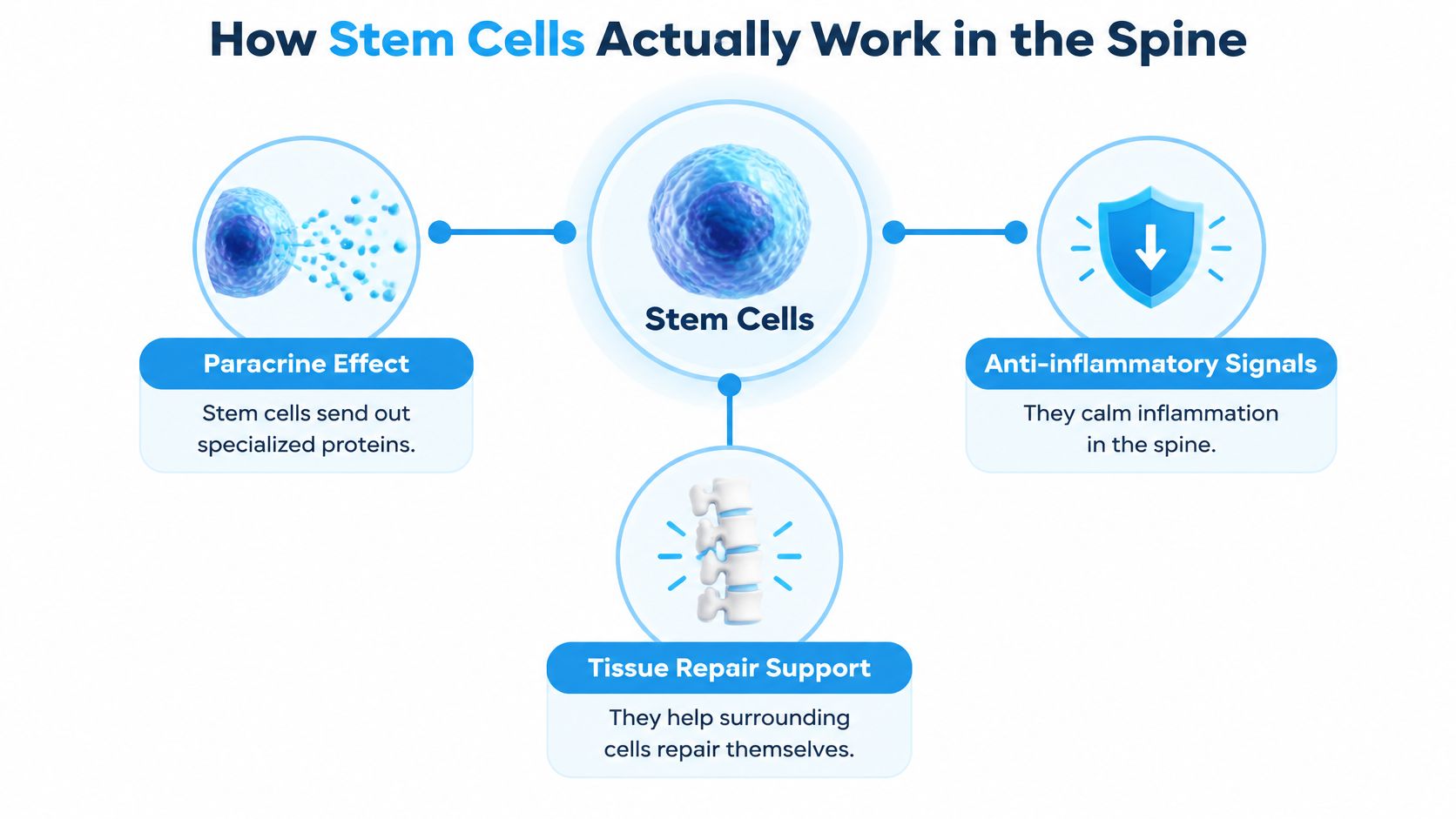
The stem cells don’t differentiate into replacement disc, nerve, or cartilage cells as the expected mechanism of back treatment. Mesenchymal stromal/stem cells, usually shortened to MSCs, work primarily through the paracrine effect: they send out specialized signals that may guide the body’s own healing processes, rather than becoming new spinal tissue themselves, as explained in this review of MSC mechanisms in low-back pain.
In the lower back protocol, four image-guided intramuscular injections totaling 100 million MSCs (plus PRP) are placed around the most affected lumbar levels. This positioning allows the cells to address the disc and surrounding structures without the cells becoming trapped inside the nucleus. A separate 100 million MSC intravenous infusion adds systemic support, followed by NAD+ and high-dose vitamin C.
The illustration below summarizes that signaling concept. Its repair language describes a proposed biological process, not a promise of disc regeneration.
Think of a coach, not a replacement player
A useful analogy is a coach communicating with the players already on the field. The coach doesn’t become a player. Similarly, MSCs release signals that can influence the patient’s existing cells.
Researchers call this collection of released substances the secretome. It includes cytokines, growth factors, and extracellular vesicles, including exosomes, that can affect inflammation, cell survival, blood-vessel responses, and extracellular-matrix remodeling, according to this review of the MSC secretome and paracrine communication.
In plain language, the proposed actions include:
- Adjusting inflammatory activity: Influencing how local immune cells respond.
- Supporting stressed cells: Sending signals involved in cell survival.
- Influencing tissue maintenance: Affecting how resident cells produce and remodel the material around them.
The following video offers another way to approach the treatment discussion.
The coach analogy has limits. Signals can encourage a response, but they can’t guarantee that damaged tissue has the capacity to rebuild. A broader review of MSC biology and wound repair
Lower Back Stem Cell Treatment – 100 Million MSC around most affected Vertebrae + 100 Million MSC IV
Which Back Conditions May Respond to Stem Cell Treatment
The diagnosis matters. The Dream Body Clinic lower-back protocol is used for:
- Herniated or bulging lumbar discs
- Degenerative disc disease
- Facet joint arthritis
- Sciatica / lumbar radiculopathy
- Early-to-moderate spinal stenosis
- Persistent pain after prior surgery when supporting tissues remain treatable
An on-site MRI is included and required. The most common reasons treatment is not recommended are large osteophytes or a complete structural tear the protocol is unlikely to help.
Published intradiscal studies commonly enrolled adults with pain lasting at least six months despite conservative care and MRI-confirmed degeneration, often excluding dominant radiculopathy from severe canal or foraminal compression, according to a systematic review of clinical MSC studies for discogenic pain. At Dream Body Clinic we don’t administer intradisc injections. We tried that in the past and never saw better results compared to injecting around the discs. This is because MSCs work via the paracrine effect. It is the signals they send out that guide the healing and regeneration process. If you inject into the disc they have no way to recruit help. Injecting around the disc allows them to rehydrate discs, heal cartilage at the facet joints and heal nerve problems like sciatica.
The conditions below are reasons people seek assessment:
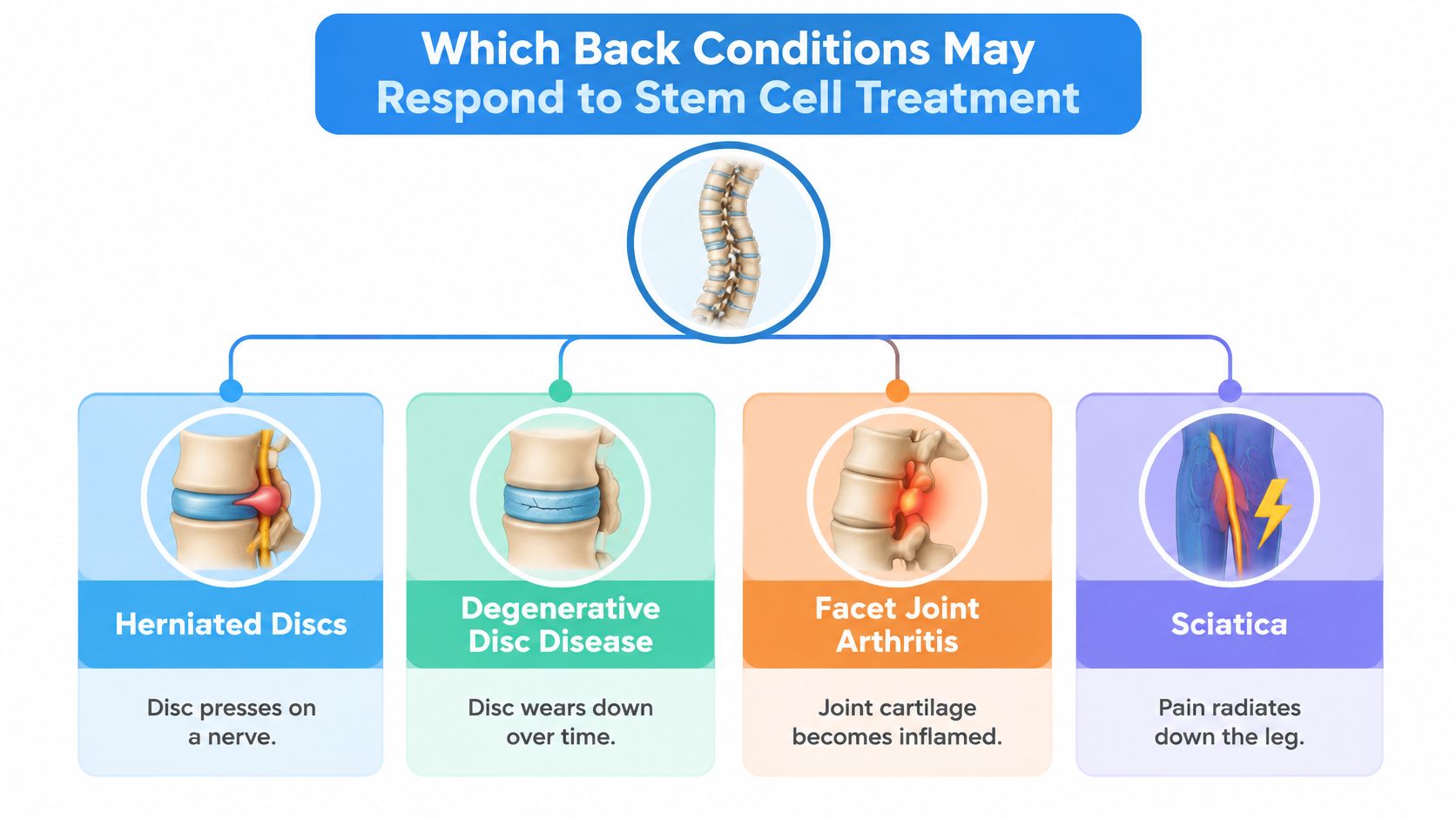
Match the proposed treatment to the suspected pain generator
| Condition being discussed | What needs clarification before treatment |
|---|---|
| Degenerative disc disease | Does the clinical assessment support the disc as a meaningful pain source and was an MRI done to assess? |
| Herniated disc | Is the proposed treatment addressing disc-related pain, or is mechanical nerve compression the central problem? |
| Facet-joint arthritis | What supports the facet joint as the treatment target, and what evidence applies specifically to that joint? |
| Sciatica | What explains the leg symptoms, and has the clinician assessed neurological function and possible compression? |
For degenerative disc disease, the important question isn’t whether an MRI shows degeneration. Ask whether your symptoms, examination, and imaging support the same explanation.
With sciatica, ask what the clinician is treating rather than accepting the symptom label as the diagnosis. When reviewing stem cell therapy for sciatica, compare the proposed approach with your neurological findings and the reason for your leg pain.
A careful assessment should also consider competing explanations, including sacroiliac pain, hip disease, stenosis, and peripheral neuropathy. The practical question is: what finding would make this clinician recommend against injecting me? A credible evaluation must leave room for that answer.
Delivery Routes and What They Mean for You
Where cells are delivered is part of the treatment, not a minor technical detail. An injection near a lumbar structure, an injection into a disc, and an infusion into the bloodstream shouldn’t be treated as interchangeable versions of the same procedure.
Start by asking the clinician to identify the intended destination on your imaging. Then ask which published evidence matches both that location and the proposed product.
This diagram shows the routes you may encounter in clinic descriptions. Labels suggesting relief or broader coverage should be understood as intended aims, not established outcomes.
Where the cells go matters. Dream Body Clinic’s standard lower-back protocol uses:
- Peri-spinal intramuscular injections (four sites totaling 100 million MSCs + PRP) around the affected lumbar segments under deep-field ultrasound
- A 100 million MSC intravenous infusion for systemic support
- Supportive NAD+ and high-dose vitamin C after the stem cell IV
This is different from routine intradiscal injection under anesthesia. The clinic previously used direct intradiscal delivery and found that placing cells around the disc allowed better signaling and recruitment of local repair cells.
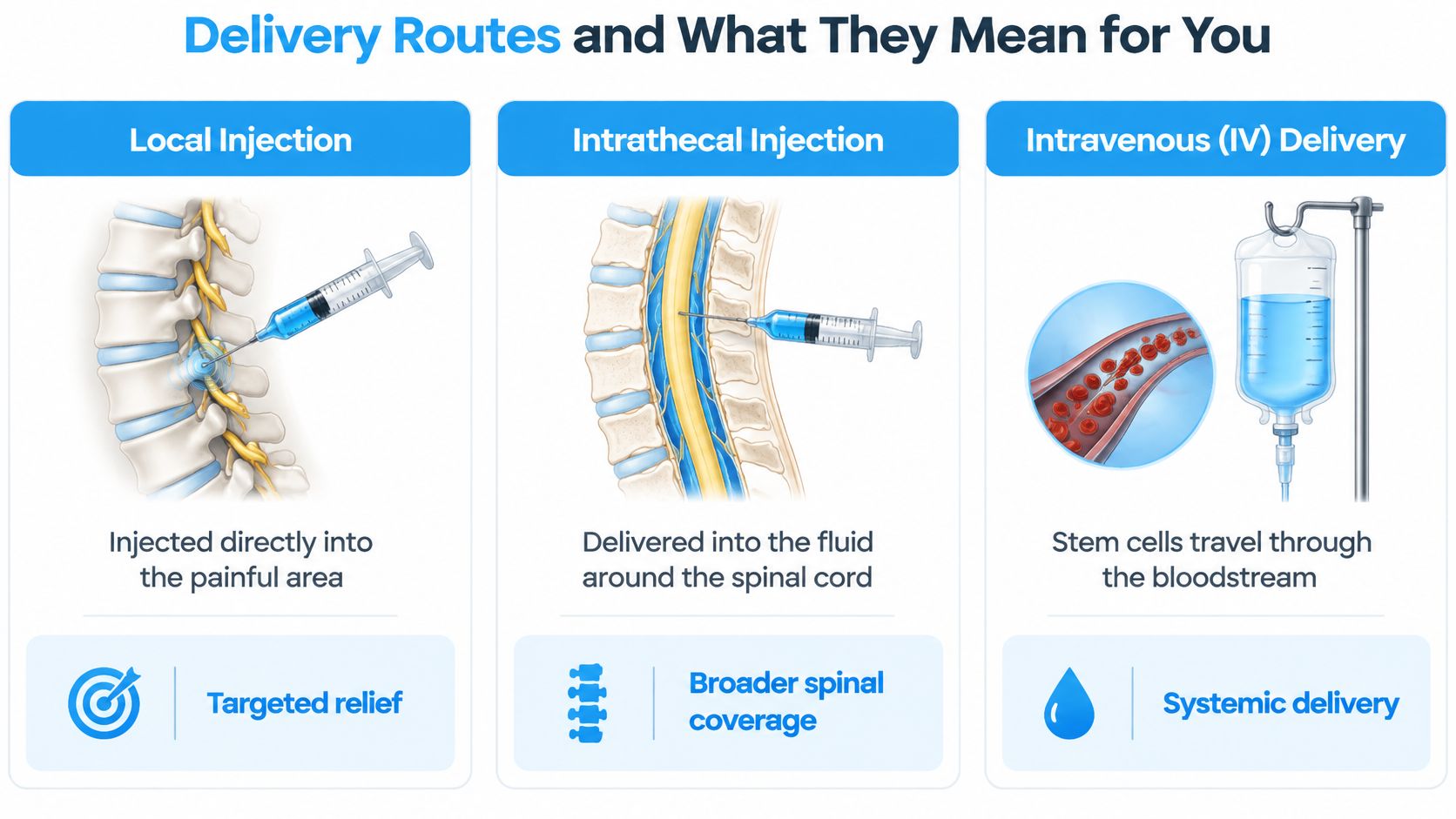
Compare the destination and the justification
| Route | What the term describes | What to ask |
|---|---|---|
| Local injection | Placement at a specified anatomical target, such as a disc or joint region | Is the product going into the disc, into a joint, or around surrounding tissues? |
| Intrathecal injection | Delivery into the fluid surrounding the spinal cord | What diagnosis justifies this route, and what evidence supports it for my condition? |
| Intravenous delivery | Infusion into the bloodstream | What supports adding systemic delivery to treatment for my particular back problem? |
With a local procedure, precise wording matters. Around a disc is not the same as inside a disc. If a clinic cites intradiscal research but proposes injections around affected lumbar segments, ask it to explain that difference.
Intrathecal delivery also requires a separate rationale. Don’t assume that proximity to the spinal cord makes it a better option for ordinary lumbar pain. Ask for a route-specific explanation of anticipated benefits, procedural risks, and alternatives.
For IV treatment, separate the proposed systemic purpose from evidence about targeted back-pain treatment. A clinic should explain why it recommends the infusion rather than relying on general language about whole-body healing.
Use an overview of how stem cell injections work to prepare terminology questions, then request your actual procedure plan in writing.
What the Evidence Says About Outcomes
Published studies show variable improvements in pain and disability with cell therapies for discogenic pain, but results are not uniform and long-term structural regeneration is not guaranteed. At Dream Body Clinic, many patients report reduced pain and improved function, with results typically peaking between three and six months. Disc height and shape can change gradually; nerve symptoms such as leg pain or tingling sometimes improve earlier than visible MRI changes. Individual outcomes vary, and not every patient is a candidate.
The all-inclusive package is $8,700 USD and includes the MRI, full blood panel, local injections, IV, and supportive drips. Patients plan a five-day stay in Bucerías.
A systematic review of six cell-therapy studies reported pooled reductions of 44.2 points in pain scores and 32.2 points in the Oswestry Disability Index, but heterogeneity was extremely high, 99.4% for pain and 99.5% for disability.
Risks, Limitations, and How to Evaluate a Clinic
Documented adverse events with this protocol are uncommon and mostly limited to temporary soreness. The clinic does not treat patients with cancer in the past five years. As with any injection, infection is a theoretical risk managed with sterile technique. Results are not guaranteed, and advanced bone-on-bone changes or large osteophytes may limit benefit.
When evaluating any clinic, ask about cell source and dose, exact placement method, what is included in the price, and how candidacy is determined. Dream Body Clinic expands its own allogeneic MSCs from Wharton’s jelly and placenta in an on-site ISO-rated lab (never frozen or shipped) and requires MRI review before treatment.
Learn more or request a free MRI review:
https://dreambody.clinic/lower-back-stem-cell-treatment/
Call (888) 704-3977 or email info@dreambodyclinic.net
7 Reasons Patients Choose the Dream Body Clinic Lower Back Protocol
- High local dose — 100 million MSCs in four ultrasound-guided peri-spinal injections plus PRP.
- Systemic support — Additional 100 million MSC IV plus NAD+ and high-dose vitamin C.
- No harvest procedure — Allogeneic cells from Wharton’s jelly and placenta; no bone marrow or fat draw.
- Fresh cells expanded on site — Processed in the clinic’s ISO-rated lab and never frozen.
- All-inclusive $8,700 package — Includes MRI and blood panel.
- Peri-spinal approach — Cells placed around affected levels for better signaling rather than trapped inside the disc.
- Short five-day stay in the Puerto Vallarta area with published pricing and remote follow-up.
| Decision question | What a usable answer includes |
|---|---|
| What am I trying to improve? | Specific activities or symptoms, not an undefined promise of healing |
| Why this treatment? | Evidence relevant to the diagnosis, product, and delivery route |
| What remains uncertain? | An honest discussion of response, durability, and structural outcomes |
| What if I don’t proceed? | A realistic plan involving continued care, further assessment, or another treatment |
| What if it doesn’t work? | Follow-up responsibility and options without an automatic repeat-treatment commitment |
Dream Body Clinic offers nonsurgical MSC-based back-treatment options in Bucerias, Mexico, with case review and support for international patients. Visit Dream Body Clinic to ask how its proposed protocol relates to your MRI findings, treatment goals, and follow-up needs, and request a written explanation of eligibility, risks, and alternatives before arranging travel.