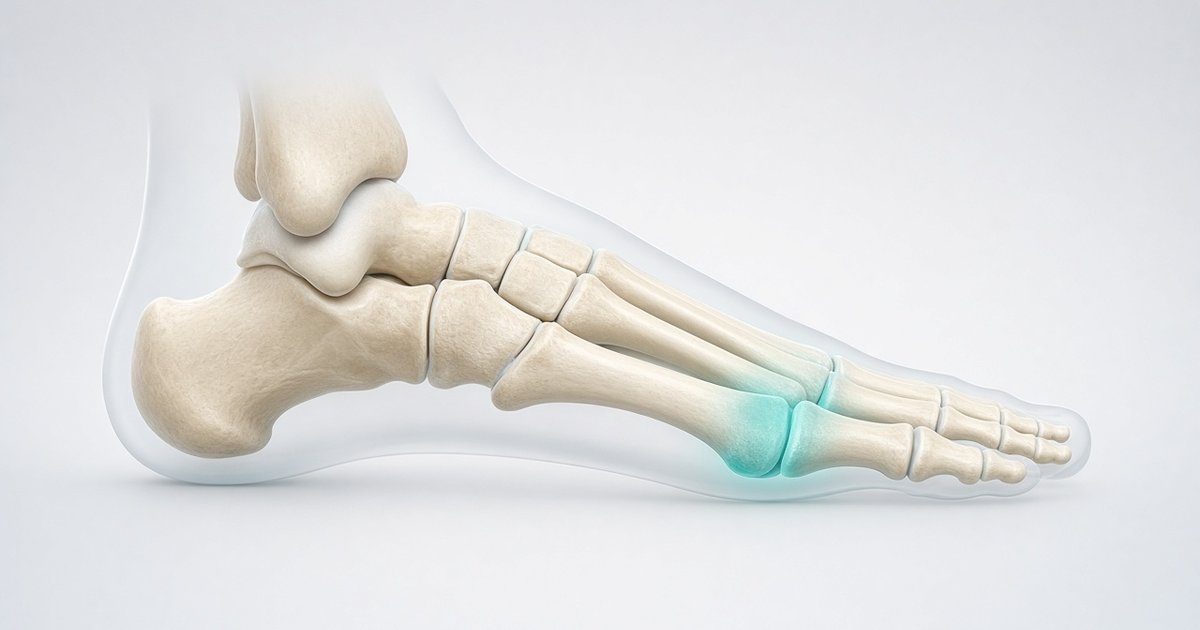
Your big toe takes a surprising amount of load. Every time you walk, it’s the last part of your foot to leave the ground, and it helps push you into the next step. When the joint at its base becomes stiff and painful, it can change how you walk, which shoes you can wear and how far you’re willing to go.
Many of the people who contact us about big toe pain have already tried stiffer shoes, inserts, anti-inflammatories and a cortisone shot or two. Some have been told the next step is surgery, often a fusion. They want to know whether a stem cell injection is a reasonable option to consider first.
This guide gives you an honest answer. We’ll explain what usually causes big toe arthritis, what the research on injections (including stem cells) does and doesn’t show, how our 25 million cell protocol works, who may be a candidate, and what the trip and recovery look like.
What Causes Big Toe Arthritis?
The joint at the base of the big toe is called the first metatarsophalangeal joint, or first MTP joint. Like any joint, its bone ends are covered with smooth cartilage. Over time, through wear, old injuries or the way a foot is built, that cartilage can thin and the joint can become inflamed.
When this happens in the big toe, doctors often use two terms:
- Hallux limitus describes a big toe that has lost some of its upward bend.
- Hallux rigidus describes a joint that has become very stiff, often with a bony bump (a bone spur) on top of the joint.
It’s common. Researchers estimate that hallux rigidus affects about 2.5% of people aged 50 and over (contemporary review of adipose-derived stem cells in the foot and ankle, 2023).
Typical signs include pain when you push off or climb stairs, stiffness when you try to bend the toe up, swelling around the joint, a bump that rubs on your shoes, and sometimes pain on the outer side of the foot as you start walking differently to protect the toe.
Big toe arthritis is different from a bunion (hallux valgus), where the toe drifts toward the other toes. The two can occur together. If your main concern is the angle of the toe, our article on big toes that point inwards is a better place to start, because an injection doesn’t change alignment.
The Usual Treatment Path
Most people start with conservative care, and many do well with it for years:
- Footwear and inserts. Shoes with a stiff or rocker-bottom sole, and carbon-fiber plates or inserts that limit how much the toe bends.
- Activity changes and physical therapy.
- Pain relief recommended by your own doctor.
- Injections. Cortisone (a corticosteroid) or hyaluronic acid (a gel-like lubricant) injected into the joint.
When those stop helping, surgeons may suggest a cheilectomy, which removes the bone spur and is often used for milder cases. For advanced arthritis, the most common operation is a fusion (arthrodesis), which joins the bones so the joint no longer moves. Fusions often relieve pain well, but the toe can no longer bend at that joint, and recovery usually involves weeks of protected walking.
That’s why some people look for a non-surgical step between “the cortisone isn’t working anymore” and “let’s fuse it.”
What Does the Research Say About Injections for Big Toe Arthritis?
Here we want to be especially clear, because the evidence for big toe injections of any kind is thinner than most people expect.
Cortisone and hyaluronic acid. A 2024 Cochrane review of non-surgical treatments for big toe osteoarthritis found that, in a placebo-controlled trial of 151 people, a single hyaluronic acid injection probably made little or no difference to pain or function compared with a placebo injection. The reviewers concluded that the overall evidence for non-surgical big toe treatments is limited (Cochrane review, 2024). A separate 2024 systematic review found only low-quality evidence for hyaluronic acid in hallux rigidus, with short-term improvements in some studies and transient post-injection pain in about 10% of patients (Foot & Ankle Orthopaedics, 2024). A 2025 review of corticosteroid injections in foot and ankle arthritis found too little trial evidence to guide their use (Rheumatology Advances in Practice, 2025).
Stem cells. For mesenchymal stem cells (MSCs) in the big toe, the published evidence is very limited. The only published clinical report we found is a 2021 case report of one 50-year-old man with moderate hallux rigidus. He received an injection of his own fat-derived stem cells into the joint, and his pain score improved over nine months with no serious side effects (World Journal of Orthopedics, 2021). A single case can’t tell us how well a treatment works or how often. A 2023 review of fat-derived stem cells in the foot and ankle said exactly that: no conclusions can be drawn for hallux rigidus from one case (contemporary review, 2023).
We also want to be transparent that this case used the patient’s own fat-derived cells. Our protocol uses donor MSCs from Wharton’s jelly and placenta, and we’re not aware of published trials of those cells in the big toe.
What we can reasonably say. Most MSC joint research comes from the knee. In knee osteoarthritis, studies generally report modest, variable improvements in pain and function, and the evidence that injections regrow cartilage is weak. Our knee injection comparison covers that research in detail. Whether those findings carry over to a small joint like the big toe hasn’t been tested in trials.
So, for big toe arthritis, MSC therapy is best understood as investigational. Some patients tell us they’ve seen meaningful improvement. Others see a little, and some see little or no change. We’d rather you go in with that understanding than with a promise.
How MSCs Are Thought to Work
MSCs are thought to act mainly through paracrine signaling. In other words, they release proteins and other signals that may calm inflammation and influence how the tissue around them behaves. They don’t appear to work by turning into new cartilage inside the joint in any meaningful amount. That’s part of why, when people do respond, changes tend to build gradually over weeks and months rather than overnight. Our article on how our cells are made and tested explains the science in more depth.
Our Big Toe Protocol
Here is exactly what our big toe treatment includes:
| Cells | 25 million culture-expanded MSCs from donated Wharton’s jelly (umbilical cord tissue) and placenta from healthy, live births |
| Delivery | A single injection into the big toe joint |
| Imaging | An X-ray before treatment to help with planning |
| Price | $1,750 USD per toe |
| Minimum stay | 4 days in Bucerías, near Puerto Vallarta |
Our cells are grown in our own lab in Bucerías, which holds three COFEPRIS licenses (Mexico’s federal health regulator) covering stem cell production, cryobank storage and regenerative medicine practice. Cells are expanded in a GMP-grade, xeno-free medium in a cleanroom, tested by COFEPRIS-authorized third-party labs, and given within 24 hours of leaving culture. You can see our licenses on our certified stem cells page.
COFEPRIS licenses our facility and lab. That isn’t the same as approval of the treatment for big toe arthritis, and MSC injections for this condition are not FDA-approved in the United States.
Who May Be a Candidate?
Every case is reviewed by one of our physicians before you book anything. In general, people who may be reasonable candidates:
- Have big toe pain and stiffness from osteoarthritis or cartilage wear in the joint
- Have tried conservative care, such as footwear changes, inserts or injections
- Want to try a non-surgical option before deciding about surgery, understanding that it may not work for them
- Are generally healthy and able to travel
You may not be a good candidate if:
- You’ve had cancer in the past five years (we don’t treat these patients)
- You’ve had a cortisone injection in the joint within the past three months
- Your main problem is toe alignment (a bunion) rather than joint pain
- The joint is already fused, or your X-ray shows very advanced bone-on-bone arthritis. We’ll discuss this honestly with you at consultation
- Your pain may be from gout, an infection, a fracture or nerve irritation, which need a different diagnosis and treatment
If we don’t think treatment is likely to be worthwhile for you, we’ll tell you.
Your 4-Day Trip
| Day | What happens |
|---|---|
| Day 1 | Arrive in Puerto Vallarta, check in to your hotel and rest |
| Day 2 | X-ray and payment at the clinic |
| Day 3 | Your injection |
| Day 4 | Fly home, with transport to Puerto Vallarta airport (PVR) provided |
Exact timing depends on scheduling. Many patients like to add a few days to enjoy Bucerías. Our travel guide and hotel options can help you plan.
Recovery and Results
Most patients walk out of the clinic the same day. Some feel tightness or soreness in the joint that evening or the next day, which usually settles on its own, and we’ll give you pain-relief instructions before you leave. Our standard aftercare plan is:
- Weeks 1–2: no exercise or sports
- Weeks 3–6: a 4-week rehab program we provide
- After 6 weeks: a gradual return to your usual activities, starting light and backing off anything that causes pain in the toe
- Months 3–6: the typical window in which patients who respond report their peak improvement
Our physicians generally ask patients to avoid anti-inflammatory medicines such as ibuprofen around treatment, and to avoid cortisone injections for several months afterward. Your physician will give you personal instructions, and you should never stop or change a prescribed medication without your own doctor’s guidance. Our recovery timeline guide explains the full plan.
We follow up remotely at 3, 6 and 12 months. Results vary, and some patients see little or no benefit. If you haven’t noticed much change by six months, tell us honestly so we can talk through what that means and what other options might suit you.
Contact us or seek urgent care right away if you develop a fever, spreading redness or warmth around the toe, swelling that keeps getting worse, or you can’t put weight on the foot.
Questions to Ask Any Clinic
Whether you choose us or someone else, ask:
- What type of cells, and how many, will be injected into my joint?
- Is the injection image-guided?
- What published evidence exists for this treatment in the big toe specifically?
- Who reviews my X-rays, and will you tell me if I’m not a good candidate?
- What does the price include, and what’s extra?
- What happens if I don’t notice any improvement?
Our guide on how to choose a stem cell clinic has a longer checklist.
Frequently Asked Questions
Can stem cells regrow cartilage in my big toe? There’s no reliable evidence that they do. MSCs are thought to work mainly by calming inflammation and signaling to nearby tissue, and studies in larger joints show weak evidence of cartilage regrowth. We don’t promise structural repair.
Is this an alternative to a big toe fusion? For some people it may be a way to try a non-surgical option first, but it isn’t a replacement for surgery and there are no trials comparing the two. If treatment doesn’t help, surgery remains an option, and you should discuss that with an orthopedic or foot and ankle surgeon.
How much does stem cell treatment for big toe arthritis cost? Our big toe protocol is $1,750 USD per toe and includes 25 million MSCs and an X-ray. Flights and hotel are separate.
Can I treat both big toes on the same trip? Ask us at your consultation. The price is per toe, and your physician will advise whether treating both at once suits you.
How soon will I notice a difference? Patients who respond usually notice gradual changes, with peak improvement commonly reported between three and six months. Some people notice little or no change.
Is it safe? In published studies of MSC joint injections, the most common side effects are short-lived pain and swelling at the injection site. Any injection carries a small risk of infection. Long-term safety data are still limited, and these treatments aren’t FDA-approved.
Do I need to bring imaging? Please send any recent X-rays or MRI reports with your consultation request. We take an X-ray at the clinic on Day 2 either way.
Thinking About Your Options?
If big toe pain is limiting how you walk or what you can do, a free consultation is a good first step. It’s a conversation, not a commitment: we’ll review your history and imaging, explain what the evidence does and doesn’t show for your situation, and tell you honestly whether we think treatment is a reasonable option.
Schedule your free consultation, call (888) 704-3977, WhatsApp +52 322 232 1055, or email info@dreambodyclinic.net.
Disclaimer: This article is for educational purposes and is not medical advice. Mesenchymal stem cell therapy for big toe arthritis is investigational and is not approved by the U.S. FDA. Published evidence for this use is very limited, results vary, and some patients see little or no benefit. Treatment is provided in Mexico at a COFEPRIS-licensed facility. Please consult your physician before making treatment decisions.