You’ve finished the scans, followed the rehabilitation plan, and still find yourself losing the thread of a conversation, struggling with fatigue, or feeling unlike yourself months after a traumatic brain injury. Your family may see progress, while everyday tasks still require far more effort than they used to. That gap often leads people to search for stem cell therapy for TBI, hoping regeneration might address problems that routine rehabilitation hasn’t fully resolved.
The science is more nuanced than many treatment pages suggest. Mesenchymal stem cells, or MSCs, aren’t best understood as replacement parts that become new brain cells. Their proposed role is closer to that of signaling coordinators, releasing specialized messages that may influence inflammation, cell survival, blood flow, and the brain’s own repair processes.
The Traumatic Brain Injury Stem Cell Treatment Page at Dream Body Clinic explains in great detail how the Mesenchymal Stem Cells (MSCs) work.
Table of Contents
- Introduction to Life After TBI and Why Regeneration Matters
- How MSCs Actually Work Through Paracrine Signaling
- Proposed Mechanisms Inside the Injured Brain
- Delivery Routes and How Clinics Design Protocols
- What Human and Preclinical Evidence Shows So Far
- Who May Be Considered and What Realistic Outcomes Look Like
- Key Takeaways and Next Steps for Exploring Care
Introduction to Life After TBI and Why Regeneration Matters
Recovery after TBI rarely follows a simple line. Someone may regain strength and walking ability but continue to experience memory problems, slowed thinking, irritability, sleep disruption, or difficulty returning to work. Another person may appear physically well while struggling with planning, emotional regulation, or sensory overload. These symptoms can persist even when conventional rehabilitation has produced meaningful gains.
Standard care still matters. Neurological rehabilitation can combine physical, occupational, speech, cognitive, and psychological support, with treatment adapted to the person’s remaining limitations. Readers looking for a clear overview of rehabilitation approaches may find the MedAmerica Rehab Center neuro guide useful when organizing questions for a rehabilitation team.
Regenerative medicine enters this conversation because TBI can involve more than the initial impact. Secondary processes, including inflammation, oxidative stress, swelling, blood-brain barrier disruption, and cell death, may affect vulnerable tissue after the original injury. MSC-based treatments can modify that environment and support the brain’s existing repair capacity.
That distinction shapes every practical question. The important issue isn’t whether cells are delivered. It’s which cells are used, how they’re administered, when they’re given, what symptoms are being targeted, and how the treatment is combined with rehabilitation. Traumatic Brain Injury Stem Cell Treatment (TBI)
By the end of this guide, you should be able to separate the proposed biology from marketing language, understand the main delivery routes, interpret the human evidence, and prepare more useful questions about candidacy, safety, follow-up, and realistic outcomes.
How MSCs Actually Work Through Paracrine Signaling
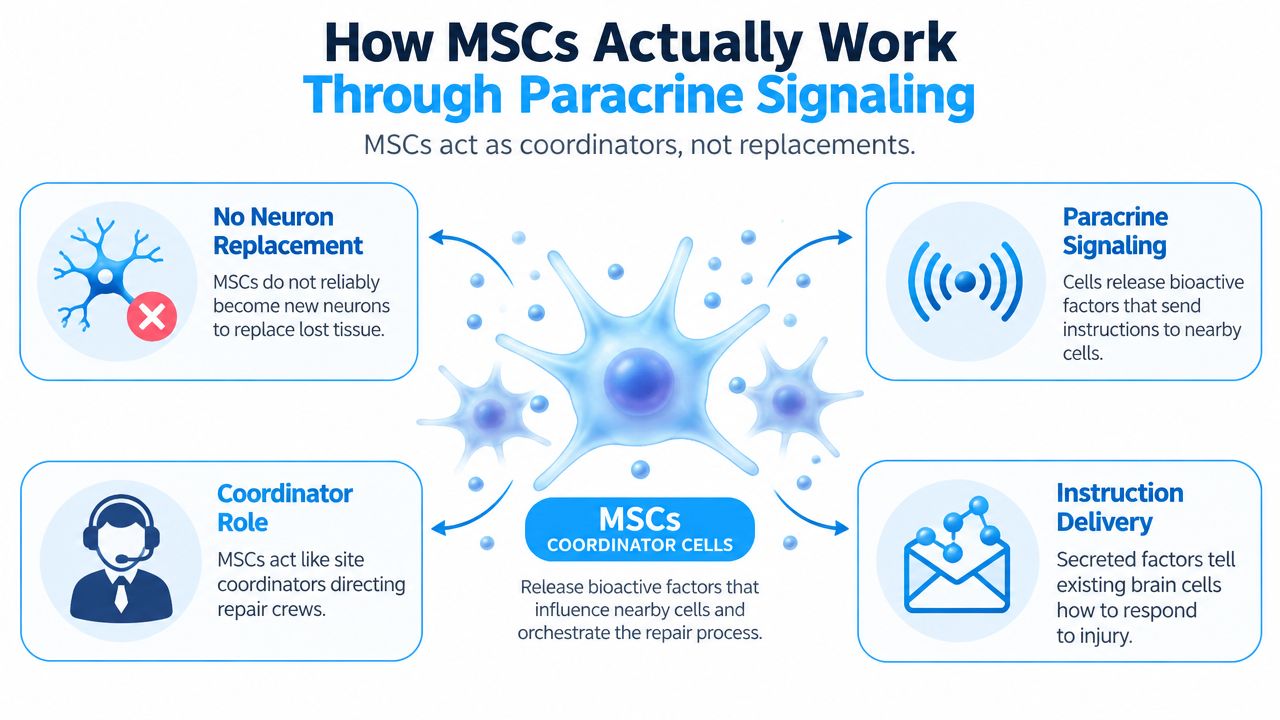
The most important clarification is also the one that’s most often missed: MSCs don’t reliably differentiate into new neurons that replace lost brain tissue. Early theories emphasized the possibility that MSCs might transform into neural cells, but reviews describe little evidence that they become functional neurons in the injured brain. The observed benefits are mainly attributed to signals released by the cells, rather than direct neuron replacement (2015 review of cell-based TBI therapy).
A useful analogy is a damaged construction site. MSCs aren’t bricks that permanently become part of a rebuilt wall. They act more like site coordinators, communicating with immune cells, blood-vessel cells, support cells, and surviving neural networks. Their messages may help the local repair crews respond in a more organized way.
That communication is called paracrine signaling. In plain language, the cells release specialized signals that influence nearby or systemically connected cells. These signals include growth factors, cytokines, and extracellular vesicles, which carry biological instructions that may affect inflammation, cell survival, vascular responses, and plasticity (2024 review of stem cell therapies for neurological disorders).
What the signals may coordinate
The signals don’t rebuild the brain in a mechanical sense. Instead, researchers propose that they may:
- Moderate immune activity: MSCs can influence inflammatory responses that may otherwise harm vulnerable tissue.
- Provide neurotrophic support: Secreted factors may help stressed neurons and neural networks survive.
- Preserve existing connections: Protecting partially injured networks may support later rehabilitation and neuroplasticity.
- Communicate through extracellular vesicles: These vesicles can carry molecular signals that influence recipient cells.
A 2026 NIH and PMC review describes transplanted cells as working mainly through paracrine signaling, immunomodulation, neurotrophic support, and preservation of vulnerable neural networks, with extracellular vesicles contributing to the therapeutic effect (NIH and PMC review on stem cell therapy for TBI).
The practical consequence is significant. If MSCs function as temporary signaling coordinators, treatment success may depend on the condition of the injured environment, the route of administration, the timing, and the patient’s rehabilitation plan. The therapy isn’t a simple replacement of missing neurons, and it shouldn’t be presented as one.
Proposed Mechanisms Inside the Injured Brain
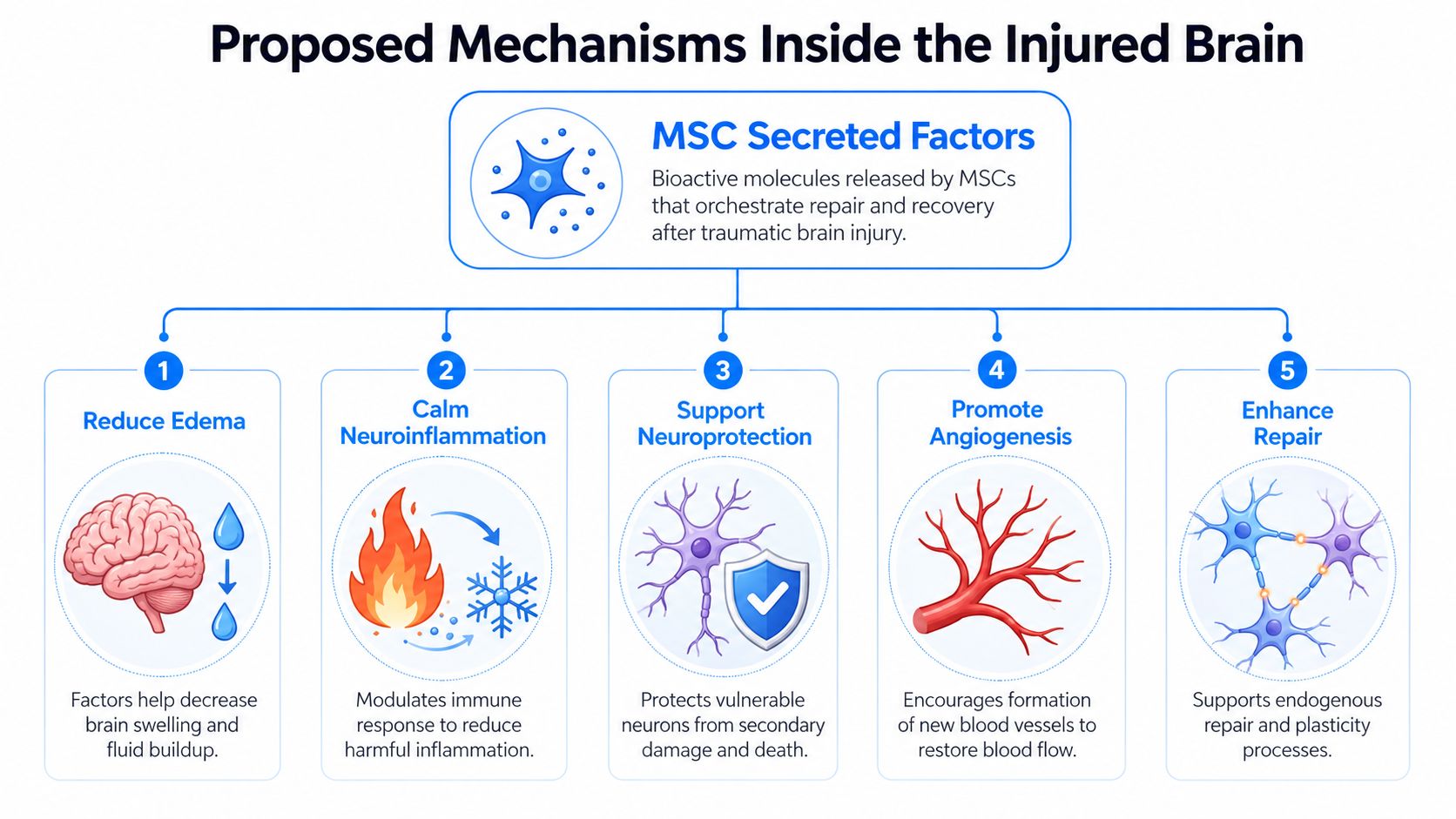
Once the paracrine principle is clear, the proposed biological effects become easier to understand. MSCs may release a mixture of signals rather than a single drug with one defined target. Researchers therefore describe the therapy as multimodal, because several processes may be influenced at the same time.
Controlling the secondary injury environment
After TBI, swelling and fluid shifts can place additional stress on neural tissue. MSC-derived signals are proposed to help reduce edema and support the stability of the blood-brain barrier, which helps regulate movement between the bloodstream and brain tissue. The aim isn’t to reverse the original impact directly. It’s to make the surrounding environment less hostile to surviving cells.
Inflammation presents a similar challenge. Some immune activity is part of healing, but an excessive or poorly regulated response may contribute to ongoing tissue stress. MSCs are studied for their immunomodulatory effects, meaning they may adjust immune behavior rather than turn it off.
Researchers also examine effects on apoptosis, or programmed cell death, and oxidative stress. These mechanisms matter because partially injured cells may remain vulnerable after the initial trauma. Signals associated with MSCs may support neuroprotection during that period..
Supporting the brain’s own repair systems
The brain can adapt through neuroplasticity, and surviving cells may contribute to endogenous repair. MSC signals are proposed to support neurogenesis, the formation of neural cells from the brain’s own resources, as well as angiogenesis, the formation of new blood vessels. Better vascular support may help sustain tissue that remains viable after injury.
Named factors discussed in TBI research include BDNF, bFGF, GDNF, NGF, and VEGF. These molecules are associated with neuronal support, growth, vascular responses, or repair signaling.
This is why the proposed benefit is better described as supportive and modulatory than as direct reconstruction. Readers seeking a clinic-based discussion of MSC research in neurological conditions can also review mesenchymal stem cells and neurodegenerative disease research.
Delivery Routes and How Clinics Design Protocols
Delivery route shapes the treatment question. Intravenous infusion is less invasive, but gets almost no stem cells to the brain which makes it the least effective route.. Intrathecal injection places cells in cerebrospinal fluid, while direct lesion-directed delivery positions them near injured tissue. Each route changes where MSC signals may act, how invasive the procedure is, and how predictable distribution becomes.
Comparing the main approaches
To heal a brain injury, you need to get to the brain. The best approach we have found is an intrathecal application of mesenchymal stem cells. This is where our anesthesiologist injects into the lower back into the thecal sac. The thecal sac is the tissue around the spinal cord that holds the spinal cord fluid in. By getting the MSCs into the spinal fluid it allows them to travel up the spinal cord to the cerebrospinal fluid in the brain. It sounds like a scary injection, but it is very easy and near painless when done.
The second best route to the brain is via nebulization. This allows the stem cells to be breathed in where many absorb into the mucus membrane at the back of the throat then dissipate into the carotid artery where they go straight to the brain. This is great, but the stem cells still have to pass the blood brain barrier which is very difficult due to their size. Some of them can slip in like a mouse going under a door, but many won’t make it. This is the least invasive way to the brain, but also not nearly as effective as an intrathecal iinjection.
An IV is the worst way to the brain. A stem cell IV takes the MSCs straight to the heart then the lungs. At the lungs they get trapped in the small blood vessels where about 70% get stuck for 2 to 3 hours. Many of those trapped cells dissipate into the lungs and go about healing damage there. The cells that do pass the lungs have many things to target along the way and the brain is the last place they go. They then have to pass the blood brain barrier so the IV is the least effective for brain issues like TBI.
What Human and Preclinical Evidence Shows So Far
A person may notice gradual changes after TBI, while a study measures recovery through clinical, imaging, or biochemical markers. Human research has moved beyond isolated case reports, yet stem cell therapy is not an established standard treatment for TBI. A 2024 systematic review identified 11 clinical studies involving 402 participants, including 249 treated cases and 153 controls. All included studies reported improvement in at least one measured marker, and the review reported no serious adverse events (2024 systematic review in PubMed).
At Dream Body Clinic we have been offering the intrathecal application of MSCs for TBI for over 6 years. In this time we have found that about 80% of TBI patients have a full recovery, meaning they got the results they were hoping for. About 15% saw improvement, but could benefit from a follow up treatment a year or more later to try and get to full recovery and about 5% are non-responders. There are always non-responders with any medical treatment as this is medicine, not magic, but 5% is an incredibly small percentage.
What controlled pooling adds
A controlled meta-analysis of adult TBI cellular therapy included 5 high-quality studies with 367 participants and an average follow-up of 7.58 months. Compared with controls, the pooled analysis found significant overall improvement, with OR = 0.26, 95% CI 0.15 to 0.48, and p = 0.0001. However, the Fugl-Meyer Motor Scale and Disability Rating Scale subscales did not reach statistical significance, with p = 0.24 and p = 0.82, respectively (controlled meta-analysis of adult TBI cellular therapy).
The practical reading is cautious optimism. A pooled signal may coexist with uncertainty about specific functional outcomes, especially when studies use different cell preparations, protocols, and measurement tools.
Evidence rule: Human research currently supports feasibility and a safety signal more strongly than a definitive, broadly applicable efficacy claim.
Animal research provides a wider testing base. A systematic review and meta-analysis of 80 animal studies found that MSCs improved sensorimotor and cognitive deficits and reduced anatomical damage in TBI models. Results were stronger with earlier treatment and direct lesion delivery, but animal recovery does not reliably predict human outcomes (MSC animal-study meta-analysis).
The research is slowly catching up to what real world application is seeing anecdotally at www.dreambody.clinic. We are focused on helping people heal not on publishing papers.
Who May Be Considered and What Realistic Outcomes Look Like
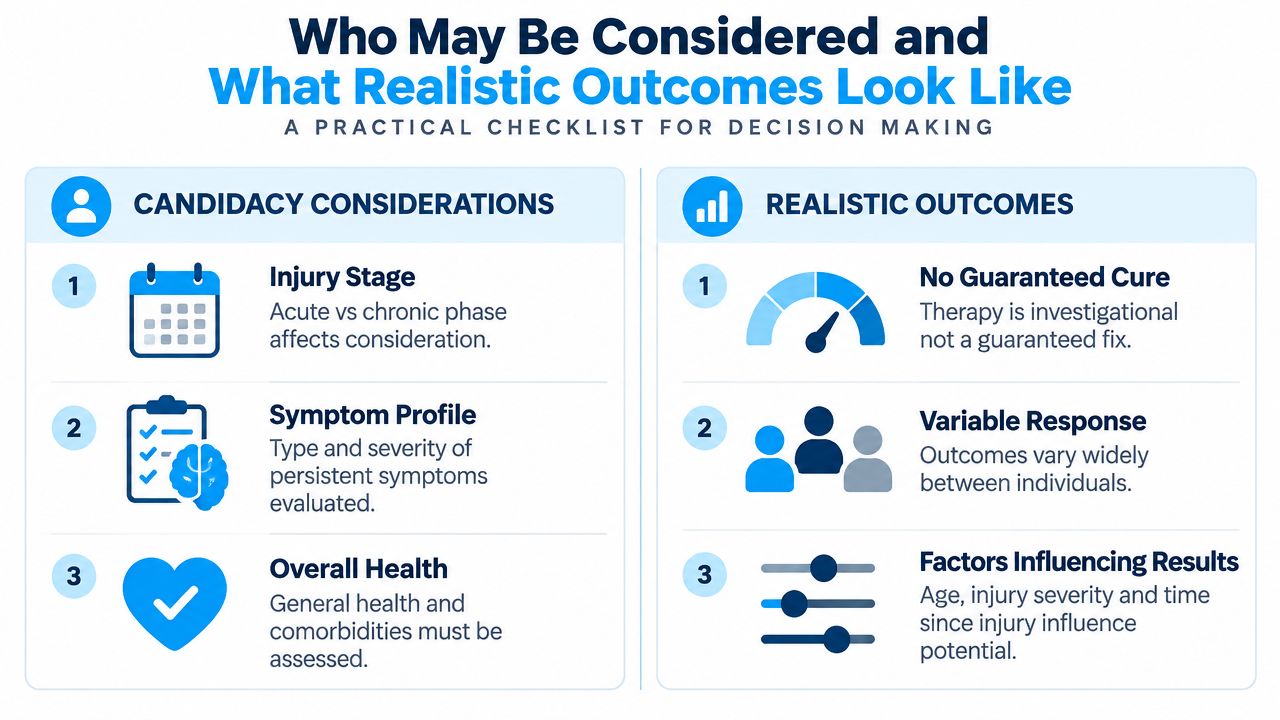
Candidacy begins with the injury, not the product. A clinician should review the original diagnosis, imaging, injury severity, current symptoms, medications, medical history, and rehabilitation response. The treatment discussion may differ substantially for someone in an acute phase compared with someone living with chronic cognitive or motor disability.
Chronic TBI symptoms are an active research focus. A 2025 U.S.-linked Phase II trial is enrolling 51 adults with chronic TBI to study intravenously administered autologous adipose MSCs in relation to structure, cognitive outcomes, functional outcomes, and neuroinflammation (report on the chronic TBI Phase II trial). Enrollment and investigation don’t prove effectiveness, but they show that researchers are examining more than immediate post-injury rescue.
A practical candidacy checklist
- Define the target problem: Is the main concern memory, executive function, mood, mobility, spasticity, fatigue, or a combination? Vague goals make treatment evaluation difficult.
- Separate stable symptoms from changing symptoms: A recent decline may require medical investigation before regenerative therapy is considered.
- Review overall health: Cardiovascular disease, infection risk, immune conditions, medications, and anesthesia or procedure concerns can affect suitability.
- Plan rehabilitation around treatment: Any potential biological support still needs task-specific therapy, cognitive strategies, sleep management, and appropriate medical care. At Dream Body Clinic we often recommend adding the medication cerebrolysin to help patients rehab and heal faster. It is a combo of 14 peptides that are small enough to cross the blood-brain barrier and has been the go to for TBI treatment in Europe since the 1950’s. Unfortunately it is not available in the USA, Canada, UK or Australia. Fortunately it is available at dream body clinic and is legal to take home with our fly and buy program.
- Set measurable outcomes: Use baseline cognitive, functional, and neurological assessments so later changes aren’t judged only by memory or hope.
A realistic outcome might be a change in a defined functional measure, improved tolerance for therapy, or no meaningful improvement. Response can vary, and the therapy shouldn’t be sold as a guaranteed cure. Age, injury severity, time since injury, symptom pattern, and coexisting health problems may all influence the interpretation of results, but no clinic can promise a particular recovery.
For people comparing providers, brain and nerve stem cell treatment information can help frame questions about evaluation and protocol details. The key is to request individualized medical reasoning rather than relying on a general eligibility statement.
Key Takeaways and Next Steps for Exploring Care
MSCs aren’t replacement neurons. They’re studied as signaling coordinators that release paracrine factors, cytokines, growth factors, and extracellular vesicles. Those messages may influence inflammation, neuroprotection, vascular support, and the brain’s own repair processes each have different rationales and tradeoffs. Human evidence remains early, while preclinical evidence is stronger, so a serious consultation should distinguish safety observations and feasibility from proven functional recovery.
Before contacting a clinic, gather your imaging, medical records, rehabilitation reports, medication list, and a clear description of your current limitations. Ask why the route and cell product were selected, how adverse events are monitored, what follow-up includes, and whether the treatment operates within the relevant COFEPRIS-regulated framework.
Dream Body Clinic describes case review, treatment planning, and remote follow-up for international patients, including neurological protocols delivered through routes such as intrathecal administration. Traumatic Brain Injury Stem Cell Treatment (TBI)
The hopeful position is also the careful one. Research is advancing, but informed patients should pursue transparent protocols, realistic goals, and continued rehabilitation rather than promises of guaranteed regeneration.
Dream Body Clinic offers case review for people exploring MSC-based approaches to neurological conditions, including TBI, with protocol discussions focused on route, medical history, and follow-up. Visit the Traumatic Brain Injury Stem Cell Treatment (TBI) to learn how to begin a consultation and prepare your records for clinical review or Call (888) 704-3977 for a free consultation.