You’ve tried resting the shoulder, followed a rehabilitation plan, and perhaps had a cortisone injection, yet reaching overhead, sleeping on that side, or lifting a bag still hurts. Your scan may mention a rotator-cuff tear, tendinopathy, arthritis, or another problem, and the prospect of surgery can feel as troubling as the pain itself.
Stem cell injections for shoulder conditions are often presented as a regenerative alternative. The situation is more specific. Mesenchymal stem cells, commonly called MSCs, can help heal cartilage loss (arthritis), labrum partial tears, ligament and tendon issues. Your diagnosis, imaging, previous treatment, cell product, injection technique, rehabilitation, and follow-up all affect whether treatment is sensible. That is why at dream body clinic we always start with an MRI then consultation as part of the Stem Cell Shoulder Treatment.
This guide separates the biology from the marketing. You’ll learn how the paracrine effect works, which shoulder conditions have been studied, what MSC injections may and may not achieve, which adjuncts matter, and what really works.
Table of Contents
- Why Shoulder Problems Lead People to Consider Stem Cells
- How MSCs Actually Work Inside the Shoulder
- Shoulder Conditions MSC Injections Are Used For
- Technique, Cell Source, Dose, and Adjuncts
- What the Shoulder Evidence Actually Shows
- Who Is a Reasonable Candidate
- Common Misconceptions Worth Correcting
Why Shoulder Problems Lead People to Consider Stem Cells
Shoulder pain rarely behaves like one simple disease. A painful shoulder may reflect a partial-thickness rotator-cuff tear, chronic tendinopathy, glenohumeral osteoarthritis, adhesive capsulitis, labral injury, bursitis, or pain referred from the neck. Each diagnosis changes the treatment decision, and none should be reduced to the phrase “damaged shoulder.”
The usual pathway begins with diagnosis, activity modification, medication where appropriate, physical therapy, and time. Some patients improve with rehabilitation. Others continue to experience weakness, restricted movement, or pain despite conservative care. Depending on the imaging and examination, an orthopedic specialist may discuss a targeted injection, PRP, arthroscopic repair, or shoulder replacement.
MSC treatment fits into the current field as a biologic option. The proposed value isn’t that cells magically rebuild every injured structure. It’s that MSCs can alter the local inflammatory and repair environment by communicating with nearby tissues.
Practical rule: Before asking how many cells a clinic uses, ask what exact diagnosis the injection is intended to treat and which outcome will determine whether it helped.
That question matters because pain relief, improved range of motion, increased strength, and visible tendon integrity are different outcomes. A person may move more comfortably without a tear closing on MRI. Conversely, a structural change may not produce a meaningful improvement in daily function.
A useful consultation should therefore clarify five points:
- Diagnosis: What does the examination and imaging show?
- Treatment role: Is the injection being offered alone or alongside surgery and rehabilitation?
- Mechanism: Is the clinic describing signaling and host-tissue repair, or promising direct tissue replacement?
- Evidence: Does the supporting research match your condition and treatment route?
- Contingency plan: What happens if symptoms persist or the shoulder deteriorates?
Those questions help you evaluate a stem cell injection for shoulder pain without treating a persuasive sales page as a clinical conclusion.
How MSCs Actually Work Inside the Shoulder
The simplest accurate analogy is a temporary radio tower. Injected MSCs don’t become a new rotator cuff, a sheet of cartilage, or a replacement labrum. Instead, they act primarily as signaling centers that communicate with nearby cells and influence the environment around the injury. That then guides the healing of labrum, tendon, ligament or cartilage damage.
Reviews of MSC biology describe the cells’ main therapeutic contribution as paracrine signaling. Their secretome includes cytokines, chemokines, growth factors, extracellular-matrix components, and extracellular vesicles that communicate with host cells rather than directly differentiating into replacement shoulder tissue, as discussed in this review of MSC signaling biology.
The radio-tower analogy has several parts:
- The MSCs broadcast signals. These chemical messages can influence inflammation, cell survival, blood-vessel formation, and matrix remodeling.
- Nearby host cells receive the messages. Resident tendon, cartilage, immune, and connective-tissue cells respond according to the local injury environment.
- The shoulder’s own repair processes do the work. MSCs can guide the healing and regeneration processes.
- The signal is temporary and context-dependent. The effect depends on the tissue, injury, cell source, processing, dose, delivery site, and rehabilitation environment.
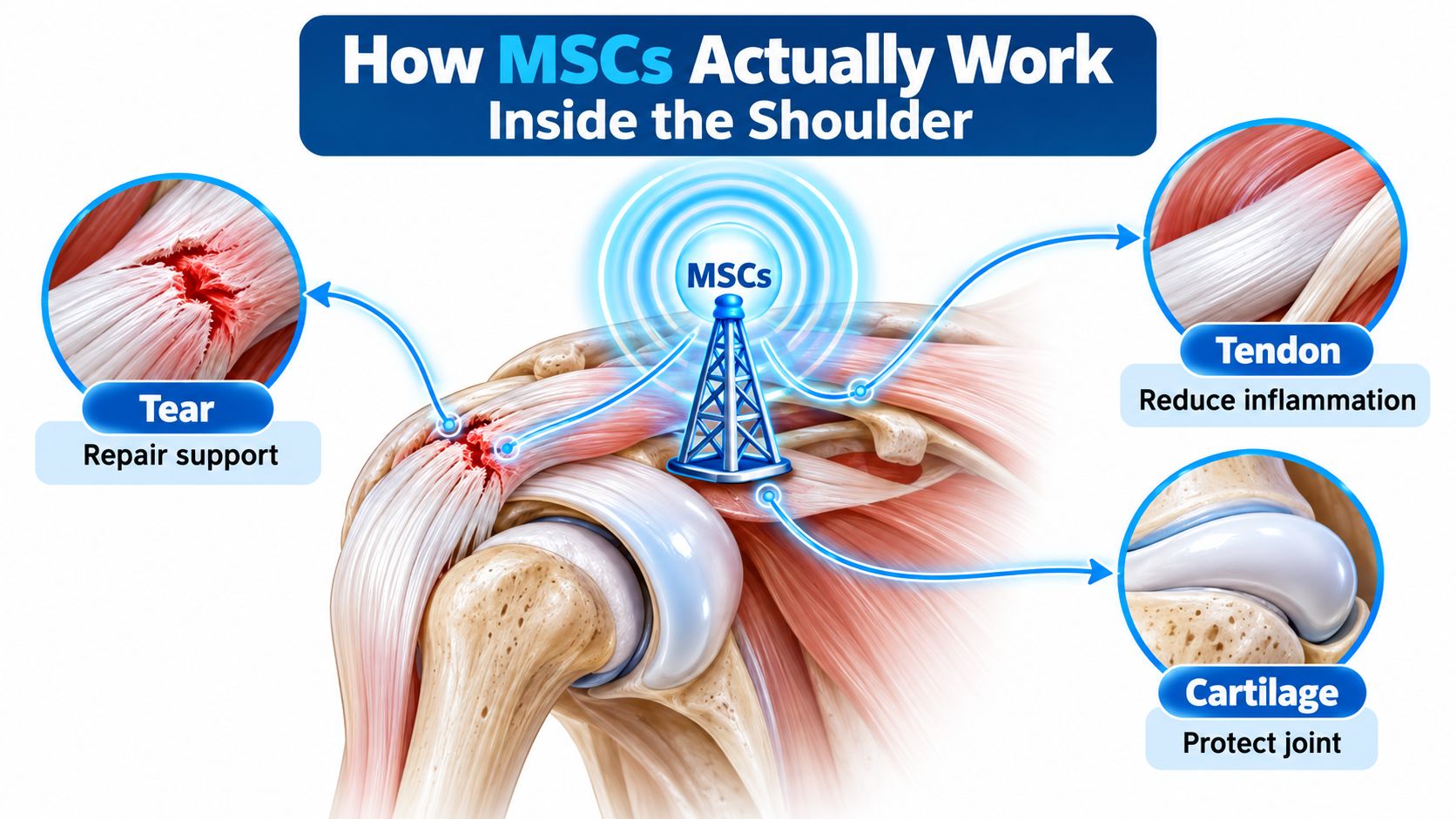
Some of the signals discussed in MSC research include interleukin-10, or IL-10, an anti-inflammatory cytokine, along with growth-related factors such as TGF-β and VEGF. MSC-derived extracellular vesicles can carry molecular instructions between cells. Together, these signals may help reduce excessive inflammatory activity, support local cell survival, influence vascular responses, and guide extracellular-matrix behavior.
That doesn’t mean the cells “know” exactly how to rebuild a shoulder. The biology is more like sending instructions to a worksite than delivering a finished replacement part. The local tissue still determines how it responds, and the injured structure may not have the capacity to restore itself fully.
The important distinction is simple: MSCs don’t differentiate into other shoulder cells as their primary therapeutic action. They send specialized signals that guide the patient’s own healing response.
This model also explains why an injection may influence more than the needle track. Signals can affect neighboring cells and the broader inflammatory environment, although the size and durability of that effect remain active research questions. A helpful plain-language explanation of how stem cell injections work should therefore describe communication then regeneration.
Shoulder Conditions MSC Injections Are Used For
Mesenchymal Stem Cells (MSCs) can help:
- Rotator Cuff Injuries
- Labrum partial tears and damage
- Cartilage loss (osteoarthritis)
- Ligament partial tears or hyperextension
- Tendon partial tears or hyperextension
Rotator-cuff tendinopathy and tears
Rotator-cuff tendinopathy involves degenerative changes in a tendon, often with pain during lifting or overhead activity. A partial-thickness tear affects part of the tendon’s thickness, while a full-thickness tear extends through it. MSCs may be considered for selected chronic tendon problems because paracrine signals could help moderate inflammation and support the surrounding repair environment.
The evidence is not uniform. For chronic partial supraspinatus tears, a randomized trial comparing MSCs in fibrin glue with fibrin glue plus saline and saline alone found no statistically significant difference in the primary between-group outcome at three months, with p = 0.35, as reported in the randomized trial of MSCs for partial-thickness supraspinatus tears.
MSCs may also be used as an adjunct during rotator-cuff repair. In that setting, the aim may be structural support and regenerative. A lower retear risk is a good thing.
Labral injury and instability
The labrum helps deepen and stabilize the shoulder socket. Tears can occur with trauma, repetitive overhead activity, or instability. The MSC rationale here is more cautious because an injection can influence surrounding capsule, tendon, and inflammatory tissue then guide rebuilding of a detached or mechanically unstable labrum.
If the shoulder repeatedly dislocates, has a substantial structural lesion, or needs stabilization, a biologic injection shouldn’t delay an orthopedic assessment. The central question is mechanical: can the joint remain stable during ordinary and sporting activity?
Glenohumeral osteoarthritis
Osteoarthritis affects the ball-and-socket joint and can cause pain, stiffness, crepitus, and reduced function. For this problem, a realistic MSC goal is symptom modulation and functional support for cartilage regeneration.
A 2015 prospective registry evaluated 115 shoulders in 102 patients with symptomatic glenohumeral osteoarthritis, rotator-cuff tears, or both. Average DASH scores improved from 36.1 to 17.1, and average pain on a 0-to-10 scale fell from 4.3 to 2.4, as reported in the prospective registry study.
Adhesive capsulitis and AC joint arthritis require the same diagnostic discipline. A frozen shoulder is dominated by capsular stiffness, while AC joint arthritis is localized to a different joint. Both issues can be helped by MSC treatment.
| Condition | Realistic MSC role | Primary outcome goal | Evidence strength |
|---|---|---|---|
| Rotator-cuff tendinopathy | Modify the local inflammatory environment and support host repair | Pain, function, and strength | Strong and a common issue healed at Dream Body Clinic |
| Partial-thickness tear | Investigational injection option in selected cases | Symptoms and activity tolerance | Strong and a common issue healed at Dream Body Clinic. Full thickness tears can’t be healed with MSCs. |
| Rotator-cuff repair | Possible biologic adjunct | Structural integrity and retear risk | Strong and a common issue healed at Dream Body Clinic. |
| Labral injury or instability | Support surrounding tissue, not guaranteed labrum replacement | Stability, pain, and function | Strong and a common issue healed at Dream Body Clinic. |
| Glenohumeral osteoarthritis | Symptom modulation and functional support | Pain and range of motion | Strong and a common issue healed at Dream Body Clinic. |
| Adhesive capsulitis or AC arthritis | Diagnosis-dependent, if considered at all | Mobility or localized pain | Strong and a common issue healed at Dream Body Clinic. |
For a more focused discussion of the question, can stem cell therapy heal a torn rotator cuff without surgery, the answer must begin with tear morphology, chronicity, tissue quality, and mechanical demands. Shoulder Stem Cell Treatment – 50 Million Mesenchymal Stem Cells + PRP & and MRI
Technique, Cell Source, Dose, and Adjuncts
A responsible consultation should make the procedure concrete. The clinician first reviews the history, examines the shoulder, confirms the diagnosis with imaging, and decides whether the target is the joint, tendon, bursa, or a surgical repair site.
MSCs may be autologous, meaning collected from your own body, or allogeneic, meaning obtained from a donor. Autologous approaches can involve bone-marrow aspiration, often from the posterior iliac crest, or adipose-derived tissue processing. The source affects the cell population, processing method, signaling profile, quality controls, and logistics. It isn’t enough to hear the word “MSC” without learning what the product contains.
Dose is another variable, not a settled universal standard. At Dream Body Clinic we have tried many different doses over the years and have found that 50 million MSCs is the optimal dose before hitting a point of diminishing returns. Shoulder Stem Cell Treatment – 50 Million Mesenchymal Stem Cells + PRP & and MRI
PRP is offered as an adjunct because it supplies a different concentration of blood-derived signaling factors. Pre-treatment and post-treatment MRI can help document structural status, while outcome measures such as pain, range of motion, strength, ASES, or Constant scores help determine whether the patient improved.
Some clinics also discuss IV MSC administration for broader immune-modulation goals. It is ok to add an IV, but we always let people know that the main issues like cartilage, ligaments, tendons and labrum get little to no blood flow so the IV by itself won’t fix and injured shoulder. It does create a better environment all around for the direct injected MSCs to heal faster.
For international patients, procedure logistics matter. A clinic may describe an in-clinic visit lasting roughly one to three hours and remote follow-up around three, six, and twelve months, but you should confirm what is included, who reviews your imaging, and how complications are managed after you return home. A transparent overview of stem cell injection shoulder cost should distinguish treatment, imaging, laboratory work, travel, follow-up, and potential additional care.
What the Shoulder Evidence Actually Shows
The most useful evidence doesn’t ask only whether patients improved. It asks compared with what, for which diagnosis, through which delivery method, and with which outcome.
A 2025 systematic review and meta-analysis included 5 studies with 228 participants. MSC groups showed significant improvements in patient-reported outcomes, shoulder range of motion, and strength. However, when MSCs augmented rotator-cuff repair, the analysis found no significant improvement in clinical or functional outcomes compared with surgery alone, according to the 2025 systematic review and meta-analysis.
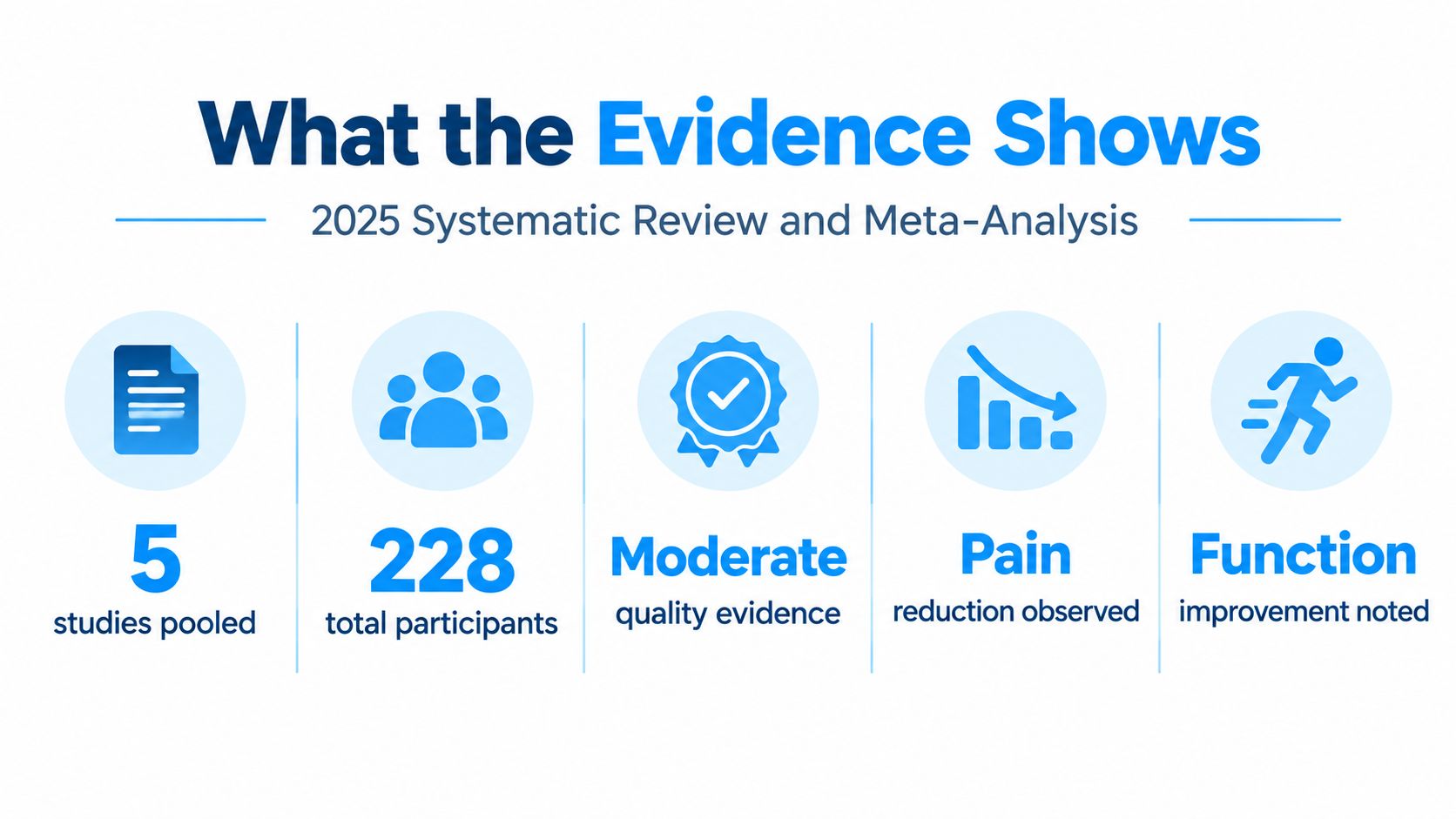
The more interesting signal was structural. MSC augmentation was associated with a lower retear risk at mid-term follow-up, with a risk ratio of 0.52 and a 95% confidence interval of 0.27 to 0.98, and at long-term follow-up, with a risk ratio of 0.24 and a 95% confidence interval of 0.11 to 0.53, in the same review. These findings support further investigation of MSCs as a surgical adjunct, and help establish an injection as a stand-alone tendon-regeneration treatment.
Shoulder Stem Cell Treatment – 50 Million Mesenchymal Stem Cells + PRP & and MRI
Why the randomized trial matters
For partial-thickness supraspinatus tears, the controlled trial compared MSCs suspended in fibrin glue with fibrin glue plus saline and saline alone. At three months, the mean activity-related pain changes were −1.37, −1.48, and −3.00 points, respectively, and the primary between-group result wasn’t statistically significant.
All groups experienced transient injection-site pain, with no persistent adverse events or significant safety differences reported in that trial.
The current literature remains small and heterogeneous, with differences in cell source, dose, delivery, rehabilitation, diagnosis, and follow-up. The strongest shoulder-specific signal comes from early-phase and relatively small studies rather than definitive large trials. At Dream Body Clinic we have over 9 years helping patients heal with the Shoulder Stem Cell Treatment – 50 Million Mesenchymal Stem Cells + PRP & and MRI . The page has many testimonials and so does our YouTube channel.
Who Is a Reasonable Candidate
Candidacy begins with imaging-confirmed diagnosis, not with a desire to avoid surgery at any cost. A clinician needs to understand the tear pattern, tissue quality, arthritis severity, chronicity, muscle condition, range of motion, strength, and activity goals before discussing an MSC injection.
A regenerative consultation may be reasonable for someone with chronic rotator-cuff tendinopathy or a partial-thickness tear that hasn’t responded adequately to rehabilitation and other appropriate care. Selected patients with smaller full-thickness tears or lower-demand goals may also discuss an investigational approach, but the consultation must include the limits of nonoperative treatment.
Glenohumeral arthritis presents a different decision. A patient who wants to postpone shoulder replacement may ask whether symptom modulation is realistic, especially when joint destruction isn’t advanced. That conversation should be made after reviewing this page Shoulder Stem Cell Treatment – 50 Million Mesenchymal Stem Cells + PRP & and MRI
Situations requiring caution
A biologic injection shouldn’t delay prompt orthopedic evaluation when the shoulder has:
- A massive, retracted tear: Retraction, muscle atrophy, and poor tissue quality can limit the likelihood that an injection will restore mechanical function.
- An acute traumatic tear in an active patient: Some injuries have a strong surgical track record and may deteriorate if assessment is postponed.
- Advanced bone-on-bone arthritis: Joint replacement may be the established option when pain and loss of function are severe.
- Possible infection or another red-flag diagnosis: Infection, fracture, neurological symptoms, or referred neck pain require a different workup.
Smoking, metabolic health, age, previous injections, medication history, and activity level may all influence healing and risk. These factors shouldn’t be used as automatic exclusions, but they should be addressed openly. A recreational swimmer with a chronic partial tear has a different decision profile from a competitive overhead athlete with an acute full-thickness injury.
Before booking international travel be sure to call (888) 704-3977 for a free consultation.
Common Misconceptions Worth Correcting
The first misconception is that MSCs turn into new shoulder tissue on demand. They don’t. The main therapeutic model is paracrine signaling, in which MSCs release specialized messages that influence inflammation, cell survival, vascular responses, and matrix remodeling. The body’s existing cells remain responsible for the repair response.
The second misconception is that a stem cell injection is automatically a one-time fix. The majority of our patients fully heal from 1 treatment, but a small percentage don’t get full results and often come back a year later for a full up treatment to get to 100%.
Regulation is part of the medical decision
U.S. regulators state that regenerative products haven’t been approved for any orthopedic condition, including shoulder conditions, but in Mexico their version of the FDA is COFEPRIS and they have made Mesenchymal Stem Cell treatment legal with the appropriate permits. Dream Body Clinic follows all COFEPRIS rules and regulations and all of our licenses and certifications are listed here – Our Lab
That warning doesn’t prove that every investigational MSC procedure is ineffective. It does mean you must distinguish regulatory authorization, clinical-trial evidence, and clinic-specific claims. A treatment being available in another country doesn’t automatically mean it has established approval or proven effectiveness in your home country.
Ask the clinic:
- Cell identity: What exactly is being injected?
- Source and screening: Is the product autologous or allogeneic, and what testing is performed?
- Processing: Where is it prepared, and how is sterility controlled?
- Dose and viability: How are cell numbers measured?
- Delivery: Is the injection image-guided, and what structure is targeted?
- Outcomes: Will the clinic measure pain, motion, strength, function, and MRI findings?
- Risk management: Who handles complications during and after international travel?
Marketing language such as “shoulder regeneration” often compresses a complex, uncertain process into a confident promise. We provide all this information and more at Shoulder Stem Cell Treatment – 50 Million Mesenchymal Stem Cells + PRP & and MRI
Dream Body Clinic offers international consultations for shoulder-focused MSC protocols, including targeted injections and adjuncts such as PRP and MRI-based assessment. If you’re considering stem cell injections for shoulder pain, visit Dream Body Clinic to submit your case for a clinician-led review and discuss whether the proposed approach matches your diagnosis, imaging, and goals.
Call us at (888) 704-3977 or on WhatsApp at +523222321055 for a free consultation.