
You've tried physical therapy, adjusted your workstation, taken anti-inflammatory medication, and perhaps received an injection. Your neck still hurts, and the pain may travel into your shoulder or arm, making sleep, driving, or working difficult. Searching for stem cell treatment for neck pain can feel like searching for one last option that might address the problem rather than temporarily quieting it.
That hope deserves a careful answer. Mesenchymal stromal cells, or MSCs, have a plausible biological mechanism, but the evidence for cervical treatment remains much less developed than the marketing language suggests. The key questions are what the cells do, whether symptom relief proves disc repair, and how an international patient can verify a clinic, product, and treatment plan before traveling.
Table of Contents
- When Neck Pain Leads Someone to Consider Stem Cells
- How MSCs Actually Work in the Neck
- The Diagnostic and Imaging Workflow Before Treatment
- What a Typical Neck Protocol Looks Like
- What the Published Evidence Actually Shows
- Common Misconceptions Worth Clearing Up
- A Due-Diligence Checklist for International Patients
- Putting It All Together for a Real Decision
When Neck Pain Leads Someone to Consider Stem Cells
Consider a patient who has lived with neck pain for months or years. Physical therapy improved mobility but didn't resolve the pain. Medication helped for a while, then became less useful. A steroid injection reduced symptoms temporarily, yet the discomfort returned. An MRI shows disc degeneration or a herniated disc, and online searches begin producing clinics that promise “regeneration.”
That patient isn't only looking for a new procedure. They're trying to understand whether the next step should be another conservative treatment, a targeted injection, surgery, or an investigational cellular therapy. The decision becomes more complicated when symptoms include arm pain, numbness, weakness, headaches, or changes in balance, because those symptoms may involve nerve roots or the spinal cord rather than the disc alone.
A responsible discussion starts by separating the diagnosis from the treatment label. “Neck pain” can arise from a cervical disc, facet joint, muscles, nerve-root irritation, spinal stenosis, or spinal cord compression. A treatment aimed at local inflammation may not address mechanical compression, instability, or progressive neurological impairment.
A practical orientation: stem cell treatment should be evaluated as a specific intervention for a specific diagnosis, not as a universal solution for every painful cervical MRI.
This article focuses on MSC-based approaches and the paracrine signaling mechanism behind them. It also examines the limited cervical evidence, explains why MRI changes and symptom changes aren't interchangeable, and provides questions international patients should ask before committing to treatment abroad. By the end, you should have a clearer basis for deciding whether conventional care, a specialist assessment, or a properly governed clinical trial deserves priority.
How MSCs Actually Work in the Neck
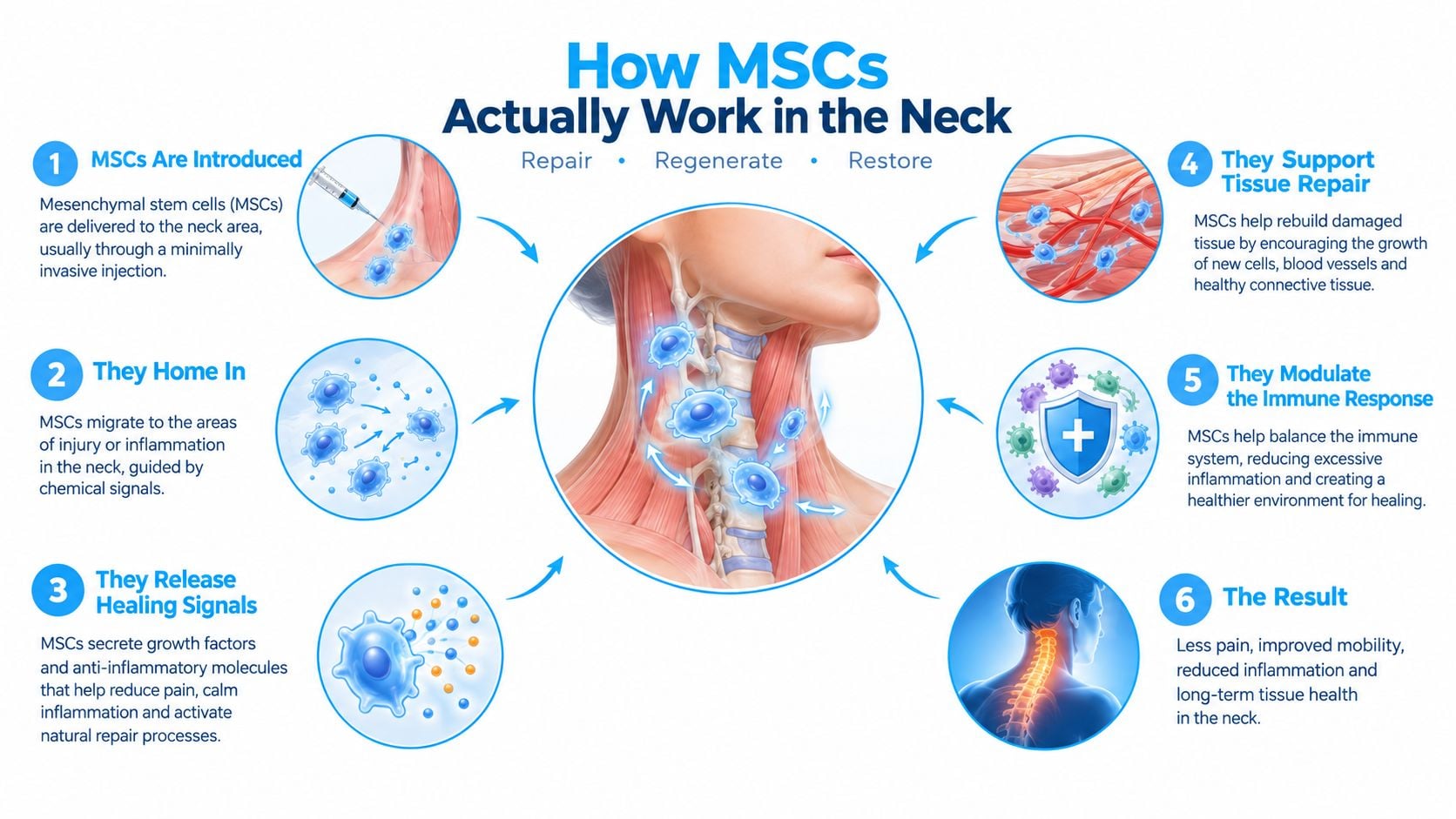
A useful analogy comes before the technical explanation. MSCs act less like replacement bricks and more like temporary project managers. They don't become the missing bricks in a damaged disc wall. Instead, they send instructions to the body's existing repair crews, helping coordinate the local environment.
Mesenchymal stromal cells don't primarily differentiate into new disc, cartilage, or nerve cells. Reviews describe limited survival and engraftment at injury sites, which makes direct transformation an insufficient explanation for most proposed therapeutic effects. The central concept is the paracrine effect, meaning that the cells release specialized biological signals that influence nearby cells and tissues.
Those signals can include:
- Cytokines and growth factors, which influence inflammation and cell behavior.
- Chemokines, which help coordinate communication among immune and repair cells.
- Extracellular vesicles, which carry molecular messages between cells.
- Immunomodulatory signals, which may alter excessive or harmful inflammatory activity.
In a degenerated cervical disc, irritated facet joint, or inflamed nerve-root environment, the proposed benefit comes from changing the local conversation. The injected cells may release signals that encourage resident cells to survive, regulate inflammation, and support repair-related activity. That biological rationale is different from claiming that the injection rebuilds a disc by supplying permanent replacement tissue. The review of MSC biology and paracrine activity describes why direct differentiation isn't enough to explain the treatment's proposed effects, while a review of MSC secretomes and immunomodulation discusses anti-inflammatory, angiogenic, neuroprotective, and related signaling effects.
The distinction matters because a plausible mechanism isn't proof of a clinical outcome. A signal that reduces inflammation might lessen pain without restoring disc height. It might improve the local environment without removing material that compresses a nerve. It could also produce no meaningful benefit if the patient's symptoms come from a problem the injection can't address.
For a patient-friendly explanation of the injection process, see how stem cell injections work. The important question isn't whether MSCs can send repair signals. They can. The important question is whether those signals reliably improve pain, function, neurological symptoms, or disc structure in people with cervical disease.
The video below offers another visual explanation of the treatment concept.

The Diagnostic and Imaging Workflow Before Treatment
A cervical protocol should begin with diagnosis, not with a cell count. The clinician needs to identify the most likely pain generator and determine whether the MRI finding matches the patient's symptoms.
The history should distinguish several patterns:
- Discogenic pain, often felt centrally or near the lower neck, sometimes aggravated by movement or loading.
- Radiculopathy, involving pain, tingling, numbness, or weakness along a nerve-root distribution.
- Myelopathy, which may involve balance problems, gait changes, hand clumsiness, or other signs of spinal cord involvement.
- Facet-joint pain, which can cause localized or referred pain with certain neck positions.
- Myofascial pain, arising from muscles and surrounding soft tissues rather than the disc itself.
A neurological examination should assess strength, sensation, reflexes, coordination, and gait. The clinician should also record baseline measures, such as neck pain, arm pain, medication use, and daily function. A neck disability index or another validated functional measure gives the patient and clinician something more useful than a general statement that the neck feels “better.”
Imaging must answer a clinical question
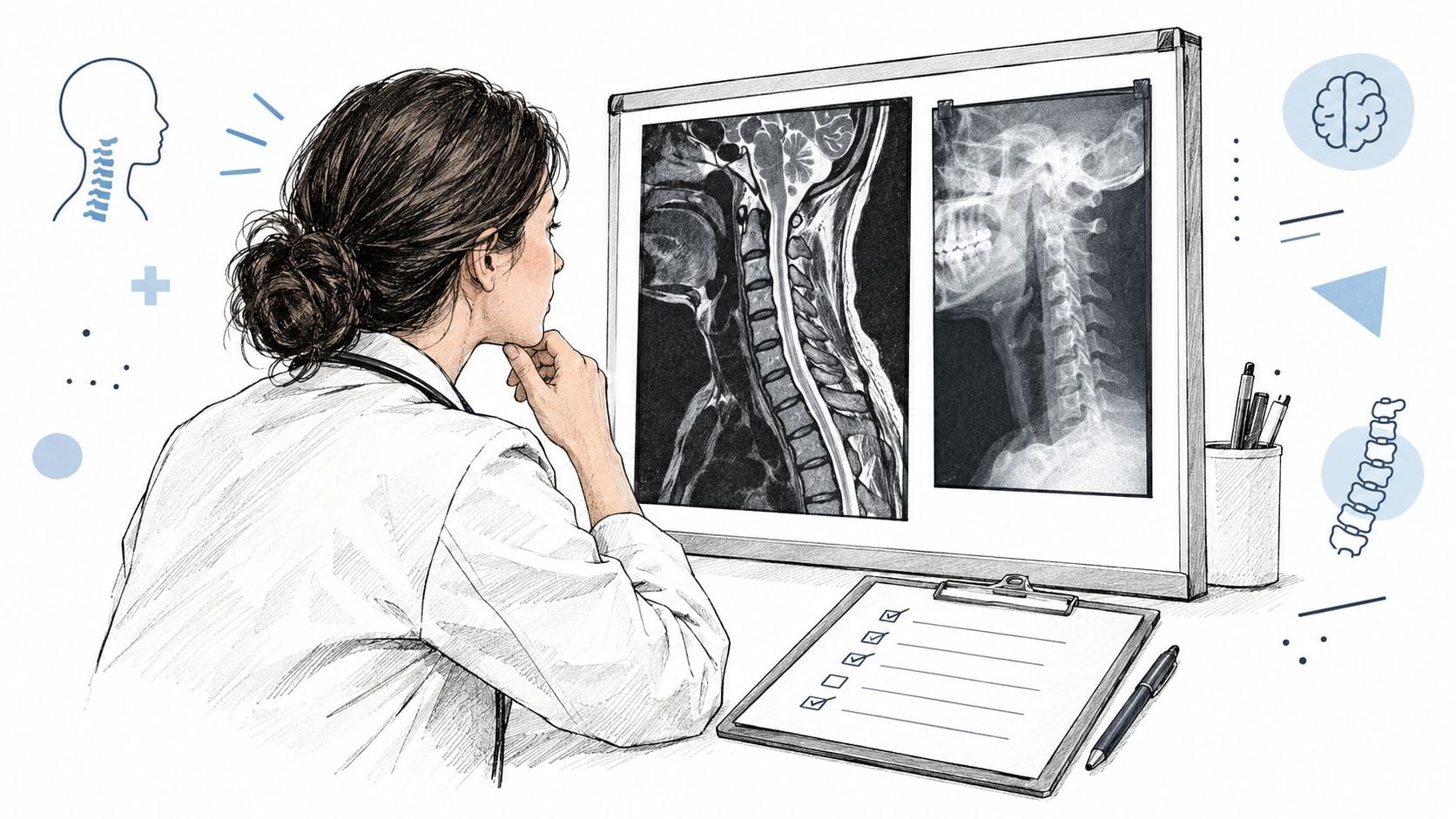
A recent cervical MRI can show disc degeneration, bulging, herniation, stenosis, facet changes, or spinal cord effects. It doesn't automatically identify which finding causes pain. Imaging-pathology concordance means that the scan, examination, and symptom pattern point toward the same structure.
For example, a disc abnormality may appear on an MRI while the patient's primary complaint comes from a facet joint or muscle. Conversely, arm weakness and reflex changes may indicate nerve or spinal cord involvement that requires a different treatment pathway. A focused discussion of facet-related symptoms can help patients understand why cervical facet-joint assessment matters before selecting a cellular injection.
Some findings should move the patient toward conventional urgent evaluation rather than regenerative treatment. These include progressive weakness, gait disturbance, bowel or bladder changes, fever, a history of cancer, or significant trauma. A clinic that promises an injection without screening for these problems is not providing a complete cervical assessment.
Pre-treatment and follow-up MRI may help document whether structural changes occurred. Still, a changed image isn't automatically a clinical success. Pain, strength, sensation, function, and neurological status need their own measurements.
What a Typical Neck Protocol Looks Like
A published clinic protocol can help patients understand the moving parts of treatment, but it shouldn't be mistaken for a universal medical standard. Different providers may use different cell sources, processing methods, doses, routes, imaging techniques, and follow-up schedules. A consultation should explain each choice rather than presenting one package as the only legitimate approach.
The components patients should see discussed
Cell source and dose should be documented clearly. Dream Body Clinic describes a neck protocol using 100 million MSCs around the most affected vertebrae and another 100 million MSCs intravenously, as stated in its publisher information. That description is a clinic-specific protocol, not evidence that this dose is established as the correct dose for every cervical condition.
Delivery route depends on the intended target. A local, image-guided injection may be directed toward a disc or facet joint when the assessment identifies that structure as the likely pain generator. An intravenous route is broader and is sometimes presented as supporting systemic immune modulation, but it doesn't replace accurate local diagnosis.
Adjuncts such as platelet-rich plasma, or PRP, may appear in orthopedic protocols. PRP supplies platelet-derived signaling molecules and may be combined with MSCs to influence the local repair environment. Combination treatment remains protocol-dependent, so patients should ask what each component is intended to do and which outcome will show whether it helped.
MRI sequencing provides a baseline and may support later structural assessment. The scan should be interpreted alongside pain, function, neurological findings, and medication use, because imaging alone can't establish meaningful recovery.
In-clinic treatment may be described as lasting one to three hours in the publisher's patient-journey information. Follow-up check-ins are commonly planned at three, six, and twelve months in that same clinic context. These are operational details of one provider's approach, not validated timelines that guarantee when improvement will occur.
The most useful consultation checklist includes:
- What is being injected? Ask for the cell source, manufacturing description, identity testing, viability testing, and dose.
- Where will it go? Clarify whether the plan involves a disc, facet joint, intravenous infusion, or another route.
- How will outcomes be measured? Request defined measures for neck pain, arm pain, numbness, strength, function, medication use, and imaging.
- What happens if symptoms worsen? The clinic should explain adverse-event monitoring, emergency access, and a rescue plan.
What the Published Evidence Actually Shows
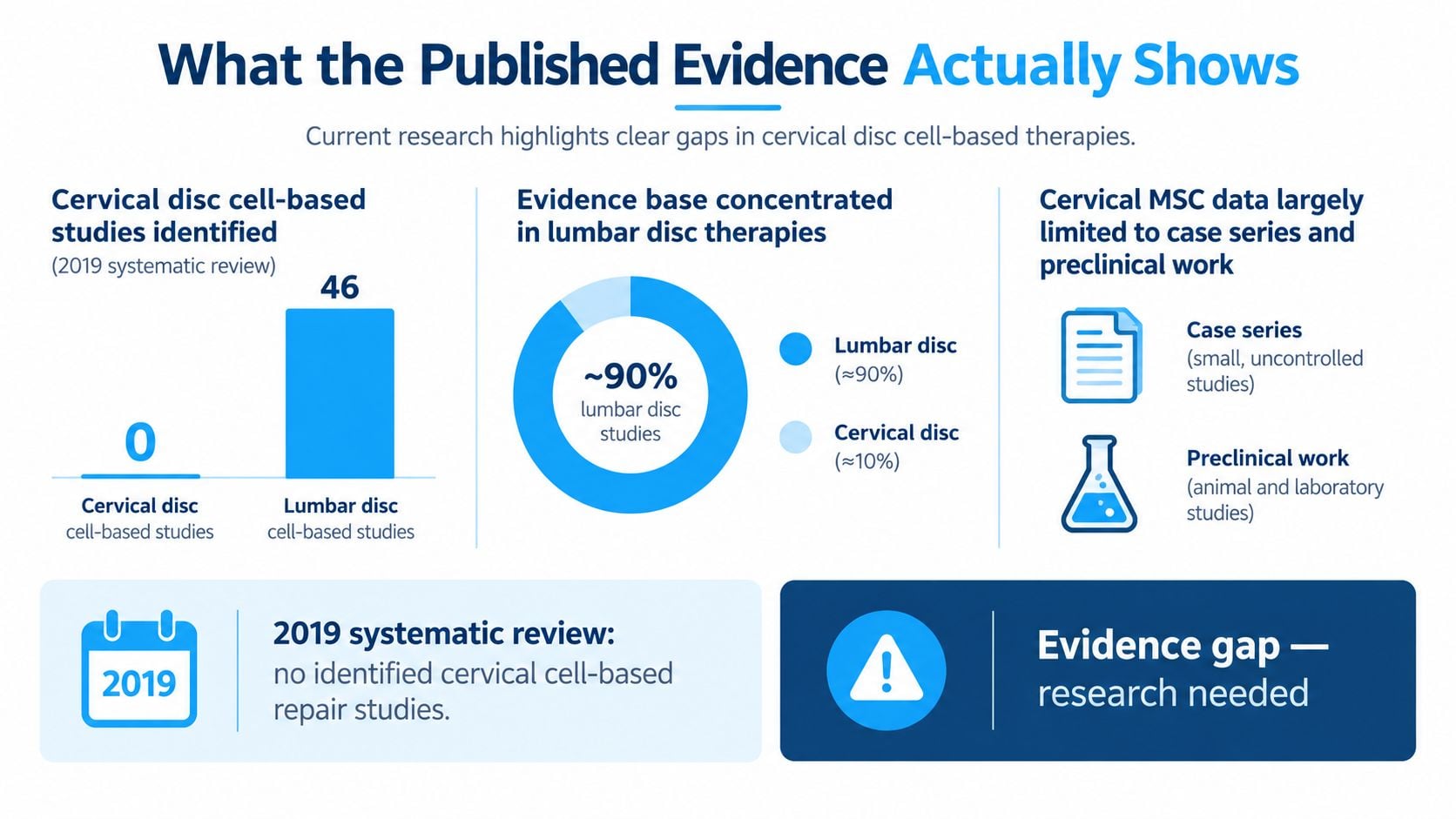
The cervical evidence gap is the first fact a patient should understand. A 2019 systematic review of cell-based intervertebral-disc therapies identified no studies specifically evaluating cell-based repair of the cervical intervertebral disc in the cited review. More recent evidence has focused mainly on lumbar degenerative disc disease, so lumbar findings cannot be transferred to the neck.
A 2021 meta-analysis included only three eligible studies involving 104 participants. It reported higher odds of reaching clinically meaningful disability-improvement thresholds, including an odds ratio of 2.06 for at least a 10-point improvement in the Oswestry Disability Index and 2.01 for at least a 15-point improvement. Those results suggest a signal worth investigating, but they don't establish that cervical MSC injections regenerate discs or eliminate neck pain.
The same review found that visual-analogue pain scores weren't different between MSC and control groups at 12 months. Disability-score differences also weren't statistically significant at three, six, or twelve months, with a significant disability improvement appearing only in analyses lasting 24 months or longer. A small evidence base with mixed findings calls for cautious interpretation, not a promise of predictable relief.

Why MRI and symptoms can disagree
A recent spine review found that MSC or mesenchymal precursor-cell injections produced some six-month MRI improvements in disc height and signal, while pain, disability, and SF-36 quality-of-life outcomes were statistically indistinguishable from sham treatment in the cited review. Only about 40% of patients were described as responders in one trial.
In plain language, an MRI can look different without the patient feeling meaningfully better. The reverse can also happen. A person may experience symptom relief through reduced inflammation or improved function without demonstrating disc regeneration on imaging. Average-group outcomes are more useful for estimating likely benefit than selected responders or individual testimonials.
A 2024 review of cell and platelet-based spinal treatments also described clinically meaningful pain and disability improvements in some studies through two years, but emphasized that the evidence was heterogeneous. Products, delivery methods, comparators, and outcome measures varied, making broad conclusions difficult in the review of spinal cell and platelet treatments.
Common Misconceptions Worth Clearing Up
Misconception one
“The injected cells become my new disc, cartilage, or nerve.”
That isn't the main biological explanation for MSC therapy. The cells don't transform into replacement cervical disc, cartilage, or nerve cells as a reliable treatment mechanism. Their proposed role is paracrine signaling, in which they release specialized signals that may influence inflammation and the activity of nearby cells.
This distinction changes the promise. A clinic can reasonably discuss potential signaling and immunomodulatory effects. It shouldn't present the injection as inserting permanent replacement parts into the spine.
Misconception two
“A better MRI means the disc is healed.”
Structural MRI changes and clinical improvement are separate outcomes. Disc height or signal may change while pain and disability remain similar to sham treatment, as the evidence discussed earlier illustrates. A patient should ask whether the treatment plan will measure both structural findings and lived outcomes, including arm pain, numbness, strength, sleep, work, and daily activity.
The word “healing” can hide several different claims:
- Symptom relief, meaning less pain or improved comfort.
- Neurological improvement, meaning better strength, sensation, or reflex-related function.
- Disc regeneration, meaning biological restoration of disc tissue.
- Structural MRI change, meaning an observable imaging difference.
These outcomes shouldn't be bundled together as if one proves all the others.
Misconception three
“Regenerative” means approved and proven.
A testimonial can describe one person's experience, but it can't establish effectiveness for all patients. The U.S. Food and Drug Administration's consumer information states that no regenerative-medicine product has been approved for orthopedic conditions including disc disease, back pain, or neck pain. It also explains that the broadly approved stem-cell products in the United States are blood-forming hematopoietic progenitor-cell products derived from umbilical-cord blood for disorders affecting blood production, not orthopedic or spinal conditions.
International clinics operate within different national frameworks, but a country's framework isn't the same as approval for a specific product or indication. Patients need those terms separated before they interpret a clinic's website, testimonial, or use of the word “regenerative.”
A Due-Diligence Checklist for International Patients
Traveling for treatment adds practical responsibilities. A patient should verify the product, the facility, the clinician, the regulatory context, and the follow-up plan before booking a flight.
Ask for written answers to the following:
| Topic | What to Ask or Verify |
|---|---|
| Cell source | Are the cells autologous or donor-derived, and how was the donor screened? |
| Testing | What infectious-disease, identity, viability, sterility, and contamination testing is documented? |
| Product traceability | Can the clinic identify the lot or batch and provide manufacturing records? |
| Dose and route | What cell count will be used, and will delivery be local, intravenous, or both? |
| Injection safety | Will cervical injections use imaging guidance, and which structure is the target? |
| Emergency planning | What adverse events are monitored, and what is the emergency or rescue plan? |
| Follow-up | Who reviews symptoms and imaging after the procedure, and how are adverse events reported? |
| Diagnosis | Do the MRI findings actually correspond with the pain pattern and examination? |
| Alternatives | What conventional treatments, specialist opinions, or trials remain appropriate? |
A national regulatory framework, such as Mexico's COFEPRIS framework, doesn't automatically mean that every cell product is approved for every indication. Patients should distinguish national oversight, authorization for a specific product, approval for a specific indication, and participation in an ethically reviewed clinical trial. Those categories can overlap, but they aren't interchangeable.
The FDA has warned that unapproved regenerative products may involve risks including infection, neurological events, unintended tissue growth, immune reactions, and contamination. Its consumer alert also explains that no stem-cell products are approved for orthopedic conditions, neurological disorders, chronic pain, or other conditions commonly marketed online in its regenerative-medicine warning.
In February 2025, the FDA cleared an investigational new-drug application for BRTX-100 to study chronic cervical discogenic pain. That development is important because it shows cervical cellular treatment remains an investigational research area rather than an established standard of care.
International patients can use this preparation checklist for stem cell therapy in Mexico as a starting point, then request documents directly from the clinic. Don't proceed without clarifying red flags, imaging-pathology concordance, alternatives, and what happens if the treatment doesn't help.
Putting It All Together for a Real Decision
Return to the patient who has tried therapy, medication, and injections. MSC treatment may offer a biologically plausible way to influence inflammation through paracrine signaling, but the cells don't become replacement disc, cartilage, or nerve tissue. The cervical evidence remains limited, and lumbar findings can't guarantee a neck-pain result.
A transparent protocol should identify the pain generator, document the cell product and route, use appropriate imaging guidance, define outcome measures, and explain adverse-event surveillance. It should also make room for physical therapy, targeted injections, specialist evaluation, surgery when indicated, and properly governed clinical trials.
The honest position in 2026 is that MSC therapy for neck pain is an investigational option, not a guaranteed cure. It may help some patients, but it can't promise disc regeneration, neurological recovery, or lasting pain relief for every diagnosis. Ask for documentation rather than slogans, compare symptom outcomes with structural claims, and seek urgent conventional care for progressive weakness, gait changes, bowel or bladder symptoms, fever, cancer history, or significant trauma.
Dream Body Clinic offers cervical regenerative-medicine evaluations and publishes MSC protocols that may include targeted treatment around affected vertebrae, intravenous administration, PRP, MRI review, and remote follow-up. If you're considering treatment abroad, visit Dream Body Clinic to request a case review and discuss your diagnosis, imaging, alternatives, and the evidence limitations before making a decision.