A single shoulder stem cell injection in the U.S. in 2026 is commonly priced around $3,500 to $9,000, with broader self-pay estimates for one joint often cited at $3,500 to $12,000. In Mexico, shoulder pricing is often lower at roughly $3,500 to $10,000, but MRI, blood work, and follow-up are often billed separately, so the headline price isn’t always the full episode-of-care cost.
This is why Dream Body Clinic offers the best price of $3,500usd for the highest quality stem cells + MRI + Blood Work Included – Shoulder Stem Cell Treatment – 50 Million Mesenchymal Stem Cells + PRP & and MRI
All of our prices are listed on the website www.dreambody.clinic so that everyone knows they are getting the same price and from the best lab possible. All guided with the newest deep field ultrasound.
If you’re reading this with a sore shoulder, a stack of imaging reports, and a quote that feels hard to decode, that’s normal. Patients don’t struggle with the word “stem cell.” They struggle with what they’re paying for.
One patient gets told a shoulder injection is a simple office procedure. Another sees a much higher quote because the plan includes imaging guidance, PRP, and a more involved orthopedic workup. Both are described as “stem cell treatment,” but they aren’t the same product, the same process, or the same level of care.
That confusion gets worse when people assume the cells are supposed to turn into brand-new tendon or cartilage. In orthopedic care, mesenchymal stem cells, or MSCs, are better understood as signaling cells. They don’t primarily fix the shoulder by becoming new shoulder tissue. They help by sending out biological signals that guide inflammation control and tissue repair. Once you understand that, shoulder pricing starts to make more sense.
The real question isn’t just “What does a shoulder stem cell shot cost?” It’s “What exactly is included in the whole treatment event, and is that treatment built around precise delivery of a useful biological signal?”
Table of Contents
- Introduction What Shoulder Stem Cell Injections Cost Today
- How Shoulder MSCs Work Through Paracrine Signaling
- What Drives Your Stem Cell Injection Shoulder Cost
- United States vs Mexico Pricing and What Is Included
- Inside a Complete Shoulder Treatment Package
- Results Value and When Cost Makes Sense
- Choosing Your Next Step With Confidence
Introduction What Shoulder Stem Cell Injections Cost Today
A common starting point looks like this. You have shoulder pain that keeps showing up when you reach overhead, sleep on one side, carry groceries, or try to train. Then you receive a quote for a stem cell injection, and the number alone does not tell you much about what you are buying.
Patients reviewing their first quote often understand the term stem cell but struggle to decode what the fee covers. One clinic may price a shoulder injection as a straightforward office procedure. Another may quote far more because the plan includes image guidance, a physician workup, added biologics such as PRP, and follow-up visits. Both may be labeled “stem cell treatment,” even though the episode of care is different in important ways.
The current price range patients usually see
For 2026, independent pricing guides place a single shoulder stem cell injection in the United States at roughly $3,500 to $9,000, while broader self-pay estimates for one joint injection commonly run $3,500 to $12,000 according to Medical Frontier’s regenerative cost and condition guides. A separate 2026 cost guide also reported a typical U.S. self-pay range of $3,000 to $8,000 for a single joint injection such as the shoulder, with a shoulder-specific range of $3,500 to $9,000 for related regenerative joint therapy in Medical Frontier’s pricing overview.
Mexico is often quoted lower, with independent summaries placing shoulder pricing at about $2,500 to $7,000. Some international clinic guides list higher package prices per shoulder as well. The key point is simple. The advertised number may reflect only the injection, or it may include parts of the surrounding workup and aftercare.
These prices don’t really reflect what you get though. Clinics in the USA are severely limited in what they can offer versus places like Mexico. The USA doesn’t allow the isolation and cultivation (replication) of stem cells for administration so that means they can’t offer a pure product of stem cells or in high numbers. So it is not really comparing apples to apples when comparing USA treatments to those abroad.
Why shoulder pricing gets confusing fast
The shoulder is less like one hinge and more like a small team of structures working together. Rotator cuff tendons, the labrum, the joint lining, the AC joint, and arthritic surfaces can all produce “shoulder pain.” Those problems do not always need the same target, the same imaging support, or the same procedural setup.
That matters because MSCs are usually being used for their signaling effects, not as tiny replacement parts. If the goal is to place signaling cells where they can influence the local repair environment, then delivery matters. A price quote starts to make more sense once you ask practical questions: Was imaging used to place the cells precisely? How many cells were prepared or delivered? Was the shoulder fully evaluated first? What follow-up is included if recovery needs to be monitored over weeks or months?
A helpful comparison is ordering surgery versus ordering an operating room, anesthesia, implants, and post-op care as separate line items. The total matters more than the headline.
Common cost differences come from items such as:
- Imaging guidance: Ultrasound or other image-guided placement may be included, or billed separately.
- Diagnostic review: MRI review, exam, and case planning may be bundled, or added later.
- Biologic add-ons: Some protocols pair MSCs with PRP or other injectables.
- Cell details: Processing method and reported cell count can affect price and what the patient is told to expect.
- Follow-up care: Recheck visits and recovery monitoring may be part of the fee, or absent.
A more useful question is, “What does the full shoulder treatment event include, and how carefully are the cells delivered to create a useful biological signal?”
How Shoulder MSCs Work Through Paracrine Signaling
People often picture stem cells as tiny replacement parts. That’s the wrong mental model for shoulder care.
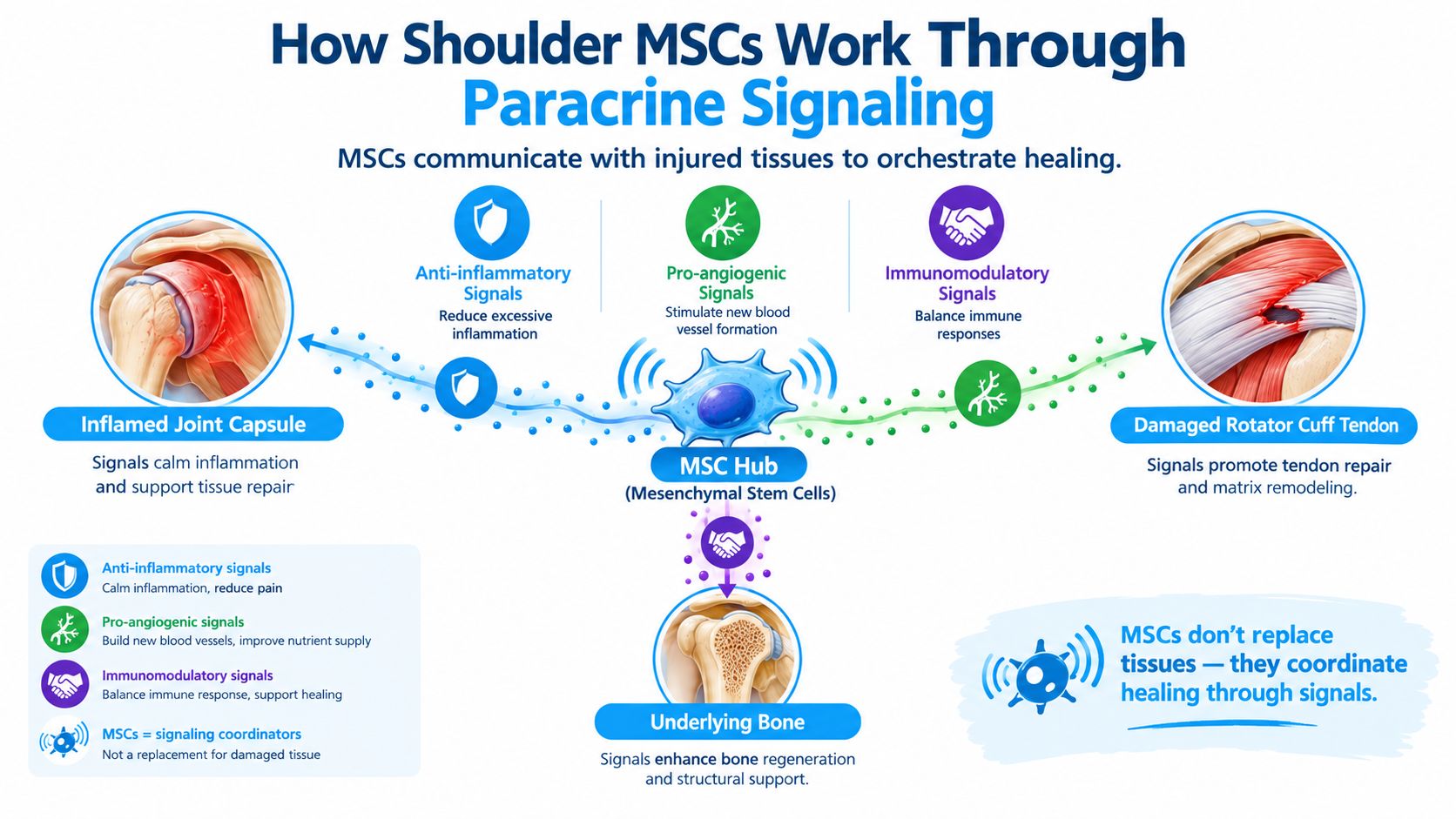
In orthopedic regenerative medicine, MSCs don’t primarily work by differentiating into new shoulder tissue. The more accepted explanation is that they act through the paracrine effect, meaning they release specialized biological signals that influence the local healing environment. A 2010 review explains that although MSC differentiation can occur, “most of the therapeutic effects are likely due to MSCs releasing soluble factors” and concludes that paracrine signaling is the primary mechanism behind benefits such as reduced inflammation and improved repair in this PubMed Central review on MSC paracrine effects.
A simple way to picture it
Think of the injured shoulder like a construction site after a storm. The MSCs aren’t showing up to become new roof shingles, bricks, and wiring. They’re acting more like a site foreman.
They send signals that help coordinate what happens next. Some signals may calm an overactive inflammatory response. Others may support blood vessel formation or influence how local repair cells behave. That doesn’t mean the shoulder instantly rebuilds itself. It means the biological environment may become more favorable for repair and symptom improvement.
Paracrine signaling means cells help nearby tissues by sending out biochemical messages, not by turning into replacement parts.
Why that mechanism matters for cost
Once you stop thinking of MSCs as “new tissue in a syringe,” the price drivers look different. You’re not only paying for the idea of cells. You’re paying for a protocol designed to deliver a meaningful biological signal to the right place.
A later systematic review found that stem-cell-derived paracrine factors can decrease apoptosis and increase angiogenesis, cell proliferation, and cell viability. this review of stem-cell-derived paracrine factors.
This is also why some educational resources on sports medicine and recovery spend more time discussing signaling biology than hype. For readers comparing joint applications, it’s also useful to see how clinics describe protocols for stem cell therapy for osteoarthritis.
What Drives Your Stem Cell Injection Shoulder Cost
Once patients start gathering quotes, they notice something frustrating. Two clinics can both say “shoulder stem cell injection” and still be pricing very different things.
Historically, that spread has widened. A 2021 university price list showed unilateral stem cell treatment at $3,000 and bilateral treatment at $3,500, while later guides reported typical U.S. shoulder costs of $3,000 to $12,000, and culture-expanded stem cell programs reaching $15,000 to $45,000. That doesn’t mean every higher quote is excessive. It means the market now includes both basic injection visits and much more expensive advanced-cell programs.
The biggest cost drivers
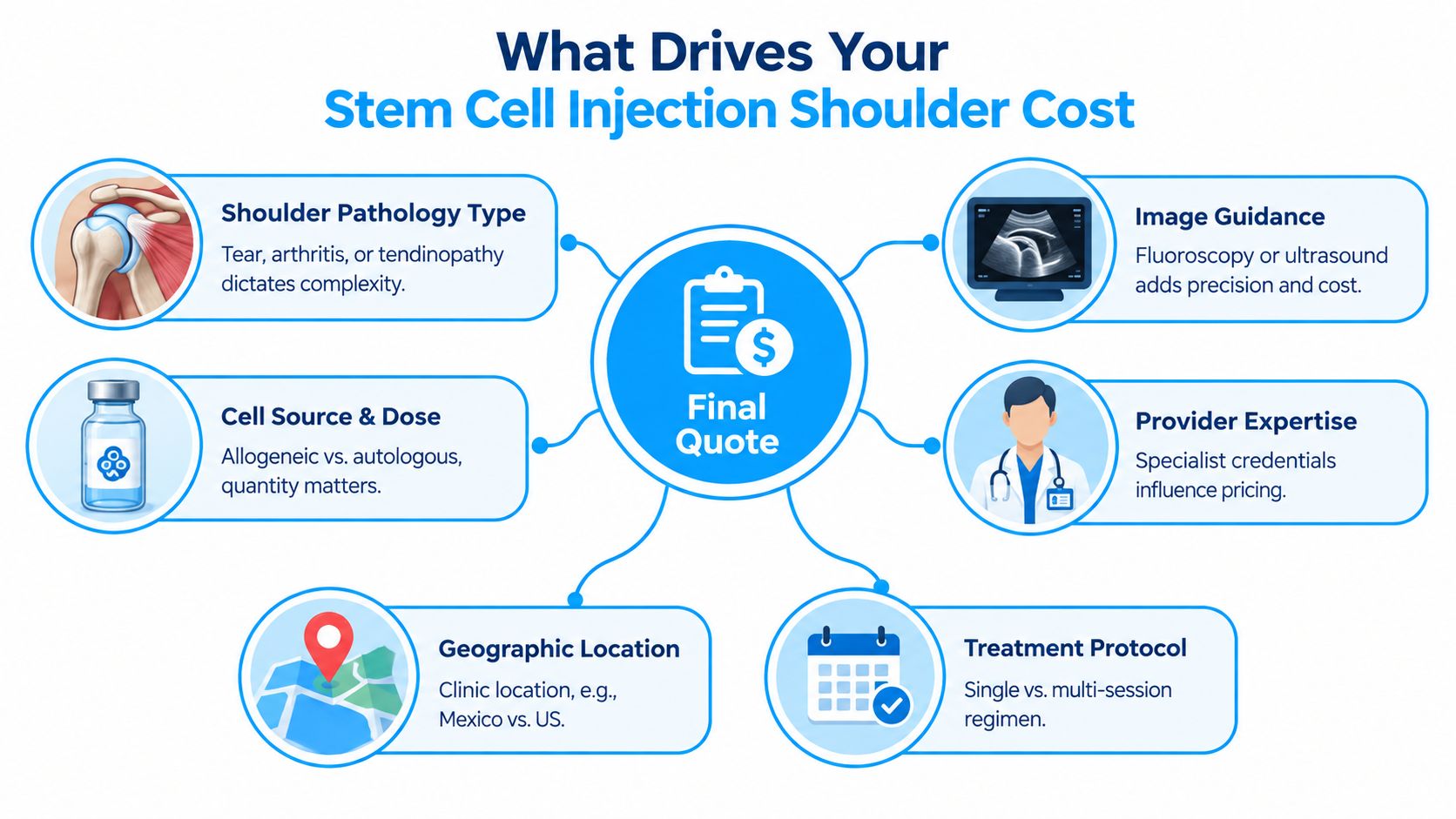
Here are the main variables that usually move the final quote.
- Pathology type matters: A straightforward AC-joint pain case may not involve the same planning as rotator cuff pathology, labral injury, or more complex multi-structure pain.
- Cell source changes pricing: Independent cost reporting lists umbilical cord MSC shoulder injections at $2,500 to $6,000, BMAC at $3,000 to $7,000, and adipose-derived stem cells at $3,500 to $8,000.
- Dose and protocol intensity matter: More involved programs may use higher cell counts or combine local treatment with broader regenerative planning.
- Image guidance adds value and cost: Precision placement into the right tissue plane or joint target isn’t the same as a blind injection.
- One shoulder or both: A single-sided plan isn’t priced like bilateral treatment.
- Adjunct therapies: PRP, additional diagnostics, and post-procedure rehab support can materially change the total.
- Clinic setting and expertise: Specialty orthopedic programs tend to price differently from simpler office injections.
This is why we make it easy to understand with the Shoulder Stem Cell Treatment – 50 Million Mesenchymal Stem Cells + PRP & and MRI
A practical way to read a quote
One useful question is this: What am I buying besides the syringe?
A lower number may cover only the injection itself. A higher number may include consultation, image guidance, PRP, procedure planning, and follow-up. Those aren’t interchangeable.
Practical rule: If they are outside the USA then ask how many incubators they have. If they don’t have at least 15 or more then be wary as it means they are probably replicating the MSCs to very far passages and freezing MSCs for later use.
Exosomes: The Hype and the Truth
We don’t offer exosomes individually because MSCs work by releasing exosomes. So you are better to get more stem cells than to add exosomes. MSCs are smart and know what exosomes to release at the correct place. Exosomes are not smart and you have to hope that you are delivering the correct exosomes to the correct place at the correct time. This is impossible to do because there are over 1,000 different types of exosomes and they are so small that we don’t even know what each one does yet. The filtration process is so rudimentary that the biologists compare it to taking a pile of dirt and using a screen to sift out the big rocks. They have to do this because when they were first used they found that a lot of patients were getting inflamed at the area of injection. This is because each exosome has a single payload of a cytokine, chemokine, trophic factor or growth factor. Some of these cause inflammation to force the body to react. If you don’t know what exosomes you are delivering to the area then you can cause issues instead of fixing them. I was at a conference a few years ago where Dr. Arnold Caplan explained this. In 10 years at the earliest we may be able to isolate exact exosomes for specific issues, but until then they are just hype. They offer what seems like huge amounts, “80 billion exosomes!”, but you will get far more than that from a solid dose of MSCs like we offer. This video explains further –https://rumble.com/v1hz410-exosomes-vs-mesenchymal-stem-cells.html
United States vs Mexico Pricing and What Is Included
Cross-border comparison sounds simple until you understand that you get way more for your money in Mexico as the USA can’t administer isolated and cultured stem cells. Most of the stem cell procedures in the USA are fat derived from the patient, bone marrow derived from the patient or they need a whole umbilical cord and placenta for frozen MSCs. These are all subpar options as none of the USA options allow full isolation of the stem cells. Clinics will tell you that you are getting tens of millions of cells, but not tell you that less than 1% of fat derived or bone marrow derived stem cell treatments are actually mesenchymal stem cells. It is no different than Coca-cola selling you apple juice that says all natural then reading the back label to see that it is 99% sugar and water with 1% juice from concentrate.
Independent cost reporting places a typical U.S. self-pay shoulder range at about $3,500 to $9,000, while Mexico is commonly listed around $2,500 to $7,000. A lot of guides try to claim that stem cell clinics in Mexico don’t include MRIs, but that is rarely the case and if it is then that is a clinic that should be avoided. Dream Body Clinic in Puerto Vallarta, Mexico includes the MRI, Blood Work and 50 Million MSCs for each shoulder – Shoulder Stem Cell Treatment – 50 Million Mesenchymal Stem Cells + PRP & and MRI
What patients often miss
- You need to know what kind of stem cells you are getting: Umbilical cord derived, bone marrow derived, fat derived or something else.
- Then you need to know what the laws in each country allow. Can they isolate and cultivate the stem cells?
- Then you need to know if they have an ISO rated lab? Or do they buy from a 3rd party lab? At Dream Body Clinic we have an ISO rated lab
- Do they use the newest deep field ultrasound for guidance?
- Do they include MRI imaging? Only an MRI will show bones and soft tissue like cartilage, ligaments, tendons and labrum.
Readers exploring broader regenerative budgeting sometimes also compare shoulder pricing with other joints, such as this page on stem cell knee injection cost.
Inside a Complete Shoulder Treatment Package
A shoulder procedure isn’t just the procedure. From a patient perspective, it starts before arrival and continues long after the injection day. That’s the part many pricing pages under-explain.
At some clinics, the complete package begins with record review and a candidacy discussion. Then come logistics, in-person assessment, imaging review, the injection itself, and a follow-up plan that tracks recovery rather than leaving you to interpret soreness and slow progress on your own.
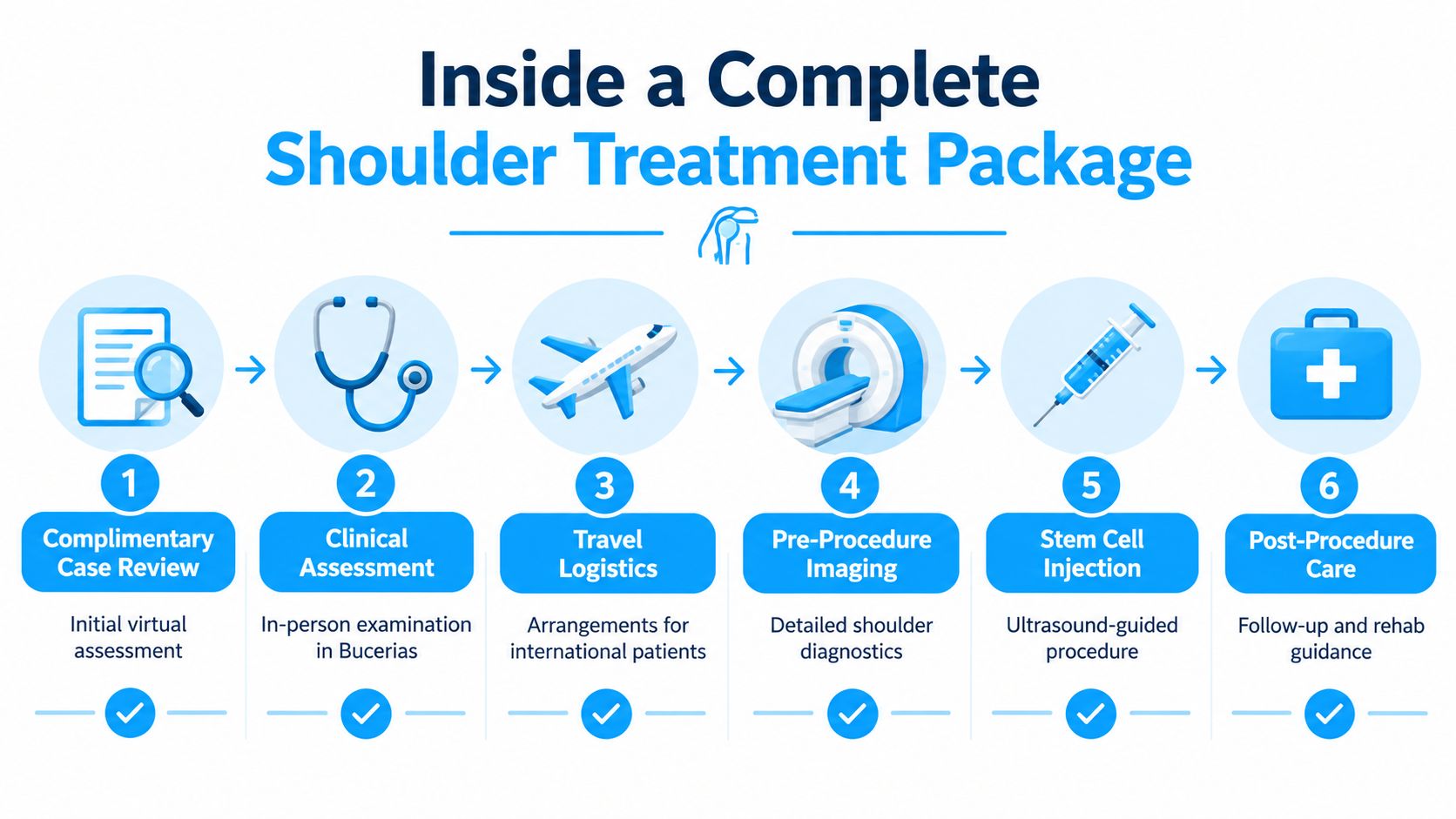
Dream Body Clinic lists all of that in our Shoulder Stem Cell Treatment – 50 Million Mesenchymal Stem Cells + PRP & and MRI
The package checklist that actually matters
When you’re comparing quotes, these components are worth checking one by one:
- Case review before travel: Does someone review your MRI report, exam history, and diagnosis before you commit?
- Clear dosing: Is the cell count stated, or are you being sold a vague “stem cell treatment” with no dose transparency?
- Targeted delivery: Will the clinician explain exactly where the shoulder is being injected and why?
- Adjuncts such as PRP: Is PRP part of the protocol, and is it included in the price?
- Imaging plan: Is MRI expected before treatment, after treatment, or both?
- Follow-up structure: Will someone check in at scheduled intervals, or are you on your own?
Why transparency matters more than a low sticker price
A transparent package helps you judge whether the quoted cost reflects actual clinical work or just marketing language. Shoulder care is highly anatomy-dependent. Treating glenohumeral arthritis isn’t the same as targeting a rotator cuff-related pain generator.
If a clinic publishes cell counts, delivery route, and follow-up expectations, it gives you something concrete to evaluate. If it doesn’t, the number on the quote can look precise while still hiding major differences in what you receive.
Results Value and When Cost Makes Sense
The hardest question isn’t “How much does it cost?” It’s “When is the cost worth it?”
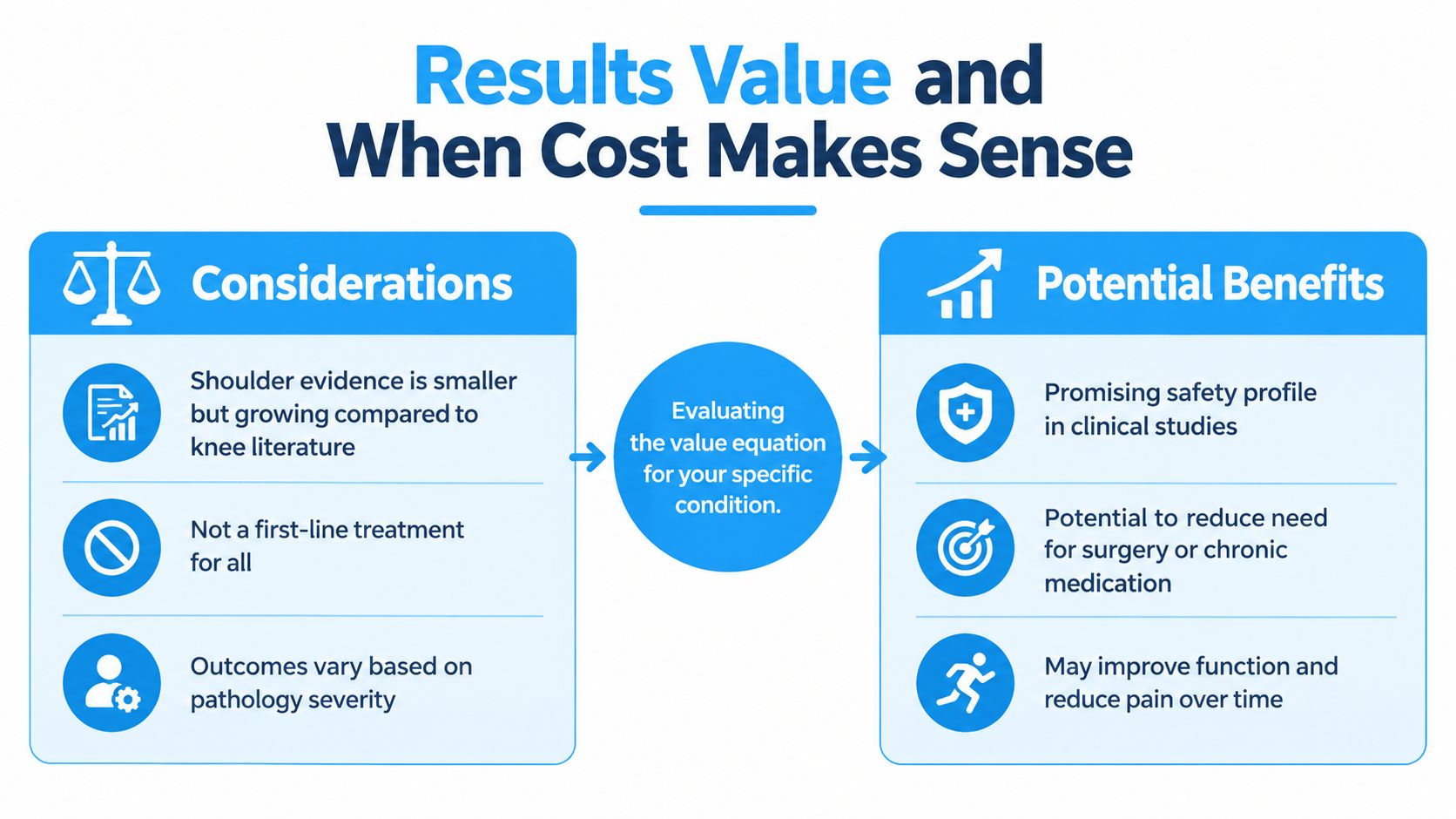
Patients often assume a more expensive regenerative procedure must be better than a cheaper injection, physical therapy, or watchful waiting. The evidence doesn’t support that kind of simple ranking. Shoulder MSC treatment sits in a space where interest is high, safety signals are encouraging, and the comparative evidence is still unsettled.
What the evidence says right now
Recent neutral coverage notes that the shoulder evidence base is smaller but growing compared with the knee literature. It also highlights that a 2022 randomized trial found MSC injection for partial supraspinatus tears was not superior to control injections for pain, function, or tear size, while new 2026 shoulder stem-cell studies were starting or recruiting in this trial and evidence summary.
At Dream Body Clinic we have seen amazing results in healing shoulders over the past 9 years. We have posted so many patient testimonials on our Youtube channel, but that doesn’t even scratch the surface as to the number of shoulders we have healed. When patients get great results they rarely come back unless for a new issue. Very few people want to get into an MRI machine if they don’t have too so that limits how much hard data we get back, but a lot of people are happy to share that treatment worked for them.
When the price may make more sense
In practice, the value equation tends to be more compelling when a patient wants a non-surgical option, understands that improvement may be gradual, and has a diagnosis where guided biologic treatment is at least biologically plausible.
It makes less sense when someone expects instant structural replacement, guaranteed tendon regrowth, or a result that no current evidence can reliably promise.
Shoulder MSC treatment is easier to judge honestly when you expect possible functional improvement over time and peak results 3 to 6 months post treatment.
Because MSCs act through signaling, and because implanted cells may not persist long, realistic goals matter. Pain reduction, improved function, and better tolerance for rehab are more grounded expectations while dramatic tissue replacement is a common occurrence.
Choosing Your Next Step With Confidence
A good decision usually comes down to three filters. Mechanism, transparency, and fit.
Mechanism means you understand what you’re buying. In shoulder care, MSCs aren’t best viewed as replacement parts. They’re signaling cells used in an attempt to influence the repair environment. Repair and regeneration takes time, but 3 to 6 months is not that long to wait, especially compared to shoulder surgery which rarely goes perfect and requires 6 months or more of rehabilitation.
Questions worth asking before you commit
Bring these questions to any consultation:
- What’s the exact diagnosis being treated? A vague label like “shoulder pain” isn’t enough. An MRI can show all.
- What is included in the quoted price? Ask about imaging, PRP, labs, and follow-up.
- Is the treatment image-guided? Precision matters in the shoulder.
- Is the cell dose disclosed? If dosing isn’t stated, ask why.
- What does follow-up look like? Recovery support shouldn’t be an afterthought.
- When should I get a second opinion? If surgery has already been recommended, or if the diagnosis is unclear, another orthopedic review can help.
A practical decision framework
If you’re comparing regenerative treatment with surgery, steroid injection, or simpler conservative care, don’t reduce the choice to one number. Compare the goal of each option, the level of evidence behind it, the recovery burden, and how clearly the clinic explains what you’ll receive.
That usually leads to a calmer, more grounded choice. Not a perfect one. Just a better-informed one.
Shoulder Stem Cell Treatment – 50 Million Mesenchymal Stem Cells + PRP & and MRI
If you’re considering this route, Dream Body Clinic offers MSC-based orthopedic care in Mexico with published protocol details, including shoulder treatment pathways and structured follow-up. If you want to know whether your shoulder case fits this kind of treatment, a case review can help you compare the likely scope of care, what’s included, and whether the quoted cost matches the treatment plan.
Call us at (888) 704-3977 or on WhatsApp at +523222321055 for a free consultation