
The most misleading advice about stem cell stroke recovery is to choose the treatment with the biggest cell dose or the most impressive recovery story. Neither tells you whether you'll walk more safely, use your hand more effectively, communicate more easily, or need less help at home.
Start with the outcome, not the sales claim. A treatment can improve a neurological score without clearly improving daily independence. And the mesenchymal stromal cells used in this field are being investigated primarily for the signals they release, not for an ability to turn into replacement brain cells.
Table of Contents
- What the Stroke Outcome Numbers Actually Say
- Why These Cells Do Not Become Neurons
- Acute Versus Chronic Timing and Routes
- When a Better Score Is Not Better Function
- Matching a Patient to the Trial Population
- Safety Findings That Do Not Prove Benefit
- Decide Whether a Trial Fits
What the Stroke Outcome Numbers Actually Say
A clinic may describe a trial as positive while an evidence review concludes that independence didn't clearly improve. Those statements can coexist because researchers measured different things.
Cochrane pooled results for stem cell transplantation after ischemic stroke
The Cochrane review of stem cell transplantation for ischemic stroke identified seven randomized controlled trials involving 401 participants and reported the following pooled results.
| Outcome scale | Pooled mean difference | 95% confidence interval | Studies and participants | Plain-language reading |
|---|---|---|---|---|
| NIH Stroke Scale, neurological impairment | −1.49 points | −2.65 to −0.33 | 5 studies, 319 people | Modest improvement; interval stays on the benefit side |
| Modified Rankin Scale, disability and independence | −0.42 points | −0.86 to 0.02 | 6 studies, 371 people | Not a statistically clear gain in independence |
| Barthel Index, help needed for daily tasks | 14.09 points | −1.94 to 30.13 | 3 studies, 170 people | Point estimate looks helpful but the interval includes no benefit |
These weren't trials of a single standardized treatment. Investigators used different cell sources, delivery routes, and treatment timings, so the pooled estimates summarize a varied experimental field rather than a ready-made protocol.
What each scale tells a family
The National Institutes of Health Stroke Scale, usually shortened to NIHSS, measures neurological impairment through a structured examination of abilities such as movement, sensation, language, and attention. A lower score generally means less impairment, but it doesn't tell you exactly how someone manages their home.
The modified Rankin Scale, or mRS, summarizes overall disability and dependence on other people. Its focus is closer to the question families often care about most: how much assistance does this person need?
The Barthel Index assesses assistance needed for everyday activities such as eating, dressing, toileting, and moving between a bed and chair. Unlike the other scales, a higher score generally indicates better function.
Consider someone whose arm examination improves but who still can't fasten clothing or prepare a meal. The change may matter neurologically, yet it hasn't necessarily removed a practical barrier to independence.
Why the confidence intervals matter
A pooled mean difference is the average difference between the treatment and comparison groups across the included studies. It isn't a promise about the improvement an individual patient will experience.
The confidence interval describes uncertainty around that average. For the disability and daily-task measures in the table, the intervals include the possibility of no benefit, which prevents a confident conclusion that treatment improved those outcomes.
Cochrane's ordinary-language conclusion was cautious: stem-cell transplantation might reduce neurological impairment, but a reliable functional benefit hadn't been demonstrated. Evidence certainty was low to very low, reflecting small studies, inconsistent methods, imprecise estimates, and substantial risk of bias.
Practical rule: When someone says recovery improved, identify the scale, the absolute change, and the comparison group before deciding what that statement means.
This doesn't prove that cell therapy can never help. It means the evidence doesn't justify treating it as an established replacement for acute stroke care or rehabilitation.
For a patient considering treatment, the useful questions are specific. Did neurological impairment change, did dependence change, or did everyday task performance change? Was the difference greater than the improvement seen in people receiving comparison care?
Stem cell stroke treatment remains investigational and, when considered, should be adjunctive to standard care. A claim about recovery should describe the outcome measured, not substitute a broad promise for a narrower finding.
Why These Cells Do Not Become Neurons
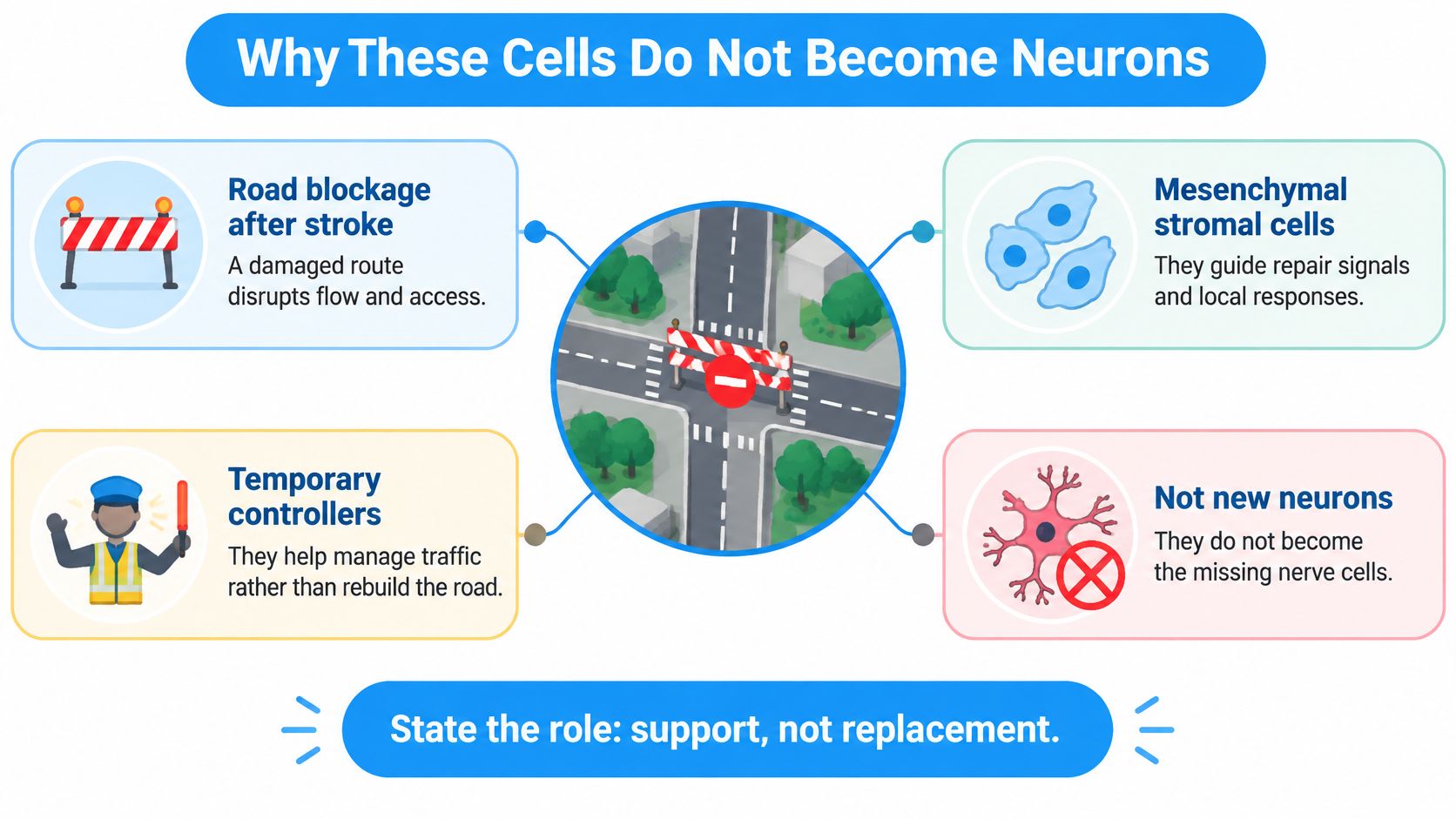
After a stroke, think of the brain as a road network with damaged routes and blocked intersections. Mesenchymal stromal cells, or MSCs, act more like temporary traffic controllers than new stretches of road: they may influence local responses, but they aren't installed as replacement infrastructure.
In the stroke-treatment mechanism being studied, these cells don't differentiate into neurons or other replacement brain cells as their main action. They work through the paracrine effect, sending specialized signals that may guide healing processes in the patient's own tissue.
What the signals contain
A stroke-focused review of MSC signaling describes biologically active substances including growth factors, cytokines, and extracellular vesicles that alter how surrounding cells behave. Growth factors help regulate cellular survival and growth, cytokines carry immune messages, and extracellular vesicles are small packages of biological cargo.
These signals can influence immune cells, blood-vessel cells, and surviving neurons. The proposed benefit comes from changing the environment around injured tissue, not from depositing a finished replacement for it.
A review of MSC-based stroke therapy describes increased expression of vascular endothelial growth factor, or VEGF, and brain-derived neurotrophic factor, or BDNF, in the ischemic boundary zone, together with support for blood-vessel formation and reactive astrocyte recruitment. The boundary zone is tissue around the area injured by loss of blood supply, while astrocytes are supporting cells that participate in the brain's response to injury.
Those biological terms describe several proposed jobs:
- Calming inflammation: Signals may change how immune cells respond after injury.
- Protecting vulnerable cells: Some cells near the damaged area are injured rather than already dead.
- Supporting small blood vessels: Vascular responses may help improve the tissue-support environment.
- Encouraging connections: Surviving neurons may have opportunities to strengthen or reorganize connections.
These are proposed repair-support mechanisms, not guarantees that a patient will recover a particular ability. Laboratory plausibility and meaningful clinical benefit are different questions.
Support is not replacement
The older cell-replacement idea required transplanted cells to survive, become neurons, join existing circuits, and perform the functions of the cells that were lost. That's a much more demanding process than releasing useful signals.
A review of mesenchymal stromal-cell therapy explains that preclinical MSC approaches didn't routinely replace dead neurons and that transplanted cells generally don't remain permanently engrafted. This helps explain why investigators focus on secreted factors and extracellular vesicles rather than permanent reconstruction.
For a plain-language explanation of administration and signaling, our guide to how stem cell injections work provides additional context. The distinction to retain is support, not replacement.
A signaling therapy might make the post-stroke environment more favorable for repair. It doesn't rebuild the infarct, the area of tissue death, as a patch of new brain.
Acute Versus Chronic Timing and Routes
The advertised cell count is the wrong first question. Before comparing doses, establish what kind of stroke occurred, how long ago it happened, and which delivery route is being proposed.
Timing changes the clinical problem. A person still receiving emergency stroke care has different needs and risks from someone living with stable, long-standing weakness.
Timing and delivery routes in stem cell stroke studies
| Clinical window | When it is discussed | Route most often compared | What current evidence can support |
|---|---|---|---|
| Acute ischemic stroke | First days to about two weeks | Intravenous infusion in early trials | Adjunct research only; reperfusion and standard stroke care remain first |
| Subacute recovery | The following weeks | Intravenous or intrathecal, according to protocol | A plasticity window where rehabilitation is a co-treatment, not an optional extra |
| Chronic ischemic sequelae | Months to years after ischemic stroke | Intravenous versus intrathecal umbilical-cord MSCs | A small route-comparison study offers preliminary findings, not a definitive ranking |
| Hemorrhagic, recurrent, or very severe stroke | Often outside the populations above | Not established | Don't assume ischemic-trial results apply |
These are practical descriptions of treatment windows, not universal eligibility definitions. A study's written inclusion criteria determine who can participate.
What the route comparison actually found
A 2025 phase II randomized trial of 32 people with chronic ischemic-stroke sequelae compared intravenous with intrathecal umbilical-cord MSCs, reported no severe treatment-related adverse events, and found fewer adverse events in the intravenous group, with significant six-month improvements in NIHSS, Functional Independence Measure, and quality of life; both groups improved by twelve months.
That result supports further investigation. It doesn't establish that intravenous treatment is superior, and it doesn't answer whether the same findings apply to acute stroke, a brain hemorrhage, recurrent stroke, or very severe disability.
The limitation isn't merely the number of participants. Investigators selected a particular population, used particular cells, and followed a particular protocol, so changing any of those features changes how directly the findings apply.
Intravenous delivery means administration into the bloodstream. Intrathecal delivery means administration into the cerebrospinal fluid through a spinal procedure, which brings its own discomfort, infection considerations, and medication-management questions.
Neither route should be described as interchangeable with the other. Delivering cells closer to the nervous system doesn't, by itself, prove a better clinical outcome.
Timing should change the treatment discussion
During acute ischemic stroke, restoring blood flow when appropriate and receiving stroke-unit care take priority. Don't delay emergency treatment to investigate regenerative options.
During subacute recovery, rehabilitation and medical stabilization remain central. A cell intervention under study must fit around those activities rather than interrupt them.
For chronic disability, the discussion shifts toward whether a proposed protocol matches the person's remaining difficulties and medical condition. Being further from the original stroke doesn't remove the need for careful screening.
A stroke is also not interchangeable with a traumatic brain injury. Our information on stem cell therapy for traumatic brain injury concerns a different cause of neurological damage, and evidence shouldn't be transferred between diagnoses without justification.
Before discussing a dose, settle these questions:
- Timing: How long has it been since the stroke?
- Subtype: Was it ischemic or hemorrhagic?
- Route: Why does this delivery method fit the person and the evidence better than another?
When a Better Score Is Not Better Function
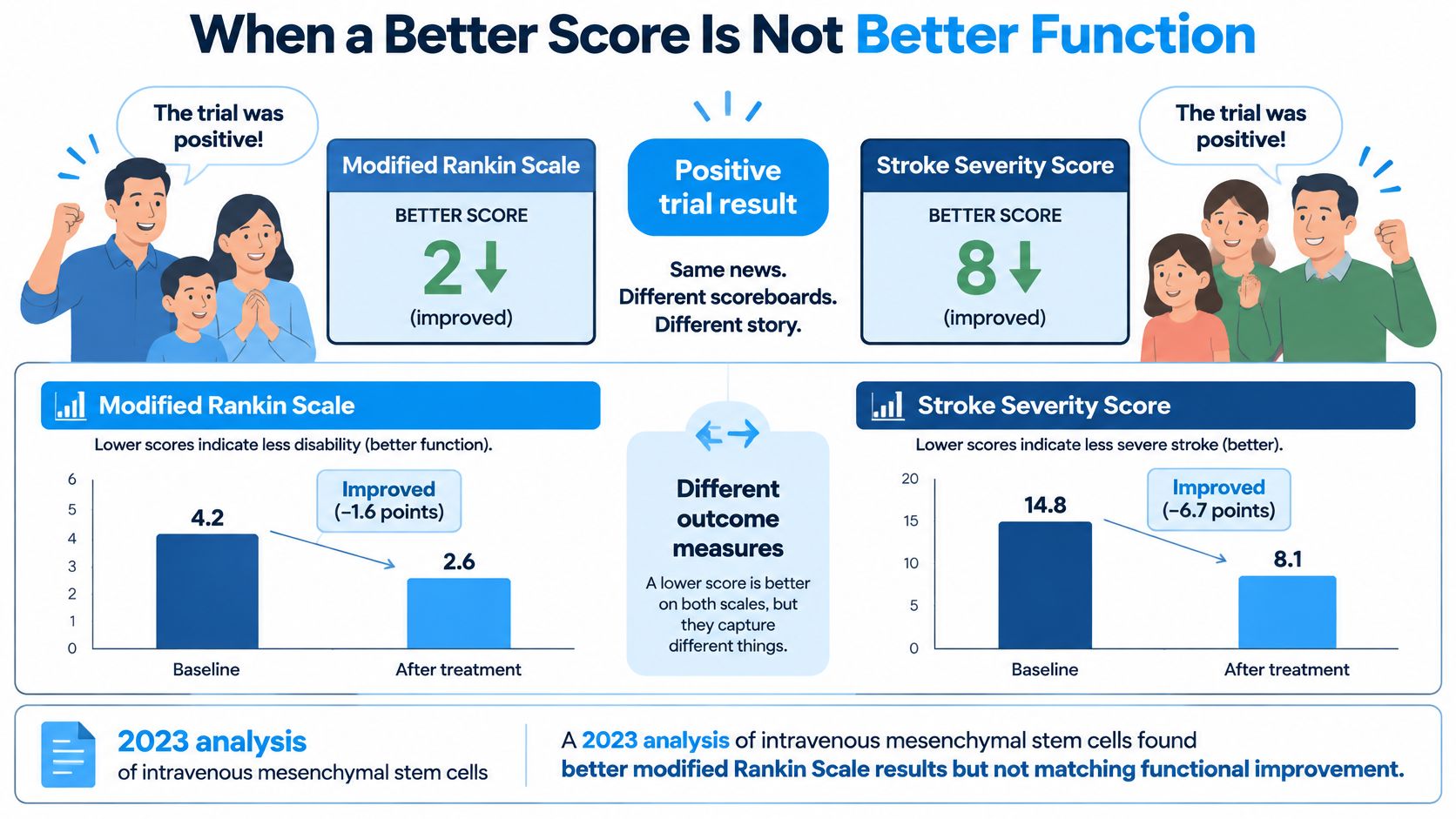
Two families hear that a stroke trial was positive. One expects better walking; the other expects clearer speech. Then they learn the investigators reported a change on a scale that answers neither question directly.
That gap is common, and it does not require dishonesty on anyone's part. Each scale counts different things. The NIH Stroke Scale scores neurological deficits during an examination, the modified Rankin Scale grades overall disability, and the Barthel Index tracks daily-living tasks such as feeding and dressing. A treatment can move one of these and leave the others flat.
A 2023 analysis of intravenous MSCs and the endpoint comparisons summarized in this stroke review found better modified Rankin Scale and Barthel Index outcomes than placebo, but no significant NIH Stroke Scale improvement or statistically significant reduction in mortality or recurrent stroke.
Read that result carefully. Disability and daily-living scores shifted while the neurological examination score and survival numbers did not. One plausible reason is that the cells influence repair through signaling, calming inflammation and supporting the tissue around the injury. That kind of help can register on a disability scale without rebuilding the damaged circuitry itself. The answer changes when investigators change the finish line.
Translate an endpoint into an activity
Statistical significance is not the same as personal usefulness. A measurable change on examination can matter, yet a family still needs to know what the person can do now that they could not do before.
Better movement during a clinical examination might not produce enough grip control to hold a cup securely. Improved leg strength might still leave someone needing assistance because balance, attention, or endurance remains limited.
Speech creates another potential mismatch. A broad neurological score may not capture whether someone can follow a conversation, find words under pressure, or communicate needs in an unfamiliar setting.
A positive result answers the question the investigators measured. It does not automatically answer the question your family is asking.
Choose a primary functional goal before treatment. Make it observable, such as transferring to a chair with less assistance or using the affected hand during a meal, rather than wanting better recovery in general.
Measure change without turning it into a success story
Record baseline performance and use the same assessment method at follow-up. Absolute point changes are more informative than a promotional percentage that hides the denominator or the definition of success.
Also record the rehabilitation received between assessments. Recovery during the early months may reflect natural recovery, structured practice, a study intervention, or a combination of these factors.
Treat imaging as a companion measure. A change on an MRI scan does not demonstrate that someone can walk farther, manage stairs, or live with less supervision.
Durability matters just as much as the initial change. Families need to know whether a gain remains useful during ordinary life, not merely whether it appeared at a favorable assessment visit.
When evaluating a report, flag these patient-facing gaps:
- Missing task data: No direct information about walking or hand function.
- Missing durability data: No evidence about whether improvements persist beyond the reported follow-up.
- Unseparated treatment effects: No clear way to distinguish rehabilitation effects from cell effects.
A report can state that stem cell treatment improved stroke recovery and be statistically accurate while staying ambiguous for one patient. The useful conclusion names the ability that changed, the size of the change, and how long investigators observed it.
Matching a Patient to the Trial Population
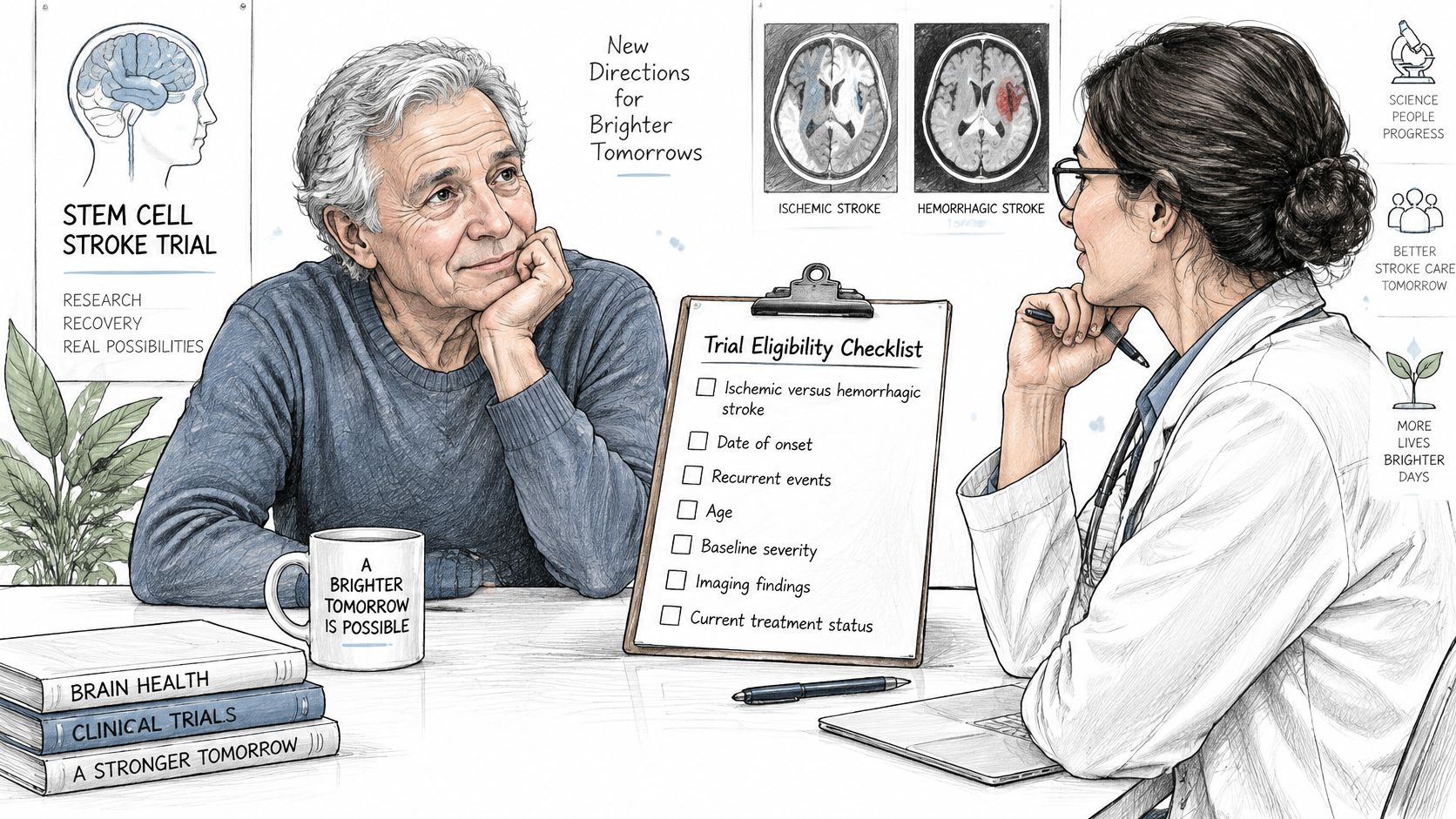
A trial average can't tell you whether you're a suitable candidate. The first job is to compare your medical situation with the people investigators enrolled.
Bring the hospital discharge summary, relevant brain imaging reports, a medication list, and a description of your current daily assistance needs. These documents are more useful for eligibility discussions than a general statement that you've had a stroke.
Put the clinical details on the table
An eligibility discussion should cover the following:
- Stroke history: Ischemic or hemorrhagic stroke, date of onset, and any recurrent events.
- Current disability: The modified Rankin assessment, assistance required at home, and ability to participate in treatment.
- Main difficulty: Whether walking, arm use, communication, or another activity is the priority.
- Medical risks: Heart disease, clotting problems, active infection, and uncontrolled illness.
- Medicines: Antiplatelet drugs, anticoagulants, and other prescriptions that may affect procedural planning.
Blood-thinning medication matters because delivery routes involve procedures, not nutritional supplements. Don't stop prescribed stroke-prevention treatment on your own to accommodate a regenerative procedure.
A person with stable chronic ischemic disability who can attend rehabilitation may resemble a chronic-stroke study population more closely than someone hospitalized with a recent brain bleed. Even a close match establishes only that the evidence is more relevant, not that benefit is likely or assured.
The treating team should also distinguish a medical exclusion from a logistical barrier. An active infection may require treatment before any elective procedure, while difficulty traveling may make follow-up or emergency access impractical.
Keep rehabilitation inside the protocol
Rehabilitation belongs in the written plan. Physical therapy addresses movement and mobility, occupational therapy connects abilities to everyday tasks, and speech-language therapy addresses communication and other relevant difficulties.
These are active treatments, not background services. If cell signaling has a useful effect, the practical aim is to make the patient's own recovery and practice more productive, not to replace repeated task-specific work.
A review of MSC evidence and clinical outcome assessment recommends evaluating treatment against standard stroke care and structured rehabilitation, using neurological, disability, daily-living, motor, and imaging assessments rather than promises of neural repair. That approach helps keep the discussion anchored to measurable needs.
Before proceeding, request a written care plan containing baseline assessments, a named functional goal, a rehabilitation schedule, and a follow-up method. Identify who will assess progress and who will respond if new symptoms occur after returning home.
For international patients, this also means identifying a local clinician who can continue ordinary stroke care. Travel coordination doesn't replace medical continuity.
Pause when a plan requires stopping prevention medicines without coordination, ignores active illness, or assumes someone can complete rehabilitation despite major access barriers. The decisive question is straightforward: am I comparable to the people studied, and is rehabilitation built into the plan?
Safety Findings That Do Not Prove Benefit
A clean safety readout is reassuring, and it is also limited. It shows the procedure was tolerated; it cannot show that function was restored, and a small study cannot rule out uncommon harms. A trial with a few dozen participants can detect frequent side effects while missing a rare complication entirely.
Safety and efficacy require separate judgments. A procedure may be tolerated reasonably well while producing no meaningful difference in disability.
A randomized stroke-trial report and related MSC findings describe a phase II randomized, double-blind trial in which intravenous allogeneic adipose-derived MSCs administered within two weeks of ischemic stroke produced adverse-event and systemic or neurological-complication rates similar to placebo, with no significant modified Rankin Scale difference through 24 months.
Biological activity is not clinical proof
A treatment can produce a measurable biological response without delivering a reliable functional benefit. In that trial, increased circulating extracellular vesicles correlated with motor improvement and MRI measures of plasticity, yet only a minority of treated participants were classified as good motor responders.
That distinction matters when reading laboratory results and imaging. A correlation can support a biological hypothesis, but it does not establish that the observed response will translate into a predictable outcome for a new patient.
Cell persistence is a separate question. Lung trapping and systemic clearance can limit how long infused cells remain after administration, so the presence of a cell product in the bloodstream is not evidence of permanent residence in the brain.
Separate the product from the procedure
Safety review should address both what is administered and how it is administered. Different delivery routes introduce different practical questions.
- Infusion monitoring: The team needs a plan for recognizing and managing reactions during administration.
- Bleeding and clotting: Existing risks and blood-thinning medicines require coordinated review.
- Spinal procedures: Intrathecal administration introduces infection and procedure-related considerations.
- Continuity: Patients need written instructions for complications, including after international travel.
At Dream Body Clinic, donors undergo health screening, and the cells are laboratory-tested for viability, purity, and pathogen-free status, including screening for major viruses and confirmation that they are viable mesenchymal stem cells. Those quality controls address product characteristics; they do not establish effectiveness for stroke recovery.
A registered trial adds a defined protocol, specified outcomes, and oversight arrangements. Registration alone still does not prove that an experimental treatment works.
- Signaling, not rebuilding: MSCs guide repair through signals rather than becoming replacement neurons in the damaged tissue.
- Score change, not reversal: A lower clinical score reflects a better examination result; the stroke itself has not been undone.
- Early gain, unknown durability: Improvement at one follow-up point does not establish that the gain will last.
The field remains a clinical research area rather than a standardized recovery service. Counseling should therefore document what is known, what remains uncertain, and how both adverse events and benefits will be tracked.
A useful assessment set includes NIHSS, modified Rankin Scale, Barthel Index, and a motor measure such as Fugl-Meyer, with imaging when relevant. The purpose is to connect any claimed benefit to a reproducible examination and an activity the patient values.
Decide Whether a Trial Fits
The decision isn't treatment or no treatment. You can remain in standard care while gathering information, consider a formal trial when eligibility is clear, or decline an offer that doesn't withstand basic verification.
Wait when essential details are missing. Uncertainty about the stroke subtype, onset date, medication plan, or functional goal is a reason to complete the assessment, not to rush into a procedure.
Verify the study before committing
A review of registered ischemic-stroke stem-cell studies reported that, as of June 2, 2024, 68 studies had been registered on ClinicalTrials.gov and 26 had been completed and published. Search the registry by diagnosis and intervention, then confirm the current recruitment status, eligibility criteria, route, and consent terms directly with the investigators.
For additional context on understanding participation, evaluating studies with Orange Neurosciences offers a clinical-trial resource. Use educational resources to prepare questions, not as proof that a particular intervention is appropriate.
Legal availability is a separate question from demonstrated effectiveness. Our guide to whether stem cells are legal can help frame that discussion without treating regulatory permission as an efficacy result.
Use a written decision checklist
Consider a formal trial only when you have baseline scores, a named functional goal, and a rehabilitation plan. Request the same assessments at follow-up and absolute changes rather than an unexplained percentage success claim.
- Proceed with evaluation: Your diagnosis and disability match the eligibility criteria, and follow-up is feasible.
- Pause: Medicines, medical stability, rehabilitation access, or informed consent remain unresolved.
- Decline the offer: The team promises a cure or new neurons, or won't document the route, dose, comparison arrangements, and follow-up schedule.
At Dream Body Clinic, our listed Stroke Stem Cell Treatment costs $3,500 USD and is described as 50M intrathecal, meaning a listed dose of fifty million cells delivered intrathecally. Across conditions, we administer stem cell therapy by intravenous infusion or targeted injection according to the condition; a commercial listing should not be mistaken for proof of trial-equivalent benefit.
Our policy is explicit: stem cell therapy offers no guarantees and isn't promoted as a cure. Keep that distinction in view when comparing commercial care with a formal study.
Before deciding, write down your answers: am I comparable to the people studied, is rehabilitation built into the plan, and will the follow-up tell me whether the treatment helped? If the answers aren't clear, continue standard care while resolving them.
Dream Body Clinic offers MSC-based care for people exploring options after stroke, with a complimentary case review to discuss medical history and treatment suitability. Visit Dream Body Clinic to share your stroke records, current medicines, and rehabilitation goals, and request a clear discussion of the proposed route, limitations, and follow-up before arranging travel.