Anti-aging stem cell therapy is not a blanket rejuvenation treatment, it’s targeted regenerative medicine. The strongest human data so far sits in frailty and facial skin ageing, with clinical trials moving from theory into structured testing. A 2023 review found 16 ongoing clinical trials in these areas, and a 2025 review found 11 trials in an anti-ageing stem-cell database, 9 of them MSC-based, which tells you where the field is really concentrated Frontiers review.
If you’re trying to decide whether this kind of care is worth attention, the right question isn’t “Can stem cells make me younger?” It’s “Which symptom or function is being targeted, what product is being used, and what human data supports that choice?” For many adults in the 35 to 70 range, the primary motivation is narrower than marketing suggests, things like slowing frailty, improving skin quality, supporting oral tissue health, or addressing a decline in stamina.
Now that DNA methylation tests are readily available anyone can test how well Stem Cells work for anti-aging 100 Million Stem Cell IV – Stem Cells to Reverse Aging: Anti-Aging Stem Cell Treatment .
Generation Lab has the most advanced DNA methylation test for tracking biological age versus chronological age.
- A lab takes DNA from blood, saliva, or another tissue.
- It measures how methylated hundreds or thousands of specific CpG sites are.
- An algorithm (an epigenetic clock) combines those values into one number: estimated age.
Table of Contents
- What Anti Ageing Stem Cell Therapy Actually Means
- How MSCs Signal Instead of Replacing Cells
- IV Versus Local Delivery Routes Compared
- Benefits With Real Evidence Versus Marketing Claims
- What the Latest Human Trials Actually Show
- Why the Type of Stem Cell Product Matters
- What to Expect During Treatment and Recovery
- Setting Realistic Expectations and Choosing a Clinic
What Anti Ageing Stem Cell Therapy Actually Means
Anti ageing stem cell therapy usually refers to mesenchymal stem cell based treatment, sometimes alongside stromal vascular fraction or cell-free products, aimed at age-related decline rather than a full-body reset. In plain terms, it’s regenerative medicine for a specific problem, not a magic restart button. That matters because different clinics use the same language for very different products.
The most defensible use cases are frailty, skin ageing, and other defined tissue problems where there’s at least some human data. That’s why the field has matured around measurable endpoints instead of vague promises. A practical way to think about it is this, people aren’t usually seeking “youth” in the abstract, they’re seeking better walking tolerance, less visible thinning of the skin, or support for tissues that aren’t recovering the way they used to.
You’ll also see plenty of overlap with broader longevity clinics, but those aren’t the same thing. Longevity programs may emphasize biomarkers, lifestyle, hormones, or medications, while stem-cell programs focus on a cell product and its delivery route. For a baseline explanation of stem cells and how they work, this overview from Dream Body Clinic is a useful starting point.
In 2026, the clearest regulatory reality is simple, most anti-ageing stem-cell offerings remain investigational. The literature cited in this article supports structured clinical development, not routine anti-ageing approval.
Practical rule: if a provider can’t tell you the cell source, the dose, the route, and the endpoint being tracked, you’re not looking at a protocol, you’re looking at marketing.
How MSCs Signal Instead of Replacing Cells
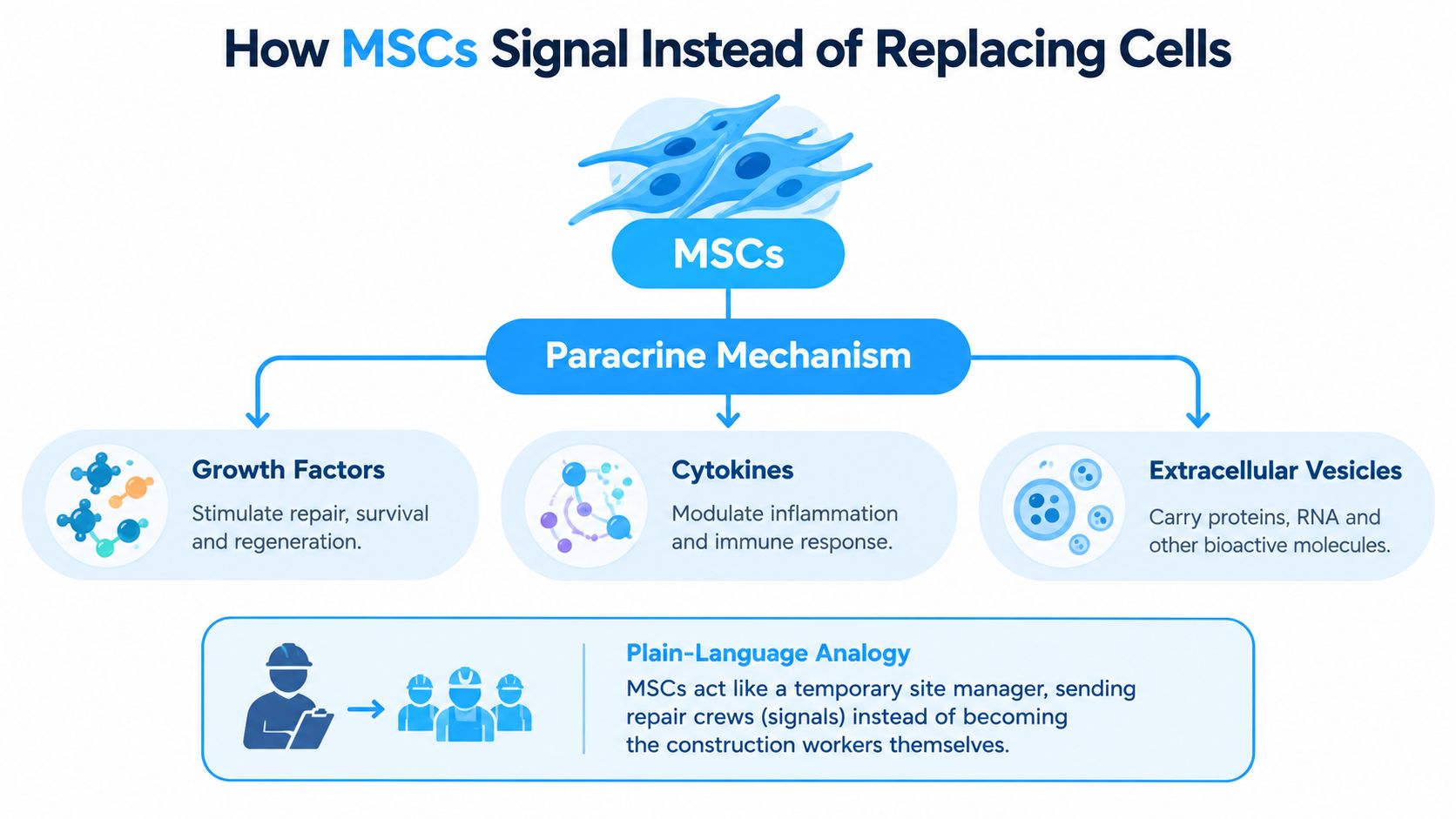
MSCs don’t work like replacement bricks dropped into damaged tissue. The better model is a temporary site manager, they arrive, send out signals, and then leave the jobsite to the body’s own repair machinery. That signal-based behavior is called the paracrine effect, and it’s the core reason MSC therapy is being studied at all.
What the signals actually do
MSC secretions include growth factors, cytokines, and extracellular vesicles, and those signals can influence inflammation, repair, and tissue coordination. One systematic review identified 234 directly released MSC factors involved in this repair process, and another review noted that implanted MSCs generally don’t survive longer than 3 weeks after injection, which makes long-term replacement by differentiation unlikely paracrine factor review. A separate secretome review frames MSC therapy as a shift away from cell replacement and toward paracrine signaling as the main mechanism secretome review.
This is why the therapy can still matter even when the cells don’t stay. The body receives a short-lived biological nudge, then responds with changes in local inflammation and repair signaling. In age-related decline, that matters more than whether the injected cell itself becomes a new skin cell, muscle cell, or nerve cell.
The most useful clinical implication is that dose, source, route, and cell viability matter a lot. If the therapy works through transient signaling, then the product has to be delivered in a way that gives the body enough of that signal to matter.
The biology is less “new tissue grows from the injected cells” and more “the injected cells tell the body how to repair itself.”
For a more practical breakdown of injection mechanics, this stem cell injection guide helps connect the biology to the procedure.
IV Versus Local Delivery Routes Compared
The delivery route changes the goal. IV treatment tries to create a body-wide signal, while local treatment tries to concentrate that signal in one tissue. That’s why the dose, target, and expected outcome look very different from one protocol to another.
The two families of treatment
IV systemic administration is the route most often discussed for frailty and broader functional decline. The studies in this area use 50 to 200 million MSCs per infusion, with the intent of creating systemic immunomodulation and metabolic signaling. Local administration is usually smaller in scope, because the cells are being placed where the problem is, such as the face, scalp, or gums.
A simple comparison helps:
| Route | Typical Dose | Tissue Target | Mechanism | Evidence Level |
|---|---|---|---|---|
| IV systemic | 50 to 200 million MSCs | Whole body | Systemic immunomodulation and paracrine signaling | Strongest in frailty studies |
| Intradermal facial | 10 to 50 million cells | Skin | Local trophic signaling, often with microneedling or PRP | Early and indication-specific |
| Intradermal scalp | 5 to 20 million cells | Hair-bearing scalp | Local follicle support and signaling | Early and limited |
| Intrapapillary gum | 200,000 to 1 million per site | Periodontal tissue | Local regeneration signaling | Early and niche |
Local delivery is more intuitive when the goal is a visible or tissue-specific change. Facial protocols are usually framed around skin quality, elasticity, or thinning. Scalp injections aim at hair retention or density support, and gum injections are designed for periodontal regeneration.
The key point is that the same cell type doesn’t behave the same way in every setting. A dose meant for systemic frailty isn’t automatically right for a facial protocol, and vice versa. For a distribution-focused discussion of systemic delivery, this recipient-age and neuronal-health study resource is relevant background.
If a clinic uses the same dose language for a face, a scalp, and an IV protocol, that’s a sign the protocol may be driven more by sales copy than by anatomy.
Benefits With Real Evidence Versus Marketing Claims
The claims around anti-ageing stem cell therapy sound broad because the marketing is broad. Clinics often talk about energy, skin quality, hair density, gum repair, cognition, and sexual health, but the human evidence doesn’t support all of those claims equally. The sensible way to judge them is by evidence tier, not by how appealing the promise sounds.
At Dream Body Clinic we provide all info on our anti-aging treatments plus testimonials and links to studies:
- 100 Million Stem Cell IV – Stem Cells to Reverse Aging: Anti-Aging Stem Cell Treatment
- Facial Stem Cell Treatment
- Penis P Shot Stem Cell Treatment
- Vagina V Shot Stem Cell Treatment
- Intrathecal Stem Cell Treatment For Brain Optimization
- Receding Gums Stem Cell Treatment
- Hair Stem Cell Treatment
What’s supported, what’s emerging, and what’s still aspirational
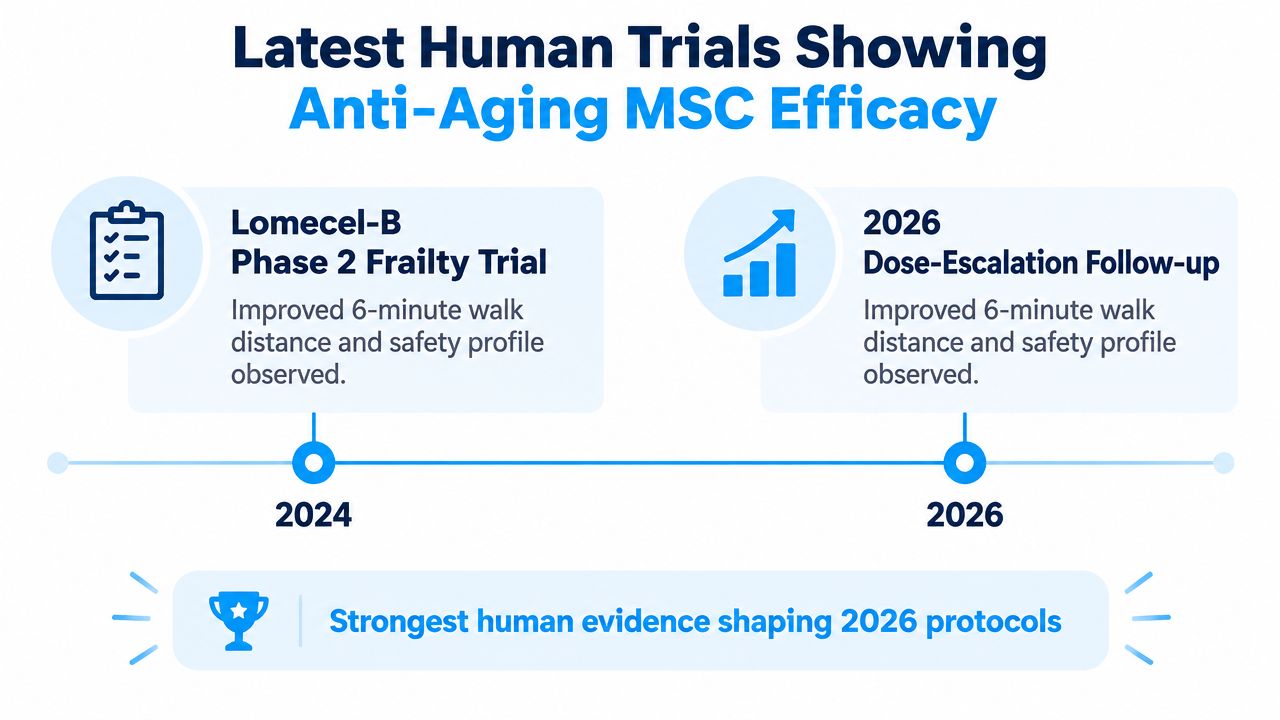
The strongest human data is concentrated in frailty, physical function, and inflammatory markers. Reviews of clinical work report outcomes such as improved 6-minute walk distance and reductions in inflammatory signals, while the 2026 frailty trial data described in the brief adds measurable functional gains at higher cell doses. That’s a real clinical signal, but it’s still targeted and specific.
Skin quality and appearance sit in a more emerging category. Facial trials exist, and the field is moving toward defined protocols, but that doesn’t justify claiming full rejuvenation. Hair, cognition, and sexual health are often marketed more aggressively than the evidence supports, so those claims need extra scrutiny.
| Claimed Benefit | Evidence Tier | Supporting Data |
|---|---|---|
| Frailty and exercise tolerance | Well supported | Functional improvement tracked with walking capacity and frailty measures |
| Inflammatory burden | Well supported | Trials report changes in inflammatory biomarkers, including TNF-related signaling in the broader literature |
| Skin quality and elasticity | Emerging | Facial aging trials are in progress, but endpoints are still early-stage |
| Hair density | Emerging | Niche protocols exist, but evidence remains limited |
| Cognitive sharpness | Aspirational | Brain MRIs are showing brain lesions healing, stroke Recovery and TBI recovery. |
| Longevity or whole-body rejuvenation | Aspirational | DNA Methylation Tests are showing a reversal in epigenetic age |
Clinics often overreach in this space. A change in inflammation doesn’t automatically translate into visible anti-ageing, and a local skin response doesn’t prove whole-body rejuvenation. If you want a useful, non-promotional framing of broader aging strategies.
What the Latest Human Trials Actually Show
Human evidence for anti-ageing stem cell therapy is narrow, but it has moved beyond anecdote. A 2023 review identified 16 ongoing clinical trials, mainly studying frailty and facial skin ageing, with MSCs as the leading platform. The trial pattern matters: researchers are testing defined products, doses, delivery methods, and measurable outcomes rather than relying on broad rejuvenation claims.
Frailty provides the clearest human signal
The strongest results come from frailty research. In a 2017 phase I trial, 15 frail older patients with a mean age of 78 years received one infusion of allogeneic MSCs at 50, 100, or 200 million cells trial record. The study helped establish a practical dosing framework. Later randomized phase II and phase 2b studies tested whether the treatment could improve function under controlled conditions.
A randomized phase 2b dose-escalation trial enrolled 148 ambulatory participants with frailty. It reported dose- and time-dependent improvement in the 6-minute walk test, including a 63.4 m gain at month 9 compared with placebo. A separate trial record supports this later study rather than reusing the earlier phase I citation.
That endpoint is clinically useful because it measures activity. A longer walking distance is not proof of reversed ageing, but it is more meaningful than a laboratory theory without a functional result.
Safety findings are encouraging but limited. A broader review found generally favorable safety and tolerability for autologous and allogeneic MSCs, with adverse effects usually mild and transient safety review. The same evidence base does not justify routine use, because large, long-term trials remain limited.
What still needs caution
Follow-up remains relatively short, participant groups are small, and researchers use different endpoints across studies. There is no solid mortality evidence or hard disease-outcome proof for anti-ageing use. Calling this a biological reset would therefore overstate the findings.
The practical conclusion is clear. MSC therapy is dose-dependent, and targeted, with the strongest human evidence currently focused on frailty rather than broad rejuvenation. Though new DNA methylation tests are showing a new way to measure aging and providing new evidence.
Why the Type of Stem Cell Product Matters
Not every clinic product belongs in the same category. Four broad types show up most often in anti-ageing conversations, and they differ in how they’re made, how predictable they are, and how much human evidence backs them. If a clinic lumps them together under one label, that should raise questions.
The main product families
Culture-expanded MSCs are the most reproducible option in published frailty and skin trials. They can come from bone marrow, adipose tissue, or umbilical cord tissue, and they allow actual dose documentation. That makes them easier to study and easier to compare.
Stromal vascular fraction is prepared from a patient’s own fat at the point of care. It contains MSCs, but also immune and endothelial cells, so the composition is less predictable. Exosome or secretome products are cell-free, which makes them biologically interesting, but they’re not the same thing as living MSCs and remain largely unapproved for systemic use.
We don’t offer exosomes individually at dream body clinic because MSCs work by releasing exosomes. So you are better to get more stem cells than to add exosomes. MSCs are smart and know what exosomes to release at the correct place. Exosomes are not smart and you have to hope that you are delivering the correct exosomes to the correct place at the correct time. This is impossible to do because there are over 1,000 different types of exosomes and they are so small that we don’t even know what each one does yet. The filtration process is so rudimentary that the biologists compare it to taking a pile of dirt and using a screen to sift out the big rocks. They have to do this because when they were first used they found that a lot of patients were getting inflamed at the area of injection. This is because each exosome has a single payload of a cytokine, chemokine, trophic factor or growth factor. Some of these cause inflammation to force the body to react. If you don’t know what exosomes you are delivering to the area then you can cause issues instead of fixing them. I was at a conference a few years ago where Dr. Arnold Caplan explained this. In 10 years at the earliest we may be able to isolate exact exosomes for specific issues, but until then they are just hype. They offer what seems like huge amounts, “80 billion exosomes!”, but you will get far more than that from a solid dose of MSCs like we offer. This video explains further –https://rumble.com/v1hz410-exosomes-vs-mesenchymal-stem-cells.html
A clinic should be able to answer a basic diagnostic question without hesitation, what product is being used, from what source, at what dose, and with what published evidence? If those answers aren’t clear, the program probably isn’t built around evidence-based regenerative medicine.
At Dream Body Clinic we culture out MSCs on site in our ISO rated lab with full info here – Our Lab
What to Expect During Treatment and Recovery
A credible anti-ageing MSC visit starts before anyone touches a needle. The intake should include a medical history review, baseline bloodwork, and a conversation about goals, because the right target for treatment isn’t the same for every patient. If the clinic doesn’t measure anything upfront, it won’t know whether anything changed later.
From consultation to follow-up
IV treatment is usually the simplest to understand. The infusion is performed under clinical monitoring, then you’re observed briefly afterward for immediate reactions. Local facial, hair, or gum procedures are often done in a single visit under local anaesthetic, with same-day discharge if the procedure is uncomplicated.
Recovery is usually described as mild and short-lived in the published clinical literature, but that doesn’t mean every reaction should be ignored. Soreness, fatigue, or local discomfort may happen, while worsening swelling, fever, shortness of breath, or unusual pain needs prompt medical review. Good programs plan follow-up at 3, 6, and 12 months so the team can track whether function, skin, or tissue markers are progressing.
You should also ask about pricing structure and what it includes, because cost is driven by cell source, processing, route, and the amount of follow-up built into the protocol. Dream Body Clinic, for example, offers anti-ageing MSC protocols within a broader regenerative practice, including IV and local approaches, but any clinic should still be judged on documentation and outcomes rather than branding.
A serious clinic doesn’t just give treatment, it gives a record of what was done and a plan for measuring whether it helped.
Setting Realistic Expectations and Choosing a Clinic
The most honest takeaway is that anti-ageing stem cell therapy can be measurable, but it isn’t magical. The pattern in human data is modest, dose-dependent benefit in specific areas like frailty and tissue repair, not wholesale reversal of ageing. That’s why the next wave worth watching is likely to be secretomes, exosomes, and engineered allogeneic products, because each one tries to refine the signal while keeping the same basic regenerative logic.
A short checklist before you book
- Clarify the product: ask whether you’re getting cultured MSCs, SVF, exosomes, or an engineered cell product.
- Ask for the dose: the clinic should state the cell count or equivalent clearly, not hide behind vague language.
- Confirm the route: IV, local facial, scalp, or gum delivery all imply different goals.
- Check the evidence: there should be a human trial or at least a defensible rationale for the indication being treated.
- Ask how outcomes are tracked: walk tests, biomarkers, photos, or tissue-specific measurements should be part of the plan.
- Watch for red flags: guaranteed results, undisclosed cell source, no follow-up, or claims of general rejuvenation without data.
The clinics that deserve your attention are the ones that speak precisely, not grandly. They tell you what tissue they’re targeting, what product they’re using, what they expect to change, and what they’ll do if it doesn’t.
If you want a careful, medically grounded conversation about MSC-based regenerative care, Dream Body Clinic can help you review whether an anti-ageing protocol fits your goals, your tissue target, and the current evidence. A proper consultation should focus on product identity, dose transparency, and measurable follow-up, not on promises of turning back time.
Call us anytime at (888) 704-3977 or on WhatsApp at +523222321055 for a free consultation