The most common advice treats craniocervical instability treatment like a menu. Pick a collar, an adjustment, or a fusion, and treat the scan you already have as the verdict. That advice skips the question that decides care: is the skull-to-neck junction moving too much under load, is the brainstem or cord being stressed, or is the pain coming from the discs, joints, ligaments and muscles of the neck?
For many people with chronic neck pain, the answer is the second kind of problem. A still picture rarely settles it, and a clinic that offers only surgery or only a collar for every neck complaint pushes people toward the wrong next step. The safer path is a sequence of gates. First, an objective diagnosis that matches symptoms to the imaging. Then a clear plan. For adults with chronic cervical pain who want to avoid surgery, that plan can be the Dream Body Clinic Stem Cell Neck Pain Treatment: 100 million mesenchymal stem cells placed around the affected vertebrae, plus a 100 million cell IV, guided by an on-site MRI.
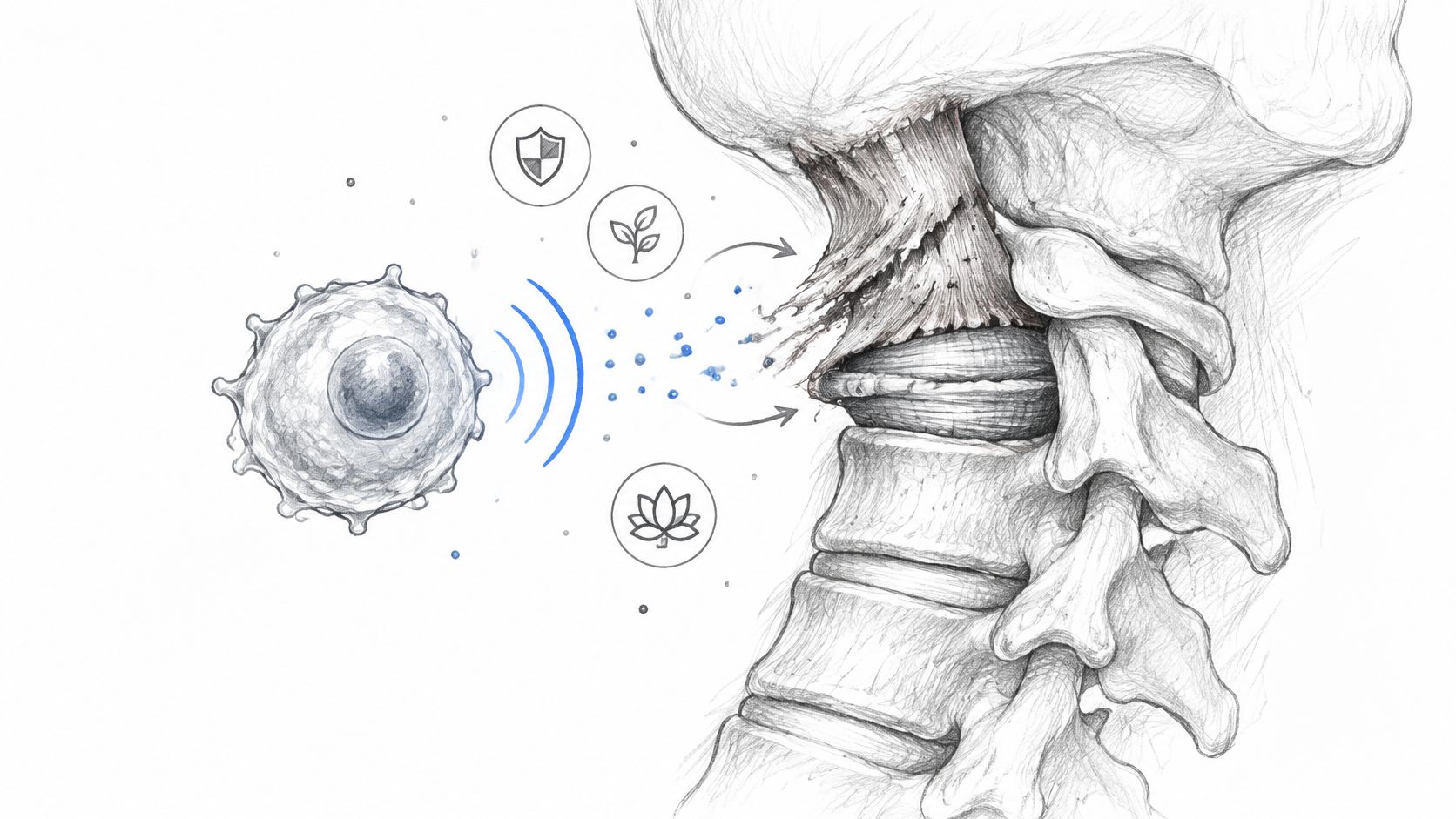
Regenerative medicine deserves honesty up front. Mesenchymal stem cells (MSCs) don’t become new ligament, disc or nerve cells. They work through the paracrine effect: they send out signals that guide the body’s own repair cells, calm inflammation and limit scar tissue. That signaling is exactly why the protocol targets the tissues around the neck, and it is also why anyone with red-flag neurological signs needs a specialist review first.
Table of Contents
- What Craniocervical Instability Actually Means
- Treatment Options Compared at a Glance
- How Specialists Confirm Upper Neck Instability
- Conservative Care as a Monitored Program
- What Regenerative Injections Can and Cannot Do
- Surgical Stabilization Results and Risks
- Confirm the Diagnosis Before Choosing a Path
What Craniocervical Instability Actually Means
The skull rests on two small bones, C1 (the atlas) and C2 (the axis). Ligaments hold that junction the way guy-wires hold a tent pole upright. When ligaments stretch or the supporting tissues are injured, the neck can stop moving the way it should. Nearby nerves, muscles and joints become irritated, and the result is pain that doesn’t go away with rest.
People describe headache at the base of the skull, neck pain, stiffness, dizziness, and numbness or tingling in an arm or hand. These symptoms often worsen with certain head positions. That is why a single resting scan can look quiet while the person still feels unsafe turning the head, and why a physician-reviewed MRI matters. At Dream Body Clinic, a cervical spine MRI is done on site before any treatment is planned.
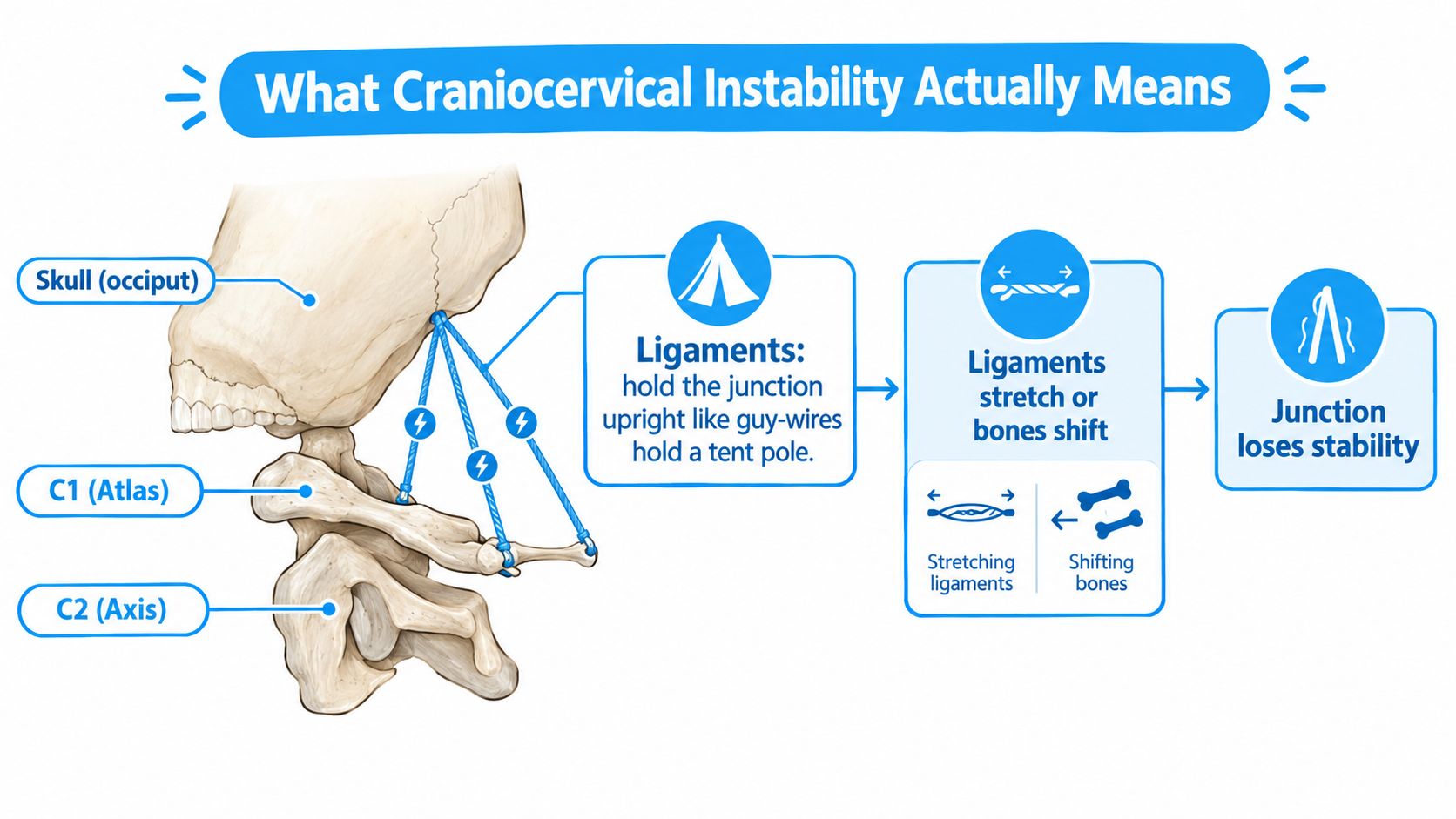
That model explains why the symptom list looks scattered. People describe a suboccipital headache at the base of the skull, neck pain, dizziness, visual disturbance, swallowing or voice changes, numbness in an arm or hand, and unsteadiness when they walk. Instability is often positional. A head position that loads the loose wires makes symptoms worse. A supported posture can ease them. That is why a single resting scan can look quiet while the person still feels unsafe turning the head.
Why the label gets applied so loosely
Treatment depends on whether the problem is mechanical, neurological, or a pain-and-inflammation problem in the supporting tissues. That split, not a clinic’s favorite procedure, is what the rest of the decision rests on.
Common settings include hereditary connective-tissue disorders such as Ehlers-Danlos syndrome, whiplash-type injury, prior neck surgery, and long-term wear of the discs and joints. There is no single universal definition, which is one reason recommendations differ so widely. Much chronic neck pain is not true instability at all. It comes from herniated or bulging cervical discs, degenerative disc disease, facet joint arthritis, ligament and tendon injury, muscle guarding, and irritated nerve roots. Those are the tissues the Dream Body Clinic neck protocol is designed to support.
Disc wear lower in the neck, described in guides to degenerative disc disease and spondylosis, is a different mechanical problem and shouldn’t be folded into an instability label.
Treatment Options Compared at a Glance
Think of the choices as a ladder, not a buffet. Patients typically start on the first rung. Each step up needs stronger objective evidence before it is even considered.
| Option | Typical candidates | What it aims to do | Main risk | Reversible |
|---|---|---|---|---|
| Conservative program (bracing, physical therapy, stabilization exercise) | Most patients, first line | Reduce symptoms and build neck control | Slow progress; symptoms can persist | Yes |
| Dream Body Clinic Stem Cell Neck Treatment (100M MSCs around the vertebrae + PRP, 100M MSC IV, NAD+ and vitamin C IV) | Adults with chronic neck pain over 3 months, ideally with MRI evidence of disc, facet, ligament or nerve involvement, who want a non-surgical option | Calm inflammation and support repair of the tissues that generate neck pain, with no anesthesia and about 20 minutes of local injections | Soreness for 1 to 3 days; small risk of infection; some patients do not respond | Cells stay where placed; no surgery to undo |
| Occipitocervical or C1-C2 fusion | Objective instability with progressive neurological signs | Mechanical stabilization | Surgical, wound and hardware complications; loss of some rotation | No |
| Decompression with stabilization | Cord or brainstem compression with matching neurological signs | Relieve compression | Neurological injury and surgical risk | No |
Conservative program. First line for most people. It is reversible, but progress can be slow.
Dream Body Clinic stem cell neck treatment. This is the option to consider when conservative care has not been enough and you want to avoid fusion or disc replacement. It combines a high local dose with a systemic dose and supportive IVs, and it is built around a required MRI review so the right candidates are treated.
Fusion. The strongest option for confirmed mechanical failure with progressive neurological decline. It carries real surgical risk and permanently changes the neck.
Decompression with stabilization. Reserved for compression that matches the exam.
Practical rule: Stem cell treatment is for chronic neck pain from the discs, joints, ligaments, muscles and nerves. If you have progressive weakness, worsening gait, trouble swallowing or breathing, or signs of cord or brainstem compression, get urgent specialist assessment first.
How Specialists Confirm Upper Neck Instability
Some findings should send you to a specialist before anything else: progressive weakness, a worsening gait, new swallowing or breathing trouble, loss of coordination, or signs of spinal-cord or brainstem compression. Fatigue, dizziness and headache still deserve a structured work-up.
Diagnosis links three things: symptoms, neurological findings, and imaging. A clinician takes a detailed history, performs a neurological exam, and then imaging earns its place. Pain that keeps returning after ordinary care is a reason to widen that work-up, and it is also the point where many patients ask about a non-surgical regenerative option.
At Dream Body Clinic the work-up is built into the five-day stay. Day 2 is bloodwork and a cervical spine MRI. On Day 3 the physician reviews the MRI, decides candidacy, and explains the injection plan before any payment or treatment. If the MRI shows you are not a candidate, you pay only for the MRI ($500) and blood panel ($300).
What each test can and can’t answer
An abnormal number without matching symptoms should prompt specialist review, not automatic surgery. If your own radiology report is from the past year, email the written report to info@dreambodyclinic.net so the doctors can give a first read on candidacy. A new MRI on site is still required.
Conservative Care as a Monitored Program
Conservative care is a functional program, not a waiting room. Write a baseline first: pain score, headache days per week, neurological function, balance, neck endurance, medication use, and what you can do in a normal day. Then you can tell whether anything is working.
- Individualized stabilization exercise. Built around the muscles that steady the head.
- Activity modification. Limit sustained extension and sudden loading.
- Short-term bracing, only as directed.
- Headache and pain management, coordinated with your prescribing clinician.
- Scheduled reassessment with written stop rules.
Conservative care is also the foundation of the Dream Body Clinic recovery plan. After treatment, patients avoid strenuous exercise for about two weeks, then follow about four weeks of light physical rehab, with nighttime decompression stretching. The first 6 to 8 weeks are the engraftment period, when the cells decide where to focus. After that, a gradual return to exercise is encouraged.
If you have already done months of therapy, bracing and medication and still hurt, that is the point to ask whether a regenerative option fits.
What Regenerative Injections Can and Cannot Do
Stem cells do not become the missing part, and this is exactly how the Dream Body Clinic protocol is designed. MSCs act through released paracrine factors rather than turning into new tissue. They can reduce inflammatory signaling, limit scar-tissue formation, support local blood vessels, and recruit or guide resident repair cells such as chondrocytes, fibroblasts, tenocytes and myoblasts. For irritated nerves they release neurotrophic factors.
What the protocol does:
- 4 injections of 25 million MSCs each (100 million total) around the most affected vertebrae, with PRP
- A separate 100 million MSC intravenous infusion
- NAD+ and high-dose vitamin C IV after the stem cell IV
- Cells are allogeneic MSCs from umbilical cord Wharton’s jelly and placenta, processed in the clinic’s own ISO-certified, COFEPRIS-licensed laboratory, with third-party batch testing provided to every patient
What it does not do: it is not a replacement for stabilization surgery when the cord, brainstem or a vertebral artery is at risk, and it is not a guaranteed result. Individual outcomes vary.
Signals, not new parts
Picture a messenger service, not a construction crew. The cells relay instructions that help calm inflammation, limit scarring and guide the body’s own repair cells. Because the cells work by signaling, they are injected around the affected levels rather than into the disc. The clinic’s current peri-spinal approach avoids anesthesia and its added cost and risk. Intradiscal injection was previously offered, and in the clinic’s experience it did not produce better results than injecting around the disc.
Before you book any regenerative treatment, ask for this in writing. Dream Body Clinic answers these directly:
- Target: The vertebral levels and soft-tissue targets are chosen by the physician after the MRI.
- Product: 100 million MSCs local plus 100 million IV, with cell source, lab processing and third-party testing documented.
- Judgment: Candidacy is decided by MRI before treatment. People with cancer in the past five years, large osteophytes, or complete tears are not treated.
Surgical Stabilization Results and Risks
Fusion is the most evidence-backed option for objectively confirmed, disabling instability. It can be the right call, and it should not be dismissed. It also changes the spine permanently, involves hospital time, and carries wound, hardware and neurological risks. Published series report unplanned reoperations for wound problems and screw-related complications. Results depend on who was selected and which construct was used.
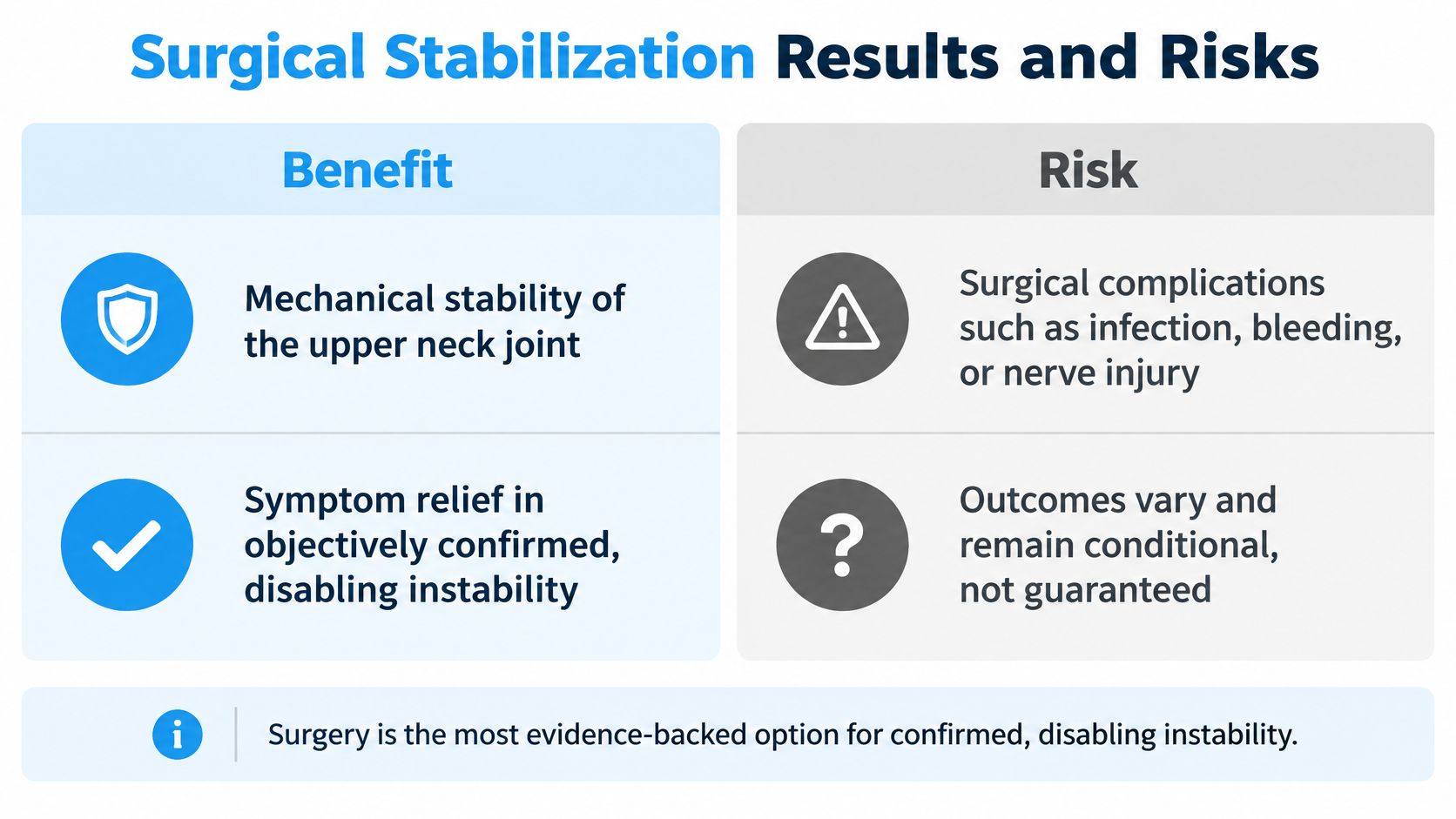
Benefit next to risk
Surgery has a clear place. For many adults whose pain comes from the discs, joints and soft tissues, a lower-risk, non-surgical option is worth evaluating before cutting.
Confirm the Diagnosis Before Choosing a Path
The decision comes down to a few gates:
- Rule out red flags. Progressive weakness, worsening gait, swallowing or breathing trouble, or cord or brainstem signs need a specialist first.
- Get a real work-up. Symptoms, neurological exam and an MRI, not a single scan or a single symptom.
- Try a monitored conservative program, with a written baseline.
- If pain persists and you want to avoid surgery, request an MRI review for the Dream Body Clinic Stem Cell Neck Pain Treatment.
Your MRI decides whether you are treated. If you are a candidate, you move ahead. If not, you will know why, and you will have only paid for the MRI and blood panel.
If you are traveling for care
The treatment takes place at Dream Body Clinic, Carmen Serdan 22, Bucerias, Nayarit 63732, near Puerto Vallarta, Mexico. Plan to be in town at least five days:
- Day 1: Arrive and rest
- Day 2: Bloodwork and MRI
- Day 3: Physician review of MRI, candidacy decision, then payment if proceeding
- Day 4: Treatment
- Day 5: Fly home
Typical arrival patterns are Sun-Thu, Mon-Fri, Tue-Sat or Wed-Sun. The MRI bed leaves about 1 ft (30 cm) to the magnet. If you may not fit, call ahead and the clinic will schedule your MRI at a partner lab. The all-inclusive package is $8,700 USD, covering the MRI, full blood panel, physician consult, local MSC injections with PRP, the 100 million MSC IV, NAD+ and vitamin C IV, and facility care. Bring prior imaging reports and disclose cancer history, infection, blood thinners and implanted devices. Patients are physician-led by Dr. Arick Francisco Barba Lopez, with Dr. Lizbeth Aguirre and Dr. Jacqueline Vega.
9 Things to Know Before Getting Stem Cell Neck Treatment in Mexico
If chronic neck pain is limiting your life and you want to avoid surgery, these are the nine things to know before you book.
1. The protocol is 100 million cells around the neck, plus an IV
Four injections of 25 million mesenchymal stem cells each (100 million total) are placed around the most affected vertebrae with PRP. A separate 100 million MSC IV follows, then NAD+ and high-dose vitamin C. The injections are peri-spinal, not into the disc, and need no anesthesia.
2. The cells are made in the clinic’s own lab
The cells are allogeneic MSCs from umbilical cord Wharton’s jelly and placenta, processed in Dream Body Clinic’s ISO-certified, COFEPRIS-licensed laboratory. Third-party batch testing is provided to every patient before treatment.
3. One published price, with the MRI included
The package is $8,700 USD and includes a cervical spine MRI, a full blood panel, a physician consult, all injections and IVs, and facility care. If the MRI shows you are not a candidate, you pay only $500 for the MRI and $300 for the blood panel.
4. It is used for the common sources of neck pain
Herniated or bulging cervical discs, degenerative disc disease, facet joint arthritis, early to moderate stenosis, ligament and tendon injury, muscle guarding, irritated nerves, and persistent pain after prior neck surgery.
5. It is not right for everyone
The clinic does not treat people with cancer in the past five years. Large osteophytes or a complete tear are the most common reasons for disqualification. Progressive neurological signs, such as worsening weakness, gait changes or trouble swallowing, need specialist care first. Some patients do not respond.
6. An MRI is required, and you get it on site
The MRI is done with the clinic during your stay. If you have a report from the past year, email the written report to info@dreambodyclinic.net for a first read, but a new MRI is still required. The MRI space is tight, so call ahead if you are concerned about fitting.
7. Plan for five days in town
Arrive and rest, bloodwork and MRI, physician review, treatment, fly home. Local injections take about 20 minutes and the IV one to two hours.
8. Recovery is gradual
Expect soreness for 1 to 3 days and walk immediately afterward. Avoid strenuous exercise for about two weeks, then do about four weeks of light rehab. The first 6 to 8 weeks are the engraftment period. Peak results are typically seen at 3 to 6 months, and results vary.
9. Prepare before you come
Stop NSAIDs at least one week before and for at least two weeks after. Avoid cortisone for about 3 months before treatment. Bring prior imaging reports. Disclose cancer history, infection, blood thinners and implanted devices.
Ready to find out if you are a candidate? Request a free MRI review: (888) 704-3977, WhatsApp +52 322 232 1055, or info@dreambodyclinic.net.
Results vary. This content is for education and is not medical advice. Stem cell treatment is not a substitute for urgent evaluation of progressive neurological symptoms.
Confirm the Diagnosis Before Choosing a Path
If you have a recent MRI then please send it to info@dreambodyclinic.net for a free review to determine if our treatment can help.
The Stem Cell Neck Treatment at Dream Body Clinic
Dream Body Clinic in Bucerias, Mexico, offers COFEPRIS-regulated mesenchymal stem cell care for international patients, including spine and neck protocols that pair stated cell counts with structured remote follow-up. If you are weighing an investigational regenerative option after a proper diagnosis, start with a complimentary case review and ask how any proposed injection would be measured against neurological stop rules. Visit Dream Body Clinic to send your records before you travel.