
Many people with osteoarthritis have heard that stem cells can rebuild worn cartilage. The more accurate picture is that mesenchymal stem cells (MSCs) work mainly by sending signals that help calm inflammation and support the joint’s own repair responses. At Dream Body Clinic in Bucerías, near Puerto Vallarta, Mexico, that is exactly how the treatment is designed and described: an MSC injection placed directly into the joint, aimed at reducing inflammation and supporting cartilage and soft-tissue repair, as a minimally invasive alternative to surgery.
Dream Body Clinic treats osteoarthritis of the knee, hip, shoulder, elbow, wrist, ankle, foot, thumb, fingers and big toe with joint-specific protocols, an on-site MRI or X-ray, and published all-inclusive pricing. Results vary, and the clinic does not promote its treatment as a cure.
Table of Contents
- How Stem Cells Help Joints Without Becoming Cartilage
- What Knee Trials Actually Show
- How Cell Dose, Delivery Route and PRP Shape a Protocol
- Where the Evidence Stands
- Expected Outcomes, Durability and Safety Over Time
- Stem Cell Injections Compared With Standard Alternatives
- Confirm Candidacy and Clinic Disclosures Before You Travel
How Stem Cells Help Joints Without Becoming Cartilage
Injected MSCs don’t need to become cartilage cells to have a proposed effect. The central idea is the paracrine effect: cells release specialized signals that act on nearby tissue and help guide the joint’s own repair responses. This is different from replacing missing cartilage with new cells.
Think of a site foreman who doesn’t lay the bricks but radios instructions to the crew. The foreman coordinates the work; the crew does it. In this analogy, MSCs send signals, while the patient’s existing cartilage and other joint cells remain central to any local response.
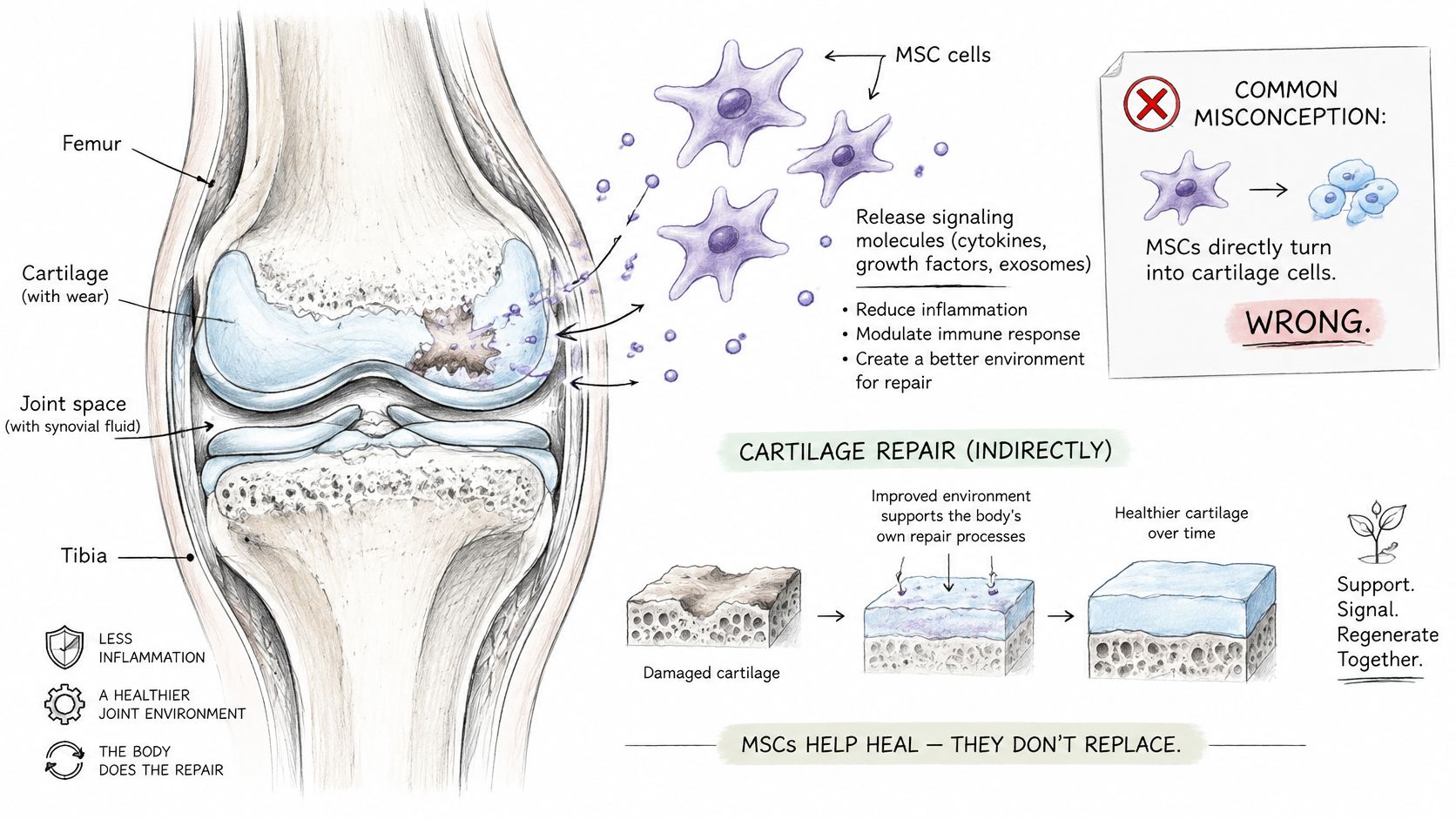
How the signaling sequence is thought to work
MSCs may respond to inflammatory cues in the joint, including interferon-gamma, tumor necrosis factor alpha, and interleukin-1 beta. In response, they can increase production of prostaglandin E2 and other mediators that influence nearby immune and tissue cells. A review describes this as a “hit-and-run” mechanism: MSC persistence and engraftment are limited, but their temporary signals may still alter the local environment. The review of the paracrine mechanism in osteoarthritis also describes soluble cytokines and chemokines, alongside extracellular vesicles that carry regulatory molecules.
One proposed link is the way those signals influence macrophages, immune cells that can contribute to inflammation. MSC-derived signals may encourage a shift from the more inflammatory M1 state toward the anti-inflammatory M2 state, which can release interleukin-10. This describes immune regulation, not injected MSCs turning into macrophages or cartilage.
Other signals may support resident chondrocytes, the cells already present in cartilage, by influencing their survival and the maintenance of the surrounding matrix. That proposed support is not the same as demonstrating a new cartilage layer. A patient may feel better without measurable structural repair, and imaging alone doesn’t establish that transplanted cells became replacement tissue.
For a broader explanation of the signaling concept, see how stem cells may support joint recovery and regeneration.
Injected MSCs don’t need to become cartilage cells to help. The central idea is the paracrine effect: the cells release specialized signals that act on nearby tissue and help guide the joint’s own repair responses. Think of a site foreman who doesn’t lay the bricks but radios instructions to the crew. Dream Body Clinic describes its cells the same way: managers on the construction site, guiding the repair process.
In practice, the clinic’s protocol places 50 million MSCs (25 million for smaller joints such as the wrist, thumb and big toe) directly into the affected joint. The cells are allogeneic MSCs from umbilical cord Wharton’s jelly and placenta from live, healthy births, and they are processed in the clinic’s own on-site, COFEPRIS-certified and ISO-rated laboratory. They are not embryonic stem cells, and there is no bone marrow harvest or liposuction.
How the signaling sequence is thought to work
MSCs seek out inflammation. Once in the joint, they can respond to inflammatory cues and release signals that influence nearby immune cells and the cells already living in cartilage. Those signals aim to:
- Calm inflammation in the joint
- Support the cartilage-making cells already present
- Limit scar-tissue formation
- Support local blood supply
- Guide the body’s own repair cells in ligaments, tendons and muscle
This explains why the clinic asks patients to avoid NSAIDs for one week before treatment and at least two weeks after, and to avoid cortisone for about three months before. Those drugs mask the inflammatory signals the cells are looking for.
A claim worth checking: Be cautious of any clinic that promises injected cells will turn into new cartilage. Signaling is the mechanism that Dream Body Clinic describes, and individual results, including imaging, vary.
What Knee Trials Actually Show
The clinical evidence supports a signal of symptom relief for some people with knee osteoarthritis. It doesn’t establish a cure, reliable cartilage restoration, or a treatment that consistently prevents surgery.
| Evidence point | Reported figure | What it means for patients |
|---|---|---|
| Randomized trials in 2021 systematic review | 14 trials with 408 MSC-treated patients | A limited evidence base with small treatment groups |
| Clinical measures favoring MSCs at about one year | 19 of 26 measures (73%) | A signal of symptom benefit, not proof of cure |
| Pain change on 0 to 10 Visual Analogue Scale | 1.8 to 4.4 points in MSC groups | Compare with control groups, not just a patient’s starting score |
| Function change on KOOS (0 to 100) | 18 to 32 points in MSC groups | Reports symptoms and function, not cartilage structure |
| Trials rated high risk of bias | 10 of 14 (71%) | Results remain provisional |
| Serious adverse events after MSC treatment | None reported in included trials | Encouraging in these trials, but not proof of zero long-term risk |
| 28-trial meta-analysis, knee osteoarthritis | 1,494 participants; WOMAC pain improved by month 3 | Evidence quality ranged from moderate to very low |
A 2021 systematic review of randomized trials included MSCs from bone marrow, adipose tissue, and activated peripheral blood. At about one year, the review found that most reported clinical measures favored MSC treatment over controls. Those measures included pain and knee-related function, but they don’t show that cartilage was restored.
A separate meta-analysis of 28 randomized trials involving 1,494 participants found modest improvement in WOMAC pain by month three, with benefits generally reported through at least twelve months. Evidence quality for several outcomes ranged from moderate to very low, and the trials used different cell sources, doses, preparations, and comparison treatments. A meta-analysis of randomized trials in knee osteoarthritis also emphasizes the distinction between improvements in symptoms and proof of structural change.
Published research on MSCs in knee osteoarthritis shows a signal of symptom relief for some people. It does not establish a cure or reliable cartilage restoration, and the trials used different cell sources, doses and preparations. Dream Body Clinic’s own knee protocol is one specific approach, and its results should be judged on its own published details rather than assumed from trials of other products.
What the safety results can and can’t tell you
The clinic reports tightness or soreness in the joint the night after treatment or the next day as the most common effect. A very small percentage of patients are non-responders. As with any injection there is a very small risk of infection, and the clinic uses iodine and microdacyn to reduce it. The clinic does not treat anyone who has had cancer in the past 5 years, as a precaution.
No clinic can guarantee an outcome. If fever, spreading redness, unusual warmth or increasing pain follows an injection, seek urgent medical review.
How Cell Dose, Delivery Route and PRP Shape a Protocol
“Stem cell therapy” is not one standardized product, so it helps to know exactly what a clinic offers. Dream Body Clinic’s joint protocols are consistent and published on each treatment page.
How Cell Dose, Delivery Route and PRP Shape a Protocol
“Stem cell therapy” isn’t one standardized product. A bone-marrow preparation, an adipose-derived preparation, a donor-derived product, and activated peripheral blood cells aren’t interchangeable just because a clinic calls each one MSC therapy.
| Variable | Options seen in practice | Why it changes results |
|---|---|---|
| Cell source | Bone marrow, adipose tissue, umbilical cord, activated peripheral blood | Products differ and shouldn’t be treated as equivalent |
| Origin | Autologous (patient’s own) or allogeneic (donor) | Affects manufacturing consistency and immune considerations |
| Processing | Expanded in culture or minimally manipulated | Changes viability, cell identity, and sterility controls |
| Cell dose | Protocols may use different amounts, including clinic-stated ranges such as 25 to 100+ million cells | No established dose-response; a larger dose isn’t proven better |
| Delivery route | Intra-articular for joints; IV or intrathecal for other indications | Route changes where cells are delivered and which risks need consideration |
| PRP pairing | Often combined with MSCs in orthopedic protocols | The combined effect is rarely isolated; ask what each component is intended to contribute |
Why Get Stem Cell Therapy in Mexico and not the USA?
In the USA they have a rule called minimal manipulation. This means they can’t fully isolate and culture stem cells for treatments. So patients can get minimally manipulated stem cells from fat, bone marrow or umbilical cord tissue, but only a small percentage of what they are calling stem cells is actually stem cells. It is mostly other types of cells due to the minimal manipulation.
There are a lot of studies on MSCs for knee repair, but even with all the evidence the hesitate to state that it really works. This is because even with over 100,000 studies done on mesenchymal stem cells (you can verify on google scholar), the FDA system gets in the way of approval. To get mesenchymal stem cells approved for knee repair each type of treatment requires a $2.5 million USD application feel. So knee osteoarthritis would be $2.5 million then meniscus repair would be $2.5 million and so on. That application fee just gets the clinic into the 4 phase FDA trials. Those typically take over 7 years and cost hundreds of millions of dollars to complete. Then at the end you can’t patent a mesenchymal stem cell so you would just be opening the market to your competition. You would spend hundreds of millions of dollars for each different type of treatment and would not be able to recover your costs. It is a flawed system designed to protect big pharmaceutical companies and keep people hooked on pills or resort to surgery.
Where the Evidence Stands
Osteoarthritis is a major health burden worldwide, and the knee is the most commonly affected joint. MSC research is most developed for the knee. Evidence is thinner for the hip, shoulder and smaller joints, which is why joint-specific protocols matter.
Dream Body Clinic offers a separate, published protocol for each joint:
Large joints include an on-site MRI and a full blood panel. The big toe and fingers include an X-ray. Individual results vary with the severity and duration of the condition.
| Joint | Evidence depth | What a patient should take from it |
|---|---|---|
| Knee | Most data and validated outcome measures | Strongest available evidence, still not proof of cartilage restoration |
| Hip | Limited controlled data | Ask for evidence specific to hip osteoarthritis |
| Shoulder | Limited, mostly small studies | Treat claims of proven benefit with particular caution |
Expected Outcomes, Durability and Safety Over Time
Set a baseline before treatment so you can judge change by more than memory. Record pain, stiffness, and function using a consistent measure, and decide with the clinician what improvement would matter to you. No single threshold applies across all trials, so agree on your own targets before an injection.
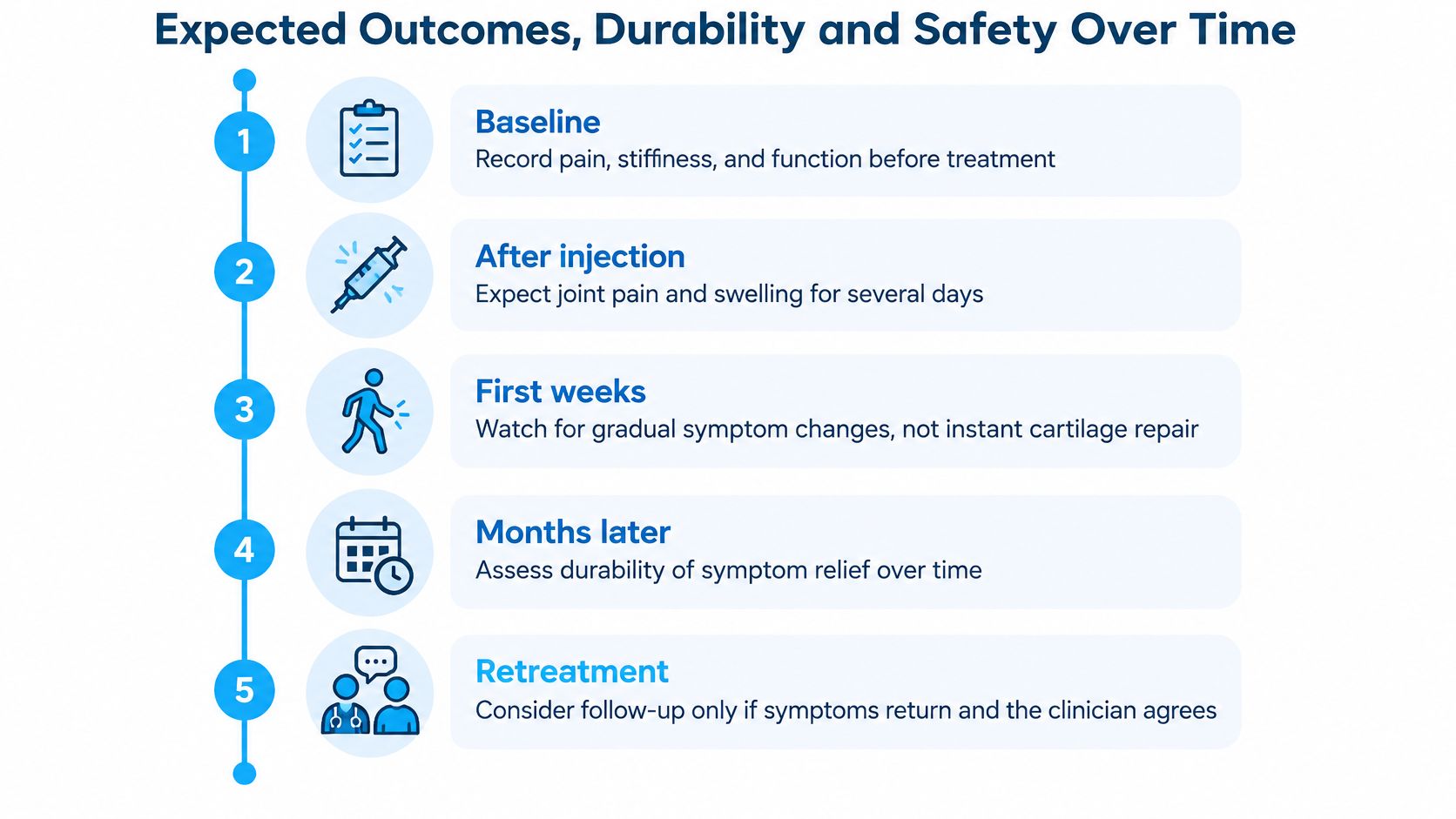
Joint pain and swelling for several days after an intra-articular injection are among the commonly reported short-term effects, and are often local and transient. Fever, spreading redness, unusual warmth, or pain that keeps increasing after the first days needs urgent medical review, because infection is an important complication to exclude. A synthesis of registered osteoarthritis trials and their safety reporting notes mostly local, transient short-term effects while highlighting gaps in long-term safety, durability, structural change, and repeat-treatment evidence.
Use checkpoints to guide decisions
Stem Cell Injections Compared With Standard Alternatives
An MSC injection is an option for symptom relief and an established way to rebuild cartilage. Exercise, weight management, injections, and joint replacement each serve different purposes, so the choice is not treatment versus no treatment.
| Option | Evidence strength | Invasiveness | Typical role |
|---|---|---|---|
| Exercise and physiotherapy | Strong, included in guidelines | Non-invasive | First-line foundation |
| Weight management | Strong for knee symptoms | Non-invasive | Reduces joint load |
| Corticosteroid injection | Short-term relief; repeated use is debated | Minor injection | Short-term flare control |
| Hyaluronic acid injection | Mixed evidence | Minor injection | Symptom-relief option |
| PRP injection | Evidence still developing | Minor injection | Sometimes combined with MSCs |
| MSC injection | Investigational; small trials of variable quality | Minor injection, with travel and cost considerations | The Best way to repair and regenerate a damaged joint |
| Joint replacement surgery | Well established for end-stage disease | Major surgery | Definitive option when conservative care fails |
Compared with cortisone, the clinic’s position is that steroid shots can reduce inflammation quickly but often give short-term relief, and its protocol aims to support the joint’s own repair instead. Compared with surgery, the stem cell injection typically involves more manageable downtime and no hospital stay. Surgery remains the established choice when the joint is too far gone, and the clinic’s MRI is designed to identify those cases.
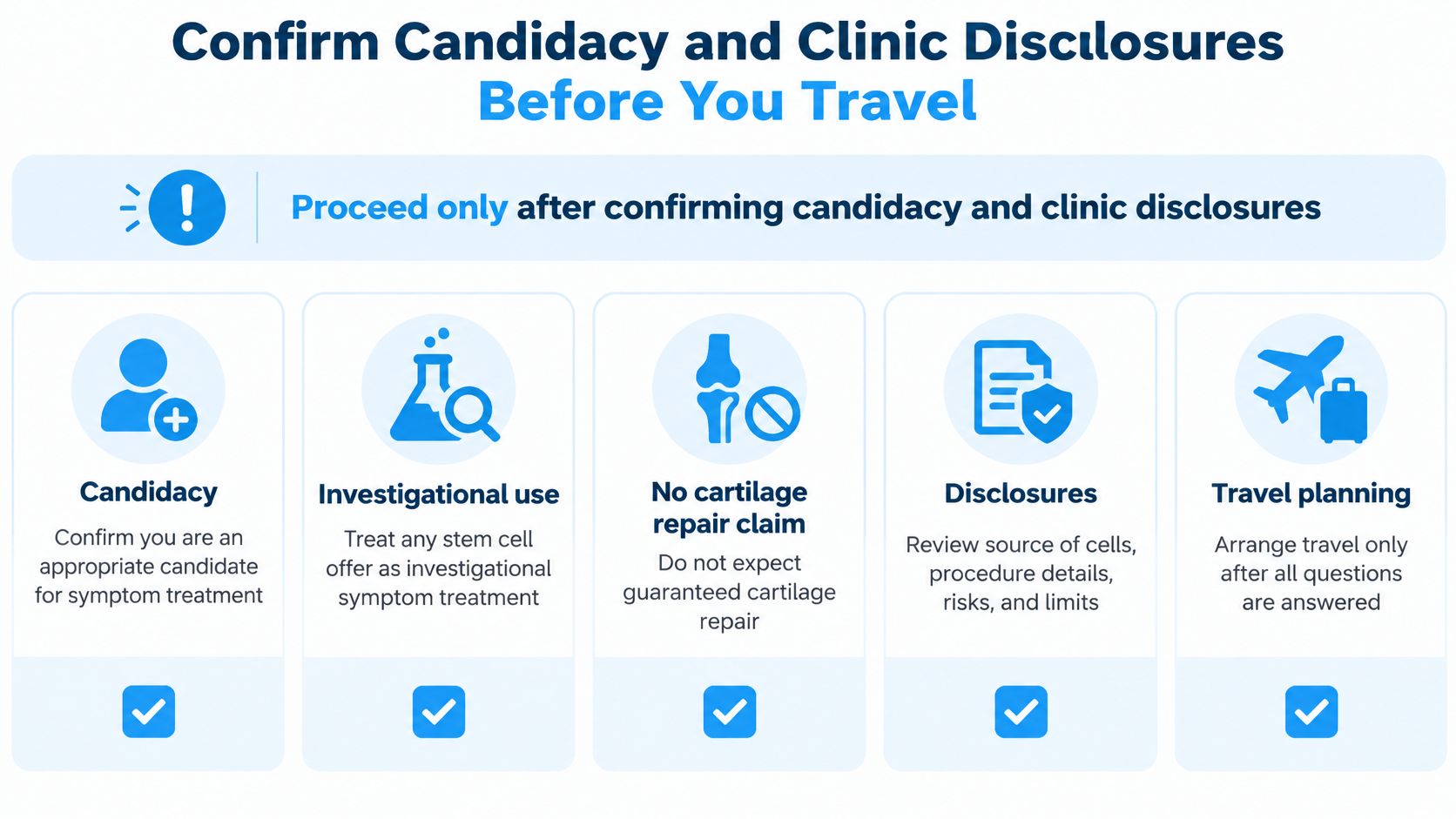
Confirm Candidacy and Clinic Disclosures Before You Travel
A clear diagnosis and a fully described protocol matter more than any promise. At Dream Body Clinic, candidacy is decided by MRI before treatment.
- Confirm the diagnosis. Email your written MRI or X-ray report from the past year to info@dreambodyclinic.net for a first read. A new MRI on site is still required for the large joints.
- Match the joint to the protocol. Each joint has its own page with the dose, price and itinerary.
- Get product and procedure disclosures. Ask about cell source, lab processing, third-party testing, dose and route. The clinic provides all of these.
- Agree on measurements and follow-up. Decide which pain and function measures you will track.
- Plan for problems and alternatives. Know who to call, and that surgery remains available.
- Check the MRI fit. The open MRI is not claustrophobic, but space is limited: about 1 ft (30 cm) from the bed to the magnet. If you may not fit, the clinic schedules your MRI at a partner lab.
Who is not treated: The most common reasons for disqualification are advanced osteophytes (bone spurs) and a complete tear. The clinic does not treat people who have had cancer in the past 5 years. If the MRI shows you are not a candidate, you pay only $500 for the MRI and $300 for the blood panel.
Typical five-day schedule: Day 1 arrive and rest, Day 2 MRI and bloodwork, Day 3 MRI review, then payment, Day 4 treatment, Day 5 fly home.
Regulation: Treatment is delivered in Bucerías under COFEPRIS oversight, in the clinic’s own licensed laboratory. This is a clinic protocol, not an FDA-approved U.S. indication, and U.S. rules are different from the rules in the country where treatment is offered.
Before treatment: Stop NSAIDs at least 1 week before and avoid cortisone for 3 months before. Bring prior imaging reports and disclose cancer history, infection, blood thinners and implanted devices.
Dream Body Clinic is a physician-led regenerative clinic at Carmen Serdán 22, Bucerías, Nayarit, led by Dr. Arick Francisco Barba Lopez. To find out whether your joint is a candidate, request a free consultation: (888) 704-3977, WhatsApp +52 322 232 1055, or info@dreambodyclinic.net, or visit dreambody.clinic.
Results vary. This content is for education and is not medical advice.
Related Topics: COFEPRIS clinics, knee osteoarthritis, MSC therapy, osteoarthritis stem cell therapy, paracrine effect