

The popular advice to try stem cell injections before hip replacement skips the most important question: what would count as success? Less pain, easier walking, and rebuilt cartilage aren't interchangeable outcomes. Before choosing stem cell injections for hip pain, look for measured improvements in everyday function, then ask what the treatment hasn't been shown to change.
Table of Contents
- Hip Injection Results You Can Check
- Why These Cells Signal Healing
- Who Is Injected and How
- The Timeline After a Hip Injection
- Injection Versus Hip Surgery by Situation
- Limits Risks and Unproven Claims
- Decide Before You Travel for Care
Hip Injection Results You Can Check
A substantial reduction in pain would matter if putting on socks or walking to the shop currently hurts. In a 2017 prospective hip osteoarthritis study, 10 patients received three weekly injections of their own bone-marrow-derived mesenchymal stem cells, and average visual analogue scale pain fell from 4.2 to 1.1, approximately 74%, with a reported p-value of 0.0001.
That's an encouraging result, but it isn't the same as a treatment success rate. The percentage describes the change in the group's average pain score, not the proportion of patients cured. Without a comparison group, the study couldn't establish how much improvement came from the injection rather than other influences.
What the scores actually mean
The same study reported improvements in hip function, alongside an important mismatch between symptoms and imaging. Its results are collected below so the different outcomes don't get blended into a single regeneration claim.
What hip MSC studies measured
| Evidence | Patients or joints | Pain or function | Structure |
|---|---|---|---|
| 2017 BM-MSC series, three weekly injections | 10 patients | VAS 4.2 to 1.1; Harris 61.9 to 85.7; Vail 61.2 to 78.2 | X-ray grade unchanged in 9 of 10 |
| 2024 scoping review | 7 studies, 72 patients | Lower pain and better function; no established dose-response | No completed hip BM-MSC randomized trials, leaving structural effects unproven |
| 2024 systematic review | 10 studies, 316 patients | Short-term pain and function gains | Some cartilage imaging signals; methods too mixed for reliable comparison |
| 2023 evidence review, discussed under treatment limitations | 6 studies, 61 joints | Significant scores in 5 of 6; WOMAC change near 9.1 points in several | Imaging change not established; not proof of a new joint |
For the prospective study, higher Harris and Vail scores indicated better function. The WOMAC score, which measures pain, stiffness, and functional difficulty, moved in the favorable direction from 34.5 to 19.2, but its reported p-value of 0.15 didn't meet conventional statistical significance. That result shouldn't be presented as equally certain just because the numbers improved.
A p-value also doesn't tell you whether a particular patient will benefit. It addresses a statistical question within that study, not how long relief will last or whether someone will avoid surgery.
Why the wider evidence matters
The reviews examined overlapping but differently defined bodies of evidence. Their patient totals shouldn't be added together as though they represent independent groups, and their findings don't establish that every cell product performs alike.
Cell sources, preparation methods, injection schedules, and outcome measures differed substantially. Those differences make it difficult to compare protocols or identify which component of treatment produced the improvement.
The useful distinction: A patient can report less pain and better movement while the underlying arthritis remains visible on an X-ray.
For your own decision, ask for outcomes that match your problem. If your priority is walking without a limp, a clinic should discuss walking and function, not substitute an attractive MRI image for a meaningful daily improvement.
Why These Cells Signal Healing
Say walking across a car park leaves you with a deep hip ache. If that ache becomes shorter after treatment, you might assume the injected cells have filled the worn area with cartilage. That's not the treatment mechanism you should be promised.
The injected cells don't differentiate into other cells as the intended treatment effect. They work through the paracrine effect, sending out specialized signals that may guide the healing environment. They aren't expected to become replacement hip cartilage and patch the joint surface.
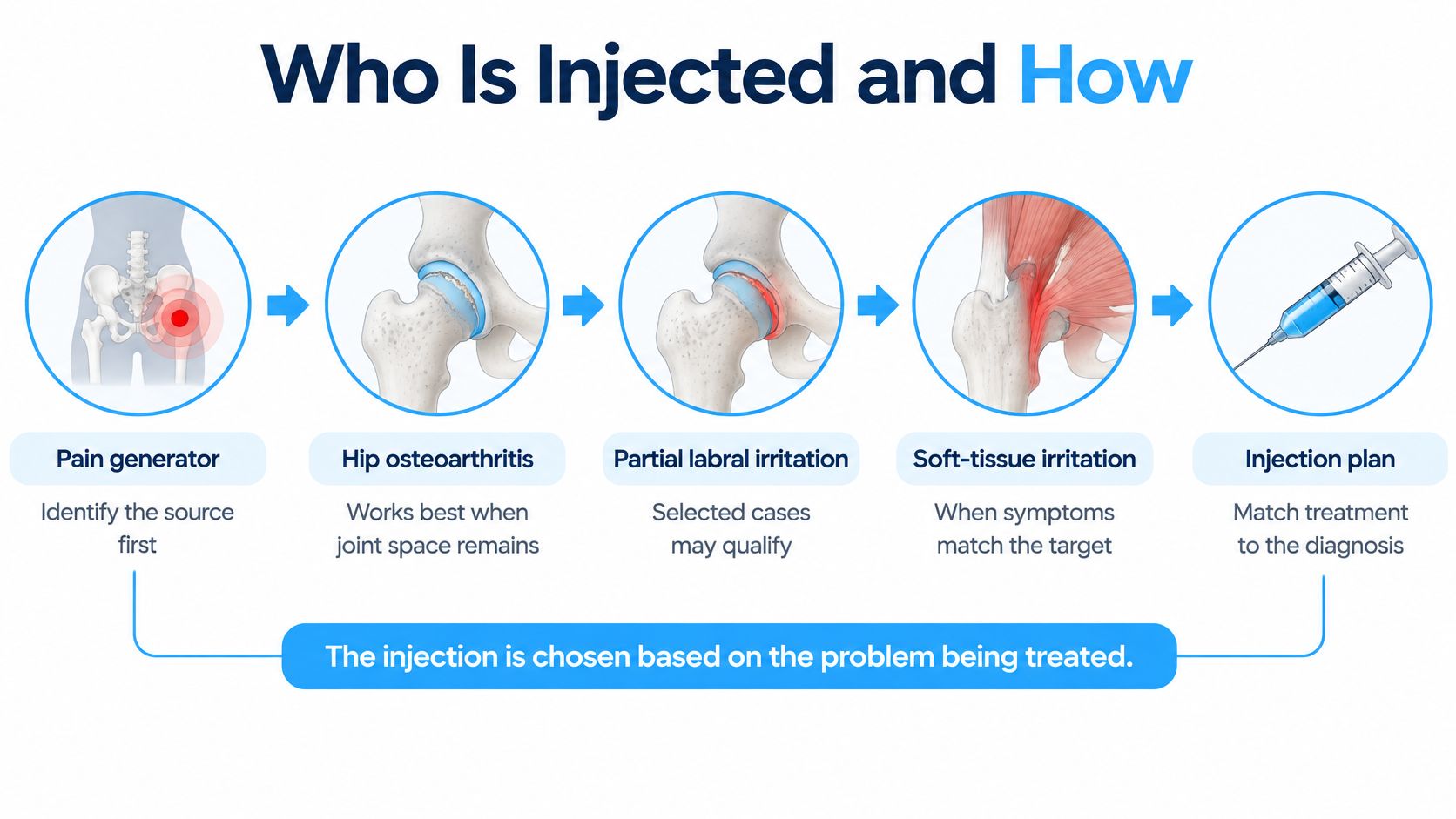
Diagnosis still comes before choosing an injection. This visual illustrates how the suspected pain source shapes that decision.
Messengers rather than building material
A useful analogy is a site foreman with a radio, not a brick that becomes the wall. A review of MSC signaling mechanisms describes the cells' release of cytokines, growth factors, chemokines, nucleic acids, lipids, and extracellular vesicles, including exosomes. These substances influence surrounding cells rather than serving as transplanted cartilage.
The proposed effects include:
- Calmer immune activity: Signals may reduce inflammatory activity and encourage macrophages toward a less inflammatory state.
- Support for existing tissue: They may help maintain the extracellular matrix, the supporting material around cells.
- Changes in cell survival: Signaling may limit apoptosis, or programmed cell death, and senescence, a state in which cells stop functioning normally.
- Recruitment of repair activity: Signals may influence the patient's own repair cells.
These are biological explanations for why treatment might help. They aren't proof that a particular injection will produce a predictable clinical result.
Why pain can improve without a rebuilt surface
A review of MSC-related osteoarthritis pain mechanisms describes how paracrine factors and exosome-associated microRNAs may influence inflammatory and pain pathways, including peripheral inflammation and central sensitization. In plain language, treatment may change both irritation around the joint and how pain is processed.
That makes symptom relief biologically plausible without requiring the injected cells to become cartilage. It doesn't mean a torn labrum, a bony obstruction, or an extensively worn surface has disappeared.
The video offers another way to understand the treatment discussion.

A better walking score can be valuable on its own. Calling that improvement a rebuilt hip adds a claim that the clinical evidence hasn't established.
Who Is Injected and How
Before discussing a cell count, the clinician needs to identify the pain generator. Pain felt near the hip can originate inside the joint, in surrounding tendons or bursae, or in the lower back. An injection aimed at the joint won't automatically treat all of those locations.
Hip osteoarthritis with remaining joint space is a more plausible setting for a symptom-focused injection discussion than advanced collapse or fixed deformity. Selected labral or soft-tissue complaints require their own assessment, not an assumption that evidence from osteoarthritis applies to every painful structure.
Start with the examination and imaging
The assessment should connect your symptoms to examination findings and imaging. Tell the clinician whether pain occurs in the groin, over the outside of the hip, down the leg, or during a particular movement.
- Check look-alike conditions: Lumbar radiculopathy, greater-trochanteric pain syndrome, and femoroacetabular impingement can require a different treatment strategy.
- Assess the bone: Avascular necrosis needs specific evaluation, particularly if there's concern about collapse.
- Document the target: X-rays help assess joint space and alignment. MRI can characterize cartilage, the labrum, bone edema, and other abnormalities when clinically appropriate.
An MRI shouldn't be ordered merely to create a before-and-after marketing image. The clinician should explain what question it answers and how the result could change treatment.
Understand what reaches the joint
For an intra-articular treatment, the injection goes inside the hip joint, generally using ultrasound or fluoroscopy to guide placement. An intravenous infusion alone isn't the same procedure. Ask the treating clinician to identify the intended location before consenting.
PRP, or platelet-rich plasma, is a blood-derived preparation containing platelets and their associated signaling factors. PRP isn't a stem cell product. If a protocol combines the two, you're receiving a combination treatment, and improvement can't automatically be attributed to MSCs alone.
Our explanation of how stem cell injections work can help you prepare questions about delivery routes and treatment components.
A larger cell count isn't a better outcome
A review describing a randomized osteoarthritis trial reports that 43 patients received a protocol evaluating 40 million MSCs, with clinically relevant pain relief compared with placebo over 6 months. That trial involved knees, not hips, so it doesn't establish a hip dose or expected hip outcome.
For any proposed hip protocol, document the tissue source, product identity, viable cell count, injection guidance, and follow-up measures. A number on a treatment sheet doesn't establish potency, appropriate dosing, or a likelihood of avoiding surgery.
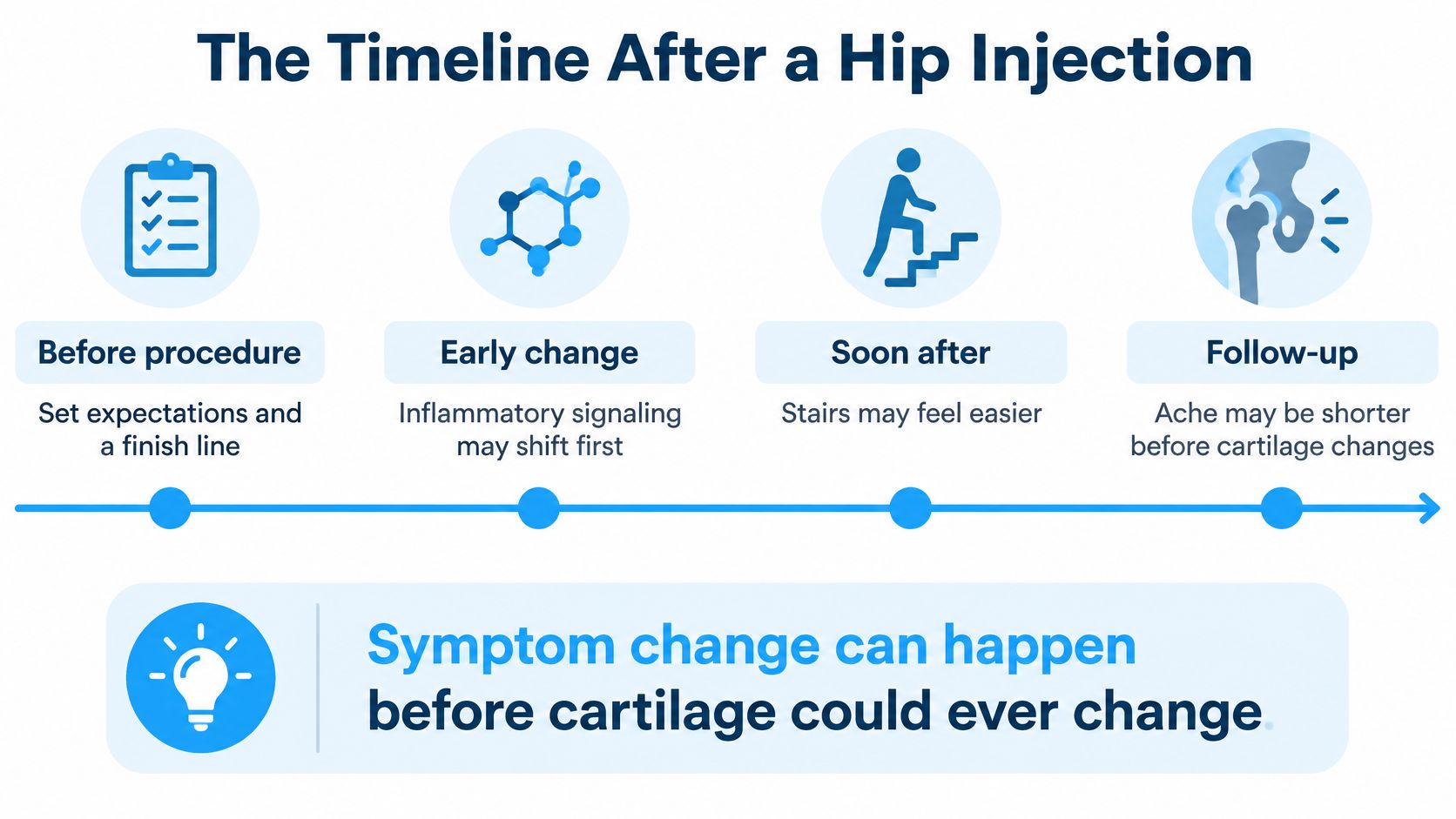
Use the following visual as a reminder to agree on follow-up before treatment, rather than interpreting every early change as permanent recovery.
The Timeline After a Hip Injection
Agree on a follow-up calendar before the procedure. Otherwise, an uncertain result can become an open-ended wait, with every uncomfortable week dismissed as too early and every comfortable day counted as success.
Some clinic discussions use 4 to 8 weeks for an initial change and 3 to 6 months for further improvement. Treat those as clinic expectations to discuss, not validated hip-study deadlines or guarantees. Your recovery instructions and reassessment schedule should reflect the actual procedure, product, and diagnosis.
Measure ordinary activities consistently
Choose home measures you can repeat under similar conditions. Record pain at rest and after a familiar walk, how long or how far you can walk before limping, and a daily task such as putting on socks or getting into a car.
Use the same pain scale each time. Also note changes in pain medication, walking aids, rehabilitation, and activity, because a lower pain score after doing much less doesn't necessarily represent better function.
Checkpoints after a hip MSC injection
The following is a proposed monitoring schedule to agree with your clinician, not a research-established timetable for recovery.
| Checkpoint | Home measures | What counts as a signal | Decision |
|---|---|---|---|
| Baseline, before injection | Pain at rest and after a set walk; walking tolerance before limping; one daily task | Recorded starting values | Start tracking from day one |
| About 6 weeks | Same three measures | Easier stairs or a shorter ache | Treat as a signal, not a cure |
| About 3 months | Same three measures | Further gains on walk or task | Continue the monitoring plan if the trend holds |
| About 6 months | Same three measures | Pain and daily task unchanged | Don't stack repeat injections; reopen diagnosis and surgical discussion |
| About 12 months | Same three measures, plus imaging if ordered | Sustained gains across all three | Compare with surgical options before any repeat decision |
Decide what would end the trial
A meaningful response should help you do something that matters, not merely change an isolated score. Say your pain feels milder, but you still can't complete the same walk or get dressed more comfortably. That's a mixed result worth discussing, not a reason to automatically purchase another injection.
Set a stopping rule: If the agreed functional goal remains unmet, reassess the diagnosis and alternatives before repeating treatment.
The timeline below separates symptom monitoring from assumptions about structural repair.
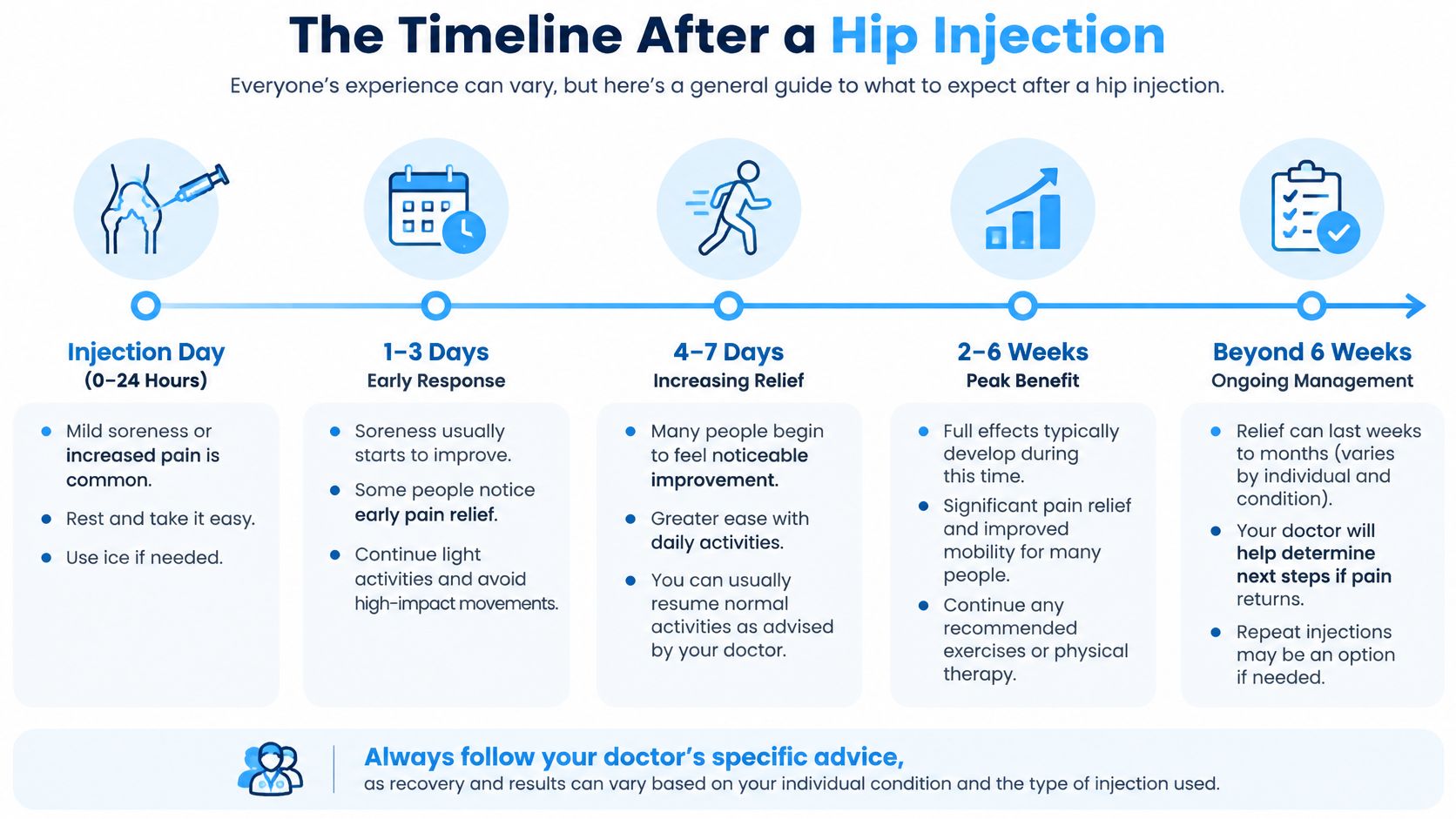
Don't wait for a scheduled checkpoint if symptoms suddenly worsen. New severe pain, fever, or difficulty bearing weight needs clinical assessment rather than routine remote follow-up.
Injection Versus Hip Surgery by Situation
If joint space remains and conservative treatment hasn't provided enough relief, an investigational injection may be part of a shared decision. If bone-on-bone disease, fixed deformity, and disabling pain dominate, an orthopedic surgical assessment deserves priority.
Less invasive doesn't mean equally effective for the same problem. An injection and an operation do different jobs, so compare them against your diagnosis rather than against a general preference to avoid surgery.
Match the option to the problem
Hip pain options by situation
| Option | Best fit | What it can change | Limit |
|---|---|---|---|
| Therapy and load management | Mild symptoms, first step | Strength, gait, joint load | Takes sustained effort; can't restore lost joint space |
| Corticosteroid injection | Acute inflammatory flare | Temporary pain relief, sometimes for weeks | Relief fades; repeat injections aren't repair |
| PRP alone | Selected mild to moderate joint irritation | Local growth-factor signaling | No MSCs; outcomes aren't consistent |
| MSC injection | Remaining joint space, confirmed joint-source pain | May improve pain and function through signaling | Not proven to prevent replacement |
| Hip arthroscopy | Mechanical labral catch with preserved cartilage | A treatable catching lesion or impingement | Poor choice for advanced osteoarthritis |
| Total hip replacement | End-stage pain, bone-on-bone disease, deformity | Replaces damaged joint surfaces and can provide substantial pain relief | Implant-related risks and a larger rehabilitation commitment |
Physical therapy isn't just a hurdle to clear before an injection. Strengthening, gait training, appropriate walking aids, and load changes may remain useful whichever treatment you choose. Weight management can also be part of the plan when relevant, without making weight loss a condition for taking someone's pain seriously.
For everyday symptom-management ideas to discuss alongside medical care, MEDISTIK's guide to hip pain relief offers a patient-facing starting point. Self-care shouldn't delay assessment of persistent or worsening pain.
Improvement and replacement can both happen
A 2025 retrospective study of adipose-derived MSC injections followed 30 patients after a single autologous injection and reported pain, function, and quality-of-life improvement in 27 over 12 months, while two underwent total hip replacement. The study was small, observational, and uncontrolled, so it couldn't establish that the injection reliably delayed surgery.
That distinction matters if postponement is your main reason for considering treatment. Ask what you would gain from a delay and what you might lose if pain, sleep disruption, or reduced mobility continues.
Arthroscopy addresses selected mechanical problems in a sufficiently preserved joint. Replacement addresses a damaged joint surface more directly, but involves risks including infection, dislocation, and implant-related problems.
Choosing surgery after an injection isn't evidence that you failed treatment. It may mean the joint needs a different solution.
Don't allow a commitment to avoiding surgery to become a commitment to living with progressively restricted movement.
Limits Risks and Unproven Claims
A hip with severe bone-on-bone loss, major deformity, or active infection is a poor setting for a routine intra-articular MSC symptom trial. Pain originating in the back or outside the joint also needs a diagnosis-specific plan. Candid screening is more useful than reassuring everyone that they qualify.
The 2023 evidence review of hip MSC treatment identified six studies involving 61 treated hip joints, with significant patient-reported improvement in five of six, and several reaching a WOMAC change of approximately 9.1 points. It found no published level-1 randomized controlled trial establishing hip efficacy at that time, supporting an investigational, rather than established disease-modifying, role.
Small safety studies leave unanswered questions
A small study may detect soreness or a temporary inflammatory flare but miss uncommon infection, clotting, or other procedure-related complications. No serious adverse events observed isn't proof of long-term safety. The tissue source and processing methods matter, so safety findings from one preparation shouldn't be transferred automatically to another.
The FDA's consumer alert on regenerative medicine products states that regenerative products marketed for orthopedic conditions, including hip pain and osteoarthritis, haven't been FDA-approved and warns about serious harms, including infections associated with unapproved products. Receiving care abroad doesn't make that warning irrelevant, although U.S. approval status doesn't by itself determine legality in another jurisdiction.
Turn reassurance into documentation
Before consenting or traveling, obtain answers you can keep with your medical records:
- Product identity: Exact tissue source, donor screening where relevant, and whether the preparation matches the treatment described in the supporting studies.
- Laboratory controls: Processing laboratory, sterility and release testing, identity testing, and viability documentation.
- Procedure details: Clinician credentials, imaging guidance, dosing rationale, and the plan if injection placement or treatment must change.
- Accountability: Applicable local regulatory status, adverse-event reporting, emergency arrangements, and a named contact after you return home.
- Continuity: Copies of imaging and procedure records, plus a plan for sharing them with your local physician or future surgeon.
Our overview of stem cell therapy for osteoarthritis can support the consent conversation, but educational material doesn't replace product-specific documentation.
Ask which symptoms require urgent local care. Fever with escalating hip pain, drainage, a newly swollen leg, chest pain, or shortness of breath shouldn't be managed only through a clinic messaging service. Consent should describe a symptom-focused treatment trial, not guaranteed cartilage restoration or cancellation of a future operation.
Decide Before You Travel for Care
Travel should follow a clinical decision, not create one. Consider proceeding only when the clinician has confirmed that pain originates inside the hip, useful joint space remains, and a fair trial of therapy and load changes hasn't provided adequate relief.
Those criteria aren't automatic clearance. Your medical history, medications, infection risk, imaging, and ability to obtain follow-up still need review. If replacement already appears to be the appropriate treatment, arrange a hip surgeon's assessment before spending money on international care.
Verify the actual protocol
At Dream Body Clinic, our Stem Cell Hip Treatment uses 50 million mesenchymal stem cells plus PRP and includes MRI. Our orthopedic procedures are minimally invasive and non-surgical, and our listed joint treatment price for the hip is $3,500 USD. These are protocol and pricing facts, not evidence of a guaranteed outcome or of superiority over other treatment choices.
Before booking, request written confirmation of what's included, the product documentation, the applicable regulatory status, and the study references supporting the proposed approach. A published cell count doesn't answer those questions, and the commercial term joint regeneration shouldn't be interpreted as proof that a worn joint will be restored.
Use our patient checklist for preparing for stem cell therapy in Mexico to organize records, travel questions, and practical preparations. Keep your local physician involved before you leave, especially if you take anticoagulants or have conditions that could complicate a procedure or travel.
Arrange care after the flight home
Our patient pathway includes a complimentary case review, an in-clinic assessment, and structured remote follow-up. Remote check-ins should be used to review your recorded pain, walking tolerance, and chosen daily task, not just to ask whether you feel better.
- Before departure: Save imaging, medication lists, emergency contacts, and your baseline activity notes.
- Before returning home: Obtain the procedure record and clear written instructions for activity, rehabilitation, and warning symptoms.
- During follow-up: Report setbacks as well as gains, including changes in medication or walking aids.
Your decision should remain reversible. If the expected functional benefit doesn't arrive, you need a route back to local assessment and other treatment options, not pressure to keep repeating injections.
Dream Body Clinic offers a non-surgical hip MSC treatment with PRP and MRI, supported by case review and remote follow-up. Visit Dream Body Clinic to submit your imaging and discuss whether a measured symptom-focused trial fits your hip diagnosis, goals, and alternatives.