
If you live with fibromyalgia, you already know how hard it is to explain. The widespread ache, the fatigue, the nights that don’t restore you, the mental fog. Scans and blood work often come back normal. You’ve probably been told to exercise, try a nerve-pain medicine or an antidepressant, pace yourself, and wait.
Mesenchymal stem cell (MSC) infusions are one of the things people find when they keep looking. This guide explains what fibromyalgia is (and what it isn’t), what published research on MSCs actually shows, exactly what our protocol involves and costs, and who may be a reasonable candidate. Results vary. Human studies are scarce, nobody can promise you a result, and this is not a replacement for the care you already have.
What Fibromyalgia Is — and What It Isn't
Fibromyalgia is a long-term condition that causes widespread pain and tenderness, fatigue and trouble sleeping. Many people also have fibro fog (trouble concentrating or remembering), stiffness, and a higher sensitivity to light, noise or temperature. The U.S. National Institute of Arthritis and Musculoskeletal and Skin Diseases (NIAMS) describes it as increased pain sensitivity: the nervous system amplifies signals that other people would filter out. Researchers often call this nociplastic pain or central sensitization.
Two things matter for anyone reading clinic pages. It is not classified as an autoimmune disease. There is no autoantibody test that diagnoses it, and it is not caused by the immune system attacking your organs the way rheumatoid arthritis or lupus can. Some studies have found signs of low-grade inflammation, and about half of people tested in pooled analyses show changes in small nerve fibers. That research is still evolving. It does not mean stem cells will “reprogram” your immune system or repair damaged organs. There is also no single confirming scan or blood test. Doctors diagnose it from your history and symptoms, often using the 2016 American College of Rheumatology criteria, and use tests mainly to look for other explanations.
About 2% to 4% of adults are thought to have fibromyalgia, more often women. It can overlap with rheumatoid arthritis, lupus, osteoarthritis, irritable bowel syndrome, depression or anxiety, which is one reason a careful diagnosis matters before anyone talks about an infusion.
Why the Usual Next Steps Can Still Leave You Searching
There is no cure for fibromyalgia. The 2016/2017 European Alliance of Associations for Rheumatology (EULAR) recommendations give their only “strong for” rating to exercise — aerobic activity and strength training, on land or in water. Patient education, therapies such as cognitive behavioral therapy, and medicines such as amitriptyline, duloxetine or pregabalin have weaker, more selective support. In the United States, the FDA has approved pregabalin, duloxetine and milnacipran for fibromyalgia.
Those options help some people and barely touch others, and side effects can be hard to live with. That gap is real, and it is why people look at regenerative clinics. It is not, by itself, evidence that an MSC infusion will close the gap.
How MSCs Are Thought to Work
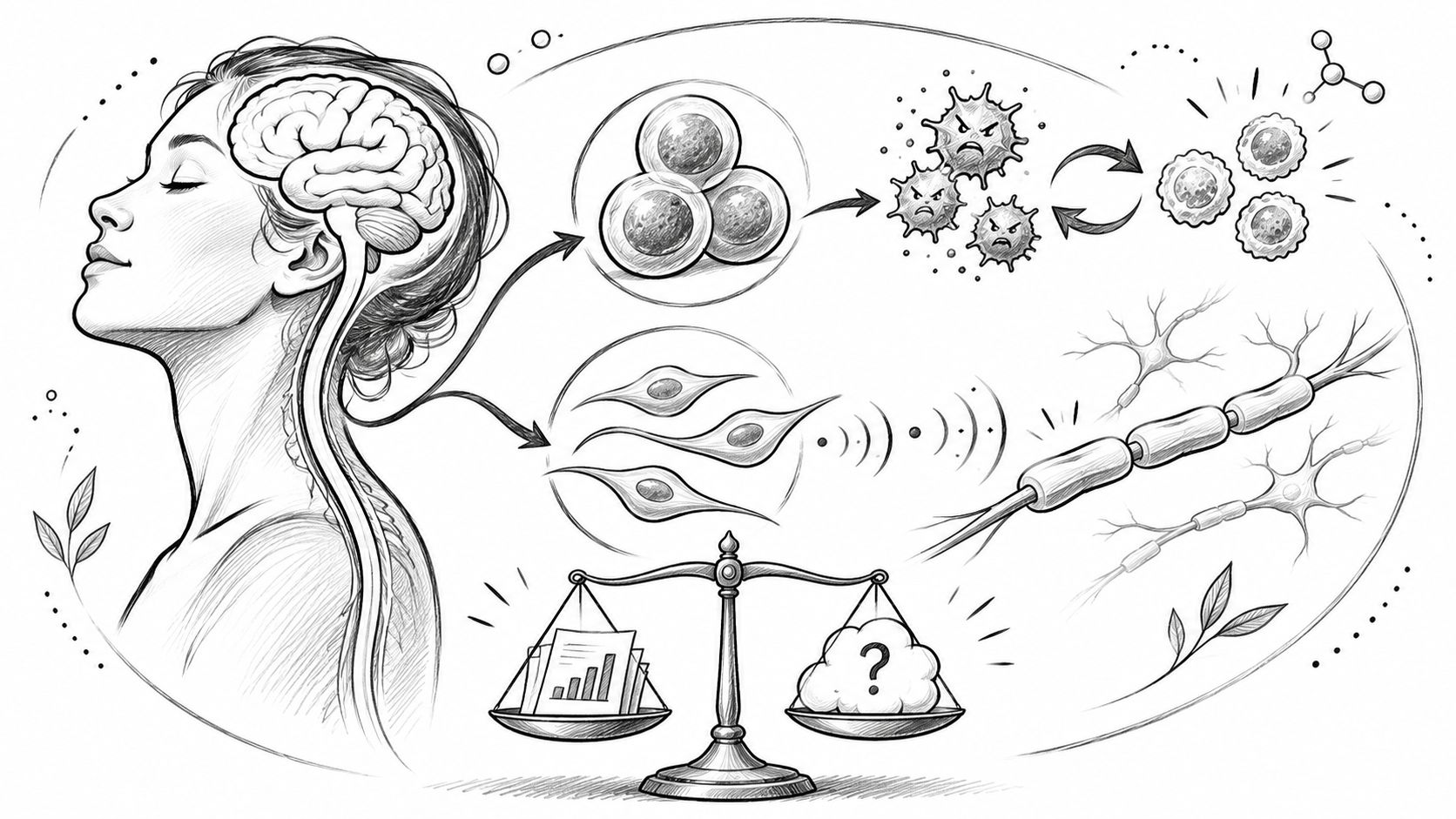
Mesenchymal stem cells are best understood as signaling cells. Most of what they appear to do happens through paracrine signaling: they release proteins and other molecules that influence nearby immune cells and the local environment. They can turn into cartilage, bone or fat cells in a lab dish, but there’s little evidence that infused cells settle in your tissues and become new ones.
For fibromyalgia, the idea is that those signals might calm inflammatory activity and affect how the nervous system handles pain. That is a biological rationale drawn from lab work, animal models and MSC research in other conditions. It is not proof that an infusion will lower your pain, lift your fatigue or clear your fog.
What Does the Research Show?
The honest summary is short: there are no published randomized controlled trials of MSC infusions for fibromyalgia that we can point you to. Here’s what does exist.
- Animal studies, not human ones. The most directly relevant paper is Mokhemer and colleagues, published in Life Sciences in 2023 (PMID 37196857). Researchers used a reserpine model that produces fibromyalgia-like pain in rats, then gave bone marrow MSCs. The treated animals improved on short-term behavioral and physical measures, and inflammatory signals in the brain fell, at a follow-up of about a week. A separate rat study used the liquid the cells grow in (conditioned medium), not the cells themselves. Rats are not people, and a week’s follow-up is not a recovery timeline.
- A single published human case report (Centeno et al., Clinical Case Reports, 2017). One person with long-standing fibromyalgia received an intravenous infusion of donor fat-derived MSCs and reported improvements in pain and quality of life. A single case cannot tell us whether the cells caused the change. Those cells were also a different product from ours: adipose-derived, not the Wharton’s jelly and placental MSCs we use.
- Reviews of the idea, not of proven benefit. Narrative reviews discuss why MSCs might help and consistently say that randomized trials in people with fibromyalgia are still needed. We have not found a peer-reviewed study that reports a 60% to 75% response rate, and we are not aware of large finished trials.
We’re not aware of any published study of donor MSCs from umbilical cord tissue (Wharton’s jelly) or placenta, the cells we use, given for fibromyalgia. Our protocol is based on our physicians’ experience with these cells and on the broader science of MSC signaling, not on a fibromyalgia trial.
One more reason to be careful when you read any results, including patient stories: fibromyalgia symptoms naturally rise and fall. Any report without a comparison group can look better than the treatment itself deserves. That’s why controlled trials matter, and why we ask people to track symptoms with their own doctor before and after a trip.
What Stem Cell Therapy Can and Can't Do
- It is not a cure for fibromyalgia, and it is not shown to reverse the condition or “reprogram” your immune system.
- It is not a proven treatment for damaged organs or tissues, because fibromyalgia is not a disease of organ destruction.
- It is not a replacement for exercise, sleep routines, psychological therapies or medicines your own doctor has prescribed.
- It may reduce pain, fatigue or fog for some people over the following months. Some people notice little or no change.
- Combining it with human growth hormone (HGH) is sometimes discussed online, including on older pages of ours. HGH is not part of this protocol, and we don’t have trial evidence that adding it improves fibromyalgia outcomes.
Our Fibromyalgia Protocol
Here’s what our fibromyalgia treatment includes:
| IV infusion | 300 million culture-expanded MSCs |
| Also included | An NAD+ and high-dose vitamin C IV drip after the stem cells, and a full blood panel |
| Cells | Donor MSCs from Wharton’s jelly (umbilical cord tissue) and placenta from healthy, live births |
| Price | $11,500 USD |
| Minimum stay | 4 days in Bucerías, near Puerto Vallarta |
A note on dose, because we think you should know it: there is no published dose-finding study of MSCs for fibromyalgia, so we cannot point to a trial that shows 300 million cells works better than a lower dose. This is the same IV tier we use for several systemic protocols. Our physician will explain the reasoning for your case.
Treatment goes ahead only after laboratory clearance. If bloodwork or the physician review shows you shouldn’t proceed, we’ll tell you before the infusion.
Our cells are grown in our own lab in Bucerías, which holds three COFEPRIS licenses (Mexico’s federal health regulator) covering stem cell production, cryobank storage and regenerative medicine practice. Cells are expanded in a GMP-grade, xeno-free medium in a cleanroom, tested by COFEPRIS-authorized third-party labs for identity (flow cytometry), mycoplasma and endotoxins, and given within 24 hours of leaving culture. You can see the licenses on our certified stem cells page, and our article on how our cells are made and tested explains more.
COFEPRIS licenses our facility and lab. That isn’t the same as approving stem cell therapy for fibromyalgia, and these treatments are not FDA-approved in the United States.
Our short checklist, 9 things to know before fibromyalgia treatment in Mexico, covers the same protocol in brief.
Risks and Side Effects
We’d rather you hear about risks from us before you book. Based on our experience with this protocol:
- Fever or headache for a few hours after the IV, or the next day, in about 1 in 100 patients.
- Infection is a small risk with any IV.
- Clots or vein irritation are a rare risk with any IV, which is one reason we do bloodwork first, especially if you have high cholesterol.
- A temporary flare or no response. Some patients notice no change. Fibromyalgia also fluctuates on its own, so a bad week after travel isn’t automatically a treatment failure — or a sign that it worked.
- Unknown long-term effects. Long-term safety data for donor MSCs given for fibromyalgia are limited. The U.S. FDA has warned consumers about unapproved stem cell products and reported serious harms from some of them elsewhere. That’s part of why we publish our protocol, licenses and testing, and why a physician reviews every case before booking.
Please don’t stop or change any prescribed medication without talking to your own doctor. We’ll review your current list during the consultation.
Who May Be a Candidate?
A physician reviews every case before you book. In general, people who may be reasonable candidates:
- Have a fibromyalgia diagnosis from their own doctor, with records that help us understand what else has been considered
- Have already given recommended care a real try, including movement, sleep support and whatever medicines their physician thought were appropriate
- Understand that results vary, may not help, and is meant as an addition to regular care, not a replacement for it
- Are well enough to travel
You may not be a good candidate if:
- You’ve had cancer in the past five years (we don’t treat these patients)
- You have an active infection, or bloodwork suggests one
- Another condition better explains your symptoms and hasn’t been evaluated — for example an untreated inflammatory disease, a primary sleep disorder or a neuropathy that needs its own workup
- Travel itself would be unsafe or more than you can manage right now
If we don’t think treatment is likely to be worthwhile for you, we’ll tell you.
Your 4-Day Trip
| Day | What happens |
|---|---|
| Day 1 | Arrive in Puerto Vallarta and rest |
| Day 2 | Bloodwork, then payment |
| Day 3 | Treatment: the IV infusion followed by the NAD+ and vitamin C drip |
| Day 4 | Fly home |
Exact days can shift with scheduling, and you’re welcome to stay longer. If pain or fatigue makes travel harder, tell us early so we can plan transport and rest time. Our travel guide and hotel options can help you plan.
After Treatment
Changes, if they come, tend to be gradual. Many patients tell us they notice the most difference somewhere between 3 and 6 months, but results vary and some people notice little or no change. Because symptoms naturally fluctuate, record a simple baseline with your own doctor before you travel — daily pain, fatigue, sleep and what you can do in a day — so any change can be measured rather than remembered.
We follow up remotely at 3, 6 and 12 months. Keep up the movement, sleep and pacing strategies that already help you. If you notice no change by six months, tell us honestly so we can talk through what that means.
Seek medical care right away if you develop a fever that doesn’t settle, chest pain, sudden weakness, trouble speaking, severe shortness of breath or sudden swelling in a limb after any infusion.
Questions to Ask Any Clinic
Whether you choose us or someone else, ask:
- What published study supports this exact cell product and dose for fibromyalgia?
- Is fibromyalgia being treated as an autoimmune disease, and if so, what is that based on?
- Are the cells tested before use, and by whom?
- What happens to my current medications, and who decides?
- How will we measure whether anything changed, given that my symptoms already rise and fall?
- What does the price include, and what happens if bloodwork shows I shouldn’t proceed?
Our guides on how to choose a stem cell clinic and what stem cell therapy costs in Mexico go deeper.
Frequently Asked Questions
Can stem cells cure fibromyalgia? No. There is no cure for fibromyalgia, and Results vary. Some people report less pain, fatigue or fog over the following months. Some notice little or no change.
Is fibromyalgia an autoimmune disease that stem cells can “reprogram”? No. Fibromyalgia is not classified as an autoimmune disease, and we don’t claim that MSCs reprogram the immune system or regenerate damaged organs.
Will I be able to stop my fibromyalgia medication? Don’t stop or change any medicine without your own doctor. This protocol is offered as an addition to your regular care.
How many treatments will I need? Our published protocol is a single IV treatment. The dose is the same 300 million-cell tier we use for several intravenous protocols; what differs is how we talk about expectations, because the fibromyalgia evidence is thinner. If you notice no change by six months, tell us so we can talk through what that means. We don’t have a trial that tells us whether a second infusion helps.
Will insurance cover it? Insurance generally doesn’t cover stem cell therapy for fibromyalgia, and many U.S. insurers classify it as experimental.
These treatments have not been approved by the U.S. Food and Drug Administration (FDA). Dream Body Clinic’s regenerative medicine treatments are provided under COFEPRIS licensing (license 23-TR-18-020-0001). COFEPRIS is Mexico’s equivalent of the FDA, and Mexico is where we operate.
Thinking About Your Options?
If you’re wondering whether an MSC infusion is a reasonable thing to explore alongside the care you already have, a free consultation is a good place to start. It’s a conversation, not a commitment. A physician will review your history, explain what the evidence does and doesn’t show, and tell you honestly whether we think treatment is a reasonable option.
Schedule your free consultation, call (888) 704-3977, WhatsApp +52 322 232 1055, or email info@dreambodyclinic.net.
Disclaimer: This article is for educational purposes and is not medical advice. Results vary. Published human evidence is very limited, results vary, and some patients see little or no benefit. Treatment is provided in Mexico at a COFEPRIS-licensed facility. Do not stop or change any medication without your own doctor. Please consult your physician before making treatment decisions.