You’ve just received an MRI report, and your search history has filled with phrases such as stem cells for spinal cord injury treatment, “walking again,” and “neural repair.” Maybe the injury happened recently, and your family is asking whether an infusion could prevent permanent paralysis. Or perhaps you’ve lived with spinal cord injury for years and are wondering whether a newer treatment could finally change what rehabilitation hasn’t.
The honest answer isn’t a simple yes or no. Stem-cell therapy is a developing clinical field, not a guaranteed spinal-cord replacement procedure. The most useful question is more specific: Which cell type, delivery route, timing window, and symptom target fit this injury?
Table of Contents
- What Patients Really Want to Know About Stem Cells for Spinal Cord Injury
- How MSCs Actually Heal a Spinal Cord Through the Paracrine Effect
- What the Clinical Trial Evidence Shows So Far
- Matching Cell Type to Your Injury Stage and Symptom Target
- Delivery Routes and Timing Windows That Change the Results
- How Rehabilitation Integrates With Stem Cell Therapy
- Safety, Limits, and What Stem Cells Cannot Yet Do
- A Practical Decision Checklist Before You Choose a Clinic
What Patients Really Want to Know About Stem Cells for Spinal Cord Injury
Consider two patients. One is within 48 hours of an incomplete C5 injury and wants to know whether stem cells can stop paralysis from progressing. The other is seven years beyond a chronic, complete injury and hopes treatment might restore independent walking. Both may spend late nights comparing overseas clinics, treatment costs, testimonials, and claims that sound more certain than the science.
Their situations are biologically different, so treating “stem cells” as one intervention creates confusion from the start. A cell product, route of administration, injury stage, rehabilitation plan, and outcome measure can all change what a study is testing.
The central correction: Mesenchymal stem cells, commonly called MSCs, don’t become replacement neurons, oligodendrocytes, or motor circuits inside the injured spinal cord.
MSCs work mainly through the paracrine effect. They release specialized biochemical signals that influence inflammation, blood vessels, surviving neurons, support cells, and the local injury environment. That’s closer to sending instructions to the body’s repair systems than building a new spinal cord from transplanted cells.
Four questions matter more than a miracle claim
- Which cell type? Bone-marrow MSCs, umbilical-cord MSCs, adipose-derived cells, and neural progenitor cells aren’t interchangeable.
- Which route? Intrathecal, intravenous, and direct intraspinal delivery place cells in very different environments.
- Which timing window? Acute, subacute, and chronic injuries have different inflammatory conditions and repair potential.
- Which symptom target? Motor recovery, sensation, pain, spasticity, bladder function, and other autonomic outcomes may respond differently.
The published field now includes substantial human research rather than isolated anecdotes. A 2023 review compiled 142 eligible reports and registries representing 4,727 enrolled patients, while the collected interventions had different completion and reporting statuses (the review in Brain). That volume supports careful evaluation, not automatic confidence.
The aim is to understand what the cells do, what human trials have shown, how rehabilitation fits, and how to question a clinic before making a decision.
How MSCs Actually Heal a Spinal Cord Through the Paracrine Effect
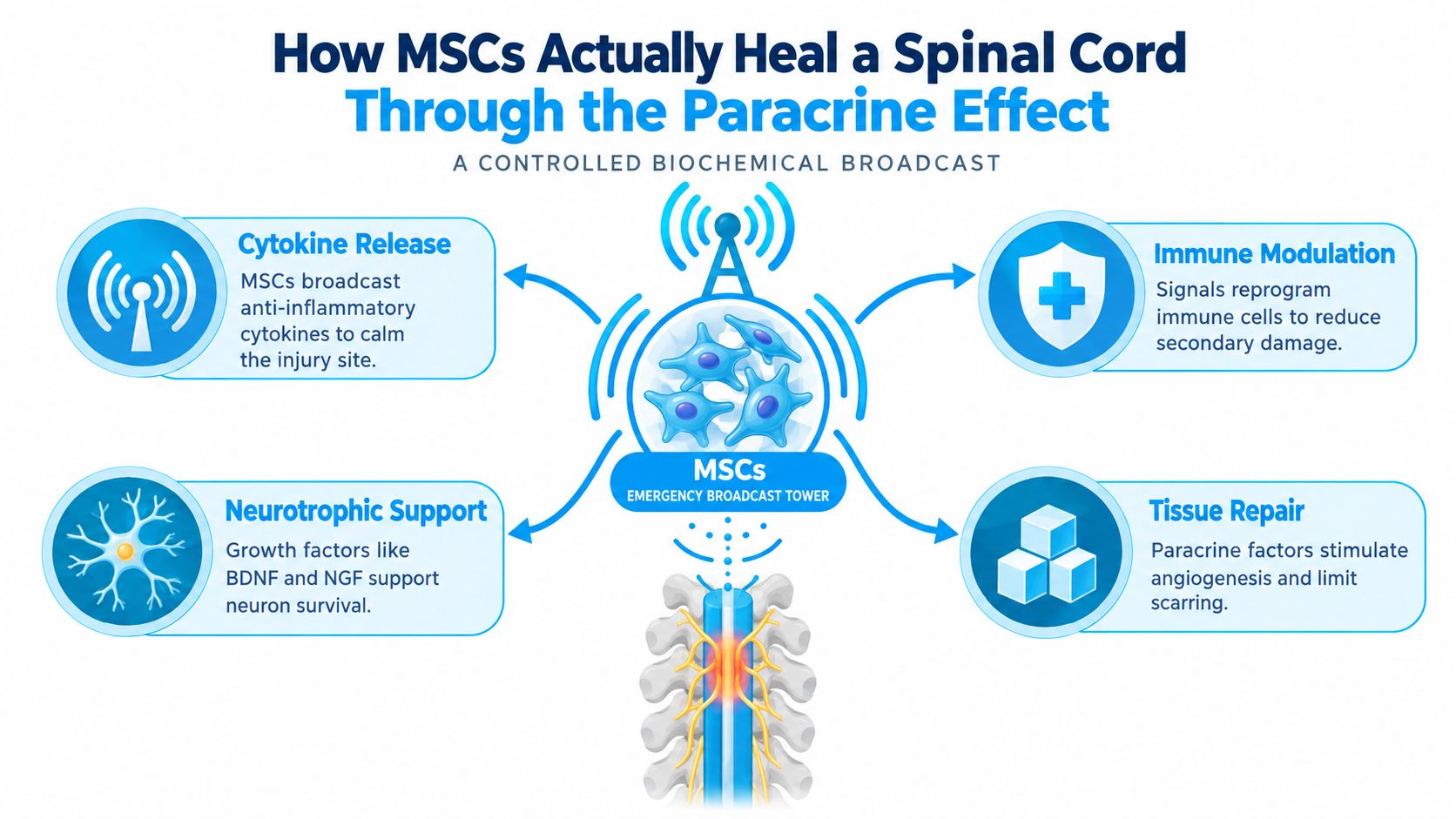
Think of MSCs as an emergency broadcast system, not replacement construction workers. After transplantation, they release signals into an injured environment that contains inflammation, disrupted blood flow, damaged axons, immune activity, and scar-forming processes.
The word paracrine describes local communication. A cell releases molecules, nearby cells receive them, and those recipient cells alter their behavior. The MSC usually doesn’t need to transform into a neuron to influence whether a surviving neuron remains healthy.
Step one, send biochemical signals
MSCs release cytokines, trophic factors, and extracellular vesicles, including microvesicles and exosomes. A 2024 review of MSC mechanisms describes this secretory activity as a major way MSCs influence cell metabolism and the post-injury microenvironment.
Some commonly discussed signals have different roles:
- BDNF and GDNF can support neuronal survival and the function of damaged neural tissue.
- VEGF can support vascular repair and the blood supply needed by surviving cells.
- TGF-beta and IL-10 can help reduce excessive inflammatory activity.
- IGF-1 can support axonal health and repair-related responses.
A clinical review also identifies VEGF, HGF, IGF-I, stanniocalcin-1, TGF-beta, and GM-CSF among bioactive factors associated with MSC activity and neuron or oligodendrocyte survival (Cell & Bioscience review).
Step two, influence the injury environment
The signals can alter how immune cells respond, reduce secondary damage, and affect the behavior of glial cells. Researchers also study whether these factors help recruit resident progenitor cells and remodel the extracellular matrix around the lesion.
That mechanism differs from neural progenitor-cell strategies. Neural progenitor cells are selected partly because they may attempt to differentiate into neurons or glia. MSCs, by contrast, are primarily being used as signal-producing cells. They don’t differentiate into the replacement spinal-cord cells patients often imagine.
The paracrine model helps explain why MSCs remain relevant across acute, subacute, and chronic research. Their signals may influence inflammation early, support repair-related biology later, and modify the environment around an established injury. It doesn’t mean the same product works equally well at every stage.
For a patient-friendly explanation of injection biology, see how stem cell injections work.
What the Clinical Trial Evidence Shows So Far
A patient with a spinal cord injury may ask whether stem cells will restore movement. Current human research supports a more specific question: which cells, delivery route, treatment timing, and symptom target fit the injury being treated? The evidence is encouraging in some respects, but it does not prove that MSCs restore normal movement.
A 2025 meta-analysis of 18 controlled trials reported significant improvements in motor function, sensory function, and activities of daily living. Another 2025 review of 30 studies involving 656 patients reported improvement in ASIA grade for 43.3%, motor function for 49.4%, and sensory function for 73.6% of patients, with no serious adverse events reported (the published meta-analysis).
Those figures need context. “Improvement” may describe a change in neurological classification, sensation, motor score, pain, or daily activity. It does not automatically mean independent walking. Studies also vary in cell preparation, injury level, chronicity, delivery route, rehabilitation, and follow-up, so their results cannot be combined into one predictable outcome for every patient.
At Dream Body Clinic Spinal cord injuries have not been a major focus for us. We have attempted to help some patients with spinal cord injury with mixed results. Severe cases with major loss of limb function have not responded well while more limited paralysis and movement issues have seen improvement. This is the treatment that has worked best – Intrathecal Stem Cell Treatment For Brain Optimization . The good news is that the treatment is very safe. The bad news is that we don’t have a surefire way to predict who the intrathecal treatment will help with spinal cord injury. Multiple Sclerosis (MS) patients for example have seen great results with the intrathecal treatment repairing and regenerating spinal cord lesions. So we know they can repair the spinal cord, but when it is fully severed that is when things get difficult.
What the wider research pipeline tells us
A 2026 cross-sectional analysis identified 80 interventional clinical trials internationally. Another review using narrower criteria found 32 completed or active cell-therapy trials, while a separate meta-analysis included 9 studies with 328 participants. These different totals reflect different inclusion rules, not proof that one treatment has become standard (the global trial landscape analysis).
| Study Type | Sample Size | Primary Outcome | Observed Effect |
|---|---|---|---|
| Controlled MSC trials | 18 trials | Motor, sensory, and daily-function outcomes | Significant improvements reported in a 2025 meta-analysis |
| MSC systematic review | 656 patients across 30 studies | ASIA grade, motor, and sensory function | Improvements reported across the measured domains |
| Single-arm clinical meta-analysis | 62 trials | ASIA impairment scale conversion | At least one-grade improvement reported in 48.9% of patients |
| Early human feasibility study | 10 participants | Safety and AIS grade | No serious adverse effects, with 7 participants improving by at least one AIS grade |
The single-arm analysis reported 48.9% ASIA impairment scale improvement by at least one grade and no serious adverse events such as tumor formation in the reviewed studies (BMC Medicine analysis). A small Mayo Clinic study enrolled 10 participants, treated all of them, reported no serious adverse effects, and found that 7 improved by at least one AIS grade (Mayo Clinic report).
The overall picture supports feasibility and possible functional benefit, not a universal walking-restoration protocol. Reasonable expectations focus on incremental changes in selected functions, often alongside rehabilitation. For broader regenerative-neurology context, patients can review stem cell therapy for traumatic brain injury, while remembering that brain and spinal cord injuries are different conditions.
Matching Cell Type to Your Injury Stage and Symptom Target
Cell source matters because each type differs in biology, preparation, and clinical history. The practical question is not whether stem cells will work in general. It is which cell type, injury stage, and symptom target best match the person being treated.
| Cell Source | Best Injury Stage | Symptom Target | Evidence Strength |
|---|---|---|---|
| Bone-marrow MSCs | Subacute and chronic research settings | Pain, sensory changes, motor and functional outcomes | Broad clinical experience, with heterogeneous results |
| Umbilical-cord MSCs | Especially relevant to early or subacute protocols | Inflammation control and locomotion-related outcomes | Active research, with protocol-dependent signals |
| Adipose-derived MSCs | Variable, often considered when accessible cell collection matters | Pain and autonomic symptoms | Less established for motor recovery |
| Neural progenitor cells | Chronic and selected experimental injuries | Remyelination and neural replacement strategies | Fragmented early-phase evidence |
Bone-marrow MSCs have one of the deeper spinal-cord injury research records. In some chronic thoracic settings, studies describe modest motor and sensory gains. Those findings do not establish the same benefit for acute cervical injury. The closer the study population is to the patient’s injury level, completeness, duration, and symptoms, the more useful its results become. The problem is that the Bone-marrow MSCs being offered in the USA are not a pure, isolated product. US law doesn’t allow the isolation and cultivation of MSCs so the bone marrow derived stem cells offered there are about 70% MSCs and 30% other cells. This is not safe for intrathecal injection. So any bone marrow stem cell treatment has to be done in a clinical study setting or abroad.
Umbilical-cord-derived MSCs may provide strong immunomodulatory activity and can be expanded for research protocols. A recent review found that locomotion outcomes appeared stronger in some subgroups when these cells were delivered immediately after injury at lower doses. Bone-marrow MSCs appeared more favorable for some pain outcomes. The comparison supports matching cell type to symptom target, rather than treating one source as universally superior.
MSCs primarily act through paracrine signaling. They release molecules that can influence inflammation, blood-vessel support, immune activity, and the local repair environment. They are not expected to become large numbers of new neurons that replace the cells lost in the injury.
Adipose-derived cells are accessible and abundant, but evidence for neural-lineage signaling and motor recovery is less established. Some protocols consider them for pain or bladder-related symptoms, although those uses still require careful clinical evaluation.
Neural progenitor cells are different from MSCs. Clinics and research teams may discuss them for chronic complete injuries when remyelination or neural replacement is the intended strategy. A 2026 review of early-phase intraparenchymal studies covered five distinct cell platforms, including OECs, fetal neural stem cells, embryonic stem-cell-derived oligodendrocyte progenitors, fetal spinal-cord-derived neural progenitors, and autologous Schwann cells (chronic-injury review). That range reflects a fragmented research field, not one validated chronic-SCI solution.
Delivery Routes and Timing Windows That Change the Results
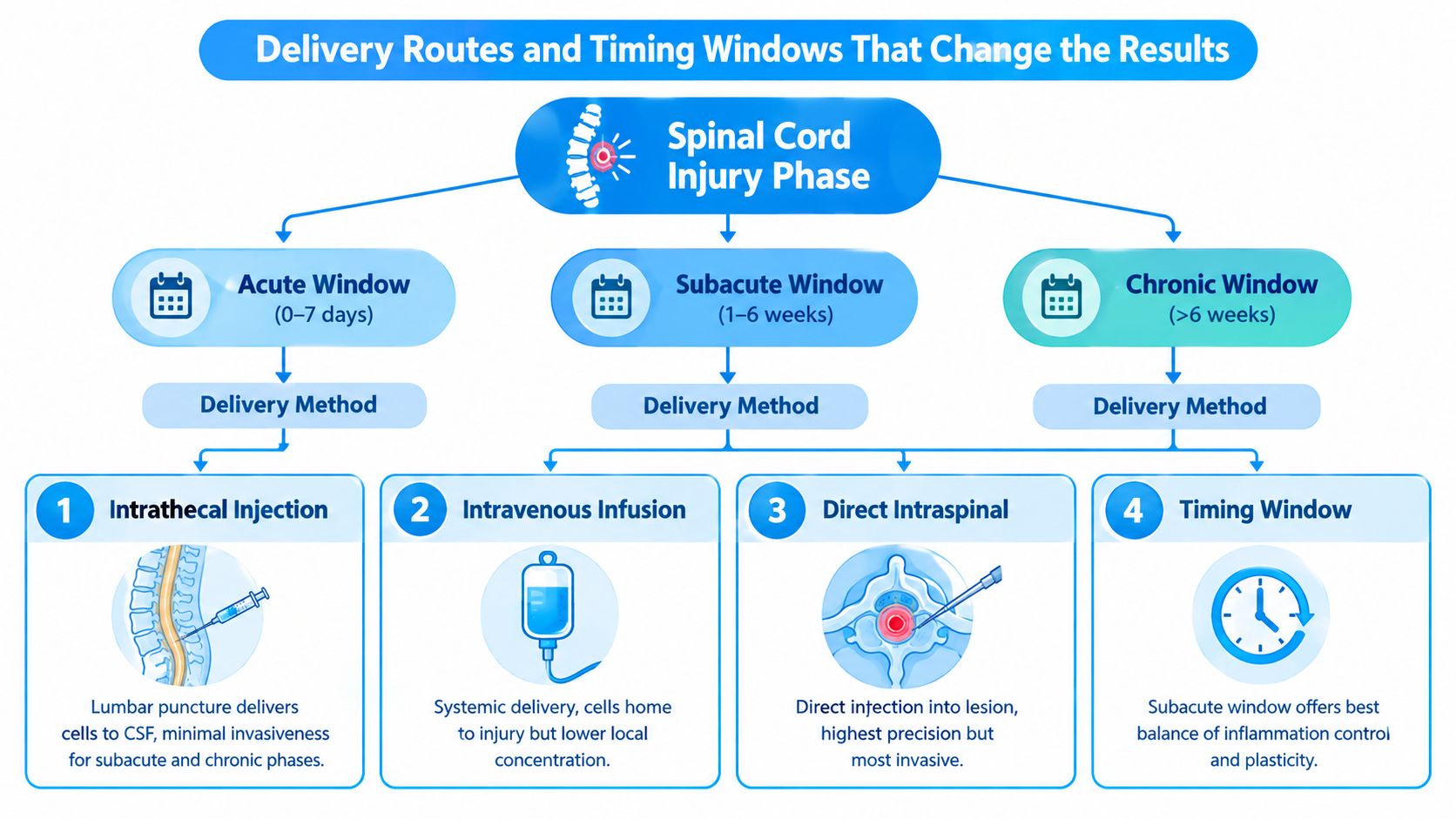
The route determines where cells travel, how invasive treatment is, and how much of the product reaches the target. Timing determines the biological conditions those cells encounter.
Match the route to the objective
- Intrathecal injection uses a lumbar puncture to place cells into cerebrospinal fluid. It’s less invasive than direct surgery and may suit subacute or chronic protocols, but cells can disperse along the fluid column rather than concentrating at one lesion.
- Intravenous infusion is the least invasive route. Cells circulate systemically, yet many may be retained in the lungs before reaching the spinal cord, which can reduce local exposure.
- Intraparenchymal injection places cells directly into or near the lesion. It offers precision but requires surgery and is generally associated with specialized clinical trials and major centers.
Timing changes the biological challenge
Acute injury, generally described in clinical protocols as under two weeks, involves intense inflammation and tissue instability. That environment may destroy many transplanted cells, even though early immune modulation could be valuable.
Subacute injury, from two to twelve weeks, may offer a compromise. Inflammation is still active, but the tissue may be more receptive to repair signals and rehabilitation. Some researchers consider this a potentially favorable window, but a protocol’s actual timing and patient criteria still matter.
Chronic injury, beyond three months, involves a more stable lesion, possible cavities, established scarring, and reduced plasticity. Treatment may need to focus on modifying the local environment and pairing cellular therapy with intensive training rather than expecting spontaneous reconnection.
These choices shouldn’t be separated. A subacute patient receiving intrathecal cells is being treated under a different logic from a chronic patient considered for direct intraspinal transplantation. Patients researching procedure details can compare questions about route and monitoring through intrathecal stem cell injection treatment, while asking whether the information applies specifically to spinal cord injury.
How Rehabilitation Integrates With Stem Cell Therapy
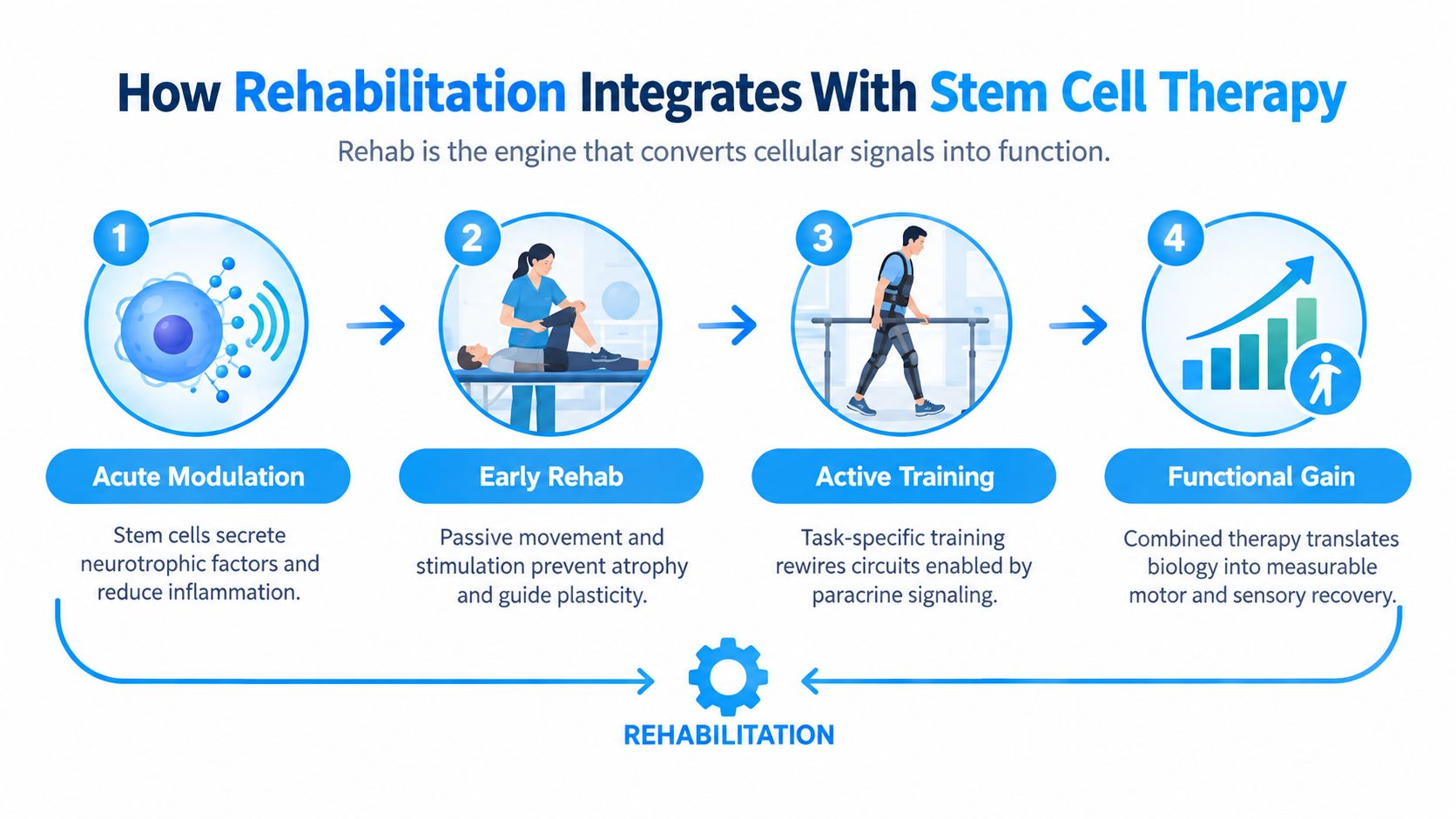
Cell therapy can change the chemical environment, but rehabilitation supplies the activity that makes functional remodeling useful. Signals alone don’t teach the nervous system how to stand, grasp, transfer, or coordinate a step.
A rehabilitation team may combine task-specific physical therapy, bodyweight-supported treadmill work, functional electrical stimulation, occupational therapy, and targeted training for transfers or hand function. These interventions repeatedly activate spared pathways and give the nervous system a meaningful task around which it can organize.
Build rehabilitation before and after treatment
Before infusion, clinicians can document baseline strength, sensation, spasticity, bladder and bowel function, pain, transfers, and walking ability where applicable. Pre-treatment therapy can also identify whether the patient can tolerate the training needed afterward.
After treatment, the plan should translate biological opportunity into repeated practice. Passive movement and stimulation may help maintain range and reduce atrophy, while supported standing, gait practice, reaching, and hand-focused tasks can provide structured input to surviving circuits.
Follow-up matters because a neurological change may be small and easy to misinterpret without consistent testing. Measures such as AIS classification, motor scores, sensory examination, walking capacity, pain scales, and daily-function assessments give the team something more reliable than a single encouraging session.
The evidence supports functional improvement as a possibility, but the available summaries don’t justify claiming that combined cell-plus-rehabilitation protocols always outperform cell-only care. A responsible clinic should explain its rehabilitation schedule, outcome measures, and follow-up process rather than treating therapy as an optional add-on.
Practical rule: If a clinic can describe the cell product but can’t explain the rehabilitation protocol, ask how it plans to convert cellular signaling into daily function.
Safety, Limits, and What Stem Cells Cannot Yet Do
A patient may hear that MSC treatment appears tolerable and assume the procedure is low-risk in every setting. The evidence supports a narrower conclusion. Reported events in spinal-cord injury studies include transient fever, headache, and injection-site reactions. Serious risk depends on the cell product, delivery route, sterility, dose, anesthesia, and patient selection.
The reviewed MSC studies have not reported tumor formation, but that observation does not make every commercial product or unregulated procedure safe. It also does not show that MSCs rebuild a severed cord. Their main therapeutic action is paracrine signaling, releasing factors that may support surviving cells and influence inflammation and repair. They are not yet a reliable source of replacement neurons.
Safety doesn’t equal approval or effectiveness
Ask whether the protocol belongs to a properly reviewed clinical trial or is offered as a medical service outside a conventional approval pathway. The clinic should explain donor screening, cell identity, sterility and release testing, adverse-event reporting, and emergency care.
The limits are practical:
- Incomplete recovery: MSCs cannot restore complete function by themselves after a fully severed spinal cord.
- Variable results: Cell source, dose, route, injury duration, level, completeness, and rehabilitation differ across studies.
- Chronic injury biology: Long-standing complete injuries may have few surviving pathways and established scar tissue.
- Outcome ceiling: Sensation, pain, spasticity, or bladder control may be more realistic targets than normal walking.
A treatment can be tolerable without being effective for every symptom. It can also show promise without having enough evidence for routine use. A review indexed by PubMed described MSC transplantation as safe and feasible while emphasizing that high-level efficacy remains unproven and larger randomized trials are needed (review indexed by PubMed).
That distinction matters during consent. Anyone promising guaranteed walking, complete paralysis reversal, or one cell source that works for every injury is offering certainty the evidence does not support. A credible consultation should state the intended symptom target, expected limits, possible risks, and what findings would count as meaningful change.
A Practical Decision Checklist Before You Choose a Clinic
Use a consultation to test the protocol, not just the enthusiasm surrounding it. A clinic should be able to connect its proposed cells and route to the patient’s injury stage, symptom target, rehabilitation capacity, and measurable follow-up plan.
Seven questions to ask
- Is the protocol ethically reviewed? Ask whether an institutional review board, ethics committee, or appropriate regulatory body has reviewed the treatment and what documentation patients can inspect.
- What exactly are the cells? Request the source, identity, manufacturing method, fresh or cryopreserved status, intended dose, sterility testing, and rationale for using that product in spinal cord injury.
- Why does this route fit the lesion? Ask why the clinician recommends intravenous, intrathecal, or direct intraspinal delivery, and what evidence supports that choice.
- Why is this timing appropriate? The explanation should address whether the injury is acute, subacute, or chronic, rather than presenting one fixed schedule for every patient.
- What symptom is the treatment targeting? Ask whether the goal is motor function, sensation, pain, spasticity, bladder function, or another defined outcome.
- What rehabilitation is included? Confirm the therapy schedule before and after treatment, who provides it, and which tests will measure change.
- What happens after the procedure? Request a written follow-up plan, adverse-event contact, imaging schedule, neurological assessments, and a transparent price that separates the cell product, procedure, travel-related medical care, hospitalization, rehabilitation, and follow-up.
Dream Body Clinic describes MSC-based regenerative protocols, including neurological and intrathecal options, within its Mexico-based practice. If you contact any clinic, including an international provider, bring your MRI reports, neurological classification, injury date, medication list, rehabilitation history, and a written list of goals. A careful review should end with a realistic target and a monitoring plan, not pressure to book immediately.
This Treatment is the best for spinal cord repair – Intrathecal Stem Cell Treatment For Brain Optimization
Dream Body Clinic can discuss whether an MSC-based protocol and rehabilitation plan fit your spinal cord injury profile, including questions about delivery route, timing, and measurable goals. Visit Dream Body Clinic to request a case review and speak with the team about what can realistically be evaluated before treatment.
Call (888) 704-3977 or on WhatsApp at +523222321055 for a free consultation