
Even people without neck pain can have striking disc changes on MRI. Among healthy adults aged 60–69, reduced cervical disc signal, a marker associated with degeneration, appeared in 86% of men and 89% of women, according to an MRI study summarized in a cervical degeneration review. An abnormal scan on its own doesn’t explain why your neck hurts. That is exactly why the right starting point is a careful MRI review matched to your symptoms.
The safest approach to degenerative disc disease neck pain starts with symptoms. An aching neck, a compressed nerve root, and pressure on the spinal cord call for different decisions. For adults with chronic neck pain from worn discs, facet arthritis or irritated nerves who want to avoid surgery, Dream Body Clinic’s Stem Cell Neck Pain Treatment offers a non-surgical option: 100 million mesenchymal stem cells (MSCs) placed around the most affected vertebrae with PRP, plus a 100 million MSC IV, guided by a cervical MRI done on site.
Even people without neck pain can have striking disc changes on MRI. Among healthy adults aged 60–69, reduced cervical disc signal, a marker associated with degeneration, appeared in 86% of men and 89% of women, according to an MRI study summarized in a cervical degeneration review. An abnormal scan therefore doesn’t automatically explain why your neck hurts or mean you need a procedure.
The safest approach to degenerative disc disease neck pain starts with symptoms. An aching neck, a compressed nerve root, and pressure on the spinal cord call for different decisions, especially if you’re considering treatment abroad.
Table of Contents
- How Worn Neck Discs Start to Hurt
- Symptoms That Need Urgent Evaluation
- How Doctors Confirm the Cause on MRI
- Conservative Care to Try First
- Injections and Surgery When Conservative Care Fails
- What Stem Cell Treatments Actually Do in Neck Discs
- Confirm the Diagnosis and Plan Recovery Before Travel
How Worn Neck Discs Start to Hurt
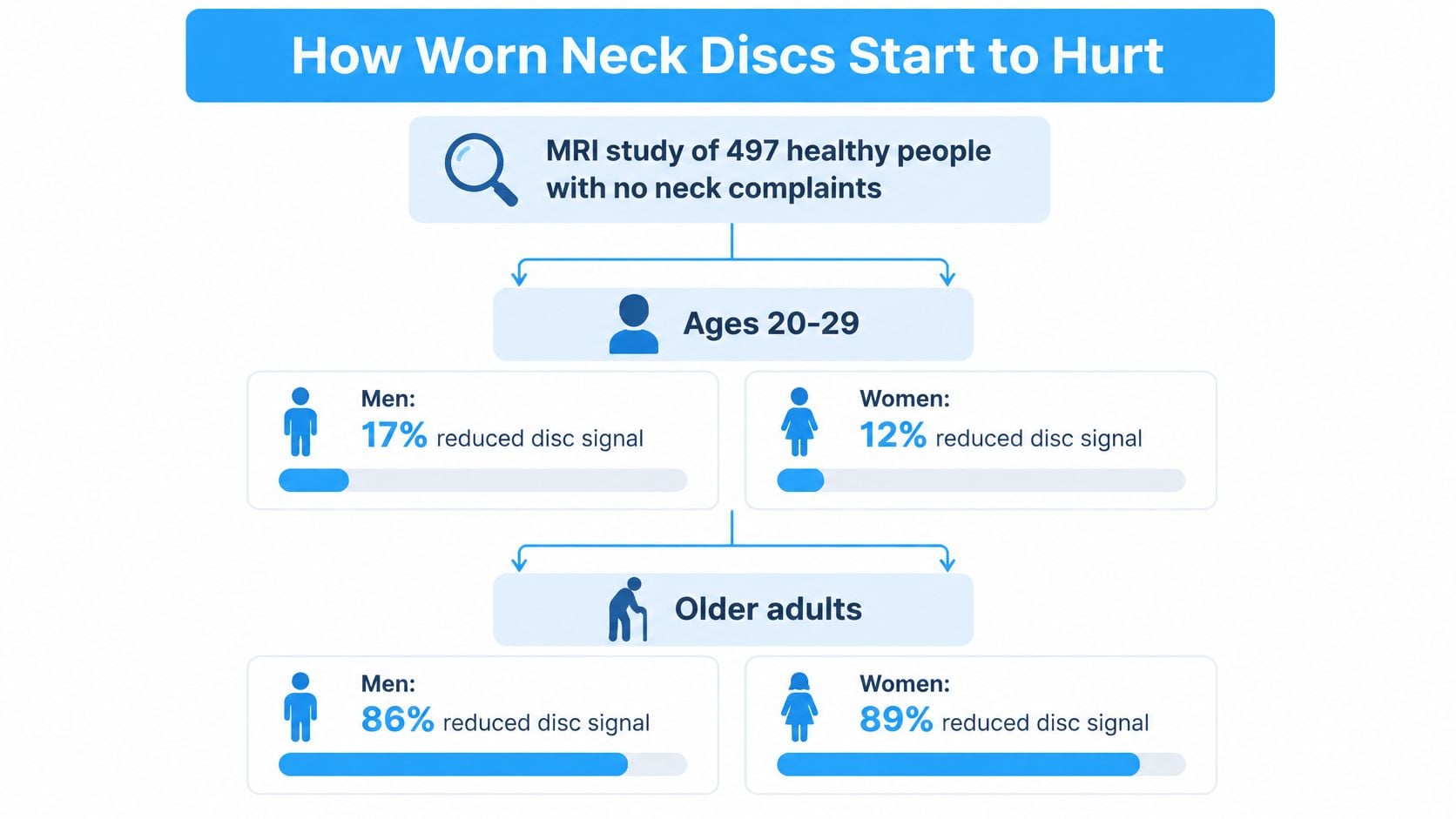
Disc changes become more common with age, but they don’t follow a simple pain scale. In the same MRI study of 497 healthy people without neck complaints, reduced disc signal was already present in 17% of men and 12% of women aged 20–29. The important distinction is between a structural change and a change that’s actually causing symptoms.
This diagram puts those findings in context.
From a cushion to altered loading
A healthy disc has a water-rich center surrounded by a tough outer ring. Think of a jam doughnut that gradually loses moisture and height, although a real disc is far more complex than that analogy suggests.
As the disc flattens, the surrounding joints and ligaments take different loads. Small sliding movements and shear can increase, while the body develops bone spurs, thickened joints, and narrower openings where nerves leave the spine.
The small joints behind the vertebrae, called facet joints, can become pain generators themselves. Understanding cervical facet joint pain helps explain why treating a disc won’t necessarily address every source of neck pain.
Inflammation can hurt without dramatic compression
The process isn’t purely mechanical. A review of disc degeneration mechanisms describes inflammatory signals, including tumor necrosis factor-alpha and interleukins, that can promote nerve-growth-factor activity and sensitize pain pathways.
That means a modest-looking abnormality can be painful, while substantial degeneration can remain silent. Inflammation, joint loading, and nerve sensitivity all influence what a person feels.
Clinicians separate the main patterns:
- Axial pain: Aching or stiffness centered in the neck, potentially arising from discs, facets, or surrounding tissues.
- Radiculopathy: Nerve-root irritation or compression producing arm pain, tingling, numbness, weakness, or reflex changes.
- Myelopathy: Spinal-cord dysfunction, which can affect hand coordination, walking, and other neurological functions.
Practical rule: Degenerative disc disease describes a spinal process, not a complete pain diagnosis.
The useful question isn’t how worn a disc looks alone. It’s whether the suspected pain source fits your symptoms and examination.
Symptoms That Need Urgent Evaluation
Mechanical neck pain often feels like stiffness or aching that changes with position, eases with movement breaks, and occurs without neurological symptoms. A different pattern requires a different response. Trouble fastening buttons, unexplained falls, or progressive weakness shouldn’t be treated as ordinary stiffness, even if the neck pain itself isn’t severe. Dream Body Clinic screens for this too, and it will not treat people whose MRI or exam points to a problem the protocol is unlikely to help.
Match the symptom to the action
Spinal-cord compression can begin subtly, and delayed diagnosis can leave residual disability. Suspected myelopathy needs MRI and prompt specialist assessment.
| Symptom | What It May Indicate | What to Do |
|---|---|---|
Neck stiffness or ache with no arm or hand symptoms, lasting more than 3 months despite care | Mechanical axial pain from discs or facet joints | Request an MRI review for the Dream Body Clinic neck protocol |
| Arm pain, tingling or numbness along one nerve pathway | Nerve-root compression, or radiculopathy | Get a neurological exam; the MRI shows whether the protocol is appropriate |
| Clumsy hands, trouble buttoning, dropping objects | Possible cervical myelopathy | Prompt specialist referral; don’t wait for further decline |
| Unsteady gait, falls, stiff or heavy legs | Possible spinal-cord compression | Urgent specialist evaluation |
| Bladder or bowel changes | Possible spinal-cord compromise, especially with other neurological symptoms | Emergency assessment now |
| Severe night pain, unexplained weight loss, fever, pain unrelieved by rest | Infection, malignancy, or another systemic cause | Prompt medical evaluation before any spine treatment |
| Rapidly worsening weakness in an arm or leg | Progressive nerve or cord injury | Emergency care |
Say you’ve developed neck discomfort and recently started dropping keys or struggling with shirt buttons. Those hand changes matter even if you can still work, drive, or exercise. Symptoms affecting both hands or involving the legs don’t fit neatly into a simple pinched-nerve explanation, and a clinician needs to assess the spinal cord first.
A degenerative MRI finding alone doesn’t make someone an emergency. The symptom pattern, examination, and rate of change determine urgency. Stem cell treatment, supplements and remote follow-up are not substitutes for evaluating these signs. Seek emergency care rather than waiting for an appointment when the emergency patterns apply.
How Doctors Confirm the Cause on MRI
An MRI can show wear without explaining your pain. To connect the scan to your symptoms, your clinician asks where the pain starts, where it travels, what makes it worse, and which activities have become difficult. The examination then checks strength, sensation, reflexes, walking, and coordination.
At Dream Body Clinic, the MRI is part of the treatment, not an extra. A cervical spine MRI is required, done on site on Day 2 of your stay, and it is included in the $8,700 package. A full blood panel is drawn the same trip.
The examination gives the scan meaning
X-rays show alignment. MRI shows discs, nerve roots, the spinal canal, and the spinal cord in greater detail. MRI is particularly useful after about 4–6 weeks of unsuccessful conservative care, or sooner if neurological function is worsening.
Pain and MRI findings do not always match, and a scan describes anatomy rather than identifying which finding causes pain. On Day 3, the physician reviews your MRI with you, decides candidacy, and explains the injection plan before any payment or treatment. If you already have a recent MRI, email the written radiology report (not the images) to info@dreambodyclinic.net for a first read. A new MRI on site is still required. If the MRI shows you are not a candidate, you pay only for the MRI ($500) and blood panel ($300).
Translate the report before choosing treatment
| MRI Finding | What It Shows | How to Read It |
|---|---|---|
| Disc bulge | A broad extension of the disc beyond its usual edge, not necessarily a rupture | Common without symptoms; assess whether it matches the examination |
| Disc herniation, protrusion or extrusion | More focal displacement of disc material, sometimes contacting a nerve root or the cord | Compare the side and level with arm symptoms and neurological findings |
| Foraminal narrowing | A nerve exit tunnel narrowed by disc material or bone | May explain arm symptoms on the corresponding side |
| Osteophytes, or bone spurs | Bony growths along vertebral or joint margins | Frequent with aging; significance rests on their location and compression |
| Facet joint arthritis or hypertrophy | Degenerated or thickened facet joints | May contribute to axial pain, especially with extension and rotation |
| Disc height loss and reduced disc signal | A dehydrated, flattened disc | Marks degeneration, not a pain diagnosis by itself |
| Spinal-cord compression or signal change | Pressure on the cord or abnormal signal within it | Raises concern for myelopathy and warrants urgent specialist review |
Keep useful treatments and stop unhelpful ones
| Option | Best Suited For | Evidence and Limits | Typical Trial |
|---|---|---|---|
| Supervised exercise targeting deep neck flexors and scapular strength | Axial neck pain and mild radiculopathy | A core rehabilitation approach; requires progression and consistent practice | 6–12 weeks, with earlier review if worsening |
| Manual therapy, including mobilization or selected manipulation | Stiffness and mechanical pain | Can improve pain and disability; screen first because cervical manipulation carries rare arterial risk | 4–8 sessions over 4–6 weeks as an individualized plan |
| Mechanical traction | Radicular arm pain when a clinician considers it appropriate | No clear added benefit when combined with manual therapy in the review discussed below | Brief supervised trial; stop without meaningful benefit |
| NSAIDs or short-course analgesics | Flare control | Symptom relief, not disc repair; check kidney, stomach, cardiovascular, and medication risks | Days to a few weeks |
| Soft cervical collar | Selected acute flares | Short-term support only; prolonged reliance can reduce muscle conditioning | Days, not weeks |
| Heat, ergonomic changes, and activity pacing | Daily aggravating positions | Supports active care; difficult to assess in isolation | Ongoing |
Measure function, not just comfort. If a well-run program doesn’t meaningfully improve pain or function, reassess and discuss escalation rather than repeating the same treatment indefinitely.
Injections and Surgery When Conservative Care Fails
Escalation should follow the pain pattern, not the availability of a procedure. Cortisone and steroid injections can reduce inflammation quickly, but the effect is often temporary, and repeated steroid use can carry tissue-related risks. Pain medication can control symptoms without repairing tissue. Surgery such as discectomy and fusion can solve structural problems, but it involves more downtime and higher surgical risk, and it permanently changes the spine. Stem cell treatment sits between these: no anesthesia, no hardware, and about 20 minutes of local injections.
Faster relief and durable recovery aren’t identical
Surgery can produce faster pain and disability reduction in the first year, and published comparisons show that disability scores between surgical and non-surgical groups converge by 12 months for many radiculopathy patients. Those findings don’t mean surgery is unnecessary. They mean the decision should weigh symptom severity, objective weakness and neurological progression against the value you place on avoiding an operation.
Dream Body Clinic’s protocol is the non-surgical option in that decision. Peak results are typically seen 3 to 6 months after treatment, as the cells work gradually. Some patients notice improvement within days or weeks, others take months, and some do not respond.
Choose the target before the technique
Objective weakness or suspected myelopathy changes the threshold for surgical referral. Stem cell treatment is not a replacement for indicated decompression.
| Option | Target Pain Pattern | Role | Main Trade-off |
|---|---|---|---|
| Cervical epidural steroid injection | Radicular arm pain | Short-term relief that may enable rehabilitation | Relief may be temporary; repeat treatment is limited by risks and clinical judgment |
| Facet joint injection or radiofrequency ablation | Axial neck pain attributed to facet joints | Diagnostic block, followed by nerve ablation when appropriately supported | Requires confirmation of the pain source; relief isn’t necessarily permanent |
| Anterior cervical discectomy and fusion, or ACDF | Radiculopathy or myelopathy with structural compression | Removes compressing disc material and stabilizes the treated level | Loss of motion at that level and increased stress on adjacent levels |
| Cervical disc arthroplasty | Selected single-level disc disease with motion-preservation goals | Replaces the disc while preserving motion | Strict anatomical selection; durability requires long-term follow-up |
Stem cell neck protocol | Chronic pain from discs, facets, ligaments, muscle and irritated nerves | Rehydrate herniated discs to relieve spinal cord pressure. Repair facet joint arthritis and heal and ligament or tendon issues. | Candidacy by MRI; soreness for 1–3 days; majority see results, but minority see partial improvement and very few see no results. |
Choose the target before the technique
An injection may reduce inflammation enough to make exercise possible. It doesn’t remove a bone spur or create space for a compressed spinal cord, and cervical injections require careful discussion of procedural risks.
Fusion removes motion at the treated segment. Disc replacement aims to preserve motion, but advanced facet disease, instability, or unsuitable anatomy can make it inappropriate.
Comparing herniated disc treatment options is useful only after identifying which structure explains the symptoms. Isolated axial pain doesn’t carry the same surgical rationale as disabling arm pain with matching nerve compression.
Objective weakness or suspected myelopathy changes the threshold for surgical referral. Symptom relief from a regenerative procedure doesn’t establish disc regeneration and mustn’t replace indicated decompression.
What Stem Cell Treatments Actually Do in Neck Discs
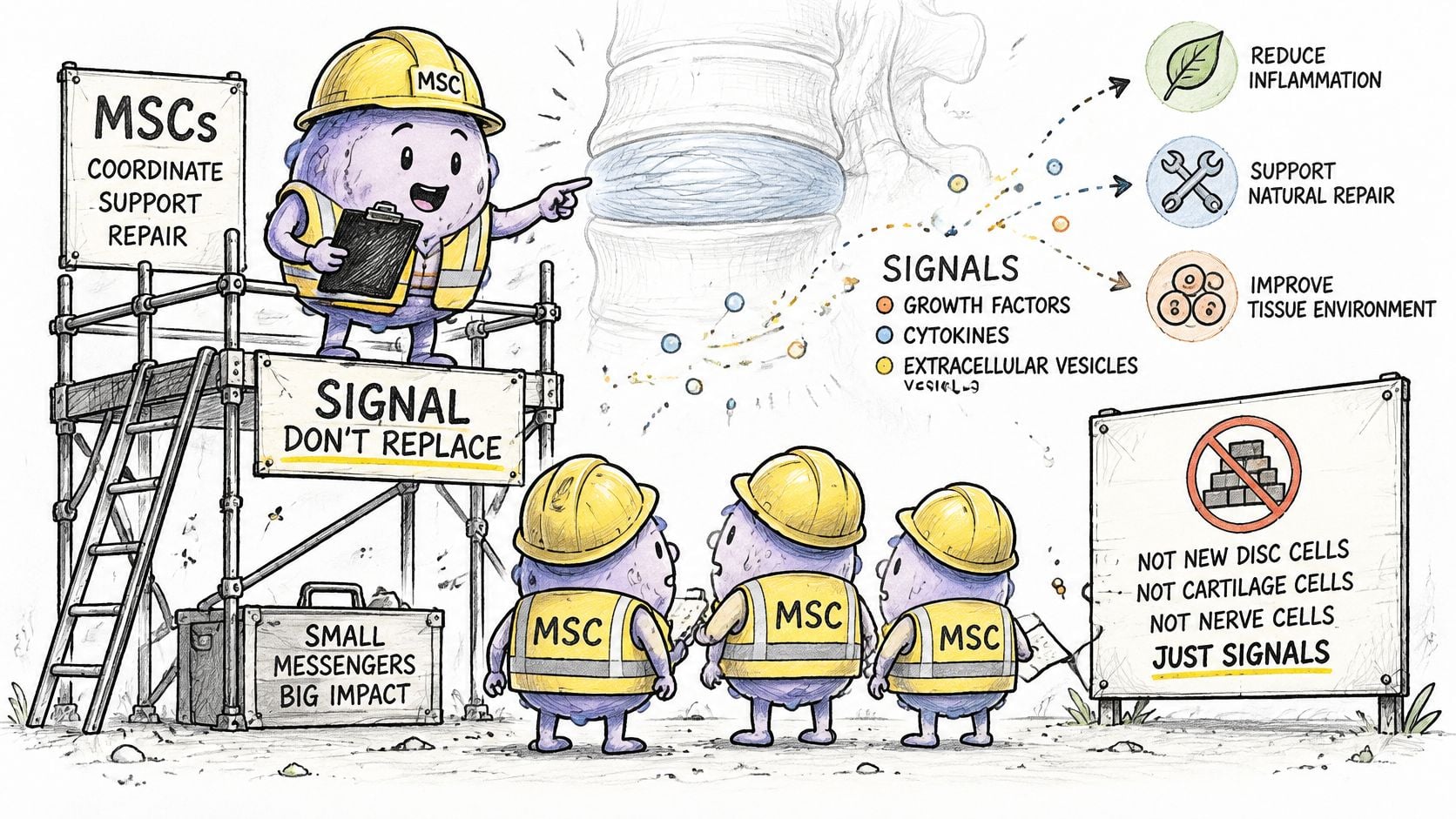
Stem cells don’t differentiate into replacement disc, cartilage, or nerve cells as the expected treatment mechanism here. The proposed effect is paracrine signaling, meaning they send specialized signals that guide the healing process of nearby native cells.
Think of a site foreman sending instructions to the crew rather than laying the bricks. This illustration represents that signaling concept, not proven rebuilding of a human neck disc.
Objective weakness or suspected myelopathy changes the threshold for surgical referral. Stem cell treatment is not a replacement for indicated decompression.
What Stem Cell Treatments Actually Do in Neck Discs
Stem cells don’t become replacement disc, cartilage or nerve cells. They work through paracrine signaling: they send out specialized signals that guide the healing process of nearby native cells. Think of a site foreman sending instructions to the crew rather than laying the bricks. In practice, MSCs can reduce inflammatory signaling, limit scar-tissue formation, support local blood vessels, and recruit or guide resident repair cells such as chondrocytes, fibroblasts, tenocytes and myoblasts. For nerves, they release neurotrophic factors.
A proposed mechanism isn’t a proven outcome
Dream Body Clinic describes this mechanism as its biological rationale. Individual imaging and pain outcomes vary. Some patients’ MRIs show improved disc appearance, others show more change in the surrounding tissues than in disc shape, and pain relief can occur even when disc shape doesn’t fully normalize. The clinic reports that more than nine years of using the peri-spinal technique, including a year of direct intradiscal injection, led it to favor injecting around the disc. In the clinic’s experience, intradiscal injection added anesthesia cost and risk without better results. These are clinic experiences, not controlled trial results, and the clinic itself says its outcomes should not be treated as identical to intradiscal trial data.
Evaluate the actual protocol
Ask for the details in writing. Dream Body Clinic answers the key questions directly:
- Cell source and dose: Allogeneic MSCs from umbilical cord Wharton’s jelly and placenta, processed in the clinic’s own ISO-certified, COFEPRIS-licensed laboratory, with third-party batch testing provided to every patient. The dose is 4 injections of 25 million cells (100 million total) plus a separate 100 million MSC IV.
- Exact route: Four image-guided peri-spinal injections around the affected vertebrae with PRP, followed by the IV, then NAD+ and high-dose vitamin C. The injections are not placed into the disc.
- Outcome measures: Pain, function, strength and sensation, with peak results assessed around 3 to 6 months.
- Safety and alternatives: Soreness or tightness for 1–3 days, a very small infection risk, and some non-responders. The clinic does not treat people with cancer in the past 5 years, large osteophytes, or complete tears. Surgery remains an option if the MRI or exam says it is needed.
Confirm the Diagnosis and Plan Recovery Before Travel
Confirm the diagnosis before booking anything. Travel planning should follow a clinical decision. Your local clinician and the treating team need a shared understanding of the suspected pain source, your neurological status and your alternatives.
The clinic is in Bucerías, Nayarit (Carmen Serdán 22), near Puerto Vallarta, with English-language coordination by phone or WhatsApp. Treatment is led by Dr. Arick Francisco Barba Lopez, with Dr. Lizbeth Aguirre and Dr. Jacqueline Vega.
Prepare a clinical file and a contingency plan
- Arrange an in-person examination. Have a clinician complete a red-flag screen and neurological assessment.
- Get your imaging reports. Email the written MRI report from the past year to info@dreambodyclinic.netfor a first read.
- Collect baseline records. Medications, allergies, previous treatments, pain scores and any documented arm strength or sensation.
- Disclose your history. Tell the clinic about cancer history, infection, blood thinners and implanted devices.
- Prepare your medications. Stop NSAIDs at least one week before and for at least two weeks after treatment. Avoid cortisone for about 3 months before treatment.
- Check the MRI fit. The MRI bed leaves about 1 ft (30 cm) to the magnet. If you may not fit, call ahead and the clinic schedules your MRI at a partner lab.
| Treatment | Early Change | Full Assessment Point | Activity Limits |
|---|---|---|---|
| Physical therapy and exercise | Symptom change may begin over 2–4 weeks | Practical review at 6–12 weeks | Gradual return; progress load with the therapist |
| Epidural steroid injection | Possible relief within days to 2 weeks | Reassess at 4–6 weeks | Light activity initially; avoid heavy strain for a few days as directed |
| Facet radiofrequency ablation | Days to weeks | Relief may last months; reassess before repeating | Light activity within days if cleared |
| Anterior cervical discectomy and fusion | Arm pain may improve within weeks | Fusion healing commonly reviewed over 3–6 months | Collar if prescribed; no heavy lifting until cleared |
| Cervical disc arthroplasty | Assessed individually; symptom relief and surgical recovery differ | Surgeon-defined follow-up | Surgeon-set restrictions |
| Dream Body Clinic MSC injection, clinic protocol | Soreness 1–3 days; some patients notice change within days or weeks | Clinic check-ins at about 3, 6, and 12 months | About 2 weeks without strenuous exercise, then about 4 weeks of light rehab; engraftment window 6–8 weeks; peak results 3–6 months |
Separate procedure time from recovery time
Plan for at least five days in town: Day 1 arrive and rest, Day 2 bloodwork and MRI, Day 3 physician review and payment if you proceed, Day 4 treatment, Day 5 fly home. Local injections take about 20 minutes and the IV one to two hours. Patients can usually walk immediately afterward.
These are planning windows, not promises. A checkpoint without measurable improvement calls for reassessment, not an automatic instruction to wait longer. Arrange return travel around written restrictions and identify a local emergency contact.
If the MRI and examination agree and no red flags exist, a consultation can show whether the Dream Body Clinic neck protocol is right for you. The all-inclusive package is $8,700 USD and includes the MRI, a full blood panel, a physician consult, the local MSC injections with PRP, the 100 million MSC IV, the NAD+ and vitamin C IV, and facility care. If warning signs are present, urgent local spine or neurosurgical evaluation comes first.
Request a free MRI review: (888) 704-3977, WhatsApp +52 322 232 1055, or info@dreambodyclinic.net.
Results vary. This content is for education and is not medical advice.
Related Topics: cervical disc degeneration, cervical MRI findings, degenerative disc disease, neck pain treatment, stem cell neck pain
Suggested SEO extras
- Title tag: Degenerative Disc Disease Neck Pain: Signs and Options | Dream Body Clinic
- Meta description: Learn the signs of degenerative disc disease neck pain, how MRI confirms the cause, and how Dream Body Clinic’s 5-day stem cell neck protocol compares with surgery and injections.
- Link to: https://dreambody.clinic/stem-cell-neck-pain-treatment/
Dream Body Clinic offers case review and cervical regenerative-medicine evaluations for people exploring nonsurgical options for degenerative disc disease neck pain. Visit Dream Body Clinic to discuss your MRI, neurological findings, previous treatment, and a measurable follow-up plan before arranging travel.