The most popular advice about a stem cell hearing loss cure is also the most misleading: find a clinic, receive an injection, and expect damaged hearing to return. Headlines promise regeneration, while advertisements often make early laboratory findings sound like established treatment. For someone who has been told that “nothing can be done,” that promise can feel compelling.
Current findings are more useful than the hype. Researchers are studying how mesenchymal stem cells, extracellular vesicles, and related regenerative strategies might support injured inner-ear tissue, but the evidence is still early and highly uneven. This guide separates age-related, noise-induced, sudden, and congenital hearing loss, explains why stem cells act more like cellular dispatchers than replacement parts, and shows how to evaluate claims from a clinic or media report. By the end, you'll have a practical way to judge whether a claim reflects credible research or outright sells certainty.
Table of Contents
- Why the Idea of a Stem Cell Hearing Loss Cure Matters Now
- How Hearing Loss Actually Damages the Inner Ear
- The Paracrine Effect and How Stem Cells Really Work
- What Preclinical Research Shows About Stem Cells and Hearing
- Human Trials and What They Actually Found
- Safety Caveats and Why Timing and Delivery Matter
- How to Evaluate Any Stem Cell Hearing Program
- Realistic Expectations and Frequently Asked Questions
Why the Idea of a Stem Cell Hearing Loss Cure Matters Now
A reader might arrive at this subject after years of worsening hearing. Hearing aids may help, but conversations still blur in restaurants. An audiogram confirms sensorineural loss, and an online search produces two opposite messages: conventional care can only manage the problem, while regenerative clinics appear to promise a cure. Neither extreme gives the patient enough information to make a sound decision.
The central question isn't whether stem cells are “good” or “bad.” It's what biological problem is being treated, what product is being delivered, and how strong the evidence is for that exact situation. A therapy designed to influence inflammation after sudden hearing loss shouldn't be presented as equivalent to a strategy for long-standing age-related damage. Cells, exosomes, extracellular vesicles, and gene therapies also aren't interchangeable treatments.
A realistic starting point: regenerative research may support surviving cochlear structures, but it hasn't established a universal way to rebuild a damaged human inner ear.
That distinction matters because hearing wellness still includes practical care today. A professional hearing assessment, protection from further noise exposure, appropriate hearing devices, and communication support remain important while regenerative research develops. Readers who want broader, non-promotional guidance can use this guide to hearing wellness from Z Audiology as a companion resource.
Hope needs a biological target
The phrase “stem cell hearing loss cure” hides several different questions. Can a therapy protect hair cells? Can it support spiral ganglion neurons? Can it restore connections between surviving cells and the auditory nerve? Can it reach the cochlea safely, remain active long enough, and produce a durable change that appears on hearing tests and in daily communication?
Research into regenerative medicine can help answer those questions, but it doesn't make a broad promise automatically credible. Educational resources about stem cell research and the future of regenerative medicine can provide context, but readers should still ask whether the discussion distinguishes laboratory findings from human treatment.
The useful promise of this article is simple. You'll be able to examine the mechanism, identify the type of hearing loss under discussion, interpret early trial findings, and recognize when a clinic is describing uncertainty responsibly.
How Hearing Loss Actually Damages the Inner Ear
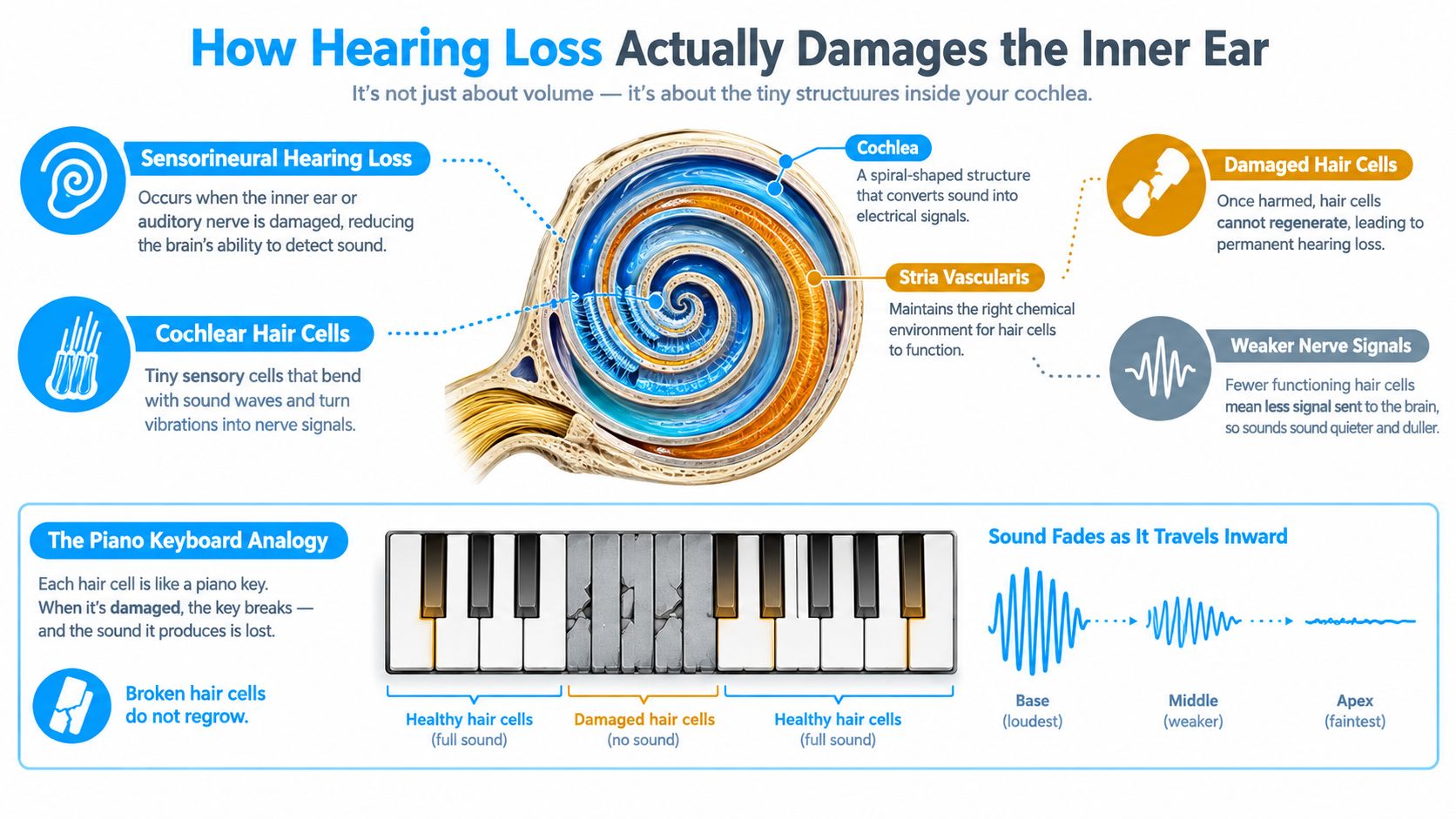
The cochlea can be understood as a tiny sound-processing instrument. Inside it, hair cells respond to vibrations and convert them into signals for the brain, while spiral ganglion neurons carry those signals along the auditory nerve. The stria vascularis helps maintain the cochlea's specialized chemical environment, which is essential for the hair cells to function.
A piano analogy makes the limitation easier to understand. If several piano keys snap, changing the music sheet won't recreate those keys. Hearing aids can make incoming sound more accessible, and cochlear implants can bypass some damaged structures, but neither option automatically regrows the original hair cells. Sensorineural hearing loss can involve hair cells, supporting cells, spiral ganglion neurons, or their connections, so a proposed cure must identify which part needs repair.
Four conditions, four biological problems
- Age-related hearing loss develops through accumulated changes affecting inner-ear cells and neural pathways. It's usually a gradual, complex process rather than one isolated injury.
- Noise-induced hearing loss can damage hair cells and their connections through intense or repeated sound exposure. The pattern and extent of injury vary from person to person.
- Sudden sensorineural hearing loss has a rapid onset and may involve several possible biological mechanisms. Timing can therefore become central to treatment decisions.
- Congenital hearing loss may arise from genetic or developmental differences. A strategy aimed at repairing acquired cellular injury may not address the underlying cause.
Conductive hearing loss is different again. It affects the outer or middle ear, such as the ear canal, eardrum, or ossicles, and shouldn't be bundled into the same regenerative promise. The distinctions matter because a therapy that might influence an injured cochlea can't be assumed to correct a mechanical blockage or a developmental difference.
A Harvard Stem Cell Institute resource on hearing states that no FDA-approved stem cell treatments for hearing loss exist, while reviews describe barriers including immune rejection, cell survival, cochlear integration, and delivery. The working question isn't whether stem cells can “cure hearing.” It's whether a defined therapy can reach the right structure and produce a meaningful, lasting repair.
The Paracrine Effect and How Stem Cells Really Work
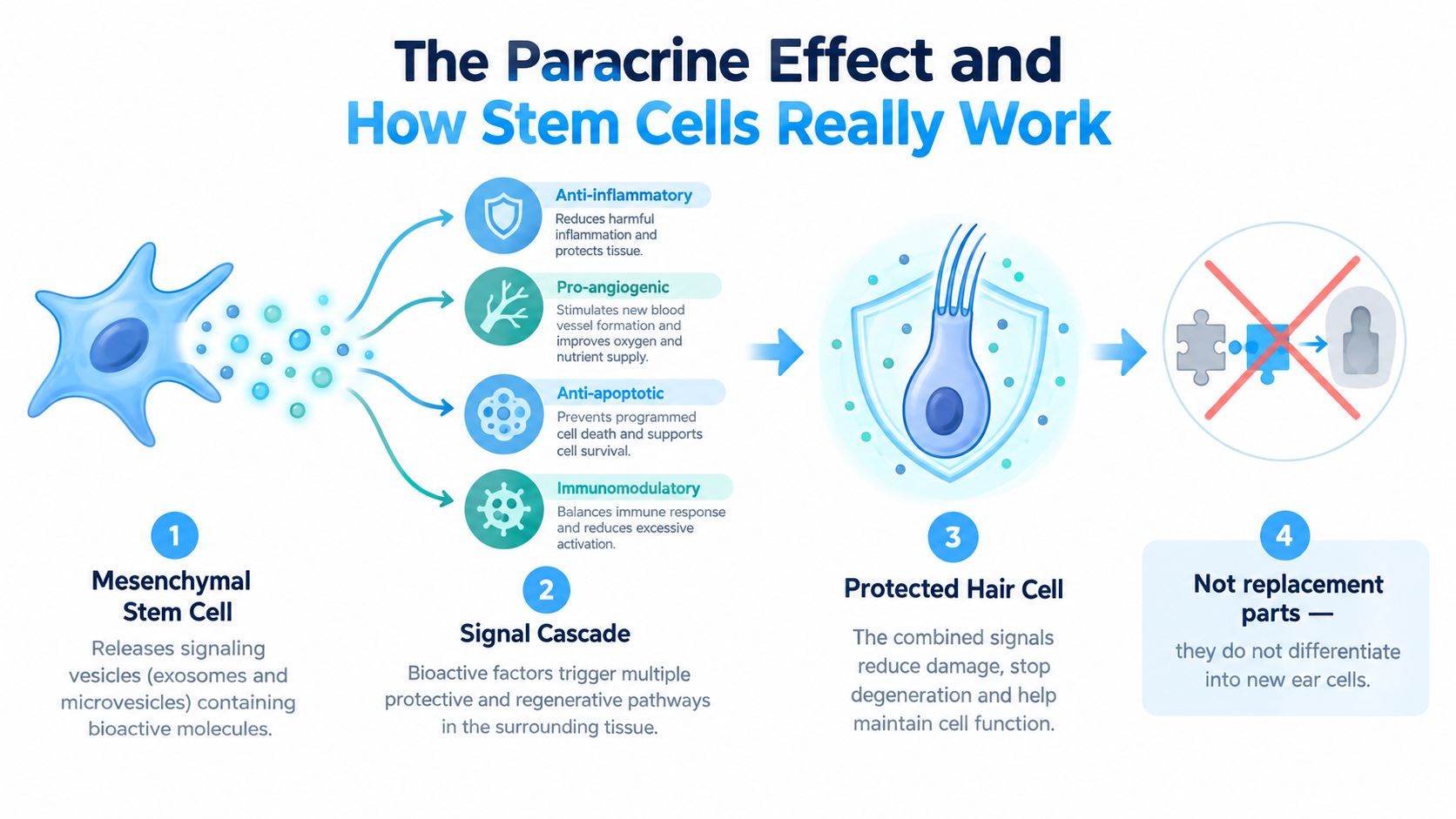
Stem cells are often described as replacement parts for a damaged inner ear. That description misleads. For the mesenchymal stem cells studied most often, the proposed benefit comes mainly from communication with existing tissue, not from becoming new hair cells or rebuilding the auditory nerve.
These cells are studied for their paracrine effect. They release specialized signals, including trophic factors, exosomes, and other messenger molecules, as explained in how stem cell injections work. Those signals may influence inflammation, cell survival, tissue repair, and the activity of the body's own cells.
The paracrine effect means that cells send out specialized signals to guide the healing process, rather than becoming replacement parts themselves.
A construction site provides a useful comparison. MSCs act more like site foremen than bricklayers. They may coordinate surviving workers, indicate where support is needed, and create conditions in which damaged tissue functions more effectively. They do not arrive with every material required to rebuild a missing structure. If too many hair cells or neural connections have been lost, better coordination cannot guarantee complete reconstruction.
Why cell replacement isn't required for a signal
A mouse study helps clarify this mechanism. Researchers used adult human nasal MSCs and reported hearing improvement even though the cells did not engraft in the inner ear. The authors interpreted the finding as evidence of a paracrine mechanism acting on endogenous spiral ganglion cells, rather than proof that transplanted cells became inner-ear tissue. The mouse study and its findings therefore inform biological mechanisms, not a human cure.
A review describes how MSC-derived signals may protect against ototoxic injury. Related research discusses trophic factors and exosomes that influence cochlear cells and may reduce apoptosis. This review of MSC mechanisms in hearing loss supports the distinction between signaling and replacement.
The wording matters. Saying that “the cells regenerated the ear” goes beyond the evidence. A more accurate description is that the cells may release signals that protect or support surviving auditory structures. That possibility still leaves several clinical questions open, including how long any effect lasts, which patients might respond, and whether the same signaling process could apply to every type of hearing loss. No FDA-approved stem cell cure currently resolves those questions.
What Preclinical Research Shows About Stem Cells and Hearing
Animal research provides the strongest body of evidence so far, but it answers a specific question: can a biological intervention influence hearing-related measures in a controlled model? It doesn't answer every clinical question about diagnosis, long-term safety, durability, or real-world speech understanding.
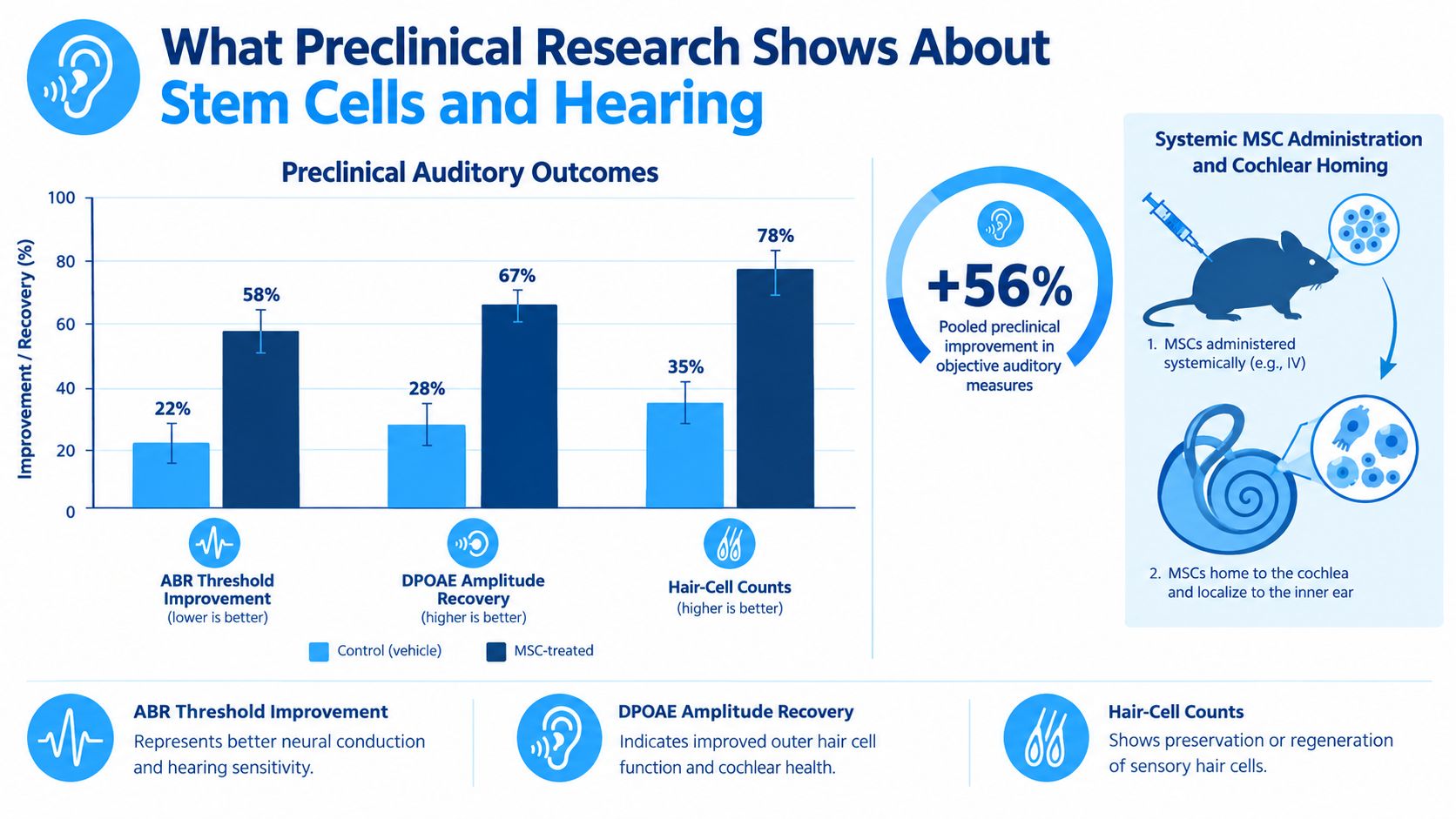
A systematic review of MSC treatment for sensorineural hearing loss reported pooled preclinical improvements of about 15.22 dB in auditory brainstem response, or ABR, and about 9.10 dB in distortion-product otoacoustic emissions, or DPOAE. These are objective auditory measures, which makes the findings useful as a research signal. The review also noted that only two completed clinical trials were available at the time, so the results shouldn't be presented as proof of a durable human cure. The systematic review and its pooled findings provide the necessary context.
What the signals may mean
ABR measures electrical activity along the auditory pathway in response to sound. DPOAE testing reflects the function of certain cochlear outer hair cells. Improvements in either measure can indicate that an intervention affected auditory biology, but they don't automatically mean that a person will understand speech normally or stop needing a hearing device.
The proposed mechanism has also been observed at the signaling level. In noise- or drug-induced hearing-loss models, systemic MSC administration induced abundant neurotrophin expression at injured cochlear sites, supporting regeneration-related activity involving auditory hair cells and neurons. The cochlear-regeneration review discussing neurotrophin expression helps explain why researchers focus on molecular communication rather than cell replacement alone.
A mouse model can control the cause of injury, the cell product, the dose, and the timing. Human patients bring different causes, disease durations, immune responses, cochlear anatomy, and treatment histories. That gap is why a strong animal result should lead to carefully designed human testing, not a guaranteed treatment claim.
Here is a short visual introduction to the research:
The field's structure reinforces the caution. A 2023 systematic review found that roughly 90% of included publications were animal-model studies and about 10% were clinical trials. The review of stem cell therapy for sensorineural hearing loss concluded that progenitor stem cells may help repair damaged cochlear cells, but clinical translation remains early-stage because the evidence includes heterogeneous experimental designs rather than standardized human protocols.
Human Trials and What They Actually Found
Human evidence exists, but it's small enough that every study needs careful reading. A registered phase 1/2 trial summarized in a poster involved 11 children with less than 18 months of hearing loss who received intravenous cord-blood stem cells. Auditory brainstem response thresholds improved in 5 patients, and the poster reported no adverse effects, while also stating that more trials were needed before the approach could be considered established. The trial poster offers a signal worth investigating, not a general answer for every child or adult with hearing loss.
A different approach was examined in a 2026 phase 1 study involving intratympanic human umbilical cord MSC-derived extracellular vesicles for refractory sudden sensorineural hearing loss. The treatment was well tolerated, with no serious adverse events reported. Signals of hearing improvement appeared only at lower dose levels and when treatment began within 22 days of onset, which makes the result particularly relevant to timing and delivery rather than to a universal cure. The 2026 phase 1 study of extracellular vesicles should be read as early safety and signal-finding evidence.
Human stem cell hearing trials at a glance
| Study | Population | Delivery | Key Finding |
|---|---|---|---|
| Registered phase 1/2 trial summarized in a poster | 11 children with less than 18 months of hearing loss | Intravenous cord-blood stem cells | ABR thresholds improved in 5 patients, with no reported adverse effects; more trials were needed |
| 2026 phase 1 study | People with refractory sudden sensorineural hearing loss | Intratympanic umbilical cord MSC-derived extracellular vesicles | Well tolerated, with hearing-improvement signals at lower doses and treatment started within 22 days of onset |
These studies involve different populations, products, routes, and disease contexts. Comparing them as if they tested the same treatment would be a category error. The emerging pattern is narrower and more credible: earlier, localized, disease-specific biologics may be more rational than a one-size-fits-all injection marketed for every type of hearing loss.
“Well tolerated” also has a precise meaning. It describes observed safety in a particular study and follow-up period. It doesn't mean the treatment is proven effective, risk-free for every person, or appropriate outside a properly monitored protocol.
Safety Caveats and Why Timing and Delivery Matter
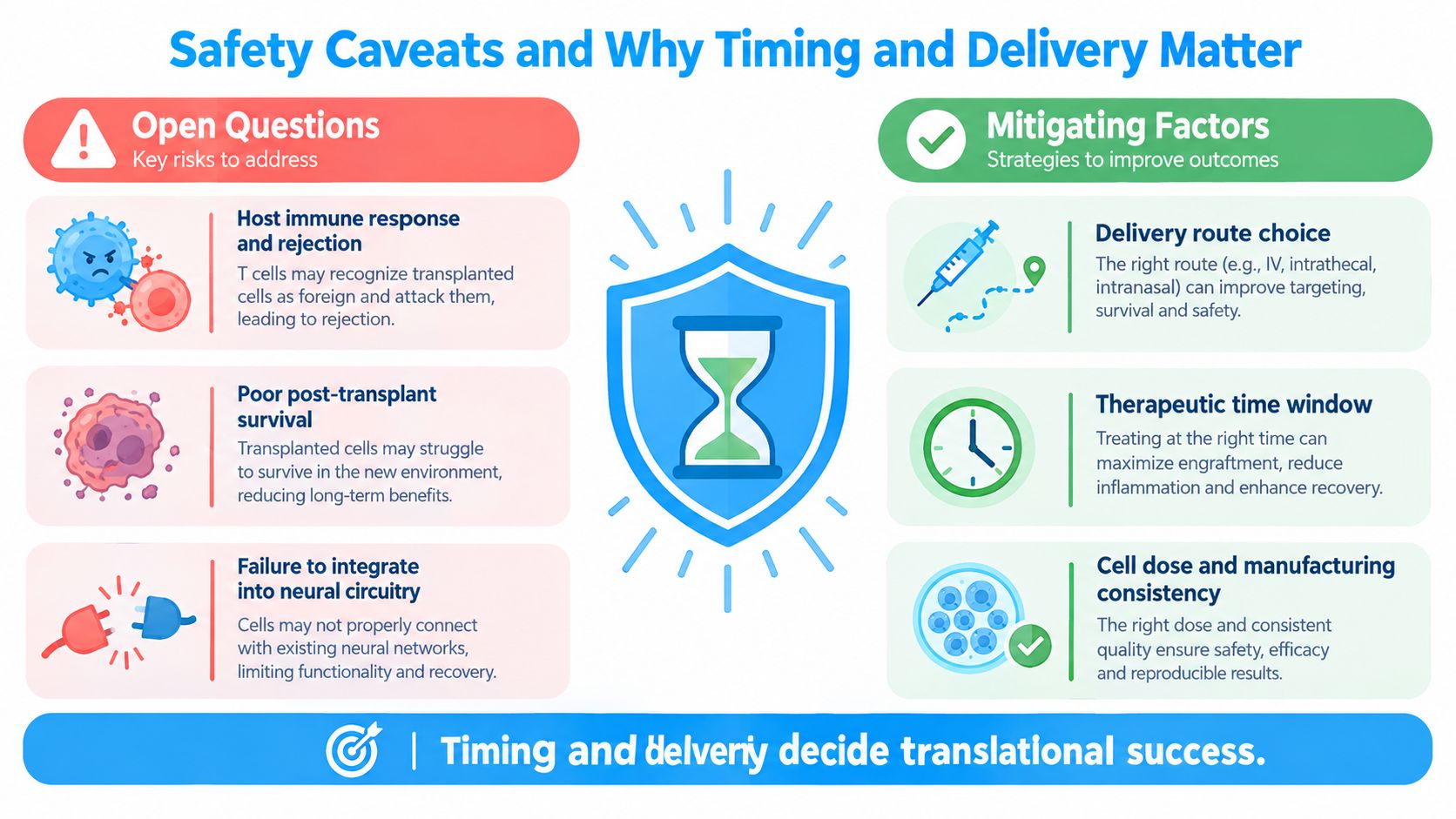
A cochlea is a delicate structure with limited space and complex neural connections. A therapy must reach the intended area, remain biologically active, avoid harmful immune reactions, and influence the right cells without disrupting the auditory system. That combination explains why promising laboratory work can take time to become a reliable clinical treatment.
Researchers continue to face several translational barriers:
- Immune response: The host may react to donor material, and donor-cell rejection remains an important concern.
- Cell survival: Transplanted cells may not survive in the target environment long enough to deliver a useful signal.
- Cochlear integration: Even surviving cells must communicate with the correct local structures without becoming disruptive.
- Delivery: Reaching the inner ear reliably is difficult, and the route can affect both exposure and risk.
Timing changes the treatment question
The sudden-hearing-loss study illustrates why timing can't be separated from mechanism. Hearing improvement signals appeared when treatment began within 22 days of onset, not as a general result across all treatment timings. A newly injured cochlea may still contain responsive cells and active inflammatory processes, while a long-standing injury may present a different and more difficult biological target.
That doesn't mean everyone with recent hearing loss should pursue an experimental cell product. Sudden hearing loss requires prompt assessment by an appropriate medical professional, because established urgent evaluation and treatment decisions shouldn't be delayed while someone researches regenerative options.
Regulation adds another layer. In the United States, there are no FDA-approved stem cell treatments for hearing loss, so a clinic operating in another regulated framework, such as Mexico's COFEPRIS system, shouldn't imply that local oversight equals FDA approval or proven efficacy. It should explain what is being administered, how the patient is assessed, what monitoring is provided, and what remains uncertain.
Patients also need a plan for unexpected symptoms after any injection. A practical resource on pain after a stem cell injection can help frame questions about post-procedure monitoring, but it can't replace direct medical advice or emergency evaluation when symptoms are severe.
How to Evaluate Any Stem Cell Hearing Program
A credible consultation should feel more like a diagnostic discussion than a sales presentation. The clinician should first identify the hearing-loss type, review the audiogram and history, and explain why the proposed product could plausibly affect the suspected injury. A clinic that skips diagnosis and promises the same treatment for age-related, noise-induced, sudden, and congenital loss is ignoring the biology.
Use these questions before paying for a program:
- What type of hearing loss is being treated? Ask whether the proposed protocol targets conductive, sensorineural, mixed, sudden, age-related, noise-induced, or congenital loss.
- What exactly is being delivered? Clarify whether the product contains living cells, exosomes, extracellular vesicles, a gene therapy, or another biologic.
- What route will be used? Intravenous, intratympanic, local, and other delivery routes create different biological and safety questions.
- What evidence supports this exact protocol? Ask for human studies involving a comparable diagnosis, product, route, dose, and timing, rather than general references to stem cell research.
- Which outcomes are realistic? A responsible team should distinguish changes in ABR, DPOAE, audiogram thresholds, speech understanding, tinnitus, and daily communication.
- How will safety be monitored? Request details about pre-treatment evaluation, adverse-event reporting, follow-up testing, and who handles complications.
- What happens if there's no improvement? The answer should include continued audiology care rather than pressure to purchase repeated interventions.
Evidence-based language versus red flags
Evidence-based programs describe paracrine support, uncertainty, candidacy limits, and adjunctive care. They don't tell patients to abandon hearing aids or cochlear implants, and they don't treat “well tolerated” as a synonym for “effective.”
Red flags include guaranteed restoration, claims that transplanted cells become new ear cells without evidence, vague references to “clinical studies,” and a protocol that ignores the cause or duration of hearing loss. A regulated setting can provide useful process safeguards, but oversight doesn't turn an early-stage therapy into an approved cure.
The evidence distribution is another simple test. The 2023 review cited earlier found that the field remains dominated by animal studies and heterogeneous designs, rather than standardized human protocols. A clinic should acknowledge that limitation instead of presenting preclinical results as a finished treatment.
Realistic Expectations and Frequently Asked Questions
A stem cell hearing loss cure remains a research goal, not an available FDA-approved treatment. Stem cell research is a genuine and active direction for hearing loss, with encouraging findings in laboratory and animal studies and limited early human research. MSCs are mainly studied as signaling cells. They release trophic factors and exosomes that may support injured tissue, like dispatchers sending repair instructions rather than replacement parts becoming new ear cells.
Can stem cells help age-related hearing loss specifically?
Possibly, though current evidence cannot promise a dependable result. Age-related hearing loss may involve the sensory cells, supporting structures, auditory nerve, or several of these at once. Treatment suitability would therefore depend on the person's pattern of cochlear and neural injury. A broad advertisement cannot show that its protocol matches those mechanisms.
Are exosome therapies the same as stem cell therapy?
No. Exosomes and extracellular vesicles are biological packages released during cellular signaling. Stem cell therapy administers living cells. The two approaches can be related, yet they differ in composition, manufacturing, delivery, safety questions, and clinical evidence. Research describes MSCs as influencing cochlear cells and reducing apoptosis through paracrine signals, including exosomes, rather than turning into replacement ear cells. The review discussing MSC paracrine signaling supports that distinction.
What should someone with sudden hearing loss do now?
Seek prompt evaluation from a qualified medical professional rather than waiting for regenerative research. Sudden hearing loss can require time-sensitive care, and the immediate plan depends on the onset, examination, diagnosis, and test results. Discuss established treatment first. Research participation should come later, with clear information about eligibility, evidence, risks, and follow-up.
A careful reader should track registered trials, examine methods instead of headlines, and ask whether results apply to their type and duration of hearing loss. Future therapies may become narrower and better validated. For now, uncertainty is safer than a guaranteed promise.
Dream Body Clinic offers mesenchymal stem cell programs in Mexico within a COFEPRIS-regulated framework. Its candidacy assessment considers medical history, diagnosis, and treatment history. Visit Dream Body Clinic to request a clinical review and discuss options with its medical team.