You've been sitting through another afternoon with a hot, tight ache across your lower back, and standing up takes a second longer than it used to. Maybe the pain runs into one leg on the drive home, or it locks in after a long meeting and only eases when you lie flat. Rest, therapy, and tablets have already had their turn, and you're asking whether an injection could change the next year.
That question turns on three things: what the cells do, whether your pain pattern matches the treatment, and what the months after an injection usually look like.
Table of Contents
- What Stem Cell Injections for Lower Back Pain Are
- Which Back Conditions the Treatment Targets
- Candidacy, Contraindications and Red Flags
- What the Evidence Shows and What Results to Expect
- Protocol Components, Doses and Imaging
- What Happens on Treatment Day
- Recovery Timeline, Risks and Warning Signs
- Confirm Your Candidacy and Book a Case Review
What Stem Cell Injections for Lower Back Pain Are
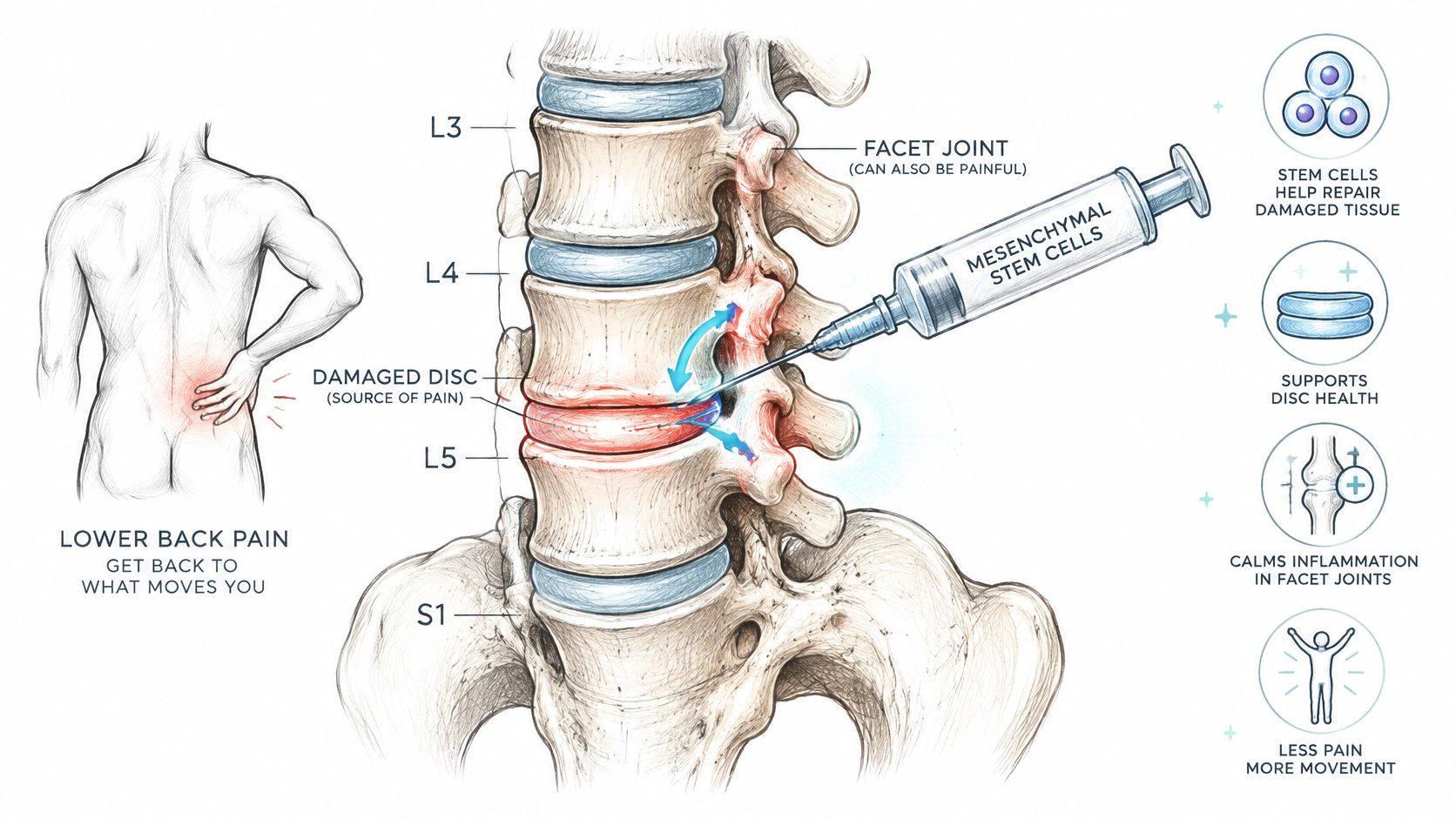
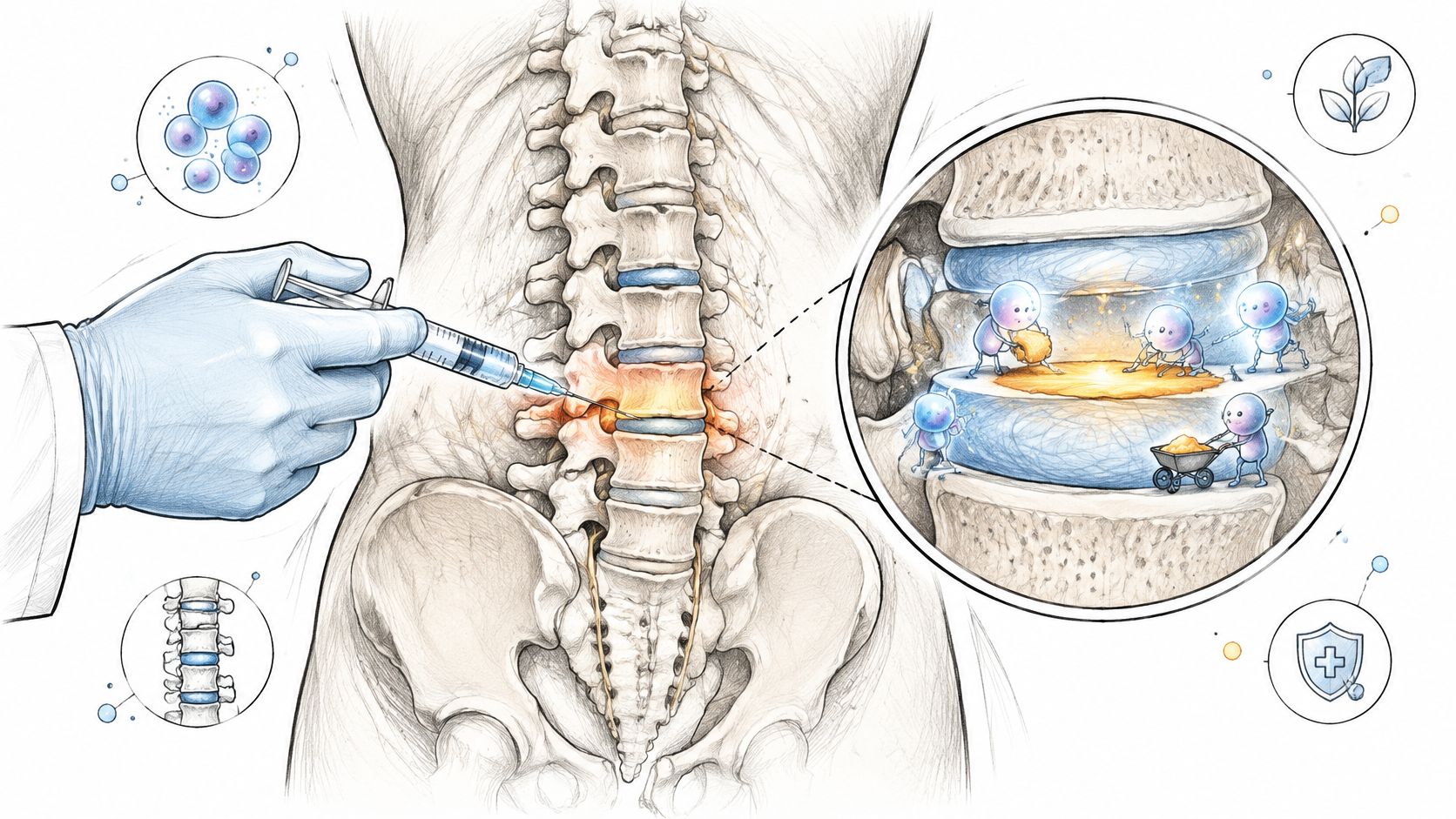
Stem cell injections for lower back pain place mesenchymal stem cells (MSCs) at the painful part of the lower spine: the tissue around a worn disc, a facet joint, or the area near an irritated nerve. The goal is calmer inflammation and better local repair in the tissue you already have. The disc keeps its current shape, and nothing mechanical gets rebuilt.
The foreman role
MSCs do not become disc, nerve, bone, or cartilage once injected. A 2025 meta-analysis in the Asian Spine Journal describes their benefit as paracrine signaling: the cells release factors that reduce inflammatory signaling, wake up resident cells, support collagen and proteoglycan production, slow abnormal nerve ingrowth, and contribute to pain relief.
The cells work like a site foreman. He never pours the concrete or becomes the wall; he sends instructions so the crew already on site does the repair in better order. Injected MSCs act as short-lived coordinators, and relief can still follow from those signals after the cells themselves have cleared the area.
That distinction matters when you weigh expectations. A treatment that coordinates repair can ease pain and improve function while leaving the worn disc exactly where it was on the MRI.
In the United States, the Food and Drug Administration has not approved stem cell products for orthopedic conditions such as disc disease or back pain. Dream Body Clinic delivers its treatments under COFEPRIS, Mexico's health regulator, which oversees the clinic's protocols.
Which Back Conditions the Treatment Targets
Two people can walk in with the same MRI report and need completely different plans. An injection aimed at a disc problem does nothing for a narrowed canal, so the first job is naming the pain generator, the way an electrician traces a dead outlet back along the circuit before replacing a single part.
| Condition | Where the pain usually comes from | Typical signs | How treatment is matched |
|---|---|---|---|
| Herniated disc | Inner disc material pushes outward and irritates a nerve or the outer disc wall | Pain that may radiate, worse with sitting or bending | Cells are placed around the disc, not into it; nerve pain caused by a herniated disc is a listed treatment |
| Degenerative disc disease | Disc height and hydration fall with wear; pain is often discogenic | Chronic ache and stiffness, often worse after long sitting | The discogenic pattern is the group most often studied |
| Facet joint arthritis | Small joints at the back of the spine wear down | Localized pain, worse with backward bending | Dominant facet pain goes to separate assessment first |
| Sciatica | Nerve root compression sending symptoms down a leg | Pain, numbness or tingling down one leg | Its own protocol pairs 100 million MSCs injected into the lower back with a 100 million MSC IV |
| Spinal stenosis | Narrowed spinal canal pressing on nerves | Leg pain on walking that eases with sitting | Sent for a stenosis workup, not an automatic injection plan |
Read that last column as a matching exercise. It describes how each diagnosis is handled, not a guarantee of coverage. Spinal stenosis is not a listed indication, and leg pain that builds while walking and fades when you sit belongs with a surgical or neurological review before anyone discusses cells.
Why the diagnosis outranks the syringe
"Lower back pain" is not one disease. A bright disc on MRI doesn't prove that disc is the pain source, and nerve-root pain, facet pain, sacroiliac pain, and stenosis do not respond as if they were the same problem.
A 2025 systematic review in the International Journal of Spine Surgery included only 283 cases across eight articles, with mixed cell sources, techniques, and outcome measures. Results built on discogenic patients transfer poorly to people whose pain comes mainly from nerve compression, facet joints, sacroiliac joints, stenosis, or a non-spinal cause. Reviews of sacroiliac and facet joint regenerative injections draw on far smaller pools of studies, which is why confidence there is thinner and dominant facet or sacroiliac pain gets referred out rather than absorbed into the lower back plan.
Practical rule: Match the pain generator before you match a protocol. Symptom relief is not the same as a promise of structural repair, and no result can be promised across every "sciatica" label.
While you sort a disc injury from ordinary muscle soreness, the herniated disc guidance from Thermo Recovery Wear is a plain companion on early movement and load. Our page on stem cell injections for herniated discs is the disc-specific counterpart.
Triage in practice:
- Discogenic pattern: Central ache, worse with prolonged sitting, MRI degeneration that lines up with the exam.
- Radiculopathy: Pain, numbness, or tingling in a clear leg path.
- Stenosis pattern: Leg pain that builds with walking and eases with sitting. That pattern needs a surgical or neurological look before anyone talks about cells.
- Conservative care first: A real trial of therapy, activity change, and medication should come before an injection discussion.
Which row sounds like your week? That answer matters more than the word "stem cell" on a brochure.
Candidacy, Contraindications and Red Flags
The people studied for intradiscal MSC care are usually adults with chronic discogenic low-back pain, symptoms for at least six months despite conservative care, and MRI evidence of moderate-to-severe degeneration that matches those symptoms. A review of 10 clinical studies covering 736 patients, with a mean follow-up of 21.6 months, reported modest average gains in pain, disability, and quality of life, as summarized in this clinical review. Cell source, dose, and selection still differed widely, so an average is not your personal forecast.
This is a biologic approach, not a mechanical disc replacement. MRI wear by itself is not a ticket.
| Factor | Favours considering treatment | Rule out or refer first |
|---|---|---|
| Pain duration | Around six months or more despite conservative care | Recent onset with no conservative trial |
| Imaging | MRI shows moderate-to-severe degeneration that matches symptoms | MRI findings alone, without matching pain |
| Pain source | Pattern consistent with discogenic pain | Dominant facet or sacroiliac pain, or stenosis needing surgical review |
| Neurological status | Stable strength and sensation | Progressive weakness, numbness in the saddle area, or bladder or bowel change |
| Infection, fracture or cancer | None present | Active infection, fracture or malignancy |
| Baseline measures | Pain score and Oswestry Disability Index recorded | No baseline scores recorded before treatment |
What the clinician checks
Confirm the pain is discogenic. Exclude progressive neurologic deficit, infection, fracture, malignancy, and pain that is clearly driven by the facet joints or the sacroiliac joint. If those other joints dominate, treating the disc area misses the source.
Track change with a visual analog scale or numeric rating scale and the Oswestry Disability Index. A pain number and a function score, written down before treatment, stop memory from rewriting the month. "I think I'm better" is weaker than a repeated score you can compare.
Get urgent medical care, not an injection pathway, if you have progressive leg weakness, numbness in the saddle area, or a new change in bladder or bowel control. Those signs can mean nerve compression that needs same-day assessment.
Before a case review, gather prior imaging reports, your medication list, what conservative care you tried and for how long, and any history of infection or cancer. Eligibility is decided after that assessment. A symptom paragraph in an email is not a yes.
What the Evidence Shows and What Results to Expect
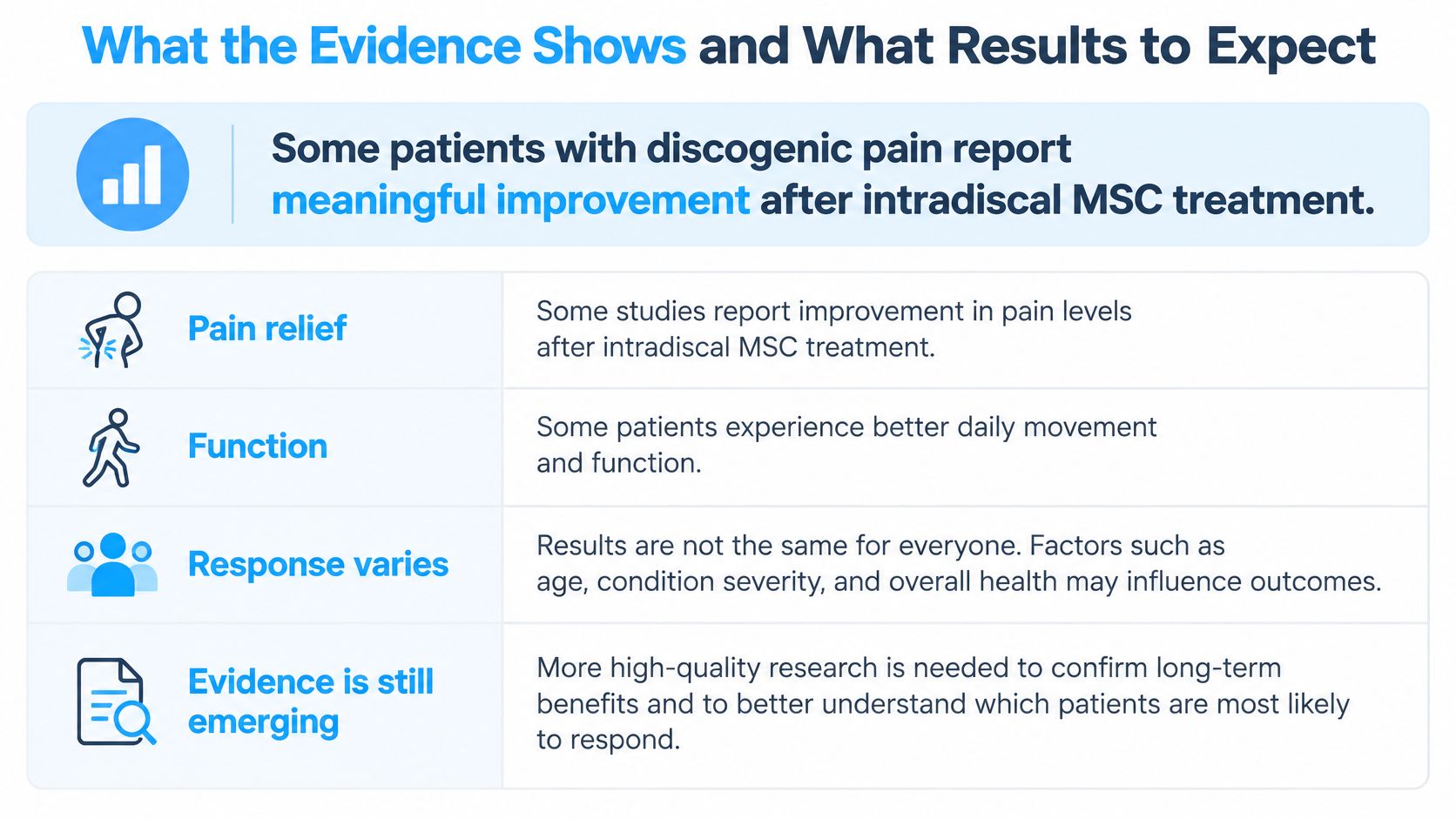
No single study hands a worn disc a verdict. The research on cell-based treatment for discogenic pain reads like several small juries returning different verdicts, so the honest question is not "does it work" but "how much improvement, how often, and for whom."
The scale of the research
| Study | Participants | What it found | Main limit |
|---|---|---|---|
| 2023 systematic review of MSC therapy for discogenic pain | 14 publications, 303 patients | Promising but limited; 10 studies used bone-marrow-derived cells | Inconsistent results across studies |
| 2021 randomized trial in chronic low back pain | 100 patients with moderate degenerative disc disease | Tested allogeneic bone-marrow-derived mesenchymal precursor cells against a control arm, and its outcome fed the review's mixed overall picture | One trial, one cell product, one protocol |
| 2020 randomized trial of an intradiscal cell product | 13 patients | No significant difference from saline; pain and disability scores fell in all groups | Very small sample |
| Review of intradiscal biologic treatments, 6-month outcome | MSC-treated patients | Roughly half of treated patients met the study's definition of success at six months; a stricter worst-case reading moved that share lower | Estimate for groups, not individual patients |
A 2023 systematic review identified 14 publications and 303 patients, and ten of those studies used bone-marrow-derived cells. One of the larger trials, published in 2021, randomized 100 patients with chronic low back pain and moderate degenerative disc disease to allogeneic bone-marrow-derived mesenchymal precursor cells or a control. The review's pooled look at six-month outcomes put about half of treated patients over the success line, with a stricter worst-case reading pulling that share lower. Treat that as a group average, never a forecast for one spine.
A 2020 randomized trial of only 13 patients found no significant difference between an intradiscal cell product and saline, even though pain and disability scores fell in every group. Small trials can look successful because time, rehab, and expectation move scores too.
How to read a conflict
Studies disagree the way weather forecasts disagree when each runs a different model. Cell source, dose, injection technique, diagnostic rules, outcome definitions, and follow-up length all differ, so you cannot average them into one success rate and hand it to the next patient.
Match the claim to your diagnosis. For discogenic pain, a realistic reading is partial relief and easier daily movement in some people, on a timeline of months rather than days. For a herniated disc pressing on a nerve, nobody can promise structural repair of the herniation itself. And for sciatica, individual stories sit at the encouraging end of the range: in one patient's account, nerve pain was gone within 10 days of treatment, and a compressed disc with sciatica saw neuropathy resolve within two weeks. Individual outcomes like those describe what can happen, not what will happen for you.
The evidence supports careful selection and honest expectations. That is the whole message.
For a plain walk-through of how clinicians weigh these studies when advising patients, this short video covers the same ground before you look at protocol details.
Protocol Components, Doses and Imaging
A stem cell protocol works like a matched toolkit: each part has one job, and not every diagnosis uses every part. Our lower-back protocol has five components, and a published cell count is a dose, never a promised result, because source, route, and technique differ from study to study. Ask why each part was chosen for your scan. For the biology behind a local injection, see how stem cell injections work.
| Component | Published detail | Purpose | Pairing or imaging |
|---|---|---|---|
| Direct injection into the lower back | Four shots; 100 million MSCs in the sciatica protocol | Local anti-inflammatory and repair signaling | Placed around the disc rather than inside it |
| IV infusion | 100 million MSCs | Support for muscles and spinal stability | Given alongside the local injection |
| Ozone injection before stem cells | Ozone given first for disc problems | Stated aim of clearing misfiring nerves | Followed by the stem cell treatment |
| Platelet-rich plasma (PRP) | Often paired in orthopedic protocols; dose set at assessment | Supports the local healing environment | Included based on diagnosis and exam |
| MRI imaging | Pre and post MRI | Compares anatomy and tracks structural change | Included in many orthopedic protocols |
What each part is for
- Direct injection. The lower-back protocol uses mesenchymal stem cells as four shots into the lower back, and the sciatica protocol uses 100 million MSCs at the treatment area for local anti-inflammatory and repair signaling. Placement matters: the cells go around the disc rather than inside it, the way repair crews work the ground surrounding a damaged structure instead of tunneling into the structure itself.
- IV infusion. A separate 100 million MSCs go in a vein at the same visit. If the local shots target the injury, the infusion supports the wider system, helping the muscles and stability around the spine while the injections handle the targeted tissue.
- Ozone for disc problems. This step is matched to the diagnosis: it applies when the problem is a disc, and the stem cell treatment follows with the stated aim of clearing misfiring nerves. A back pain pattern without disc involvement can skip it, so its absence from your plan is a design choice rather than a shortcut.
- PRP. Platelet-rich plasma is often paired in orthopedic protocols to support the local healing environment. Whether it joins your protocol, and at what dose, is decided at assessment rather than copied from a fixed menu.
- MRI. Pre-treatment and post-treatment imaging lets you compare anatomy instead of relying on memory alone. A picture change and a pain change are different facts; record both, because one can improve while the other stays put.
The right combination comes from your diagnosis and exam, which is why two people describing "lower back pain" can leave with different plans. Bring your questions to the case review instead of treating a cell count as a warranty.
What Happens on Treatment Day
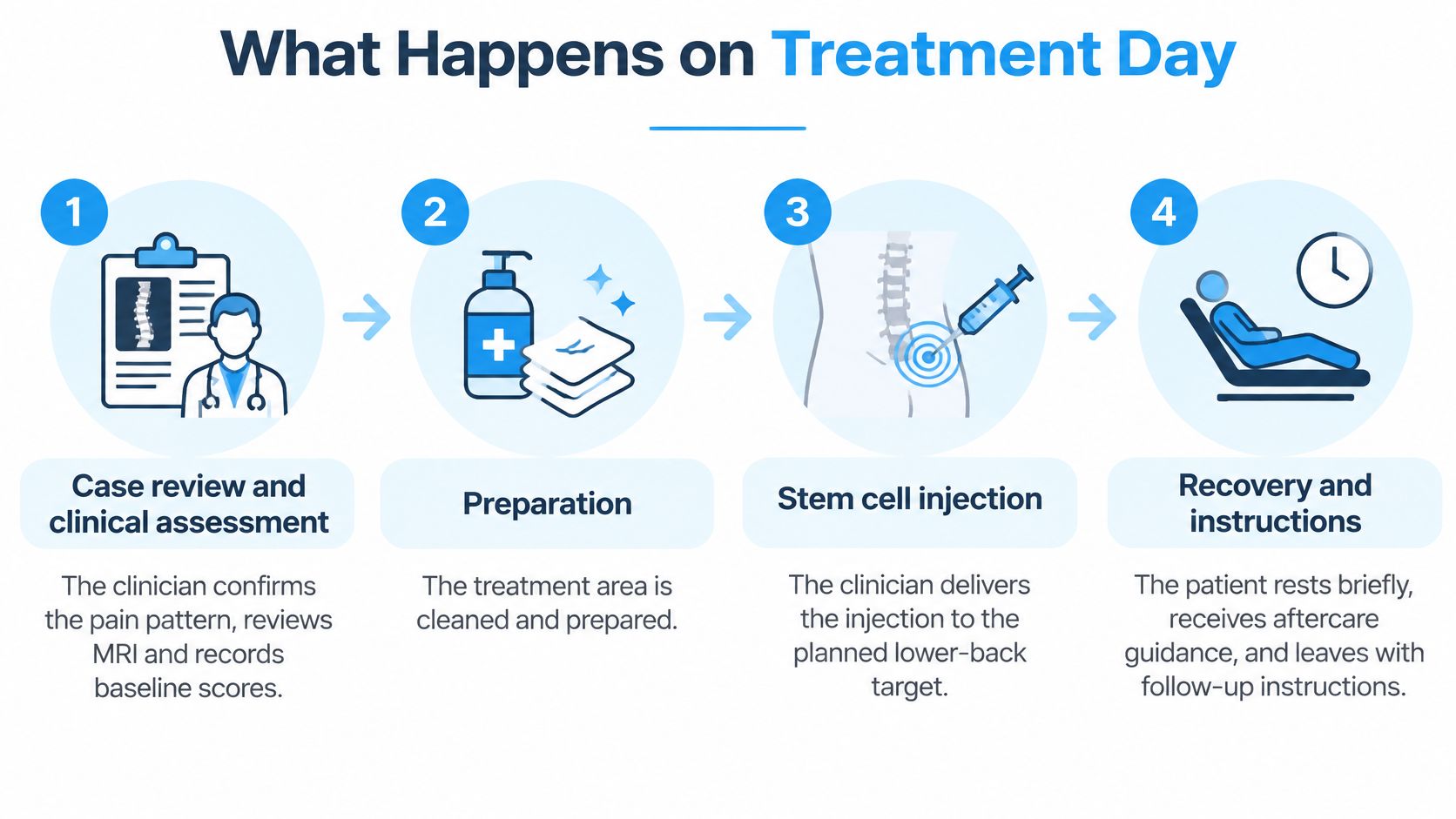
A treatment day works like a short outpatient visit: arrive with a plan already shaped by your MRI, leave when the planned steps are done. The whole visit usually fits within one to three hours, and sensations vary, so pressure or soreness are possibilities rather than promises.
The sequence
- Case review and clinical assessment. The clinician confirms the pain pattern, reviews the MRI, and records baseline pain and disability scores so later check-ins have a starting line.
- Imaging review and planning. The target is read from the pain source: a disc pattern points around the disc, a facet pattern points toward the irritated joint, and leg-dominant nerve pain points toward the root involved. Different targets mean different needle paths.
- Consent and preparation. You hear the risks, the likely sensations, and the alternatives before anyone numbs the skin. Ask which parts are included that day: local shots, IV, ozone, PRP, or imaging.
- Local numbing. The injection area is numbed so placement is tolerable. Numbing explains pressure more than it explains a pain-free day.
- Ozone, when the protocol includes it. For disc problems, ozone comes first. Other back patterns can skip this step.
- Stem cell placement. The lower-back shots go to the sites chosen from your scan and exam. In disc cases they follow ozone with the stated aim of clearing misfiring neurons, and the cells are placed around the disc rather than inside it.
- Discharge. You leave once the visit is complete, typically within one to three hours of arrival.
You may feel pressure during placement and soreness afterward. If sedation is used, arrange a driver. Plan on rest at your hotel or at home, and keep the day quiet even if the numbing makes you feel better than expected.
If a step is not on your plan for that day, ask before you assume it was included.
Recovery Timeline, Risks and Warning Signs
People often assume any spinal injection means a high rate of serious harm. The safety record in selected disc patients is quieter than that fear, and it is also narrower than a slogan.
A prospective pilot of intradiscal adipose-derived MSC therapy for single-level lumbar disc degeneration reported positive pain and function over 12 months, and treatment was generally well tolerated, according to the pilot study report. No unexpected or serious adverse events were recorded. One participant had a post-treatment flare that settled with appropriate pain relief. The authors also cited a meta-analysis of 36 MSC trials and 1,012 treated participants, which found no significant adverse-event pattern beyond transient, self-limiting fever.
That pilot was small, had no control group, and excluded people with radicular pain. It required single-level degeneration and left out discs with height below 50%. Favorable 12-month findings fit carefully chosen degenerative-disc pain. They don't prove every herniation or every case of sciatica will follow the same curve.
Any spinal injection can still bring local infection, bleeding, a temporary rise in pain, or nerve irritation. Infection is watched through fever and spreading redness. Bleeding is watched at the site. A pain flare is compared with your baseline, not with a stranger's story. New weakness is a nerve sign, not a "settling" sign. If pain jumps after treatment, read worse pain after a stem cell injection and contact the clinic rather than waiting it out in silence.
| Window | What is typical | Contact the clinic if |
|---|---|---|
| First two weeks | Gradual change in pain and mobility; activity limits as instructed | Pain rising rather than settling, or new numbness |
| About 3 months | Scheduled remote check-in on symptoms and function | Symptoms worsening since treatment |
| About 6 months | Scheduled remote check-in with pain and disability scores | Any loss of bladder or bowel control, which needs urgent care |
| About 12 months | Scheduled remote check-in on the longer course | Symptoms that have returned or worsened since 6 months |
Call promptly for a persistent fever, spreading redness, new or worsening weakness, or any bladder or bowel change. Loss of bladder or bowel control is urgent care, not a routine check-in topic.
Confirm Your Candidacy and Book a Case Review
Decide before you book. Revisit the candidacy checks, and treat the expected result as partial, individual, and not guaranteed. A matching diagnosis plus a clean safety screen is the bar. A hopeful email is not.
As of the FDA's 2024 consumer guidance, the only FDA-approved stem-cell products in the United States were hematopoietic progenitor-cell products from umbilical-cord blood, approved for disorders of blood production. No stem-cell or regenerative-medicine product had been approved for orthopedic conditions, including disc disease or back pain. Dream Body Clinic delivers treatment under COFEPRIS, Mexico's FDA equivalent, and you should judge consent, product characterization, infection control, image guidance, and follow-up on their own, apart from marketing lines.
- Request a complimentary case review through the lower-back treatment page.
- Send MRI reports, a medication list, the conservative care you tried and how long it lasted, and any history of infection or cancer.
- Complete a clinical assessment. Eligibility is decided there, not from a symptom description alone.
International patients coordinate in English by phone or WhatsApp, with travel arranged to Bucerias, Nayarit, and remote follow-up at about 3, 6, and 12 months. Patients have come from more than 40 countries. Pricing isn't published here. Ask for a written quote that states what it includes, such as imaging, ozone, PRP, the IV, and follow-up.
Before you commit, ask how each protocol element was chosen for your diagnosis, how infection control and image guidance are handled, and how pain and disability scores are recorded at each follow-up.
Dream Body Clinic provides mesenchymal stem cell care for lower-back pain, including herniated discs, degenerative disc disease, facet joint arthritis, and sciatica, delivered in Mexico under COFEPRIS oversight. If your symptoms have lasted despite conservative care and your imaging matches the pain, a case review is the right next conversation. Visit Dream Body Clinic to start that review.